2027 University Extension vs. Community College Paralegal Certificates: What Are You Paying For?

Co-Founder and Chief Data Scientist
A university extension certificate may carry a familiar university name, while a community college certificate may offer a lower advertised price. Neither detail tells you what you are buying. If you are entering paralegal work or adding legal skills to an existing career, the consequential differences are credit value, required coursework, practical training, schedule, and total cost. This guide compares those factors so you can identify the pathway that meets your goal without paying for features you will not use - or overlooking requirements you need.
Key Things You Should Know
- Neither institution type is automatically the better buy: compare total required costs against transferable credit, practical training, and the schedule you can actually complete.
- ABA approval belongs to individual paralegal education programs, not every program at an institution; institutional accreditation and professional certification are separate matters.
- The median pay for paralegals and legal assistants was $62,890 in May 2025, with 0% projected growth for 2025-2035. That occupational median is not a starting salary or a return promised by either certificate.
What is the difference between university extension and community college paralegal certificates?
A university extension program is typically offered through a university's continuing or professional education unit. A community college program is offered through a two-year college. Neither label tells you whether the certificate carries college credit, has ABA approval, or requires a degree for admission. Those features depend on the specific program.
The comparison below separates common possibilities from facts you must confirm. It is useful because two certificates with the same name can represent quite different purchases.
| Decision factor | University extension certificate | Community college certificate |
| Credit value | May be noncredit continuing education or credit-bearing coursework | May be a credit-bearing academic certificate or a noncredit workforce program |
| Typical scheduling options | May be designed around working adults, but meeting times vary | May offer day, evening, online, or mixed schedules, depending on courses |
| Possible advantage | Focused professional study or a format compatible with existing work | Potential pathway into further college study, if credits apply |
| Key risk to check | A university-branded certificate may not award university credit | A low per-credit price may not cover prerequisites or required fees |
Credit-bearing does not automatically mean transferable. If further study matters, get a written explanation of how the courses apply to a particular degree; the receiving institution makes the final transfer decision. This also matters if you are considering transferring earlier coursework into a business law degree rather than treating the certificate as your final credential.
Which paralegal certificate pathway offers better value for your career goals?
Choose the program that supplies the skills and credential value your target employers recognize at a total cost you can sustain. A career changer seeking an entry-level legal-support role should prioritize legal research, writing, procedure, document work, and opportunities to demonstrate those skills. Someone who already works in a law office may place more value on an evening schedule or instruction in a missing practice area.
University extension may be worth a higher price if its particular program offers a workable schedule, relevant supervised assignments, or employer-recognized training that a cheaper alternative lacks. Community college may offer better value if its courses apply toward an associate degree or meet the same immediate employment goal for less. Neither conclusion follows from the institution's name alone.
If your goal is broader business or regulatory work rather than paralegal practice, compare the certificate curriculum with business law programs for career-focused adult learners. A broader degree takes a different investment of time and money; it should not be purchased solely because it sounds more advanced.
How much do university extension and community college paralegal certificates cost?
There is no reliable category-wide price that substitutes for a program quote. Extension schools may publish a package price or charge by course; community colleges may charge by credit and residency category. A quoted per-credit rate and a quoted full-program price are not comparable until you account for all required coursework.
Request an itemized, current total from each school. The comparison should include tuition, mandatory fees, books, research-platform or software charges, prerequisite courses, technology requirements, and any travel or placement expenses. Also ask whether you must pay again to retake a course offered only at limited times. The cheaper advertised certificate can cost more if it requires substantial additional coursework.
Do not assume federal aid covers a certificate because its institution participates in federal aid programs. Eligibility depends on the specific program and the student; noncredit offerings may have different funding options. Confirm program-level aid eligibility and borrowing terms with the financial aid office before using loans in your comparison. For additional candidates, see lower-tuition online paralegal programs with ABA approval, then verify each program's current approval, format, and full cost directly.
What accreditation should a paralegal certificate program have?
Check institutional accreditation first: it concerns the college or university, not a promise about the paralegal curriculum. Then check whether the individual paralegal education program has American Bar Association approval. The ABA approves qualifying programs; it does not institutionally accredit schools or certify their graduates as paralegals.
ABA approval can be a useful screening factor when a target employer prefers it, but an unapproved program is not automatically poor or unusable. Verify a claimed approval in the ABA's current paralegal program directory, and confirm that the listed program - not merely another program at the same school - is the one you intend to enter. Ask local employers whether approval matters in their hiring decisions before paying extra for it.
How do online and campus-based paralegal certificate programs compare?
Online delivery may remove commuting, but it does not necessarily remove scheduled class meetings, timed exams, group work, or an in-person internship. Campus courses can provide face-to-face practice and local connections, but travel and fixed meeting times add costs. Either institution type may offer either format.
Ask for a current course schedule and a sample assignment, not just an "online" label. Confirm live-meeting times, exam arrangements, required campus visits, access to legal research tools, and who finds any internship placement. If you work full time, a predictable evening class may be more practical than an online cohort with daytime attendance requirements.
What courses do paralegal certificate programs typically include?
Core coursework commonly covers legal research and writing, civil litigation, legal ethics, and document preparation. Programs may add contracts, real estate, family law, criminal law, or legal technology. Compare required assignments, not just course titles: drafting a research memorandum or organizing a case file demonstrates more about practical training than a catalog description alone.
Paralegals perform substantive legal work under attorney supervision; coursework does not authorize independent legal advice or representation. If you mainly need legal knowledge for a non-paralegal job, check whether a broader legal studies course or degree matches your responsibilities better than training centered on litigation support.
What are the admission requirements for paralegal certificate programs?
Requirements vary by program. Some certificates accept applicants with a high school diploma or equivalent; others are post-baccalaureate programs requiring a bachelor's degree, or they require prior college credits or particular general education courses. "Certificate" alone does not identify the entry level.
Check the published admissions rules before comparing prices: a prerequisite you have not completed adds both time and cost. If you want college-level paralegal study but do not meet a post-baccalaureate certificate's requirements, compare online associate programs in paralegal studies as a separate route, including their general education requirements.
How long does it take to complete each paralegal certificate pathway?
Completion time depends on required courses, prerequisites, course sequencing, and whether you attend part time - not on whether the provider is an extension school or community college. An intensive format can finish sooner only if you can keep up with its scheduled work; a required course offered infrequently can delay either pathway.
Ask each program for a course-by-course plan based on your actual start term and availability. Confirm when required classes run, whether you can pause enrollment, and whether an internship must occur during business hours. If your eventual goal is a degree, include the time needed to confirm transfer credit rather than assuming the certificate shortens that path.
What jobs and salaries can paralegal certificate graduates expect?
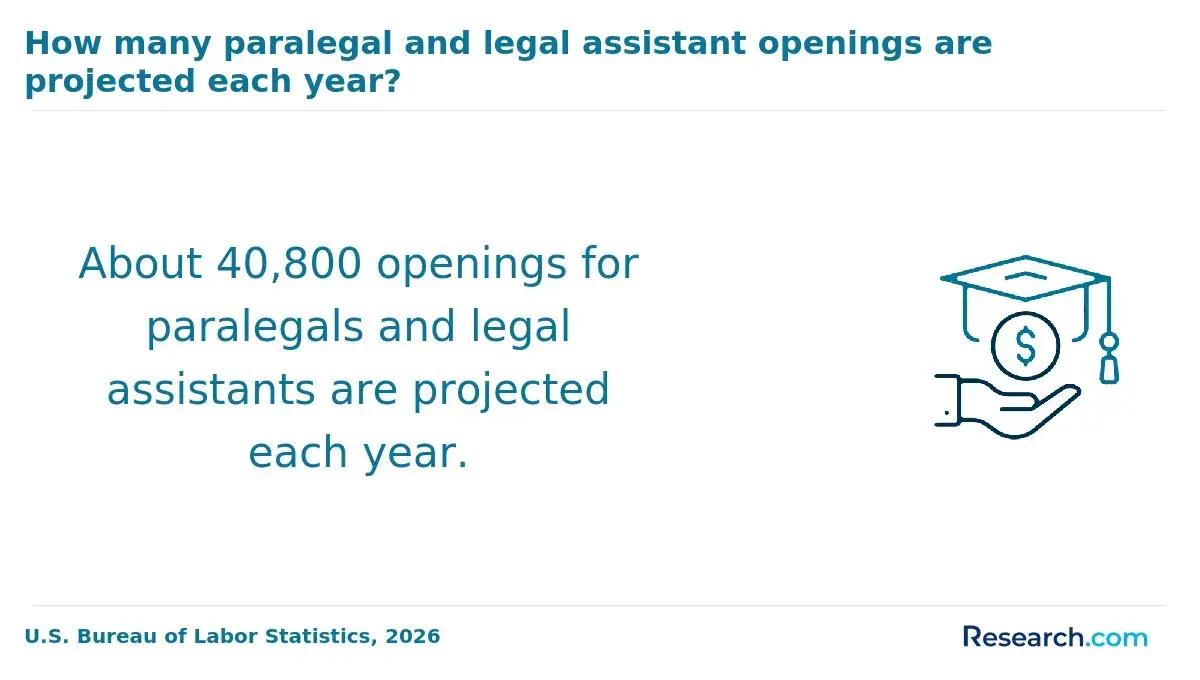
Relevant openings may include paralegal, legal assistant, or other supervised legal-support work, depending on experience and employer requirements. The Bureau of Labor Statistics reports median annual pay of $62,890 in May 2025 for paralegals and legal assistants. It projects 0% growth for 2025-2035 but about 40,800 openings per year, largely reflecting workers leaving or changing occupations. These figures describe the combined occupation, not new certificate holders' starting pay.
A certificate can help demonstrate legal-specific skills, but employers may also weigh prior office experience, writing ability, software skills, and education beyond a certificate. If local postings consistently ask for a bachelor's degree, consider comparing faster bachelor's pathways in paralegal studies against the certificate's cost and time commitment. Do not assume the additional degree will produce a particular salary.
Do paralegal certificates qualify graduates for professional certification?
A school-issued certificate records completion of an educational program. Professional certification is a separate credential awarded by a certifying organization or, where applicable, a state system. Finishing a certificate does not automatically make someone a certified paralegal, and ABA program approval does not create individual ABA certification.
Certification eligibility depends on the credential's current rules, which may combine education, experience, and an exam. Before enrolling with a particular certification in mind, compare that organization's eligibility language with the school's exact credential and coursework; obtain written clarification if the match is unclear. Also check any rules in the state where you plan to work. Certification is not a universal prerequisite for paralegal employment.
Other Things You Should Know About Law & Paralegal
Possibly. Ask whether tuition assistance covers continuing education as well as college-credit courses, whether approval is needed before enrollment, and whether reimbursement depends on your grade or continued employment.
Relevant electives can help you learn terminology and workflows, but they do not establish expertise by themselves. Pair coursework with supervised experience and examples of relevant work.
Ask whether the actual schedule matched the advertised format, whether assignments reflected workplace tasks, and which required expenses surprised them. Their experiences provide context, not a guarantee of your outcome.
Not necessarily. Entry-level office experience can help you test your interest and identify skill gaps, while a certificate may help you pursue supervised legal-support roles. Compare local job postings and the cost of waiting against the cost of enrolling now.
References
- Postgraduate Employment Outcomes of Undergraduate and Graduate Public Health Students: A Scoping Review | nih.gov https://pmc.ncbi.nlm.nih.gov/articles/PMC8579388/
- Cost of Attendance (Budget) | 2025-2026 Federal Student Aid Handbook https://fsapartners.ed.gov/knowledge-center/fsa-handbook/2025-2026/vol3/ch2-cost-attendance-budget
- Accreditation in the U.S. | ed.gov http://www.ed.gov/laws-and-policy/higher-education-laws-and-policy/college-accreditation/accreditation-in-the-us
- The Difference Between Clock Hours and Credit Hours | dhs.gov https://studyinthestates.dhs.gov/2016/03/difference-between-clock-hours-and-credit-hours
- Paralegal Studies | ccp.edu https://www.ccp.edu/degree-programs/paralegal-studies
- Tuition & Fees | Ivy Tech Community College https://www.ivytech.edu/tuition-aid/tuition-fees/
- Legal Studies | Coastal Pines Technical College https://catalog.coastalpines.edu/legal-studies
- Course Descriptions | Sturm College of Law https://law.du.edu/academics/registrar/course-descriptions
- Tuition, Fees and Parking - Academic Catalog 2026 - 2027 | Forsyth Tech Community College https://catalog.forsythtech.edu/2627/page/tuition-fees-and-parking
- What Are Credit Hours? All You Need to Know | University of the People https://www.uopeople.edu/blog/what-are-credit-hours/