2027 Transferring Environmental Technology Credits Into Public Health

Co-Founder and Chief Data Scientist
Environmental technology coursework can be a strong starting point for public health study, but a school may accept a course without applying it to the requirement you expected. That distinction matters if you are returning to college, transferring from an applied associate program, or trying to avoid repeating laboratory and statistics courses.
This guide explains where your credits are most likely to fit, who makes the decision, and how to compare degree pathways using a written evaluation rather than an advertised transfer maximum.
Key Things You Should Know
- Environmental science, chemistry, statistics, and exposure-related courses may satisfy general education, prerequisites, electives, or some major requirements; a transcript alone cannot establish equivalence.
- Ask for a degree audit showing accepted credits, requirements satisfied, remaining courses, and residency rules. The number of credits accepted is not the number of credits removed from your graduation plan.
- Compare the courses and terms still required, not just tuition or transfer limits - especially if laboratory classes, major courses, or internships are offered on a limited schedule.
What Environmental Technology Credits Transfer Into Public Health Degrees?
Environmental technology programs often cover sampling, water quality, hazardous materials, chemistry, biology, geographic information systems, and technical reporting. Public health programs may recognize that work, but its destination in the degree depends on course content and academic level. Accepted credit can count toward the total needed to graduate without satisfying a specific general education, prerequisite, or major requirement.
The comparison below shows plausible uses, not guaranteed equivalencies. Schools assess the actual course, including its laboratory component and learning outcomes.
| Previous coursework | Possible application | Common point of review |
| College chemistry or biology with a lab | Science general education or a major prerequisite | Lab hours, course level, and required topics |
| Statistics | Quantitative general education or a statistics prerequisite | Inferential methods and software or lab expectations |
| Environmental sampling or exposure assessment | Environmental health elective or, with approval, a major substitution | Whether the course connects measurements to population health |
| Occupational safety, GIS, or technical communication | Elective, supporting course, or occasionally a major requirement | Program-specific competencies and credit limits |
A hands-on monitoring course may demonstrate valuable technical skill yet omit epidemiology, community risk communication, or health policy. Conversely, a public health environmental health course may not replace a technical laboratory course. If you are considering study beyond a bachelor's degree, comparing graduate public health degree types can help you separate undergraduate transfer planning from later graduate preparation.
How Do Schools Evaluate Environmental Technology Transfer Credits?
The receiving institution has final authority over its degree. Its registrar or transfer-credit office typically determines whether coursework is accepted; the public health department decides whether an accepted course satisfies a major requirement or qualifies for a substitution. An admissions offer or preliminary transfer estimate may not settle either question.
Build an evidence file before requesting an evaluation. These steps make it easier for a school to judge the work you completed and for you to compare its decision with another school's.
- Request official transcripts from every institution attended, including any college that awarded credit through an applied or competency-based program.
- Collect catalog descriptions and, for likely major matches, syllabi showing topics, assignments, learning outcomes, contact hours, and laboratory work from the term you took each course.
- Ask how the school handles quarter-to-semester conversion, minimum grades, older science courses, repeated courses, nontraditional credit, and any transfer-credit cap.
- Request a written degree audit identifying each accepted course, the requirement it satisfies, remaining requirements, and credits that must be earned at the receiving institution.
- If a relevant course appears only as a free elective, ask the department about its documented substitution or appeal process before enrolling.
For online options, use the same audit standard. A guide to choosing an online public health bachelor's program can help identify programs to investigate, but only the receiving school can approve your credits.
Does Public Health Program Accreditation Affect Transfer Credit Acceptance?
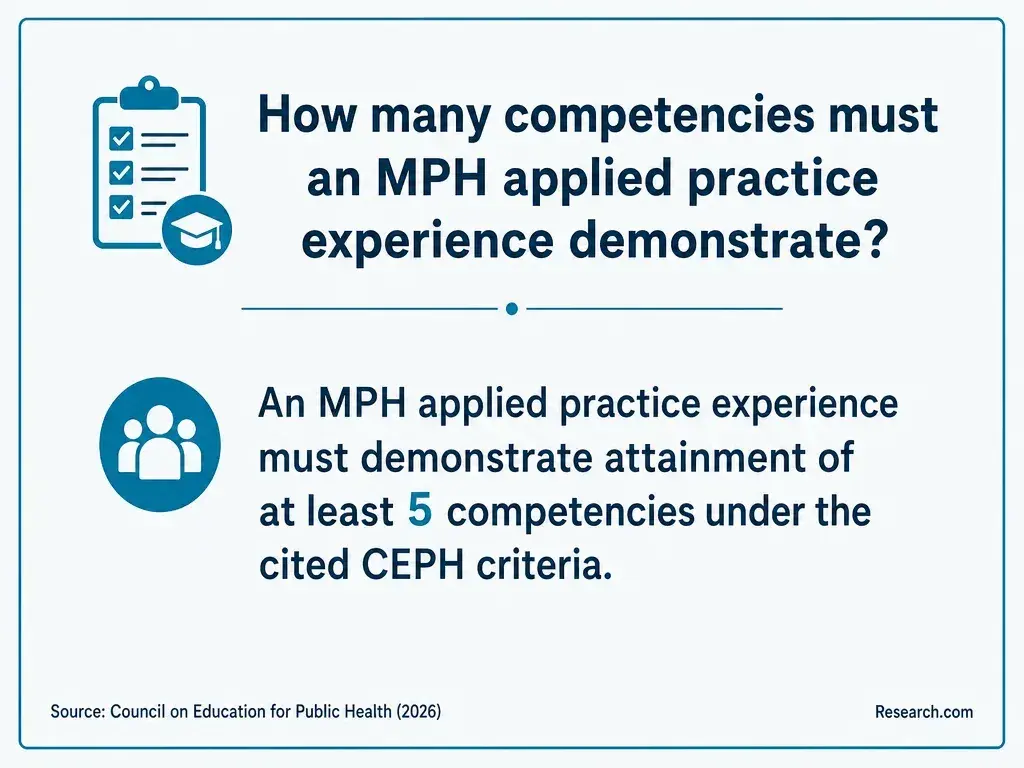
Accreditation matters, but it is not a transfer guarantee. Check the institution's accreditation when assessing academic standing and potential eligibility for federal student aid. Separately, the Council on Education for Public Health (CEPH) accredits specified schools, programs, or units of public health. Verify whether the degree you are considering falls within the accredited scope; do not assume every degree at the institution does.
Neither institutional accreditation nor CEPH status automatically makes an environmental technology course equivalent to a public health course. The receiving school's transfer and major-substitution policies control that decision. If you may pursue an MPH later, online MPH program accreditation comparisons offer a starting point for checking graduate options separately from your undergraduate credit evaluation.
A BA or BS in public health may be a good fit if you want population-health coursework alongside your technical background. A BS may have more science or quantitative requirements, while a BA may offer a different mix of supporting courses; the actual curriculum matters more than the letters in the degree name. A bachelor of applied science or degree-completion program may be structured to accommodate applied associate coursework, but you still need to check how many credits satisfy major and graduation requirements.
If your goal is environmental sampling, compliance, or a technical occupational-safety role rather than population-health practice, finishing an environmental science or related degree may preserve more of your existing coursework. If you already hold a bachelor's degree, an MPH or specialized MS is usually a new graduate pathway, not a place to transfer undergraduate technical credits into graduate requirements. Prior courses may strengthen an application or meet a prerequisite without reducing graduate credit requirements.
Doctoral study is a still later decision, not a shortcut for using unused undergraduate credits. Information on online doctorates in public health is most relevant if you eventually seek advanced practice leadership or research training; it should not drive a current bachelor's transfer choice.
Sometimes, but the closer the learning outcomes, the stronger the case. A course in exposure assessment might support an environmental health requirement if it addresses human exposures and population-level implications. A course focused entirely on equipment calibration may be valuable preparation while fitting better as an elective. Likewise, a general statistics course may satisfy a quantitative prerequisite without replacing a public health course that applies statistical reasoning to health data.
Ask the major adviser to compare your syllabus with the required course's outcomes. If substitution is denied, find out whether the course can satisfy another requirement before assuming the credit is wasted. Do not confuse this undergraduate review with graduate admissions: MPH programs with less restrictive admissions may still require you to complete their own graduate core after admission.
For a bachelor's transfer pathway, distinguish admission to the university from admission to the public health major. Schools may review prior college grades, transferable coursework, completed prerequisites, and application deadlines separately. Some allow students to enter the institution before declaring the major; others require a separate major application or a specified course sequence.
An applied associate degree does not necessarily satisfy the same general education requirements as a transfer-oriented associate degree. Ask admissions and the major department which requirements remain, whether prerequisites must be finished before major admission, and whether science or statistics courses have grade or recency rules. If you already have a bachelor's degree and are considering graduate study instead, check the specific program's requirements; conditional public health master's eligibility varies by institution and should not be assumed.
Online delivery can reduce commuting, but it does not automatically remove scheduled classes, group work, internship obligations, or in-person laboratory requirements. Campus study may make it easier to access laboratories and local faculty support, while an online degree-completion format may better fit employment or caregiving. Either format can produce a poor transfer outcome if the courses you still need are offered infrequently.
Compare programs using the same written degree audit, then ask when each remaining required course is offered, whether it has prerequisites, and where any field experience can be completed. If speed is important, online public health bachelor's accelerated class options are worth examining - but shorter classes do not remove course sequences or guarantee an earlier graduation date.
The reliable estimate starts with the remaining degree audit, not the number of credits on your old transcript. Group the remaining courses by prerequisites and term availability, then check whether residency rules require a minimum amount of study at the new institution. A course accepted as an elective may increase your recorded credits without shortening the critical sequence of required classes.
For cost, compare tuition for the remaining required credits, mandatory fees, books or software, travel, and any internship-related expenses. Ask the financial-aid office how your transfer credits, enrollment level, and remaining eligibility affect aid; do not assume that a lower advertised per-credit price yields the lowest completion cost. Scholarships for a later MPH are a separate calculation. If graduate study is part of your plan, guidance on online MPH net tuition after scholarships can help you frame that future comparison without treating prospective aid as guaranteed.
Your technical background may be especially useful in environmental health work involving sampling records, exposure information, water or air quality, workplace hazards, and communication with communities or regulators. Depending on the employer and jurisdiction, possible entry points include environmental health technician, program assistant, field-data coordinator, or supporting roles in environmental or occupational health programs. A public health bachelor's can add population-health context, basic data interpretation, and program skills, but it does not itself grant inspection authority, a professional certification, or a clinical license.
Match the job description to evidence you can show: documented field methods, quality control, clear technical reports, and a supervised project that translates environmental findings for a public health audience. Some specialist, managerial, or research roles call for additional experience, graduate education, or jurisdiction-specific credentials. Before considering an advanced degree for career progression, compare its cost with the duties it would actually qualify you to pursue; public health doctoral tuition and career comparisons are relevant only if those advanced responsibilities are your goal.
What Salaries and Job Outlook Can Public Health Graduates Expect?
There is no dependable salary figure for "environmental technology credits transferred into public health." Pay and hiring prospects depend on the occupation, location, employer, experience, and any required credential. The US Bureau of Labor Statistics reports wages and employment projections by occupation - not by undergraduate major or transfer history. An environmental science and protection technician, an occupational health and safety specialist, and a health education specialist perform different work and should not be treated as one salary category.
Start with job postings for your target role and location, identify their actual degree and certification requirements, then compare the corresponding Bureau of Labor Statistics occupational profile. If an MPH is a realistic later step, Master of Public Health earning potential can provide additional context, but occupation-wide medians are not predicted earnings for a particular graduate.
Other Things You Should Know About Public Health
Yes. Save syllabi, lab descriptions, and graded-work summaries when available. They can support a substitution request if a catalog description is too brief to show what you learned.
Not necessarily. Each receiving institution applies its own degree requirements and evaluation policies. Request a separate written assessment from every school you are seriously considering.
Only if the school offers an applicable prior-learning assessment or approved substitution route. Employment experience alone does not automatically award academic credit.
Contact the transfer-credit office to check the record, then ask the public health department which requirement it may satisfy. Keep the response and any approved change in writing.
- Enablers and barriers of community health programs... - PMC https://pmc.ncbi.nlm.nih.gov/articles/PMC11520389/
- Air Pollution and Your Health | National Institute of Environmental Health Sciences https://www.niehs.nih.gov/health/topics/agents/air-pollution
- Social Determinants of Health (SDOH) | cdc.gov https://www.cdc.gov/about/priorities/why-is-addressing-sdoh-important.html
- Supplemental Environmental Projects (SEPs) | US EPA https://www.epa.gov/enforcement/supplemental-environmental-projects-seps
- Access to Health Services - Healthy People 2030 - odphp https://odphp.health.gov/healthypeople/priority-areas/social-determinants-health/literature-summaries/access-health-services
- Transfer Credit Information - Undergraduate Admission https://admission.gatech.edu/transfer/transfer-credit
- Systems Thinking for Public Health: A Case Study Using U.S. Public Education - NAM https://nam.edu/perspectives/systems-thinking-for-public-health-a-case-study-using-u-s-public-education/
- How Public Health Interventions Make A Difference | Kent State Online https://onlinedegrees.kent.edu/college-of-public-health/community/public-health-interventions
- BS/MPH in Environmental Health | Emory University https://sph.emory.edu/degrees-programs/dual-degree/bs-mph-environmental-sciences-environmental-health
- Public Health Funding - U.S. Public Health | KFF https://www.kff.org/other-health/health-policy-101-u-s-public-health/