2027 Reconciling a Fictional Hospital Revenue Waterfall

Co-Founder and Chief Data Scientist
A hospital can report substantial patient charges while collecting much less cash - and neither figure necessarily equals revenue. Reconciling a fictional hospital revenue waterfall makes those differences visible without exposing patient information. This guide is for aspiring revenue-cycle analysts, healthcare administrators, and professionals considering further education. You'll learn how to build and check the waterfall, where errors arise, and whether a healthcare administration degree, healthcare-focused MBA, or narrower training best fits your career goal.
Key Things You Should Know
- A revenue waterfall bridges operational charges to recognized patient-service revenue; a separate receivables bridge explains collections. Treating cash as current-period revenue is a common reconciliation error.
- Reconcile by service period, payer, and adjustment type, then trace differences to claim, remittance, and general-ledger records. A denial is not automatically a write-off.
- For revenue-cycle work, hands-on reimbursement and data skills often matter more than a degree title. The Bureau of Labor Statistics' $126,520 median for all management occupations in May 2025 is not a revenue-cycle-manager salary.
What Is a Hospital Revenue Waterfall and How Is It Reconciled?
A hospital revenue waterfall is a bridge from an operational starting figure - usually gross patient charges - to the amount recognized as net patient-service revenue. It explains why list-price charges differ from expected payment under payer contracts, patient financial-assistance policies, and estimates of collectibility. The precise labels depend on the hospital's accounting policies and reporting system.
Reconciliation has two distinct tests. First, the waterfall's recognized revenue must agree with the relevant general-ledger accounts after documented timing and classification differences. Second, the receivables rollforward must explain how outstanding balances changed: beginning receivables plus recognized revenue and applicable adjustments, less collections and write-offs, equals ending receivables. Cash collected on an older claim belongs in the receivables bridge, not automatically in current-period revenue.
For a fictional hospital, use synthetic claim-level records and assign every charge, allowance, payment, and write-off a service date, posting date, payer, and account. Aggregate the records to the reporting period, compare totals with the ledger, and investigate unmatched items rather than inserting a balancing adjustment. That exercise also clarifies why HIM and healthcare administration educational pathways emphasize different parts of the same process: reliable health information supports claims, while administration addresses financial and operational decisions.
How Do Healthcare Administration Programs Teach Hospital Revenue Reconciliation?
Healthcare administration programs commonly approach reconciliation as a management problem: how reimbursement rules, contracting, documentation, billing operations, and financial reporting affect decisions. An applied assignment might ask students to explain a variance between expected reimbursement and ledger revenue, then recommend a control that would prevent it from recurring.
Course titles alone do not establish that a program teaches claim-level reconciliation. When you review online Master of Health Administration degrees, inspect syllabi and capstone descriptions for payer-contract modeling, revenue-cycle metrics, spreadsheet or database work, and use of de-identified claims. An MHA may offer stronger hospital-specific context than a general MBA; an MBA may be more useful if your goal also requires broad finance and leadership training. Neither automatically substitutes for practice with actual billing workflows.
What Education and Skills Are Required for Hospital Revenue Cycle Careers?
Requirements vary by employer and role. Billing and claims positions may be accessible through relevant experience or targeted training, while analyst and management openings may prefer a bachelor's degree, substantial revenue-cycle experience, or both. Employers can value demonstrated command of payer contracts, claim edits, denials, patient accounting, spreadsheets, and financial controls more than an advanced degree without applicable experience.
A career changer should start with transferable skills. Accounting experience helps with ledger ties and receivables; data analysis helps identify payer and posting patterns; clinical documentation experience helps explain coding and claim problems. The remaining gap is usually hospital reimbursement and system workflow. If that gap centers on records, coding, or information governance, compare online CAHIIM-accredited health information management programs with administration degrees rather than assuming they prepare students for identical jobs.
For a first management role, add staff coaching, escalation decisions, and communication with finance, coding, and clinical teams. A degree can develop those skills, but it does not confer supervisory experience or a promotion.
The table shows a fictional, symbolic waterfall. Its letters are placeholders, not hospital results or accounting entries to copy unchanged. It separates the revenue calculation from collections so the same activity is not counted twice.
| Stage | Fictional expression | Reconciliation check |
| Gross patient charges | G | Agree charge detail to the operational source for the defined service period. |
| Contractual allowances | G − A | Compare estimated allowed amounts with payer terms and claim detail. |
| Charity care and other price concessions | G − A − H − I | Confirm classifications and estimates against policy; avoid counting the same reduction twice. |
| Net patient-service revenue | N = G − A − H − I | Tie N to recognized revenue in the general ledger, accounting for documented timing differences. |
| Collections and ending receivables | Separate receivables rollforward | Trace payments and remaining balances to patient accounts and ledger control accounts. |
Here, H represents charity-related charges in an operational charge bridge. Charity care generally is not recognized as revenue, so H should not be mistaken for a routine reduction of revenue already recorded. I represents other estimated price concessions. A later deterioration in a patient's ability to pay may instead raise a bad-debt question under the hospital's accounting policy. Pending claims and denials require investigation; neither should automatically be labeled an expense or permanent write-off.
This is a useful test of any finance course: can students explain both the arithmetic and the accounting treatment? When comparing accelerated healthcare-focused MBA degrees, check whether an applied project addresses reimbursement and receivables - not just general corporate revenue.
Look for healthcare financial management, reimbursement or payment systems, health information systems, operations improvement, and analytics. Financial management should cover accrual reporting and receivables; reimbursement should explain how payer terms affect expected payment; analytics should help students investigate variances by payer, service period, or claim status.
A useful syllabus question is: Will I work through a charge-to-revenue bridge and reconcile it to both a ledger and a receivables report? A course that discusses hospital budgets but never handles claims or adjustments may support leadership development without preparing you for hands-on revenue-cycle analysis. If you are considering year-long master's programs in healthcare administration, examine course sequencing carefully; a short calendar does not establish that specialized finance practice is included.
Yes, if the program provides relevant assignments and a schedule you can sustain while gaining or maintaining practical experience. Online delivery alone does not establish flexibility: live sessions, group work, exam windows, and field experiences may still have fixed times.
Ask for a sample course calendar and an example of a finance or analytics assignment. Also ask whether students can use synthetic data, whether software access is included, and whether career services support working professionals seeking hospital roles. For someone entering the field, an accessible billing, patient-access, or analyst opportunity alongside study may be more valuable than finishing a degree quickly without relevant experience. If start timing matters, consider choosing a healthcare administration program around its start dates, but verify its actual course schedule before enrolling.
There is no single defensible price or completion time for "a healthcare administration degree." Total cost depends on the credential, required credits, tuition basis, mandatory fees, materials, and any fieldwork or travel. Time depends on transfer credit, course availability, enrollment intensity, and whether the program requires a project or placement.
For an apples-to-apples comparison, request each school's required credits and current per-credit or total-program tuition, then add mandatory fees and expected non-tuition costs. Compare a realistic part-time schedule - not only an advertised fastest finish - and subtract employer assistance only if you meet its eligibility and repayment rules. An affordable healthcare administration master's program comparison can help build a shortlist, but confirm current charges directly before making a borrowing decision.
If your immediate goal is claim reconciliation rather than broader leadership, compare the full degree's cost and time with a focused course plus supervised revenue-cycle work. The cheaper route may be sufficient; the degree may be more useful when advancement requires broader organizational responsibility.
First, verify that the institution holds recognized institutional accreditation and that the credential is eligible for any employer education benefit you intend to use. Then assess field-specific accreditation where it fits your goal. CAHME accredits eligible graduate healthcare management programs; CAHIIM pertains to health information and informatics programs. Business-school accreditation is a separate consideration for an MBA, not a substitute for checking its healthcare curriculum.
If graduate healthcare management training is your priority, comparing accredited online MHA pathways offers a relevant starting point. Confirm the accreditation status of the specific program and delivery option with the accreditor and school before applying. Accreditation can signal external review; it does not prove that a particular course teaches revenue-waterfall reconciliation or that an employer will hire its graduates.
Possible paths include patient-access or billing specialist, denial-management specialist, revenue-cycle analyst, patient-accounting supervisor, and revenue-cycle manager. Their work differs: analysts investigate variances and trends; supervisors manage queues, controls, and staff; managers coordinate performance across departments and payer relationships. Job titles and degree expectations vary by hospital.
For a career changer, an analyst or operational role adjacent to existing accounting, data, or clinical-documentation experience is generally a more credible first target than a department-head position. Build a portfolio exercise using synthetic claims, document the assumptions behind each adjustment, and explain how you resolved a ledger variance. After substantial management experience, some professionals explore online healthcare administration doctorate pathways for advanced leadership or academic goals. A doctorate is not ordinarily the direct route into revenue-cycle operations.
What Are the Salary and Job Outlook for Healthcare Revenue Cycle Managers?
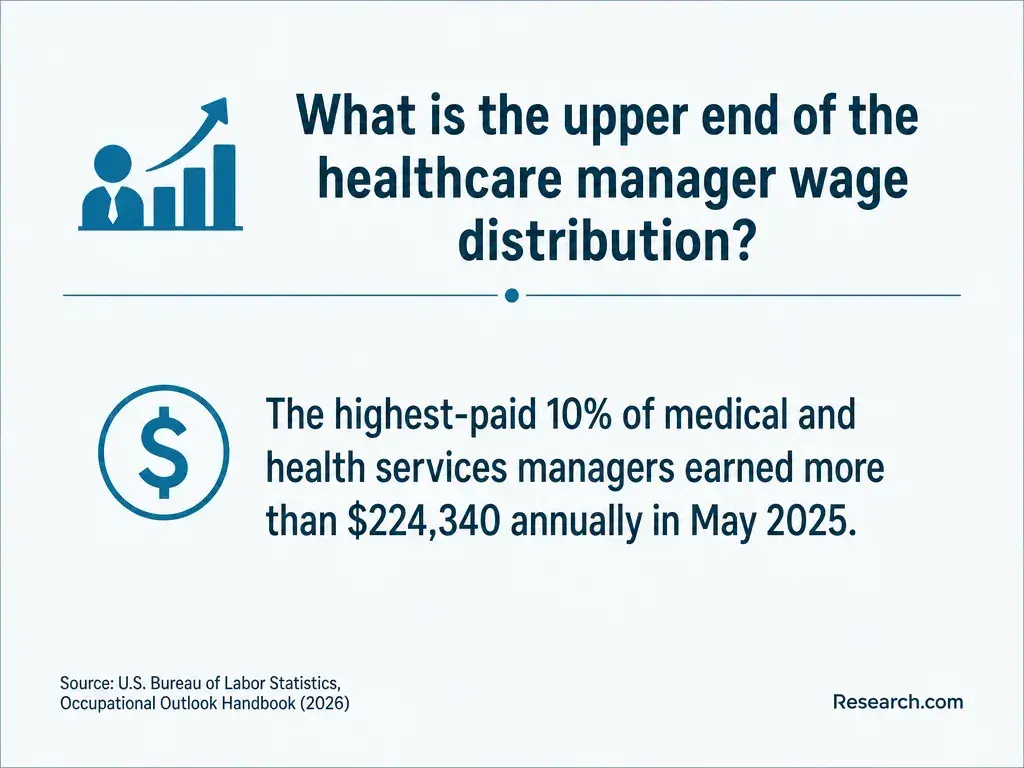
The U.S. Bureau of Labor Statistics does not provide a single, directly comparable national wage figure for the title "healthcare revenue cycle manager." Its median annual wage for all management occupations was $126,520 in May 2025. That broad figure is context, not an estimate of what a revenue-cycle manager - or an MHA or MBA graduate - will earn. Pay depends on duties, location, employer, and prior experience.
BLS projects overall management employment to grow faster than the average for all occupations from 2025 to 2035, but that projection likewise does not isolate revenue-cycle managers. For a personal decision, compare local postings' pay ranges and experience requirements with your present compensation and the cost of training. Advanced study should serve a specific next role: even affordable online doctorates in healthcare administration warrant a separate cost-and-career assessment, not an assumption of a salary increase.
Other Things You Should Know About Healthcare Administration
Use synthetic or properly de-identified data unless your employer and school explicitly authorize another arrangement. Remove identifiers and follow applicable privacy and security rules.
No. It explains patient-service revenue and related adjustments. Profitability also depends on operating expenses and other income or losses.
Check whether they are reversals, corrections, or reclassifications, then trace them to source transactions. Do not discard them merely to make the waterfall look cleaner.
Yes. Build a synthetic claim ledger in a spreadsheet with service dates, expected payments, adjustments, cash postings, and account balances. State your assumptions and make every total traceable to its underlying rows.
- Revenue Cycle Management: The Art and the Science - PMC https://pmc.ncbi.nlm.nih.gov/articles/PMC11219169/
- 42 CFR § 413.89 - Bad debts, charity, and courtesy allowances. | LII / Legal Information Institute https://www.law.cornell.edu/cfr/text/42/413.89
- Hospital Charity Care: How It Works and Why It Matters | KFF https://www.kff.org/health-costs/hospital-charity-care-how-it-works-and-why-it-matters/
- Revenue Cycle Management Considerations - AMA Ed Hub https://edhub.ama-assn.org/steps-forward/module/2827452
- What Is Revenue Cycle Management (RCM)? | AAPC https://www.aapc.com/resources/what-is-revenue-cycle-management
- Healthcare Revenue Cycle Management: A Complete Guide | Revecore https://www.revecore.com/insights/resources/healthcare-revenue-cycle-management
- Net Patient Revenue (NPR) | Definitive Healthcare https://www.definitivehc.com/resources/glossary/net-patient-revenue
- Understanding Contracted Rates in Healthcare | Rivet Health https://www.rivethealth.com/blog/understanding-contracted-rates-in-healthcare
- A Guide To Contractual Adjustment in Medical Billing | rapidclaims.ai https://www.rapidclaims.ai/blogs/contractual-adjustment-medical-billing