2027 Paralegal Certificates With Portfolio-Based Assessment: What Work Will You Produce?

Co-Founder and Chief Data Scientist
A paralegal certificate can promise practical training, but "portfolio-based" does not tell you what you will actually make - or whether anyone will give you useful feedback. If you are comparing programs, the difference matters: a polished writing sample is more useful than a folder of unreviewed assignments.
This guide explains the documents and work products you may produce, how programs assess them, and which questions to ask about coursework, approval, cost, and scheduling before you enroll.
Key Things You Should Know
- A useful portfolio may contain research memoranda, draft pleadings or discovery materials, contract summaries, and organized case files; the exact work depends on the program.
- Look for documented feedback and revisions, not just a final collection of assignments. Ask whether samples are simulated, supervisor-reviewed, and safe to show employers.
- A certificate is education, not professional certification or permission to practice law. For context, the U.S. median pay for paralegals and legal assistants was $62,890 in May 2025 - not an entry-level salary promise.
What Is a Portfolio-Based Paralegal Certificate?
A portfolio-based paralegal certificate is an educational program that assesses at least some learning through a collection of completed work. Instead of relying only on exams, it may require students to submit drafts, receive feedback, revise their work, and assemble selected pieces into a final portfolio. "Portfolio-based" is a program description, not a standardized credential; schools decide which assignments count and how they are graded.
Ask whether the portfolio is required for graduation and whether instructors assess the quality of each piece or merely confirm that it was submitted. A paralegal certificate also differs from professional certification: an organization or state system grants the latter under its own rules. Neither credential, by itself, authorizes someone to practice law as an attorney.
What Work Will You Produce in a Paralegal Certificate Portfolio?
Expect work products that demonstrate a process - finding authority, organizing facts, drafting accurately, and correcting errors - rather than a set number of documents. The table shows plausible assignments to look for in a published syllabus or portfolio rubric; it does not describe a universal curriculum.
| Work product | What it can demonstrate | Important limitation |
| Legal research memorandum | A research question, relevant authority, citations, and a reasoned analysis | Strong writing does not substitute for attorney review of legal conclusions. |
| Draft pleading or discovery materials | Fact organization, procedural awareness, and careful drafting | Rules and forms vary by jurisdiction and case. |
| Contract or regulatory summary | Issue spotting and clear communication of provisions or requirements | Summarizing a document is not independently giving legal advice. |
| Case chronology or document index | Record management, consistency, and attention to detail | A realistic exercise should protect confidential information. |
The best evidence of learning may be a first draft, instructor comments, and corrected version of the same assignment. Confirm what can leave the classroom: work involving actual clients or an internship may be confidential, so an anonymized or simulated sample may be the only appropriate piece to share.
How Do Portfolio-Based Paralegal Certificates Build Job-Ready Skills?
A well-designed assignment connects the finished document to the work behind it. For example, a research memo can require students to identify the controlling jurisdiction, check whether an authority remains valid, write for an attorney audience, and revise after feedback. A case-file exercise can test whether dates and names remain consistent across documents.
Those exercises resemble parts of legal-support work, but a classroom portfolio is not proof that a graduate can handle a live matter without supervision. Ask who reviews drafts, how often students revise them, and whether grading covers accuracy, citations, formatting, confidentiality, and deadlines. If a school advertises legal databases, e-discovery, or artificial intelligence tools, distinguish a passing mention from student access and graded hands-on work. Software exposure alone does not establish proficiency.
Which Courses Are Included in Portfolio-Based Paralegal Programs?
Course names vary, but legal research and writing are particularly important when the goal is a portfolio. Civil litigation, contracts, legal ethics, and legal technology can add different kinds of work products. A program focused on one practice area may produce a narrower portfolio than a general paralegal curriculum; neither approach is automatically better.
Compare course descriptions with the assignments they require. A litigation course that produces a revised discovery draft tells you more about assessed skills than a course title alone. If your goal is primarily HR policy or regulatory work rather than paralegal employment, human resources law concentrations in legal studies illustrate a different educational route. Such non-JD legal studies education does not qualify graduates to practice law.
Do Portfolio-Based Paralegal Certificates Need Accreditation or ABA Approval?
Portfolio assessment does not, by itself, require American Bar Association approval. The ABA approves qualifying paralegal education programs; it does not institutionally accredit schools or certify individual graduates. Institutional accreditation is a separate status. Check any claimed ABA approval against the ABA's current directory of approved paralegal education programs, and check institutional accreditation with the school's recognized accreditor.
Approval may matter to a particular employer or to someone planning to pursue a credential with specific education rules, but a non-ABA-approved program is not automatically unsuitable. Compare its curriculum, instructor feedback, graduate outcomes when documented, and cost. State rules and employer preferences differ, so verify any requirement relevant to where you intend to work rather than assuming it applies nationwide.
What Are the Admission Requirements for a Paralegal Certificate?
Requirements depend on the certificate. Some admit applicants with a high school credential; others are designed for people who already hold a degree or have completed college coursework. Before applying, check the published prerequisite, whether the certificate carries college credit, and whether admission to the school also means admission to the program.
If you already have an associate degree and expect to continue your education, compare the certificate with legal studies bachelor's routes for associate degree holders. Do not assume certificate courses will count toward a later degree: the receiving institution decides whether and how credits transfer. A noncredit certificate may still teach useful skills, but its work and expense should be evaluated on that basis.
How Long Do Portfolio-Based Paralegal Certificate Programs Take?
Completion time depends on prerequisites, course sequencing, enrollment intensity, and whether the portfolio is assembled throughout the program or completed in a final course. Published program length may assume full-time study. A working student should check how often required courses run and whether missing one course delays the final assessment.
Do not confuse a paralegal certificate timeline with online master's in legal studies program length. A master's degree is a different academic commitment and may be unnecessary if your immediate goal is to produce supervised paralegal work samples. For either route, compare the calendar you can actually follow, not just the shortest advertised completion time.
Are Online Portfolio-Based Paralegal Certificates as Effective as Campus Programs?
Either format can support a strong portfolio when students complete comparable assignments and receive specific, timely feedback. The more useful comparison is how the work is taught and assessed: online classes may have scheduled meetings, fixed deadlines, supervised exams, or an in-person internship. "Online" does not necessarily mean asynchronous or self-paced.
When choosing an online paralegal certificate, ask to see a sample syllabus or portfolio rubric. Confirm how students obtain research resources, submit revisions, meet instructors, and complete any placement. If an internship is required, ask who arranges it and whether the program permits a remote placement or relevant current employment; do not assume either option is available.
What Careers and Salaries Can Paralegal Certificate Graduates Expect?
A certificate portfolio may help an applicant demonstrate writing, research, and organization for paralegal or legal assistant roles. Hiring requirements vary by employer, and a portfolio does not guarantee a job. Paralegals work under attorney supervision and cannot independently provide legal services that would constitute unauthorized practice of law.
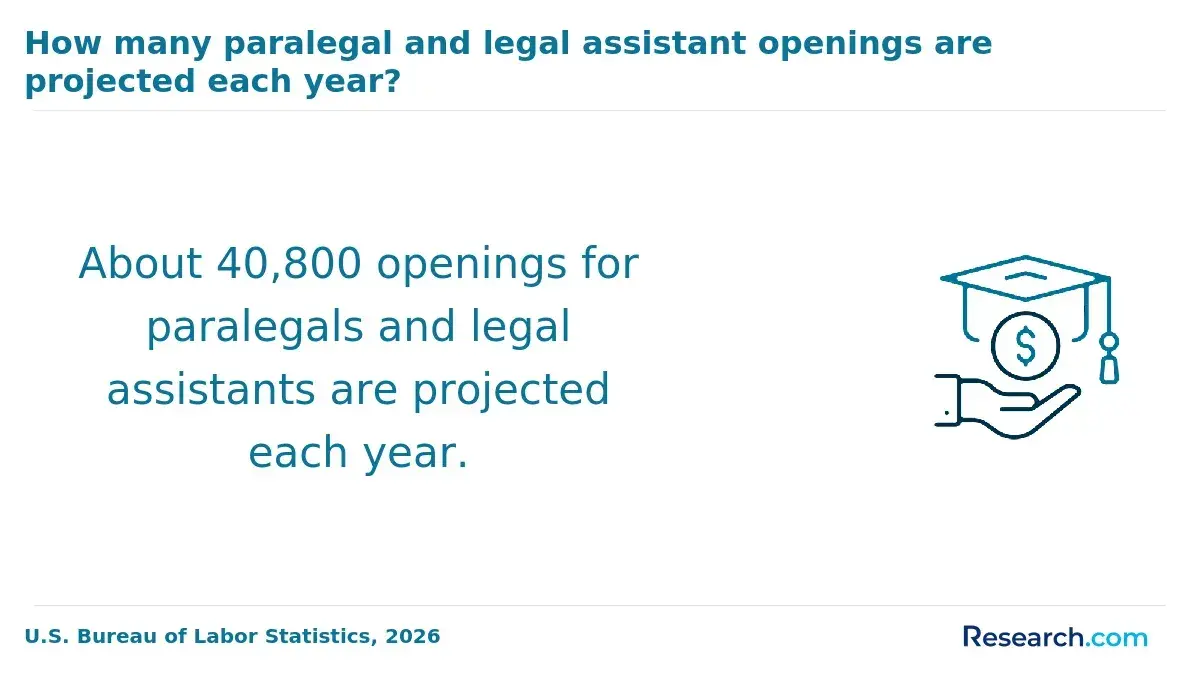
The Bureau of Labor Statistics reports median annual pay of $62,890 in May 2025 for paralegals and legal assistants, with 0% projected growth, 2025-2035, and about 40,800 openings per year. The median covers workers across experience levels and workplaces; it is not a predicted starting salary for certificate graduates. The projected openings also show why opportunities can exist despite little or no net employment growth.
If you are aiming instead for compliance or HR work, first compare job duties and employer expectations with what a paralegal portfolio actually demonstrates. A different course of study or relevant work experience may be a more direct route.
How Can You Choose a Reputable Portfolio-Based Paralegal Certificate?
Start with evidence of what you will produce and how it will be judged. Then compare the full commitment: advertised tuition is only part of the cost if books, research access, technology, travel, or an internship add expenses. Do not assume a certificate is eligible for federal student aid; ask the school whether the specific program qualifies.
Before paying a deposit, use these checks to separate a substantial portfolio requirement from a marketing label:
- Request the current course sequence, sample assignments, and portfolio grading rubric; ask how many pieces receive individual feedback and revision.
- Verify institutional accreditation and any claimed ABA program approval through the relevant accreditor and ABA directory.
- Get the total required cost and a realistic schedule, including meetings, campus visits, and internship arrangements.
- Ask which samples graduates may retain or show employers, and how confidential material must be handled.
A red flag is a promise of job placement, certification, or professional proficiency based solely on completing a portfolio. If your goal is broader legal knowledge rather than supervised paralegal work, compare that certificate's cost and purpose with choosing an affordable online legal studies master's program - but remember that a non-JD master's degree does not qualify you to practice law.
Other Things You Should Know About Law & Paralegal
Usually, you can discuss your skills, but check the program's sharing rules first. Use only work you have permission to disclose, and remove confidential or identifying information.
Follow the employer's instructions. If none are given, select a small set of your strongest, relevant pieces and be ready to explain your role and revisions.
Possibly, but credit for experience is program-specific. Ask for the school's written policy before assuming it will waive a course or portfolio assignment.
Ownership and reuse rules depend on the school, assignment, and any internship agreement. Check those terms before publishing or distributing a sample.
References
- What Does a Paralegal Do? What Are the Paralegal Job Duties? | Online Paralegal Studies Certificate Program https://paralegalonline.bu.edu/articles/duties-of-a-paralegal/
- What is a Portfolio? | Clarke University https://clarke.edu/academics/careers-internships/resume-writing-and-portfolios/what-is-a-portfolio/
- Using Portfolios in Program Assessment | Assessment and Curriculum Support Center https://manoa.hawaii.edu/assessment/resources/using-portfolios-in-program-assessment/
- Collaborative Portfolio Assessment (CPA) - KCC Composition https://kcccomp.commons.gc.cuny.edu/eng-12-portfolio-assessment/
- Rubrics to Evaluate Student Work | uoregon.edu https://teaching.uoregon.edu/resources/rubrics-evaluate-student-work
- Portfolio Assessment | Official Catalog | Charter Oak State College https://www.charteroak.edu/catalog/current/sources_credit/portfolio_assessment.php
- Paralegal Studies | Coastline College https://www.coastline.edu/programs/paralegal-studies.php
- Portfolios | The Derek Bok Center for Teaching and Learning https://bokcenter.harvard.edu/portfolios
- Experiential Learning Credit Paralegal Studies | catholic.edu https://metro.catholic.edu/academics/associates-programs/paralegal/experiential-learning-credit.html
- Revising for the Portfolio - Writing Across the Curriculum | Carleton College https://www.carleton.edu/writing/portfolio/revising-for-the-portfolio/