2027 Online SLP Master's Programs for Arkansas Residents: Eligibility, Tuition, and Clinical Placements

Co-Founder and Chief Data Scientist

Reviewed by Rhea Paul, PhD
SLP Education & Research Expert
Arkansas residents can pursue an online speech-language pathology master's degree, but the online format does not eliminate the need for supervised clinical training, state authorization, or Arkansas licensure planning. The most important decision is not simply which program offers online classes; it is whether the school can enroll Arkansas students, arrange qualifying placements, and support the pathway to practice.
This guide compares the questions to ask about tuition, accreditation, clinical sites, travel, and post-graduation requirements before applying.
Key Things You Should Know
- Arkansas applicants should prioritize a CAA-accredited program that confirms it may enroll Arkansas residents and supports clinical placements that meet the 400-hour supervised clinical education standard.
- Tuition is only one part of the investment: budget for fees, prerequisite coursework, travel for immersions, background checks, health requirements, technology, and possible relocation for a placement.
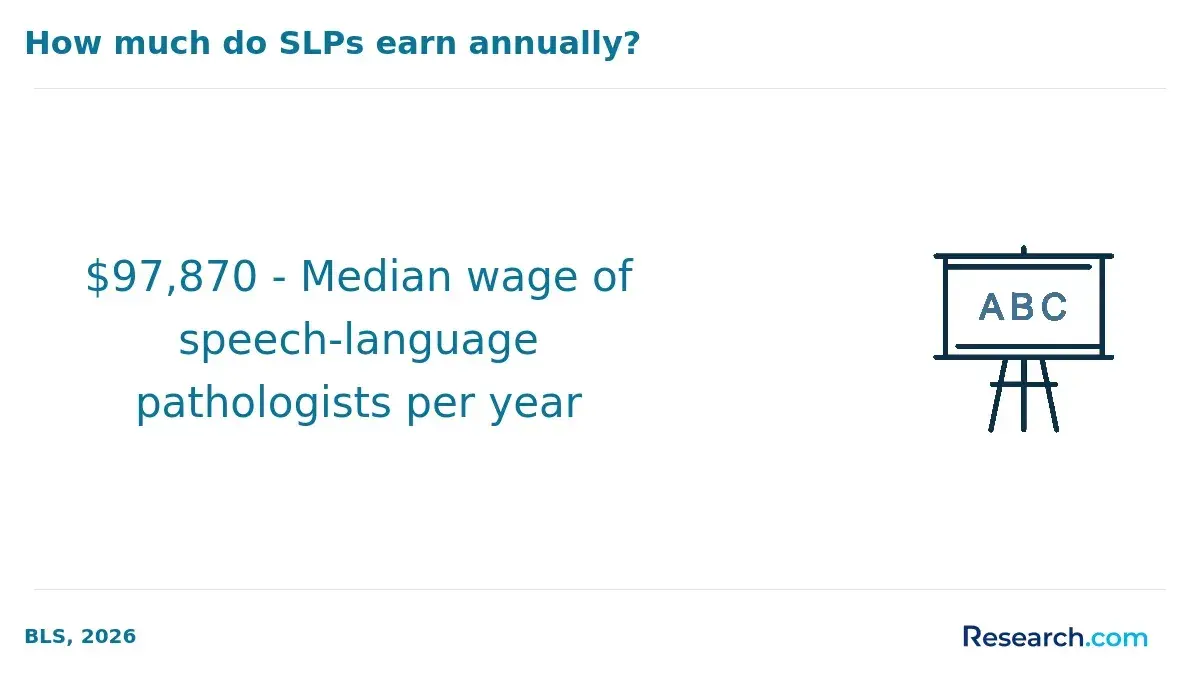
- Speech-language pathologists had a median annual wage of $97,870 in May 2025, and the occupation is projected to grow 17% from 2025 to 2035; those figures support demand but do not guarantee an individual job offer or salary.
Which online SLP master's programs accept Arkansas residents?
An online SLP master's program can be based outside Arkansas, but it must be authorized to provide distance education to Arkansas residents when you enroll. It also needs to be able to place you in supervised clinical experiences that satisfy its curriculum and support the Arkansas path to licensure. Availability can change by cohort, so an admissions representative's written confirmation is more useful than a general "online" label.
The programs below are examples of established distance or hybrid master's options that Arkansas applicants may investigate. A school's ability to accept applicants is not the same as a promise of an Arkansas clinical placement, so verify both separately before paying an application fee.
| Program | Delivery consideration for Arkansas residents | Clinical placement consideration | Best question to ask first |
| Arkansas State University Master of Science in Communication Disorders | An Arkansas-based option that may reduce out-of-state administrative complexity. | Students should confirm how the program assigns or approves school, medical, and community placements. | Can I complete every required clinical rotation in Arkansas, and what travel is still required? |
| Baylor University Online Master of Science in Communication Sciences and Disorders | Distance format may be attractive for students seeking structured online coursework. | Clinical education is still in person and may involve placement assignments beyond a student's preferred area. | Is Arkansas currently an approved enrollment state for my intended cohort? |
| Emerson College Online Master of Science in Communication Disorders | Online coursework is paired with required clinical education and program-directed scheduling. | Applicants should ask about placement lead time, travel expectations, and site availability. | What responsibility does the program retain if a local placement falls through? |
| New York University Online Master of Science in Communicative Sciences and Disorders | Students should evaluate live-course timing, required experiences, and state eligibility disclosures. | Practicum and internship requirements remain location-dependent despite online academics. | Which on-campus or in-person requirements apply to an Arkansas resident? |
Program formats, admissions cycles, and state restrictions may change. If you are comparing a wider range of SLP master's programs online, use Arkansas eligibility and clinical-placement support as initial filters rather than treating them as details to resolve after admission.
What admission and state authorization rules affect Arkansas applicants?
Most entry-level SLP master's programs expect a bachelor's degree, prerequisite preparation in communication sciences and disorders, letters of recommendation, a statement of purpose, transcripts, and evidence that the applicant can meet clinical participation requirements. A bachelor's degree in another field can be acceptable, but it commonly creates additional prerequisite or leveling coursework before or alongside graduate admission.
Admission requirements differ substantially. Many programs publish a minimum undergraduate GPA, while others conduct holistic review; some require standardized testing and others do not. Applicants who need prerequisite courses should ask whether those courses must be completed before the application deadline, before enrollment, or by a specified point in the curriculum. Applicants seeking less selective pathways can also compare easiest SLP masters programs to get into, while still making accreditation and licensure compatibility nonnegotiable.
State authorization is a separate compliance issue. Arkansas participates in interstate distance-education authorization arrangements, but each university decides where it will enroll students and may restrict enrollment because of professional-licensure rules. Before applying, obtain written answers to the following questions.
- May the university enroll a student physically located in Arkansas for my intended start term?
- Does the university state that its curriculum is designed to meet Arkansas speech-language pathology licensure educational requirements?
- Are there Arkansas-specific disclosures, additional forms, or placement restrictions?
- Will the school notify me promptly if authorization or licensure disclosures change before graduation?
A common mistake is assuming that accreditation alone resolves state authorization. Accreditation evaluates educational quality; state authorization governs whether the institution may offer the program to a resident in a particular state. Both matter.
How much do Arkansas online SLP master's programs cost?
The most reliable cost comparison is an official written estimate for the full degree, not an advertised per-credit rate. SLP programs vary in credit requirements, prerequisite needs, institutional fees, and clinical travel obligations, which means two programs with similar tuition rates can produce very different total costs.
Ask each school to itemize the charges that apply to an Arkansas distance learner. The following cost categories are especially important because they are often excluded from a headline tuition figure.
| Cost category | Why it matters | What to request from the school |
| Tuition | May be charged per credit, per term, or at a cohort rate. | Total tuition for required graduate credits, including any differential online rate. |
| University and distance-learning fees | Technology, student-service, clinical, and graduation fees can recur each term. | A term-by-term mandatory-fee estimate. |
| Prerequisite coursework | Career changers may need several undergraduate CSD courses before admission. | Whether prerequisites are included, transferable, or separately billed. |
| Clinical compliance costs | Background checks, drug screening, immunizations, CPR certification, liability coverage, and testing may be required. | A current clinical onboarding checklist with estimated student-paid items. |
| Travel and lodging | Immersions, skills assessments, and distant placements can create large out-of-pocket costs. | The number, location, and length of required in-person experiences. |
| Lost work time | Full-time clinical rotations may reduce a student's ability to maintain employment. | Typical weekly clinical hours and whether placement schedules include daytime hours. |
Federal financial aid eligibility depends on enrollment, institutional participation, and the student's circumstances. Compare net cost after grants, scholarships, employer assistance, and borrowing rather than assuming that a lower published tuition rate always creates the lower financial burden. Also ask whether tuition is locked for the cohort or can increase during enrollment.
The economic case should be considered cautiously. The U.S. Bureau of Labor Statistics reports a $97,870 median annual wage for speech-language pathologists in May 2025, but pay varies by employer, setting, experience, geographic area, productivity expectations, and hours worked. Use the figure to frame a repayment conversation, not to assume a personal earnings outcome.
Which programs are CAA accredited or candidate status?
For an Arkansas applicant planning to become a licensed speech-language pathologist, CAA status is one of the most consequential screening criteria. The Council on Academic Accreditation in Audiology and Speech-Language Pathology accredits graduate programs in speech-language pathology. Accreditation is distinct from regional institutional accreditation and from a university's general reputation.
A CAA-accredited program has completed the accreditation process. A program with candidate status is in an earlier stage of the CAA process and may be appropriate for some students, but it deserves additional scrutiny because the status, timing, and licensing implications can be more complicated. Do not assume an institution's other health programs share the same status as its SLP program.
Before enrolling, confirm the program's exact current status in the CAA directory and ask the program to explain what that status means for your graduation date. The practical distinction is summarized below.
| Status to verify | What it generally indicates | Applicant action |
| CAA accredited | The graduate program holds accreditation under CAA standards. | Confirm the accreditation period includes your expected enrollment and graduation dates. |
| CAA candidate status | The program is progressing through the accreditation process but is not described the same way as an accredited program. | Request written clarification about graduate eligibility for Arkansas licensure and ASHA certification. |
| No applicable CAA status listed | The program may not be an entry-level SLP degree that supports the usual licensure pathway. | Do not rely on general university accreditation; seek guidance from the Arkansas licensing board before proceeding. |
CAA accreditation does not eliminate the need to complete clinical requirements, pass required examinations, complete a clinical fellowship, or satisfy Arkansas board rules. It does, however, substantially reduces the risk of investing in a degree that does not match the standard professional pathway.
How do online clinical placements work for Arkansas students?
"Online" in an entry-level SLP master's program usually refers to academic instruction, not to all clinical work. Students conduct patient and client services in person under qualified supervision in settings such as schools, hospitals, rehabilitation facilities, outpatient clinics, early-intervention programs, and skilled nursing facilities.
CAA standards require a minimum of 400 supervised clinical practicum clock hours, including at least 25 hours of guided clinical observation and 375 hours of direct client or patient contact. At least 325 of the 400 hours must be completed at the graduate level. Individual programs may require more hours or specify particular populations and settings.
Placement models vary, and the difference can affect your budget, schedule, and likelihood of completing on time.
| Placement model | How it works | Trade-off for Arkansas students |
| Program-arranged placement | The university identifies or contracts with an approved site and supervisor. | Usually provides more structure, but the student may have less control over location and schedule. |
| Student-assisted placement search | The student helps identify sites while the university must approve the site and supervisor. | May improve local options, but finding a site can require substantial outreach and cannot be guaranteed. |
| Student-secured placement | The student bears most responsibility for locating a qualifying site. | Can be risky in areas with limited capacity; clarify what happens if no site is approved. |
Ask whether a placement coordinator is assigned, whether the school has current Arkansas affiliation agreements, how long approvals typically take, and whether the program can require travel outside your community. Never resign from work or sign a lease based on an assumed placement until the site and schedule are confirmed in writing.
Which Arkansas sites can satisfy practicum and internship requirements?
Potential Arkansas placement settings include public schools, special education cooperatives, hospitals, rehabilitation organizations, outpatient clinics, skilled nursing facilities, early-intervention providers, university clinics, and veterans' health settings. Examples of organizations and systems that may employ SLPs include Arkansas Children's, UAMS clinical services, the Central Arkansas Veterans Healthcare System, local school districts, and regional health systems. Employment of SLPs at a site does not mean the site has an active agreement with a particular university or available student capacity.
A qualifying site must meet the program's requirements for population exposure, supervision, documentation, liability coverage, onboarding, and clock-hour tracking. A supervisor must also meet the university's and professional standards. For that reason, students should treat a possible local employer as a lead, not as a confirmed practicum site.
When discussing Arkansas locations with a placement office, use the following process to reduce avoidable delays.
- Identify your preferred travel radius and whether you can commute to a school, medical, or rural setting.
- Ask the university whether it already has a current affiliation agreement with the site or system.
- Confirm the site serves the ages and clinical needs required for your rotation.
- Verify supervisor eligibility through the university before accepting a verbal commitment.
- Complete immunizations, background checks, training modules, and other onboarding requirements early.
Rural students should be especially cautious about placement timing. A wider geographic radius may be necessary when nearby clinicians have full caseloads, lack capacity to supervise, or work in settings that do not match a program's required experience mix.
Do Arkansas residents need additional licensure steps after graduation?
Yes. Completing a master's degree is an essential milestone, but it is not the final step to independent practice as a speech-language pathologist in Arkansas. Graduates should review requirements with the Arkansas Board of Examiners in Speech-Language Pathology and Audiology because board rules, forms, fees, and supervision procedures can change.
In general, the post-degree pathway involves a qualifying graduate degree, supervised professional experience through a clinical fellowship or comparable board-recognized process, a passing score on the required national examination, and an application for the appropriate Arkansas credential. A provisional or temporary credential may be needed while completing supervised post-graduate practice. School-based employment can also involve Arkansas educator or school-service credential requirements that are separate from the professional practice license.
The American Speech-Language-Hearing Association clinical fellowship framework commonly uses a minimum of 1,260 hours over at least 36 weeks of full-time experience, with part-time pathways taking longer. Arkansas applicants should not assume that ASHA certification requirements and state licensing requirements are interchangeable; they frequently overlap, but the licensing board makes the state-specific determination.
Technology is also changing clinical documentation, telepractice, and assessment workflows. These tools may improve access, especially in underserved areas, but they do not replace the licensed clinician's judgment, supervision obligations, privacy practices, or scope-of-practice rules.
How do fully online and hybrid SLP programs differ for Arkansas students?
The key distinction is not whether lectures are streamed. It is how often you must travel, when live classes occur, how skills are assessed, and whether the program can deliver reliable clinical support in Arkansas. All entry-level SLP programs require in-person clinical education, even if most academic content is online.
| Feature | Primarily online program | Hybrid program | Decision implication |
| Academic coursework | Usually delivered online, sometimes with scheduled live sessions. | Combines online courses with recurring campus-based instruction. | Check evening meeting times and whether attendance is mandatory. |
| Campus travel | May include limited immersions, simulations, or assessments. | Often includes more frequent in-person labs or weekends. | Calculate travel, lodging, and time away from work. |
| Clinical education | In-person at approved sites. | In-person at approved sites, potentially including university clinics. | Ask whether Arkansas sites are used and whether relocation is possible. |
| Scheduling control | Coursework may be flexible, but placements generally follow site hours. | Less flexible when campus sessions have fixed dates. | Neither format should be assumed compatible with full-time employment. |
Students who need maximum geographic flexibility may prefer a primarily online program with a proven placement process, while students who value repeated hands-on faculty instruction may prefer hybrid delivery. A related option for students who are still choosing an undergraduate route is reviewing 5 year accelerated speech pathology programs; those pathways serve a different stage of preparation and do not replace the need to meet Arkansas licensing requirements.
Which programs offer the strongest value after tuition and placement costs?
The strongest-value program is not automatically the lowest-tuition program. For an Arkansas resident, value usually comes from the combination of accreditation, clear state eligibility, realistic clinical placement support, manageable travel, and a schedule that does not create avoidable lost income or delayed graduation.
Use this comparison framework when reviewing offers. It is designed to reveal costs and risks that a tuition-only comparison misses.
| Value factor | Higher-value signal | Potential warning sign |
| Accreditation and licensure alignment | Current CAA status and clear Arkansas professional-licensure disclosure. | Vague claims about "career preparation" without a direct licensure explanation. |
| Total educational cost | Written full-program tuition and fee estimate with transparent refund policies. | Only a per-credit figure, with clinical and distance fees not disclosed. |
| Clinical placement support | Dedicated coordination, established agreements, and a clear contingency plan. | Students are expected to find sites independently with no stated backup process. |
| Travel burden | Required travel dates and locations are disclosed before deposit deadlines. | "Occasional" residency language without dates, duration, or cost guidance. |
| Schedule fit | Clear live-session and clinical-hour expectations. | Marketing emphasizes flexibility but does not explain daytime placement demands. |
An in-state public option may be financially compelling when it offers the necessary format and placement support. An out-of-state online program can still be worthwhile when it provides a stronger fit, predictable clinical coordination, or a schedule that reduces disruption. Before committing, compare the written total cost against your likely borrowing and employment plan, then assess the long-term role itself by learning what does a speech pathologist do across schools, healthcare, and community settings.
What should Arkansas applicants verify before enrolling online?
Verify the details that affect eligibility and completion before accepting an offer. Admissions staff can be helpful, but ask for policy-based answers in writing when the issue concerns Arkansas enrollment, clinical placements, accreditation, tuition, or professional licensure.
The following checks address the most common enrollment mistakes.
- Confirm that the university may enroll Arkansas residents for your exact start term, not merely that it offers an online degree.
- Confirm current CAA accreditation or candidate status directly and ask how that status applies to your expected graduation date.
- Request a written statement describing whether the curriculum is intended to meet Arkansas SLP licensure educational requirements.
- Ask who finds clinical placements, whether Arkansas affiliation agreements exist, and what happens if a placement cannot be secured on schedule.
- Get the complete estimated cost of attendance, including required fees, travel, clinical compliance, testing, and prerequisite courses.
- Review live-class times, campus immersion dates, clinical-hour expectations, and the feasibility of keeping your current job.
- Determine whether your undergraduate coursework satisfies prerequisites and whether missing courses delay your start date.
- Contact the Arkansas licensing board before enrollment if your circumstances involve an out-of-state degree, prior discipline, international education, or a plan to work in schools.
The biggest red flags are promises of fully remote clinical training, unclear accreditation language, a lack of written Arkansas disclosures, and placement policies that shift all risk to the student. A credible program should be able to explain its requirements plainly, including where uncertainty remains.
Other Things You Should Know About Speech Language Pathology
Possibly. Many master's programs accept career changers, but they usually require foundational communication sciences and disorders coursework. The number of prerequisites depends on your academic record and the program's policies, so request a transcript review before assuming you can begin graduate courses immediately.
Some students work during portions of the academic curriculum, but clinical placements commonly occur during daytime business or school hours. Ask for typical weekly course, practicum, and internship expectations before relying on full-time employment income.
For licensure planning, the critical factors are the program's CAA status, completed clinical education, examination requirements, clinical fellowship, and Arkansas board approval. The delivery format matters less than whether the program meets those professional requirements and provides appropriate clinical preparation.
The timeline varies with the clinical fellowship schedule, examination timing, application processing, and whether you work full time or part time. Plan for post-graduate supervised experience rather than expecting independent Arkansas licensure immediately upon graduation.
References
- Master of Science in Speech-Language Pathology Program https://healthprofessions.uams.edu/audiology-and-speech-pathology/programs/speech-language-pathology/
- Master's in Communication Disorders https://www.astate.edu/programs/mcd-in-communication-disorders.html
- Online Master of Science in Speech-Language Pathology https://slponline.ithaca.edu/programs/masters-speech-language-pathology-online