2027 Online Industrial Organizational Psychology Degree Programs That Accept 60, 75, or 90 Transfer Credits

Co-Founder and Chief Data Scientist
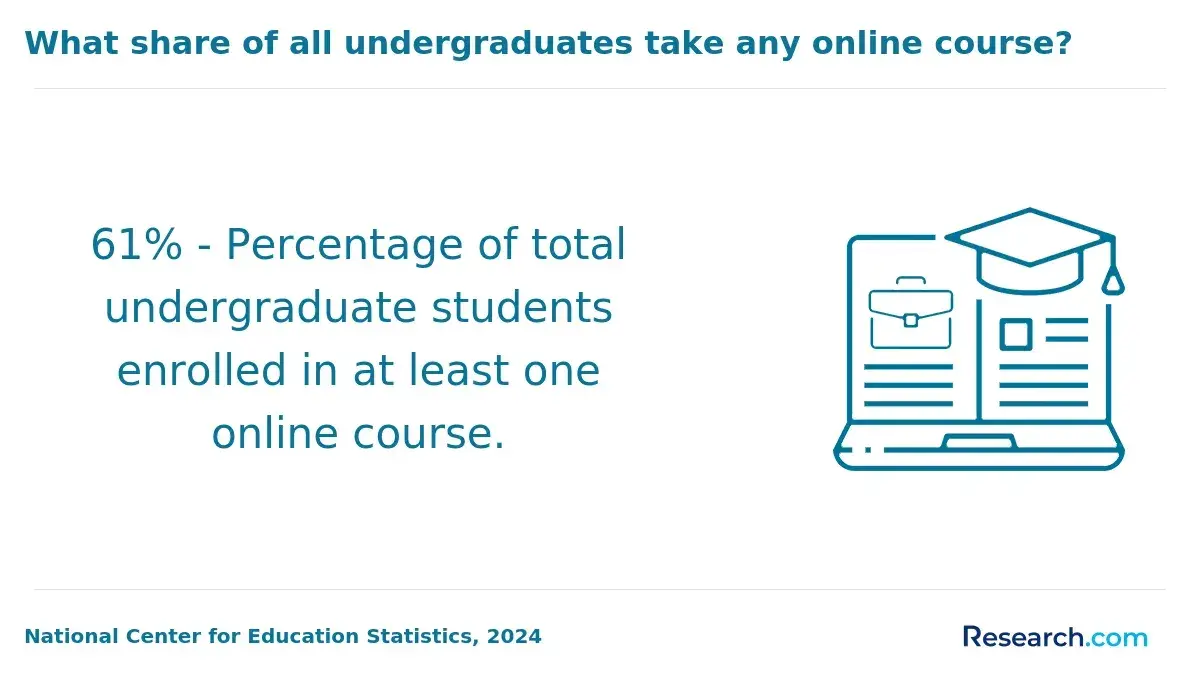
Transfer students often ask a simple question with expensive consequences: will an online industrial organizational psychology degree take 30 credits to finish, or far more? NCES reported in its Condition of Education that 10.2 million U.S. undergraduates took at least one distance education course in fall 2022, reflecting how common online completion pathways have become.
This guide is for students with substantial prior college credit who want to compare 60-, 75-, and 90-credit transfer scenarios, understand what actually applies, and estimate remaining coursework, time, and tuition before enrolling.
Key Things You Should Know
- Most bachelor's programs in industrial organizational psychology require about 120 semester credits, so transferring 60, 75, or 90 applicable credits can leave roughly 60, 45, or 30 credits before graduation.
- A school may accept more credits than it applies to your major, general education, upper-division, or residency requirements; always request a degree audit before enrolling.
- The most transfer-friendly online options often allow up to 75% of the degree to transfer, but major-course rules, minimum grades, accreditation, and course equivalencies determine whether the policy truly saves time and money.
How Many Transfer Credits Can You Apply Toward an Online Industrial Organizational Psychology Degree?
An online industrial organizational psychology degree is usually a bachelor's program in psychology with a concentration, track, or set of electives focused on workplace behavior, employee selection, training, organizational change, motivation, leadership, and research methods. When a program says it accepts 60, 75, or 90 transfer credits, it is describing the maximum number of prior college credits that may count somewhere toward the degree, not a promise that every credit will replace a required course.
The practical question is how many credits remain after the school maps your transcripts to the degree plan. The table below shows how the most common transfer-credit scenarios usually affect a 120-credit bachelor's degree.
| Transfer scenario | Typical credits remaining in a 120-credit degree | What it usually means for I-O psychology students |
| 60 transfer credits | About 60 credits remaining | Often fits students with an associate degree or two years of college, but many upper-division psychology and concentration courses may still be required. |
| 75 transfer credits | About 45 credits remaining | Can shorten the degree if general education and lower-division psychology courses transfer cleanly, but residency rules may still require a set number of credits at the new school. |
| 90 transfer credits | About 30 credits remaining | Usually the fastest completion route on paper, but only if the school accepts those credits into the correct categories and does not require additional major prerequisites. |
The key distinction is accepted credits versus applied credits. Accepted credits appear on your transfer record; applied credits reduce the number of courses you still need for graduation. Applied credits are what matter most for cost, timeline, and whether you can move quickly into graduate study, HR analytics, training, consulting support, or related business roles.
Career expectations also matter. The U.S. Bureau of Labor Statistics reported a 2024 median annual wage of $147,420 for industrial-organizational psychologists, but that occupation typically requires graduate-level education. A bachelor's degree is best viewed as a foundation for entry-level HR, training, recruiting, people analytics support, or future graduate study rather than a direct path to psychologist licensure.
Which Online Industrial Organizational Psychology Degree Programs Accept 60, 75, or 90 Transfer Credits?
Online industrial organizational psychology bachelor's programs are less common than general online psychology degrees, so students often compare psychology degrees with I-O, workplace psychology, business psychology, or organizational behavior concentrations. The programs below are examples of transfer-friendly online options or closely related psychology pathways; policies can change, so use this as a shortlist to verify rather than as a final admissions decision.
| Program or pathway type | Common maximum transfer allowance | Best fit | Important limitation to verify |
| Southern New Hampshire University, online BS in Psychology with industrial-organizational psychology concentration | Up to 90 semester credits | Students seeking a degree-completion format with a clear I-O psychology concentration | Whether previous psychology, statistics, and research courses match the concentration and major requirements |
| Liberty University, online BS in Psychology: Industrial/Organizational Psychology | Up to 75% of the degree, commonly equivalent to 90 credits in a 120-credit bachelor's program | Students who want a clearly labeled I-O psychology bachelor's program and a high transfer ceiling | Residency requirements and limits on how major or upper-level credits transfer |
| Purdue Global, online BS in Psychology in Industrial/Organizational Psychology | Often structured around a 75% maximum transfer-credit policy, depending on program rules and quarter-credit conversion | Students with prior college, military, workplace, or alternative learning credits to evaluate | How semester credits convert to quarter credits and how experiential or alternative credits apply |
| Online psychology degree with workplace, business psychology, HR, or organizational behavior electives | Often 60 to 90 credits, depending on the institution | Students who cannot find a dedicated I-O major but want coursework aligned with HR, training, and organizational development | Whether the transcript will show a concentration, elective cluster, or only a general psychology degree |
A 90-credit transfer maximum is attractive, but it is not automatically better than a 75-credit policy. A program that accepts 75 credits and applies them cleanly to general education, electives, and prerequisites may be faster than a 90-credit program that leaves you with unmet statistics, research methods, capstone, or upper-division psychology requirements.
When comparing programs, look for three things: a published transfer-credit maximum, a curriculum map that shows the I-O psychology concentration requirements, and an official transfer evaluation before you commit. If a school cannot show how your credits apply to a degree plan, the maximum transfer limit is only a marketing number.
How Can You Tell Whether Transfer Credits Will Actually Apply Toward Your Industrial Organizational Psychology Degree?
You can tell whether transfer credits will actually apply by looking beyond the total number accepted and asking how each course fills a requirement. Industrial organizational psychology programs typically include general education, core psychology courses, research methods, statistics, upper-division psychology, I-O concentration courses, electives, and a capstone or senior seminar.
Use this checklist before you assume that 60, 75, or 90 credits will shorten your degree. It focuses on the decision points that most often change a transfer student's remaining course load.
- Request a written transfer credit evaluation or degree audit, not just an admissions estimate.
- Ask which credits apply to general education, free electives, psychology core courses, I-O concentration courses, and upper-division requirements.
- Confirm the minimum grade required for transfer; many schools require at least a C for major courses, while some may accept lower grades only as electives.
- Verify whether statistics, research methods, abnormal psychology, social psychology, or organizational psychology courses must be completed at the new school.
- Ask whether the school limits transfer credit from community colleges, nationally accredited institutions, alternative credit providers, or older coursework.
- Get the final remaining credit count in writing before paying a deposit or registering for classes.
A common mistake is assuming that "90 credits accepted" means "30 credits left." In reality, 90 accepted credits might include several free electives that do not replace the I-O psychology concentration, leaving you with more than 30 credits to complete.
Also remember that accreditation rules vary by field. Psychology bachelor's programs generally depend on institutional accreditation, while fields such as speech-language pathology have discipline-specific standards, as seen in ASHA approved SLP programs. Do not assume rules from one field transfer neatly to another.
What Types of Previous College Credits Can Transfer Into an Online Industrial Organizational Psychology Degree?
Previous college credits can transfer from several sources, but each school decides what it will accept and how it will apply those credits. For I-O psychology students, the most useful transfer credits are usually general education courses, lower-division psychology courses, statistics, research methods, business electives, communication courses, and social science electives.
The following categories commonly appear in transfer evaluations. Their value depends on whether they satisfy required courses or only count as electives.
- Regionally accredited college credits, including community college and four-year university coursework.
- Associate degree credits, especially if the degree includes transferable general education and introductory psychology courses.
- Psychology courses such as introduction to psychology, lifespan development, social psychology, abnormal psychology, statistics, and research methods.
- Business-related courses such as management, human resources, organizational behavior, communication, and leadership.
- Military training evaluated through recognized credit recommendations, when accepted by the institution.
- Exam-based credits such as CLEP, DSST, Advanced Placement, or International Baccalaureate, subject to school policy.
- Prior learning or portfolio credit, especially for adult learners with documented workplace training, HR experience, leadership development, or organizational training responsibilities.
Students starting with an associate degree should check whether it covers the lower-division foundation of the bachelor's degree or simply provides elective credit. If you are still choosing an associate pathway, comparing the best associates degrees to get can help you think about transferability, workload, and long-term degree alignment.
The strongest transfer profile usually combines broad general education completion with courses that match the psychology major. Credits in unrelated subjects may still help, but they are more likely to fill free electives than reduce the I-O concentration.
How Do Residency and Upper-Division Requirements Affect Industrial Organizational Psychology Transfer Students?
Residency requirements are one of the biggest reasons a high transfer-credit maximum may not produce the shortest path to graduation. In bachelor's programs, "residency" usually means the minimum number of credits you must complete through the degree-granting school, even if you already have enough transferable credits from elsewhere.
Upper-division requirements can also affect transfer students. Industrial organizational psychology degrees often require advanced psychology courses, research methods, organizational psychology, personnel psychology, tests and measurements, statistics, or a capstone at the 300- or 400-level.
Here is how these rules commonly affect students who bring in many credits.
- A 30-credit residency rule means a student with 90 transferable credits may still need at least 30 credits at the new institution.
- A major residency rule may require a certain number of psychology or concentration credits to be completed at the school, even if the student has prior psychology coursework.
- An upper-division rule may prevent lower-division community college credits from replacing junior- or senior-level I-O psychology requirements.
- A capstone rule may require the final project, seminar, or internship-style course to be taken through the school granting the degree.
- A minimum GPA rule may require students to earn a certain GPA in major coursework after transfer.
This is why a 75-credit transfer plan can sometimes be cleaner than a 90-credit plan. If 75 credits satisfy general education and prerequisites while leaving a coherent sequence of upper-division I-O psychology courses, the student may avoid excess electives that do not move the degree forward.
How Does the Transfer Credit Evaluation Process Work for an Online Industrial Organizational Psychology Degree?
The transfer credit evaluation process is the formal review that turns your old transcripts into a new degree plan. Admissions staff may give a preliminary estimate, but the decision you need is an official evaluation showing exactly which requirements are satisfied and which courses remain.
Most evaluations follow a predictable sequence. Completing each step carefully reduces the risk of enrolling in a program that accepts credits but does not apply them efficiently.
- Collect official transcripts from every college attended, including institutions where you completed only one or two courses.
- Send transcripts directly to the receiving university according to its admissions instructions.
- Submit test scores, military records, training records, or prior-learning documentation if the school accepts those sources.
- Ask for a program-specific evaluation for the industrial organizational psychology major or concentration, not a general university transfer estimate.
- Review the evaluation line by line and identify credits listed as electives, unassigned psychology credit, or non-equivalent credit.
- Ask whether course descriptions or syllabi can improve the evaluation for psychology, statistics, research, or organizational behavior courses.
- Request a final degree plan that lists remaining courses, total credits, estimated terms, and any required sequence.
One red flag is pressure to enroll before you receive an official audit. Another is a vague statement such as "most of your credits should transfer" without a course-by-course breakdown. Transfer students should make decisions from written degree plans, not verbal estimates.
If your goal is to finish quickly, compare the transfer audit with accelerated psychology options. A guide to a 2-year psychology degree online can help you evaluate pace, workload, and whether accelerated formats fit your schedule.
How Long Does It Take to Finish an Online Industrial Organizational Psychology Degree With 60, 75, or 90 Transfer Credits?
Completion time depends on the number of applied credits, the school's term structure, course availability, and whether you study full time or part time. A 90-credit transfer student may still need longer than expected if required I-O psychology courses are offered in sequence or only during certain terms.
The table below gives a practical planning range for students transferring 60, 75, or 90 credits into a 120-credit bachelor's degree. Actual timelines vary by school, course load, and whether required courses are available every term.
| Applied transfer credits | Approximate credits remaining | Possible full-time timeline | Possible part-time timeline | Timeline risk to watch |
| 60 | 60 | About 2 academic years | About 3 to 4 years | Major prerequisites may delay upper-division psychology courses. |
| 75 | 45 | About 18 months to 2 years | About 2.5 to 3 years | Residency and upper-division rules may require more school-specific courses. |
| 90 | 30 | About 1 year | About 18 months to 2 years | Capstone, research methods, or I-O concentration sequence may prevent a one-year finish. |
Students working full time should be cautious about overloading courses just because only 30 or 45 credits remain. I-O psychology programs often include writing-heavy, research-heavy, and statistics-related courses that require steady weekly time.
Current workplace trends make course selection especially important. Employers increasingly use data tools, employee engagement platforms, and AI-supported talent systems, so students should protect room in their plan for statistics, research methods, ethics, and organizational behavior rather than filling the final credits with unrelated electives.
How Much Can Transfer Credits Reduce the Cost of an Online Industrial Organizational Psychology Degree?
Transfer credits can reduce cost by replacing credits you would otherwise pay to complete at the new institution. The real savings depend on how many credits apply to the degree, the school's per-credit tuition, required fees, books, technology charges, and whether the student remains eligible for financial aid.
Instead of relying on a school's maximum transfer number, calculate cost from the credits remaining after the official audit. The table below shows the cost logic without assuming one universal tuition rate.
| Applied transfer credits | Credits remaining in a 120-credit degree | Tuition calculation to request from the school | Potential cost effect |
| 60 | 60 | 60 × per-credit tuition, plus required fees | Can remove roughly half of the degree's credit-based tuition if all 60 credits apply. |
| 75 | 45 | 45 × per-credit tuition, plus required fees | Can reduce the remaining bill further, but residency rules may set a tuition floor. |
| 90 | 30 | 30 × per-credit tuition, plus required fees | Usually offers the lowest credit-based tuition exposure, but only when all 90 credits apply to the degree plan. |
A useful current benchmark is federal aid capacity: the maximum Federal Pell Grant for the 2024-25 award year was $7,395. That does not determine your program cost, but it shows why reducing remaining credits matters; fewer required credits can make grants, employer tuition assistance, payment plans, or savings stretch further.
When comparing programs, ask for a full remaining-cost estimate, not just tuition per credit. Include transcript fees, transfer evaluation fees, technology fees, books, graduation fees, and any required assessment or portfolio fees for prior learning.
Students comparing affordability across fields can learn from cost-focused program searches such as the cheapest SLP master's programs: the lowest sticker price is not always the lowest total cost if transfer credit, required placements, fees, or completion time differ.
Can Prior Learning, Military Training, Exams, or Certifications Count Toward an Online Industrial Organizational Psychology Degree?
Many online degree-completion programs accept more than traditional college transcripts. Prior learning, military training, exams, and professional certifications may count, but they are usually subject to limits and may apply as electives rather than major requirements.
These credit sources are worth investigating if you are close to the 60-, 75-, or 90-credit threshold. They can be especially useful for adult learners with HR, management, training, military leadership, or workplace learning experience.
- Prior learning assessment: Some schools let students submit portfolios that document college-level learning from work, training, leadership, or professional development.
- Military training: Institutions may review Joint Services Transcript or Community College of the Air Force credits and apply approved coursework where it fits.
- CLEP and DSST exams: Exams may satisfy general education or elective requirements, depending on the school's score thresholds and credit limits.
- Advanced Placement or International Baccalaureate: High school exam credit may still count if the receiving institution accepts the scores and they appear on official records.
- Professional certifications: Some business, HR, training, or technology credentials may receive elective credit if the school has an approved credit recommendation or internal review process.
The main caution is that alternative credit may not replace upper-division psychology or I-O concentration courses. A certification in leadership training, for example, might help with electives but may not replace research methods, statistics, personnel psychology, or a capstone.
Alternative credit policies also vary widely by discipline. For example, career-focused pathways such as hospitality management courses online may evaluate applied training differently than a psychology program that emphasizes research methods and behavioral science.
Do Older College Credits Expire When Transferring Into an Online Industrial Organizational Psychology Degree?
Older college credits do not automatically expire, but they may be reviewed differently depending on the subject. General education credits such as English composition, history, humanities, and many social science courses often remain transferable for many years. Courses tied to current methods, technology, statistics, research design, or professional practice may receive closer review.
For industrial organizational psychology students, older credits are most likely to raise questions when they involve statistics, research methods, psychological testing, data analysis, business technology, or workplace analytics. This matters because modern I-O work increasingly overlaps with people analytics, employee data, AI-supported HR tools, and evidence-based decision-making.
If your credits are more than several years old, take these steps before ruling them out or assuming they will count.
- Ask whether the school has expiration rules for psychology, statistics, research methods, or business technology courses.
- Provide old syllabi, catalog descriptions, or course outlines if the evaluator cannot determine equivalency from the transcript alone.
- Ask whether an older course can apply as an elective if it cannot satisfy a major requirement.
- Find out whether retaking statistics or research methods would improve readiness for upper-division I-O psychology coursework or graduate school.
- Confirm whether graduate programs you may apply to later expect recent statistics, research, or psychology prerequisites.
The best approach is practical rather than emotional: older credits are valuable if they reduce required coursework without weakening your preparation. If retaking one course improves your ability to succeed in advanced research or analytics courses, it may be worth the time even if an older version technically transfers.
Other Things You Should Know About Industrial Organizational Psychology
Yes, it may be possible. Schools usually evaluate individual courses, not just completed degrees. However, an associate degree can make general education transfer cleaner, especially when the sending and receiving schools have articulation agreements.
Usually, transfer credits count toward degree requirements but do not calculate into the new institution's GPA. Policies vary, so ask whether transferred grades affect major GPA, honors eligibility, financial aid progress, or admission to selective concentration courses.
No. Human resources focuses on employment practices, benefits, compliance, recruiting, and workforce administration. Industrial organizational psychology applies psychological research to workplace behavior, assessment, motivation, leadership, training, and organizational effectiveness. The two areas overlap, especially in talent development and employee selection.
Not automatically. Choose the school that applies the most credits to your actual degree requirements, offers the courses you need on a workable schedule, has proper institutional accreditation, and provides a clear remaining-cost estimate before enrollment.
References
- Masters in Psychology Program | Masters in Psychology Degree | University of Phoenix https://www.phoenix.edu/online-psychology-degrees/industrial-organizational-psychology-masters-degree.html
- I/O Psychology | Online MA in Psychology | TUW https://www.tuw.edu/academics/business/industrial-organizational-psychology-graduate-programs/
- Inside Online Master’s Programs in Organizational Psychology https://www.onlinemastersdegrees.org/best-programs/psychology/organizational-psychology/