2027 Online Ed.D. in Leadership and Learning in Organizations: Evaluating Research Preparation for Working with an Organization's Legal Review Process
Audited and Verified:
Our Editorial and Data Verification Process
Research.com uses government datasets, official education statistics and primary institutional information to support its career and degree guides. Our review process checks factual accuracy, occupational definitions, source dates and the requirements associated with the credentials discussed.
How This Article Was Fact-Checked
Our editorial team verifies salary estimates, employment projections, education requirements and program information against original data providers and official organizations. Salary figures are checked against the relevant occupational definitions and reporting periods. Information about licensure, accreditation and required in-person training is reviewed separately.
Fact-checked and verified on:

Co-Founder and Chief Data Scientist
A promising workplace research project can stall when an employer's legal team asks who authorized the data, whether employees can be identified, and what the university intends to publish. For working leaders considering an online Ed.D. in Leadership and Learning in Organizations, research preparation matters only if it helps them anticipate those questions without confusing academic approval with organizational permission. This guide explains the methods and review skills to look for, how to test a program's support before enrolling, and when a shorter course or supervised project may be enough.
Key Things You Should Know
- An Ed.D. can teach defensible research design and ethical data handling, but it cannot grant access to an employer's records or replace the organization's legal review.
- Look for methods courses and faculty guidance that address consent, data minimization, confidentiality, publication limits, and redesigning a project when access is denied.
- Before committing to a program, confirm its project requirements and ask your organization which approvals are needed before recruitment, data collection, or transfer.
What is an online Ed.D. in Leadership and Learning in Organizations?
It is a practice-oriented doctorate focused on how people learn, lead, and improve organizations. Programs with related names may combine adult learning, organizational change, leadership, and applied inquiry. "Online" describes where much of the instruction occurs; it does not establish that classes are self-paced or that the final project can use workplace data without approval.
For this decision, the distinction from a research-focused PhD is practical rather than absolute: an Ed.D. may emphasize investigating a problem of practice, while a PhD may place greater weight on producing broadly applicable scholarship. Neither degree overrides an employer's rules. Check the actual curriculum and final deliverable rather than relying on the degree label.
How does an Ed.D. prepare professionals for organizational legal review processes?
The most useful preparation is learning to make a proposed study reviewable: state the organizational decision it informs, identify whose information it needs, justify each data element, and describe who will see the findings. An Ed.D. is not legal training. Organizational counsel or other authorized reviewers determine what the employer permits under its policies, contracts, and applicable law.
Consider a hypothetical leader evaluating whether a new supervisor-development program improves coaching practices. Surveying participants, reviewing personnel records, and interviewing their direct reports create different risks. A sound proposal would distinguish voluntary feedback from employment records, avoid treating a pre/post change as proof that training caused it, and offer a narrower design if identifiable records cannot be released.
Several decisions may run in parallel. Faculty approve academic scope; the university's institutional review board or other designated office determines whether and how its human-subjects rules apply; the organization decides whether staff time, systems, records, and recruitment channels may be used. Counsel may also examine privacy, employment, contracts, intellectual property, and disclosure. An employer's permission does not substitute for university review, and university approval does not compel employer participation. Neither should be presumed automatic for an internal evaluation.
To judge a program's preparation, ask for a sample project-approval sequence and find out who helps students revise a design after organizational review. The strongest support teaches students to prepare a plain-language protocol, data-flow description, retention plan, and reporting boundaries before requesting access - not merely to add a confidentiality sentence to a finished proposal. Legal review timelines can become the project's critical path, so an academically acceptable backup question using authorized, less-sensitive evidence is valuable.
What research methods are taught in an organizational leadership Ed.D.?
Methods offerings vary. For work likely to receive legal review, evaluate whether students learn to match a question to a feasible design rather than simply use a particular statistical package. Quantitative preparation may cover surveys, measurement, sampling, missing data, and cautious interpretation of comparisons. Qualitative preparation may cover interview protocols, recruitment, consent, researcher bias, and protecting identities in small teams. Mixed-methods work should explain how the two forms of evidence will be integrated.
Program evaluation and improvement methods are especially relevant when a leader needs to decide whether to continue or revise an initiative. A before-and-after comparison can inform that decision, but staff turnover, selection into training, and other changes limit causal claims. Interviews may explain implementation problems, but quotations can identify an employee even after names are removed.
Ask whether assignments require students to defend their measures and access plan using the data they can actually obtain. Aggregated counts, deidentified extracts, and identifiable records are not interchangeable: small groups can sometimes be reidentified, and removing names does not itself settle consent, contractual, or institutional-review questions.
Delivery format changes how a working leader collaborates, not who controls organizational data. Online students may be able to study without relocating, but live seminars, team meetings, residencies, and advisor appointments can still constrain a legal-review schedule. Campus-based programs may offer easier in-person collaboration; they do not automatically provide faster employer approval or better access to a project site.
Compare the published attendance and project milestones against your employer's review calendar. If approval is delayed, ask whether the program allows a revised question, another authorized site, or a different source of evidence without derailing progression. For broader scheduling context, comparing Ed.D. completion timelines can help frame questions, but verify the specific program's deadlines and extension rules.
Course names differ, but a relevant curriculum may include adult learning, organizational change, leadership, research design, qualitative and quantitative methods, program evaluation, and a supervised capstone or dissertation in practice. The deciding issue is whether those courses connect learning theory to an approvable organizational inquiry.
Read syllabi or assignment descriptions where available. A methods sequence is more useful for legal-review preparation if students practice defining participants, limiting data collection, explaining confidentiality risks, and writing conclusions that respect both evidentiary limits and disclosure restrictions. A general "ethics" course alone does not establish that students receive feedback on workplace data agreements or employer-facing proposals. Confirm whether faculty, a project office, or the student is responsible for coordinating those issues.
Requirements are program-specific. Schools may ask for prior graduate study, transcripts, professional experience, recommendations, a statement of purpose, or evidence that an applicant can pursue applied inquiry. An education degree, publication record, or employer-endorsed project should not be assumed necessary unless the program says so.
For this topic, describe a real leadership or learning problem and the decisions you are authorized to influence. Do not claim access to employee data or legal approval that you have not obtained. Ask admissions whether a project site must be secured at entry and whether prior graduate credits affect admission only or can also satisfy degree requirements. Applicants with an Ed.S. can separately examine schools offering online Ed.S.-to-Ed.D. routes; credit application still requires an individual school evaluation.
Both depend on the program's required credits, enrollment pattern, tuition basis, fees, and final-project rules. Legal review can also affect time: a delayed data-use decision may postpone recruitment or force a redesign, even if coursework is on schedule. Request the program's published completion milestones and policies for project changes, leaves, and continued enrollment.
Build a budget that separates tuition from fees, required travel, technology, and any continuing-registration charges. Then check employer reimbursement caps and whether support continues if you change jobs or your project takes longer than planned. Online Ed.D. fees and cost comparisons are a starting point, not a substitute for an entry-term estimate from each school. If your immediate goal is to submit one defensible evaluation proposal, targeted methods training may cost less than a doctorate.
Experienced learning-and-development professionals may use applied research skills in training management, organizational development, evaluation, or consulting. The work can involve defining performance problems, assessing programs, negotiating access with stakeholders, and explaining findings without exposing confidential information. Senior roles also require demonstrated management and sector experience; the doctorate alone does not qualify someone to lead a department.
In higher education, organizational research may support staff development or institutional initiatives. Readers targeting that sector can compare online organizational leadership Ed.D. choices for college leaders against the responsibilities of their intended role. A broadly focused Ed.D. should not be mistaken for a state-approved educator-licensure program.
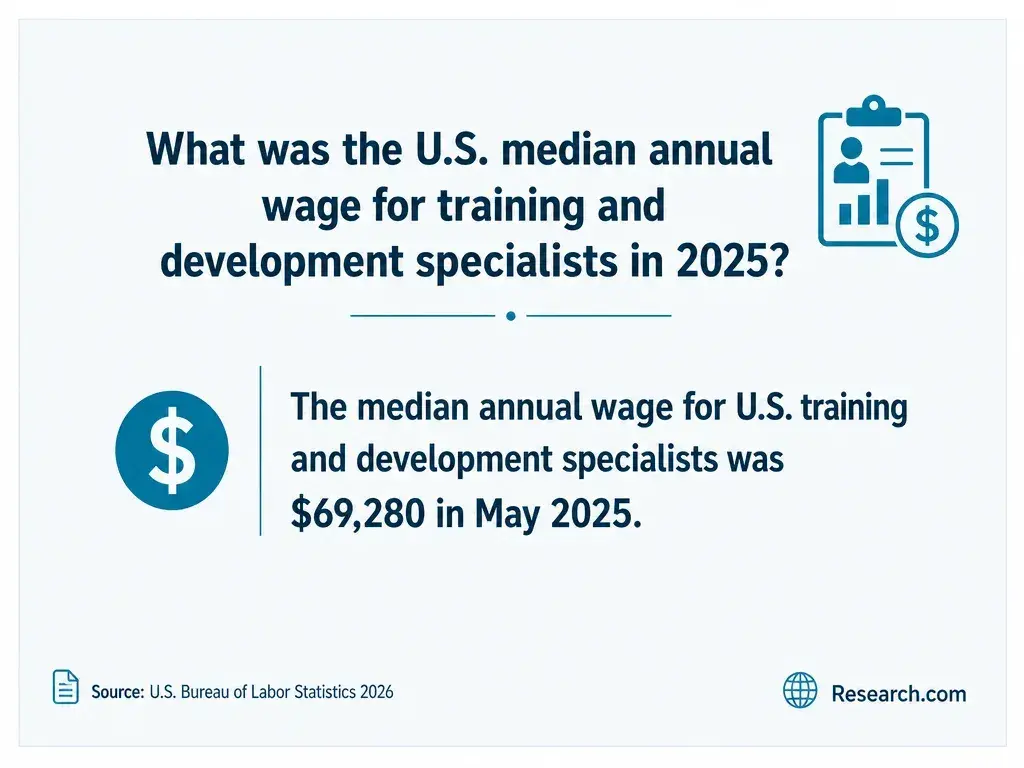
The U.S. Bureau of Labor Statistics reports a May 2025 median annual salary of $133,000 for training and development managers and projects 6.4% employment growth for that occupation from 2025 to 2035. These are occupation-wide figures, not salaries or placement results for Ed.D. graduates. They are most useful if you already have, or can build, the management experience the role requires.
For a realistic decision, compare openings and pay for your target job in your location and sector with your current trajectory. An Ed.D. may strengthen your ability to lead evidence-based learning work, but an employer may value a record of approved, completed projects more than the degree alone.
How can you choose an accredited online Ed.D. program?
First, verify the institution's accreditation and the exact degree it awards through the institution and its recognized accreditor. Then evaluate the program against the review process you will actually face. The following questions are worth putting to a program director or project coordinator; request written policies or examples where available.
- What final project is required, and when must the student obtain site, faculty, and institutional-review decisions?
- Who advises students on consent, restricted data, data-use terms, and reports an organization will not permit them to publish publicly?
- What happens academically if counsel rejects a data source, a partner withdraws, or approval arrives after the planned collection period?
- Which live meetings, campus visits, and continuing-enrollment requirements could affect a revised project timeline?
Compare answers from programs rather than treating accreditation as proof of specialized research support. If cost is a constraint, lower-cost online education doctoral programs may broaden your shortlist; confirm that any candidate actually teaches organizational inquiry and supports the kind of review your workplace requires. Choose the doctorate only if its sustained leadership and research training serves a larger goal than securing approval for a single study.
Other Things You Should Know About EdD Leadership
Only if the organization and program permit the specific material. Obtain approval for a redacted or synthetic description rather than assuming that removing names makes results shareable.
Not necessarily, but it may restrict data access and what you can submit or publish. Ask the program and the organization to resolve those constraints before committing to the site.
Do not upload restricted information without authorization. Check your organization's tool, vendor, retention, and data-use rules, along with university requirements, even when you intend only to summarize or code material.
Access and permission may end with your employment. Ask your advisor about a documented transition plan, including whether already collected data may still be used or the project must be rescoped.
- How to obtain informed consent for research - PMC - NIH https://pmc.ncbi.nlm.nih.gov/articles/PMC5980471/
- | Protecting Student Privacy - Department of Education https://studentprivacy.ed.gov/
- Informed Consent FAQs | hhs.gov https://www.hhs.gov/ohrp/regulations-and-policy/guidance/faq/informed-consent/index.html
- IRBs | ORI https://ori.hhs.gov/content/chapter-3-The-Protection-of-Human-Subjects-IRBs
- Institutional Review Boards Frequently Asked Questions | fda.gov https://www.fda.gov/regulatory-information/search-fda-guidance-documents/institutional-review-boards-frequently-asked-questions
- NIH Data Use Certification Agreement | Grants & Funding https://grants.nih.gov/policy-and-compliance/policy-topics/sharing-policies/accessing-data/certification-agreement
- What is the Institutional Review Board (IRB)? | Oregon State University https://research.oregonstate.edu/ori/irb/what-institutional-review-board-irb
- Electronic Data Security | Human Research Protection Program (HRPP) https://irb.ucsf.edu/electronic-data-security
- Data Use Agreements - Office of Research and Innovation | Research Administration and Compliance https://research.ncsu.edu/administration/data-use-agreements/
- Informed Consent - Qualitative Data Repository | QDR https://qdr.syr.edu/node/20544