2027 Online Ed.D. in Leadership and Learning in Organizations: Evaluating Research Preparation for Choosing Public Data When Internal Data Is Unavailable
Audited and Verified:
Our Editorial and Data Verification Process
Research.com uses government datasets, official education statistics and primary institutional information to support its career and degree guides. Our review process checks factual accuracy, occupational definitions, source dates and the requirements associated with the credentials discussed.
How This Article Was Fact-Checked
Our editorial team verifies salary estimates, employment projections, education requirements and program information against original data providers and official organizations. Salary figures are checked against the relevant occupational definitions and reporting periods. Information about licensure, accreditation and required in-person training is reviewed separately.
Fact-checked and verified on:

Co-Founder and Chief Data Scientist
An organizational research question may be worth pursuing even when your employer cannot release employee, learner, or performance records. The harder decision is whether public data can answer the question and whether an online Ed.D. will teach you to recognize when it cannot.
For working leaders and research-oriented applicants, this guide explains how to evaluate a program's methods training, project rules, and faculty support. It also shows how to scope a defensible public-data study before committing to a doctoral pathway.
Key Things You Should Know
- Public data can establish a labor-market, community, or institutional benchmark; it usually cannot reveal whether an intervention worked inside your organization.
- Favor Ed.D. programs that teach source selection, measurement, missing-data analysis, ethical review, and interpretation, not just statistics software.
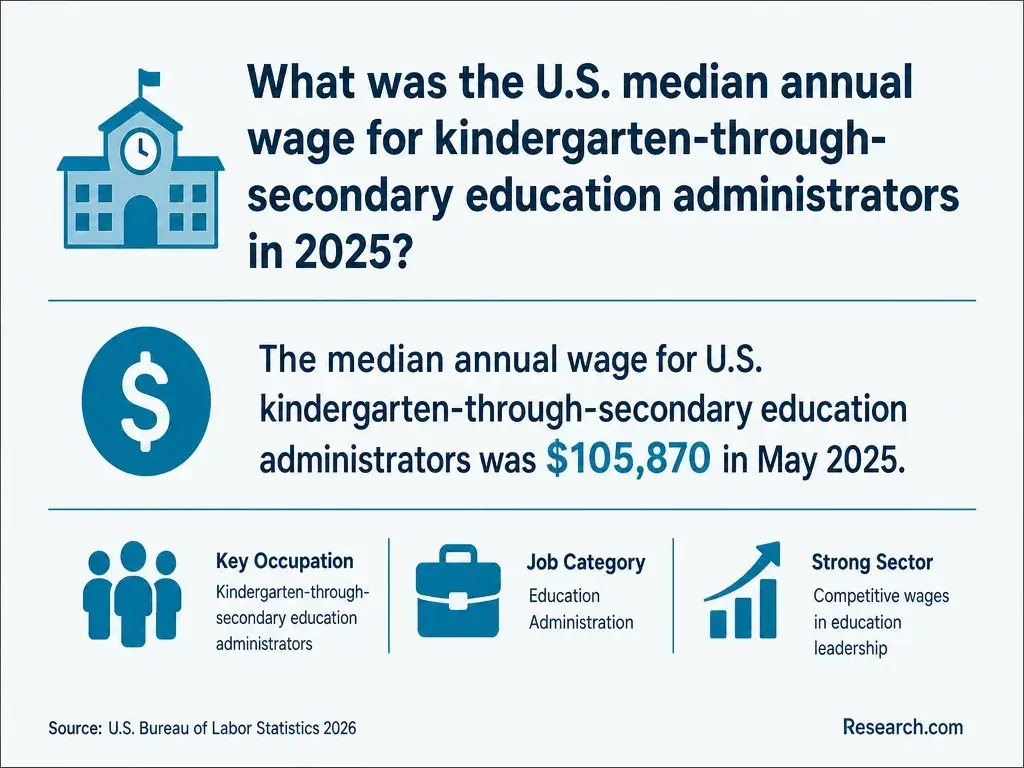
- The Bureau of Labor Statistics reports a $133,000 median annual salary for training and development managers in 2025, but that occupational figure is not an expected Ed.D. graduate salary.
What Is an Online Ed.D. in Leadership and Learning in Organizations?
An online Doctor of Education in leadership and learning is a practice-oriented doctorate concerned with how organizations develop people, make decisions, and implement change.
Depending on the university, students may study adult learning, leadership, organizational improvement, and applied research. The exact degree title, curriculum, and culminating project vary. "Online" describes delivery, not a common set of academic requirements.
For someone investigating a workplace learning problem, the useful distinction is between learning to use evidence for a practical decision and pursuing a PhD primarily to develop research expertise for scholarly work.
Neither credential automatically supplies access to organizational records. Compare the actual courses and project requirements, rather than assuming similarly named types of Ed.D. programs and concentrations provide equivalent methods preparation.
How Does an Ed.D. Prepare Leaders to Use Public Data When Internal Data Is Unavailable?
A well-designed Ed.D. should teach you to start with the decision, not the dataset. Suppose a workforce-development leader wants to decide which training to offer locally but cannot obtain employee skill assessments.
Public labor-market data could help identify regional occupations and employer demand. It could not establish which current employees need training or whether the proposed course improves their performance.
Public sources serve different purposes. This comparison shows where an external dataset may help and where a conclusion would overreach.
| Public source | Potential use | Important limit |
| BLS occupational and employment data | Describe occupations, pay, or broader labor-market conditions | Cannot measure an employer's workforce or training outcomes |
| Census community data | Describe a service area's population or economic context | Area averages may not represent participants |
| Public education datasets, such as NCES or IPEDS releases | Compare published institutional or education indicators | Definitions, reporting periods, and available units may not match a local program |
Before adopting a source, a student should be able to complete this sequence. Each step tests whether the available evidence can support the proposed claim.
- Write the decision and question separately: "Which program should we consider?" is not the same as "Did our program cause improvement?"
- Match the dataset's population, geography, unit of analysis, measures, and reporting period to the question.
- Check definitions, missing or suppressed values, sampling uncertainty, and whether results can be reproduced from the published files.
- State what remains unknown about the organization; narrow the question or seek authorized local evidence if the gap is decisive.
A public-data project might produce a defensible needs-assessment context or comparison benchmark. It should not be presented as an evaluation of internal impact without appropriate internal evidence.
Ask the program whether its culminating requirement permits an external-data question; Ed.D. programs emphasizing applied culminating work can differ substantially in acceptable projects. Public availability also does not settle every ethics question: confirm institutional review procedures, source terms, and any restrictions before combining public records with organizational information.
What Research Methods and Data Analysis Courses Do Online Ed.D. Programs Include?
Course titles commonly include research design, qualitative and quantitative methods, statistics, and program evaluation, but titles do not establish depth.
For a public-data project, inspect syllabi and assignments for practice defining a population, assessing measure validity, interpreting uncertainty, handling missing data, and communicating limitations to decision-makers. A course devoted to running software commands is insufficient if students never assess whether the data answer the question.
Qualitative or mixed-methods preparation matters too. For example, public documents may reveal how a policy is described, while authorized interviews may help explain implementation; neither should be treated as direct evidence of employee experience without an appropriate design.
Ask whether faculty supervise secondary-data projects, what analytic support students receive, and whether the program teaches students to distinguish descriptive comparisons from causal claims. Previous exposure to statistics can help, but the relevant test is whether the course sequence supports your proposed question.
Employer Confidence in Online vs. In-Person Degree Skills, Global 2024

The important comparison is access to research guidance, not simply where lectures occur. An online student can analyze public datasets remotely, but may still need scheduled faculty consultations, live methods classes, team meetings, or campus convenings.
A campus-based student may find informal collaboration easier, while facing commuting and scheduling constraints. Neither format guarantees a suitable advisor or approval for an external-data project.
Request a sample course schedule and ask how students obtain feedback on dataset selection, analysis plans, and project revisions. If you work full time, check attendance rules and the timing of group work.
If you may change employers during study, ask whether a public-data project can remain viable without a workplace sponsor; the answer depends on the program's project rules, not its delivery format.
Verify that the institution holds recognized institutional accreditation and that its status covers the institution awarding the degree. Check the accreditor's and university's official records for your intended enrollment period. Do not assume that institutional accreditation confirms a particular Ed.D. concentration, research method, or project arrangement.
If your goal involves a regulated education position, separately check the program's licensure disclosures and the relevant state authority. A general leadership and learning Ed.D. does not automatically qualify a graduate for principal, superintendent, or teacher licensure.
For this article's central decision, accreditation is a baseline check; the stronger differentiator is documented methods training and permission to complete an appropriate public-data project.
Requirements differ by institution and entry term. Programs may evaluate prior graduate education, academic records, professional experience, recommendations, and a statement of purpose; some also require an interview or other materials.
Verify the actual rules with admissions rather than assuming an education master's degree, publication record, or particular statistics course is universally required.
An applicant without internal-data access can still show research readiness. Describe a real organizational decision, the public source you might use, the limits of that source, and how you would revise the question if the evidence proves inadequate. This demonstrates judgment without claiming permission or findings you do not have.
Returning doctoral learners should also obtain a written assessment of eligibility and transfer credit. Ed.D. completion pathways after unfinished doctoral study have distinct admissions and progression rules, and prior credits do not automatically shorten a new degree.
Time and total cost depend on required credits, enrollment pace, tuition and fees, project milestones, and any travel or residency obligations.
Public datasets may be free to obtain, but using them does not eliminate tuition, analysis time, faculty review, or possible costs for software and travel. A project may also take longer if a dataset lacks the needed measures and the question must be redesigned.
Ask each program for its current degree plan, tuition basis, mandatory fees, expected project sequence, and continuation charges if the project extends beyond coursework.
Then compare those figures with your employer's written reimbursement terms and the time you can realistically devote to research. An organizational leadership doctorate cost and program value comparison is most useful when it accounts for the complete path to graduation, not advertised tuition alone.
Experienced learning and development professionals may use doctoral research preparation in program evaluation, training leadership, or organizational development. Leaders in government, nonprofits, healthcare, and education may apply it to workforce planning and improvement decisions.
These are experience-dependent paths: employers also assess sector knowledge, implementation results, management responsibility, and the ability to explain evidence to stakeholders.
A public-data project can strengthen a portfolio when it clearly documents the question, source selection, analysis, and limits of the conclusions. It is less persuasive if framed as proof of organizational impact that was never measured.
If your immediate goal is to learn one dataset or evaluation technique rather than lead sustained organizational inquiry, targeted methods training or a supervised work project may be more direct than a doctorate.
Salary depends on occupation, experience, sector, location, and employer, not the degree alone. The Bureau of Labor Statistics reports a $133,000 median annual salary for training and development managers in 2025. That is a median for people working in the occupation, not a starting offer or an estimate of what online Ed.D. graduates earn.
For a financial decision, compare your current role with positions you are realistically qualified to pursue, then weigh verified program costs against employer support and other career benefits. Public-sector pay structures and hiring rules may differ from private-sector opportunities.
If funding is central to the decision, investigate higher education leadership doctoral scholarships alongside the actual aid and eligibility terms at each school; do not assume an award or promotion will offset the cost.
What Job Outlook and Certifications Apply to Ed.D. Leadership Careers?
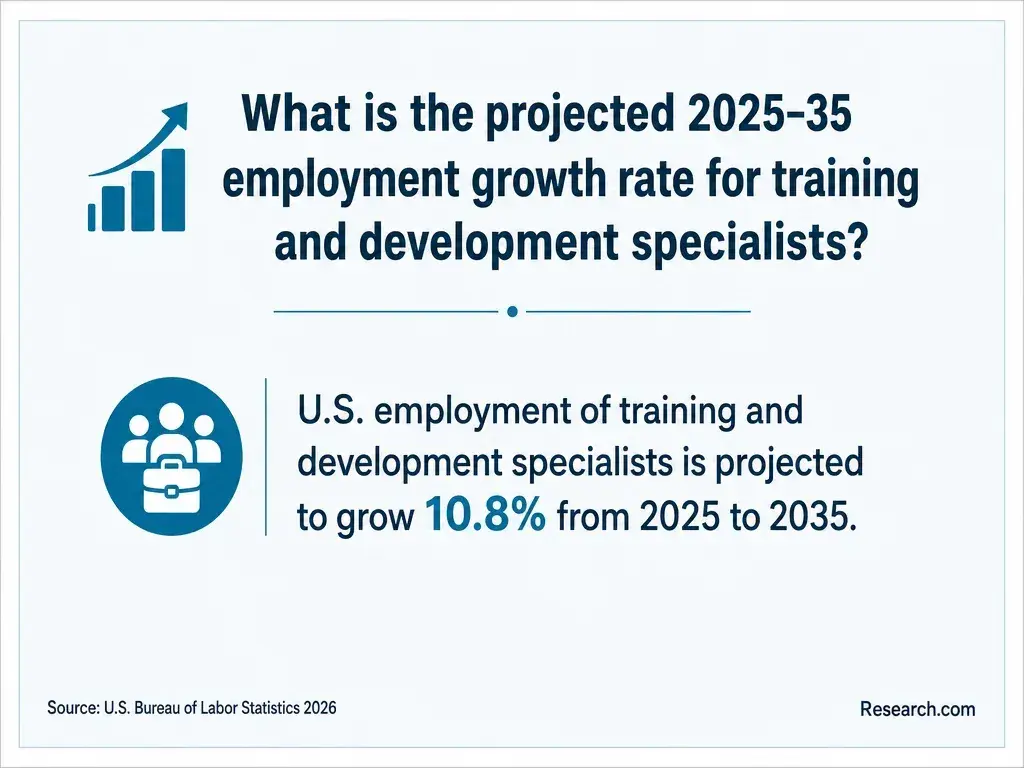
The Bureau of Labor Statistics projects 10.8% employment growth for training and development specialists from 2025 to 2035. That indicates demand for an occupation, not demand specifically for doctorate holders. Management, consulting, and education roles have different outlooks and hiring standards, so evaluate the occupation that matches your experience and target work.
Professional certifications in learning, human resources, coaching, or project management may help with a specific role, but they are separate from an Ed.D. and should be assessed against employer requirements.
Likewise, educator and school-administrator licenses follow applicable state rules. Before enrolling for career advancement, review representative job postings and ask whether employers value applied evaluation experience, the doctorate, a particular certification, or a combination.
Other Things You Should Know About EdD Leadership Programs
Synthetic data can help demonstrate an analysis procedure, but it cannot establish what happened to real employees. Ask the program whether a methods demonstration satisfies its culminating-project requirements.
Record the dataset version, retrieval date, definitions, and analysis decisions. Discuss substantive revisions with your advisor before changing an approved question or reporting new results.
Not without checking authorization and privacy obligations. Linking datasets can make individuals identifiable even when the public file alone does not identify them.
Check the source's use terms and your program's publication rules. Describe the methods and limitations accurately, and remove any restricted organizational information incorporated into the work.
- Frequently asked questions about providing public access to data | IES https://nces.ed.gov/about/public-access-research/frequently-asked-questions-about-providing-public-access-to-data
- Social Data: Biases, Methodological Pitfalls, and Ethical Boundaries - PMC https://pmc.ncbi.nlm.nih.gov/articles/PMC7931947/
- Instructional Leadership, Doctor of Education | St. John's University https://www.stjohns.edu/academics/programs/instructional-leadership-doctor-education
- 2026 UNC Online EdD in Organizational Learning & Leadership https://online.unc.edu/online-doctoral-programs/online-edd-organizational-learning-and-leadership/
- Submitting a Protocol for Secondary Data | Columbia University https://www.tc.columbia.edu/institutional-review-board/guides--resources/submitting-a-protocol-for-secondary-data/
- Data & Statistical Sources: Evaluating Data Sources - LibGuides https://libguides.rio.edu/data/evaluating
- Guidance on Secondary Analysis of Existing Data Sets | University of Connecticut https://ovpr.uconn.edu/services/rics/irb/researcher-guide/secondary-analysis-of-data-sets/
- Online Ed.D. in Leadership and Learning in Organizations | VU-EDU https://peabodyonline.vanderbilt.edu/edd-in-organizational-learning/
- Doctor of Education in Leadership and Learning in Organizations | Vanderbilt University https://www.vanderbilt.edu/online-learning/program/edd-in-organizational-learning/
- Leadership and Learning in Organizations Online Ed.D. | Peabody College of Education and Human Development https://peabody.vanderbilt.edu/academics/edd-programs/online-leadership-learning-organizations/