2027 Online Ed.D. in Leadership and Learning in Organizations Admissions: Updating an Application After a Promotion
Audited and Verified:
Our Editorial and Data Verification Process
Research.com uses government datasets, official education statistics and primary institutional information to support its career and degree guides. Our review process checks factual accuracy, occupational definitions, source dates and the requirements associated with the credentials discussed.
How This Article Was Fact-Checked
Our editorial team verifies salary estimates, employment projections, education requirements and program information against original data providers and official organizations. Salary figures are checked against the relevant occupational definitions and reporting periods. Information about licensure, accreditation and required in-person training is reviewed separately.
Fact-checked and verified on:

Co-Founder and Chief Data Scientist
A promotion can strengthen an online Ed.D. application - but only if the admissions office accepts updates and the new role adds evidence relevant to the program. If you have applied, are about to submit, or are awaiting a decision, the immediate task is to report the change accurately without disrupting your application.
This guide explains whom to contact, what to revise, and how to distinguish a new title from demonstrated leadership. It also covers the program requirements and study commitments worth checking before you decide whether the promotion makes doctoral study more feasible - or harder to manage.
Key Things You Should Know
- Contact the program's admissions office before uploading replacements: its deadline and application system determine whether a promotion can be considered.
- Describe confirmed responsibilities and decisions, not anticipated results; a stronger title alone does not establish doctoral readiness.
- A promotion can change your study schedule and employer support. Verify both before committing to an online program, even if admission is offered.
What is an online Ed.D. in Leadership and Learning in Organizations?
It is a practice-oriented education doctorate focused on how people learn, lead, and implement change within organizations. Programs with this or a similar name may draw students from business, education, healthcare, government, and nonprofits. The exact degree title, curriculum, online format, and final project depend on the institution.
For a newly promoted applicant, the fit is strongest when the role involves a substantive learning or organizational problem - such as developing managers or evaluating workforce training - and the applicant wants to investigate and improve practice. A promotion alone is not a reason to pursue a doctorate; mentorship or a focused leadership program may better serve an immediate skill gap.
How can you update an Ed.D. application after receiving a promotion?
Ask admissions what updates it accepts, then submit a brief, verifiable account through the approved channel. Do not assume an edited résumé in your applicant portal will replace materials already sent to reviewers. Policies can differ before submission, after the deadline, and once a decision has been issued.
Use this sequence to keep the update timely and consistent with your application:
- Confirm the effective date, official title, reporting relationships, and responsibilities with your employer; distinguish a completed promotion from an offer or acting assignment.
- Check the applicant portal and ask admissions whether it accepts a revised résumé, a short addendum, or neither at your current review stage.
- If invited to update, provide your application identifier, the effective date, and a concise description of the new scope; follow the specified file and submission rules.
- Ask whether other materials need revision, and retain the admissions office's instructions and confirmation for your records.
If the change occurs after a deadline, the school may keep the original application intact or decline supplementary materials. A respectful notification is still reasonable, but do not claim that the committee will review it. If admitted, report a significant employment change through any required enrollment process, especially if it affects employer funding or a proposed workplace project.
What are the admission requirements for an online organizational leadership Ed.D.?
Requirements vary by program and entry term. Schools may ask for a qualifying prior degree and transcripts, professional experience, recommendations, a statement of purpose, a résumé, and an interview. Minimum grades, graduate-credit rules, test policies, and deadlines require confirmation with the specific program. A promotion does not waive a formal requirement, while an applicant without a senior title may still have substantial qualifying leadership experience.
Applicants with an education specialist degree should ask separately whether that credential supports admission and whether any credits can apply to the doctorate; those are different decisions. A guide to doctoral progression after an education specialist degree can help frame the questions, but the receiving institution must evaluate the transcripts.
Competitive evidence is more specific than eligibility. Admissions readers need to understand the decisions you have made, the people or processes you have led, and why doctoral study is useful for a problem you can investigate responsibly. If your promotion is too recent to show outcomes, explain the scope of your new authority without inventing accomplishments.
A useful update connects the new position to the application's existing account of your work. It should clarify what changed, why the change matters, and which claims you can already support. Consider these distinctions when an admissions office permits revisions:
- Résumé: Add the official title, effective date, and confirmed responsibilities. Separate results achieved in your previous role from initiatives you will lead in the new one.
- Statement or addendum: Explain how the role sharpens a leadership or organizational-learning question. Describe a feasible area of inquiry, not a predetermined finding or a promise that your employer will provide data.
- Recommendation: Ask whether a replacement or additional letter is permitted before approaching a supervisor. A recommender who can describe your decisions and judgment may be more useful than one who knows only your new title.
For example, a move from training manager to director of workforce development may give an applicant broader responsibility for learning strategy and evaluation. It does not, by itself, establish that a new training initiative improved performance. Keep any proposed workplace inquiry conditional on organizational permission, data access, and the program's academic approval.
Verify that the university holds recognized institutional accreditation and that the Ed.D. is an actual degree it awards. Check the institution's accreditation disclosure and the accreditor's directory, including whether the status applies to the institution and location offering the online program. Ask the school about any additional approval relevant to your intended profession; do not infer program-specific recognition from a university's general accreditation.
This check matters after a promotion because employer tuition policies may specify eligible institutions or degrees. Get your employer's rules in writing before relying on reimbursement. Accreditation also does not establish that a broadly focused leadership Ed.D. prepares graduates for a regulated school-administrator license.
Depending on the program, study may connect adult learning, organizational change, leadership practice, research methods, and evaluation. For a newly promoted leader, the most relevant question is whether coursework helps with responsibilities the role actually carries - for example, diagnosing a learning problem before prescribing training or evaluating an initiative without overstating its effect.
Confirm which subjects are required rather than assuming they appear because of the degree's name. Also check whether the final requirement is a dissertation, dissertation in practice, capstone, or another approved project. A comparison of education doctorate capstone and project pathways can help you identify questions to ask, but only the program can confirm its current requirements and project-site rules.
Online delivery removes some commuting, not necessarily fixed attendance or travel. The comparison below highlights obligations that can become more consequential when a promotion adds evening meetings, travel, or responsibility for a larger team.
| Format | Potential advantage | Constraint to verify |
| Online | Study away from campus during much of the program | Live classes, group meetings, time zones, and required convenings |
| Campus-based | Regular in-person access to classmates and faculty | Commute, class schedule, and time away from work |
| Hybrid | Combination of remote work and planned in-person activity | Frequency, location, and cost of required visits |
Ask for the current attendance schedule and project expectations, then compare them with your new role's least flexible commitments. If speed matters, evaluate short-duration online Ed.D. programs against their actual course load and completion rules; a shorter calendar may mean less room to absorb a demanding promotion.
Time and total cost depend on required credits, enrollment pace, tuition structure, fees, and the time allowed to complete the final project. Published tuition may exclude travel for campus meetings, technology expenses, or additional terms if a project takes longer than planned. Request the program's current tuition schedule and a sample plan of study for your intended entry term.
When comparing tuition across online Ed.D. programs, calculate an estimated total using each school's required credits and applicable fees rather than comparing per-credit prices alone. Ask whether your promotion changes employer reimbursement eligibility, annual limits, or repayment obligations if you leave the job. Do not count support that has not been approved.
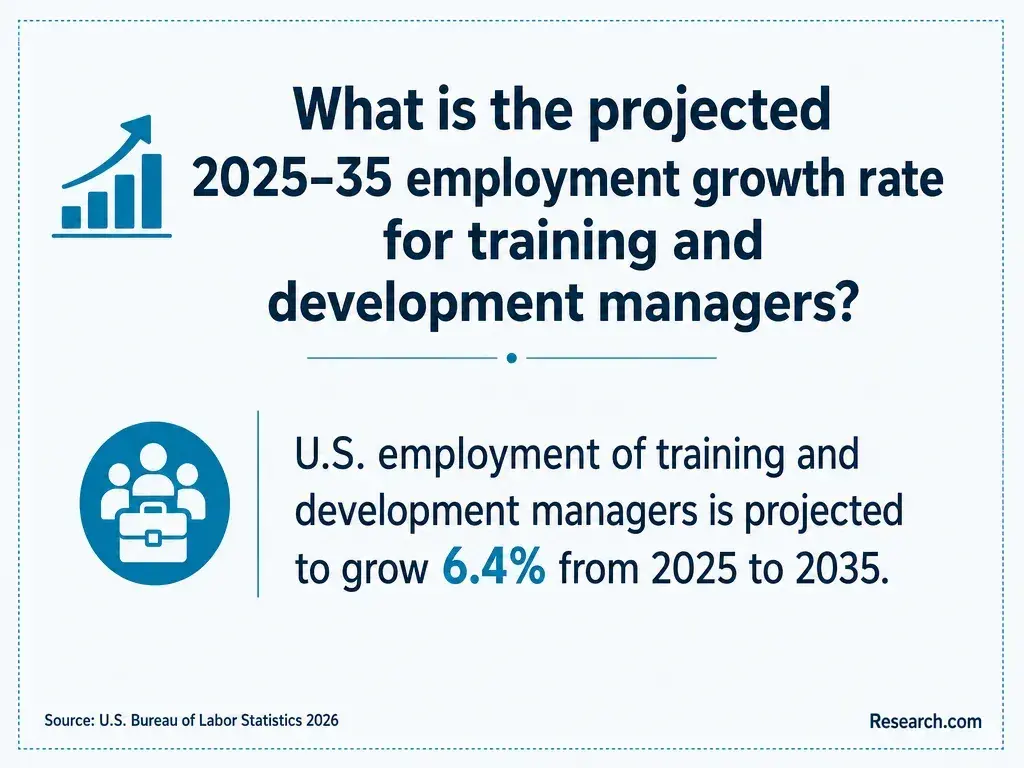
An Ed.D. may support advancement in learning and development, organizational development, consulting, or education administration when its skills match the role. Your promotion is more persuasive career evidence than the doctorate alone: employers will still assess leadership scope, results, sector knowledge, and hiring requirements.
The U.S. Bureau of Labor Statistics reports a May 2025 median annual salary of $133,000 for training and development managers. That occupational median describes workers in the role, not expected earnings for Ed.D. graduates or a return on tuition. A newly promoted applicant should compare the degree's likely usefulness with the responsibilities and compensation pathway available at their own employer.
If the immediate goal is to perform better in the new position rather than pursue sustained doctoral inquiry, an employer leadership program or targeted evaluation training may be more direct. If cost is decisive, choosing a budget-friendly organizational leadership doctorate still requires checking curriculum fit, completion obligations, and the full cost.
Do Ed.D. graduates need licenses or certifications for leadership careers?
Many organizational learning and leadership jobs do not require a license simply because the worker holds an Ed.D. Employers may value relevant certifications or experience, but the doctorate does not automatically confer either. Requirements change when a target position is regulated: principal or superintendent roles, for example, may require state-specific preparation and licensure.
If your promotion points toward a regulated education role, ask the program whether its specific degree meets the applicable state's preparation requirements and confirm the answer with the licensing authority. For an unregulated organizational role, assess whether the job posting calls for a certification, a record of leading projects, or particular functional skills before pursuing another credential.
Other Things You Should Know About EdD Leadership
Yes, if the program accepts updates - but identify it as a future appointment, give the confirmed effective date, and avoid describing planned responsibilities as work already completed.
You can ask admissions whether a current supervisor's recommendation is required and whether another person who knows your work is acceptable. Do not assume the school will contact your employer without checking its procedures.
It can provide relevant evidence if the new duties align with the program's criteria. Explain the responsibilities and transition accurately; the admissions office decides how the experience is evaluated.
Notify admissions promptly and correct the record. If you are already enrolled, also check whether the change affects employer support or an approved workplace project.
- 2300-335-1 - NIH Merit Promotion Plan https://policymanual.nih.gov/2300-335-1
- Ready to apply to the Peace Corps? Let's talk references https://www.peacecorps.gov/connect/blog/ready-to-apply-to-peace-corps-lets-talk-references/
- Guidance on Your Resume and Letter of Qualifications | wisconsin.gov https://dwd.wisconsin.gov/jobs/resume-job-narrative.htm
- 3 FAM 2310 HIRING AND PLACEMENT PROGRAM | state.gov https://fam.state.gov/fam/03fam/03fam2310.html
- Human Resources Manual - CalHR - CA.gov https://hrmanual.calhr.ca.gov/ManualItem/HistoricalView/1/111
- Letters of Recommendation for the MBA Program | Stanford Graduate School of Business https://www.gsb.stanford.edu/programs/mba/admission/application/letters-recommendation
- Online Ed.D. in Leadership and Learning in Organizations | VU-EDU https://peabodyonline.vanderbilt.edu/edd-in-organizational-learning/
- Application Guidelines | Graduate and Professional Admissions https://gradstudy.rutgers.edu/apply/application-guidelines
- Application Information - Georgetown Graduate School https://grad.georgetown.edu/admissions/application-information/
- Online Doctorate in Education and Leadership (Ed.D.) | Rockhurst University https://onlinedegrees.rockhurst.edu/online-edd-programs