2027 Is an Online Ed.D. in Leadership and Learning in Organizations a Good Fit for Learning and Development Directors?
Audited and Verified:
Our Editorial and Data Verification Process
Research.com uses government datasets, official education statistics and primary institutional information to support its career and degree guides. Our review process checks factual accuracy, occupational definitions, source dates and the requirements associated with the credentials discussed.
How This Article Was Fact-Checked
Our editorial team verifies salary estimates, employment projections, education requirements and program information against original data providers and official organizations. Salary figures are checked against the relevant occupational definitions and reporting periods. Information about licensure, accreditation and required in-person training is reviewed separately.
Fact-checked and verified on:

Co-Founder and Chief Data Scientist
Learning and development directors already lead programs, manage stakeholders, and make decisions about workforce capability. An online Ed.D. in Leadership and Learning in Organizations may deepen that work—but it also demands substantial time and money that could go toward a more targeted credential or a larger leadership assignment.
This guide helps directors assess whether doctoral study addresses a real gap in their practice, what to check before enrolling, and when another path is likely to serve their goals better.
Key Things You Should Know
- Best fit: An Ed.D. is most useful when an L&D director needs deeper preparation in organizational change, applied inquiry, and evaluating learning across systems—not simply a credential for the next promotion.
- Career reality: The U.S. median annual salary for training and development managers was $133,000 in May 2025, but that occupational figure is not an Ed.D. graduate salary or a forecast of a director's pay increase.
- Before enrolling: Verify the program's applied project requirements, live attendance and travel obligations, full cost, and whether your employer will support the work you hope to investigate.
What is an online Ed.D. in Leadership and Learning in Organizations?
An Ed.D. is a doctoral degree generally oriented toward improving professional practice. In a leadership and organizational learning program, students study how people learn at work, how organizations change, and how leaders use evidence to improve decisions. "Online" describes where much of the instruction occurs; it does not necessarily mean self-paced study or no campus visits.
For an L&D director, the distinction from a training-focused qualification matters. Designing a course is one task; determining whether training is the right response to a performance problem, securing executive support, and assessing whether learning transfers to work are broader leadership tasks. Programs differ in how deeply they address each one and in whether they require a capstone, dissertation in practice, or another doctoral project.
This degree is not automatically a school-administrator licensure program, a professional L&D certification, or a substitute for management experience. Its value depends on the curriculum and on the decisions the director expects to make with it.
Is an online Ed.D. a good fit for learning and development directors?
Often, yes—but only for a specific kind of next step. The strongest candidate is a director who already owns consequential learning decisions and wants to lead enterprise-wide capability, organizational development, or evidence-based change. Doctoral study can provide a structured opportunity to question assumptions, investigate an organizational problem, and defend recommendations to varied stakeholders.
Consider a director asked to improve leadership development across several business units. The useful doctoral question may not be "Which course should we build?" It may be whether inconsistent manager support, promotion incentives, or opportunities to practice explain why development efforts are not translating into workplace behavior. An Ed.D. is a better fit if the director can investigate such questions and has authority—or a credible sponsor—to act on the findings.
The options below differ chiefly in the breadth of the problem they prepare a director to address. They are not interchangeable credentials.
| Pathway | Potential fit for an L&D director | Principal limitation |
| Leadership and learning Ed.D. | Cross-functional change, adult learning, applied evaluation, and organizational inquiry | Substantial doctoral commitment; no automatic promotion |
| MBA or executive business study | Finance, operations, strategy, and broader business-management responsibility | May offer less depth in learning research and evaluation |
| Focused certificate or employer leadership program | A defined gap such as analytics, coaching, or change implementation | Usually narrower scope and less sustained inquiry |
| Research-oriented PhD | A goal centered on producing original scholarship and pursuing research-intensive work | May be less directly organized around improving the director's current practice |
If the immediate obstacle is limited budget authority, weak executive relationships, or too little experience leading managers, a larger assignment and strong mentorship may be more useful than another degree. If the gap is a specific measurement or design skill, targeted study is likely more efficient. An Ed.D. becomes more compelling when those narrower fixes will not address the director's longer-term leadership and inquiry goals.
What careers can an Ed.D. in Leadership and Learning in Organizations prepare you for?
For an established director, the most plausible benefit is greater readiness for a broader responsibility within or adjacent to L&D, not entry into an unrelated senior job. Possible directions include enterprise learning leadership, talent or leadership development, organizational development, workforce development, and organizational consulting. Each requires evidence of work beyond completing a degree.
An enterprise learning leader may need to set priorities across functions, manage budgets, and demonstrate how development supports business goals. An organizational development leader may diagnose processes and culture and coordinate change with HR and operations. A consultant must also win engagements, manage clients, and translate findings into feasible recommendations. For each path, a director's record of implementation, stakeholder influence, and responsible measurement will usually matter more than the doctoral initials alone.
Higher education is a possible transition, but its governance and hiring expectations differ from those of corporate L&D. Directors considering that move can start comparing Ed.D. organizational leadership study for higher education to examine that distinct goal. A general organizational learning Ed.D. does not, by itself, establish eligibility for a regulated education role.
Relevant coursework may connect adult learning and learning transfer with leadership theory, organizational culture, change implementation, and research or program evaluation. A director should look beyond course titles: the key distinction is whether assignments require students to diagnose a workplace problem, evaluate competing explanations, and make an implementable recommendation.
Methods training matters particularly when an L&D team reports course satisfaction but cannot tell whether a program changed workplace practice. Qualitative inquiry can help explain implementation barriers; quantitative analysis can help interpret participation and outcome measures. Neither method, on its own, makes a simple before-and-after comparison proof that training caused a result.
Check how the program teaches privacy and ethical use of employee data, how faculty guide applied work, and whether the required project can address a problem relevant to your responsibilities. A course mentioning analytics is not proof of advanced analytics preparation, and an employer's willingness to discuss a project is not permission to use restricted records.
Requirements vary by institution. Programs may ask for a completed graduate degree or specified graduate study, transcripts, recommendations, a statement of purpose, and evidence of relevant professional experience. Some assess an applicant's ability to identify a meaningful problem of practice. A director should describe decisions they actually made, the scope of their responsibility, and questions they are prepared to investigate—not rely on the title "director" as proof of readiness.
Ask admissions staff whether your degrees and experience meet the published requirements for your intended entry term, whether research preparation is expected, and whether access to an organization is necessary for applied work. Prior graduate credits used to establish admission eligibility are not necessarily credits applied toward the Ed.D. Directors returning after an unfinished doctoral study should request a written evaluation; Ed.D. pathways for students with prior doctoral study offer context for questions to raise, but the admitting institution decides what it will recognize.
Completion time depends on the program's credit and course sequence, enrollment pace, required convenings, and the time needed to finish its doctoral project. A cohort may keep coursework predictable while limiting the ability to pause or change pace. Project work can become less predictable if an employer changes priorities, access to data is delayed, or a proposed question needs revision.
Request a term-by-term plan rather than relying on an advertised completion estimate. Confirm when the project begins, whether courses run every term, what happens after a leave, and how long students may remain enrolled while completing the final requirement. If speed is a priority, shorter pathways through Ed.D. coursework can inform a comparison, but a shorter published schedule is useful only if its attendance and project demands are realistic alongside a director-level job.
Without a named program and entry term, there is no reliable single tuition figure. Schools may charge by credit or term, and the amount a working director ultimately pays also depends on fees, required travel, time enrolled, and employer support. Compare written estimates covering the entire degree, including the project stage—not just the first term.
The following cost categories show what to request from each school. They are separate from any potential salary benefit, which should not be assumed.
| Cost category | What may affect the total |
| Tuition and required fees | Credit requirements, billing method, annual rate changes, and continued enrollment during project work |
| Attendance costs | Required campus travel, lodging, technology, and time away from work |
| Work and household costs | Reduced hours, unpaid leave, or additional caregiving arrangements |
| Employer assistance | Annual limits, eligible expenses, grade conditions, continued-employment rules, and repayment obligations |
A useful affordability test is whether the degree remains manageable without a promotion or pay increase. Obtain the school's current charges and your employer's written reimbursement policy before committing. For a broader comparison framework, check the features on online Ed.D. affordability and degree planning published reputable education portals.
Online delivery can let a director remain employed without relocating and can make workplace inquiry easier to connect to current responsibilities. It does not eliminate scheduled class meetings, group work, faculty consultations, or possible campus convenings. Campus-based study may make in-person collaboration more routine but could demand regular travel or a different work arrangement.
Compare actual calendars, not format labels. Ask for live session times, attendance rules, group-meeting expectations, residency dates, and the support available when an applied project stalls. For directors who travel frequently or manage unpredictable launches, the ability to study from anywhere may matter less than whether the program permits a missed meeting or a temporary change in pace.
First, confirm the institution's accreditation with the recognized accreditor and the school, then confirm that the advertised award is an Ed.D. and that its curriculum serves organizational learning rather than a different leadership objective. Institutional accreditation is important, but it does not establish school-administrator licensure eligibility or certify an L&D specialist.
For a director, the most revealing program questions concern fit and execution. Use the published catalog and direct answers from the program to check the following:
- What decisions and organizational problems does the required coursework prepare students to address, and which relevant courses are required rather than occasional electives?
- What is the final project, who approves its scope, and can work at your organization qualify if data access and oversight requirements are met?
- When must students attend live sessions or campus convenings, and what happens if employment or project access changes?
- What is the full written cost estimate, and what completion or career-outcome information can the school explain clearly?
Compare those answers against your employer's tuition policy and your intended role. If your goal is specifically education-sector leadership, paying for a doctorate in higher education leadership addresses a related but distinct financial decision. Do not assume aid or employer support described for one program applies to another.
What salary and job outlook can learning and development leaders expect?
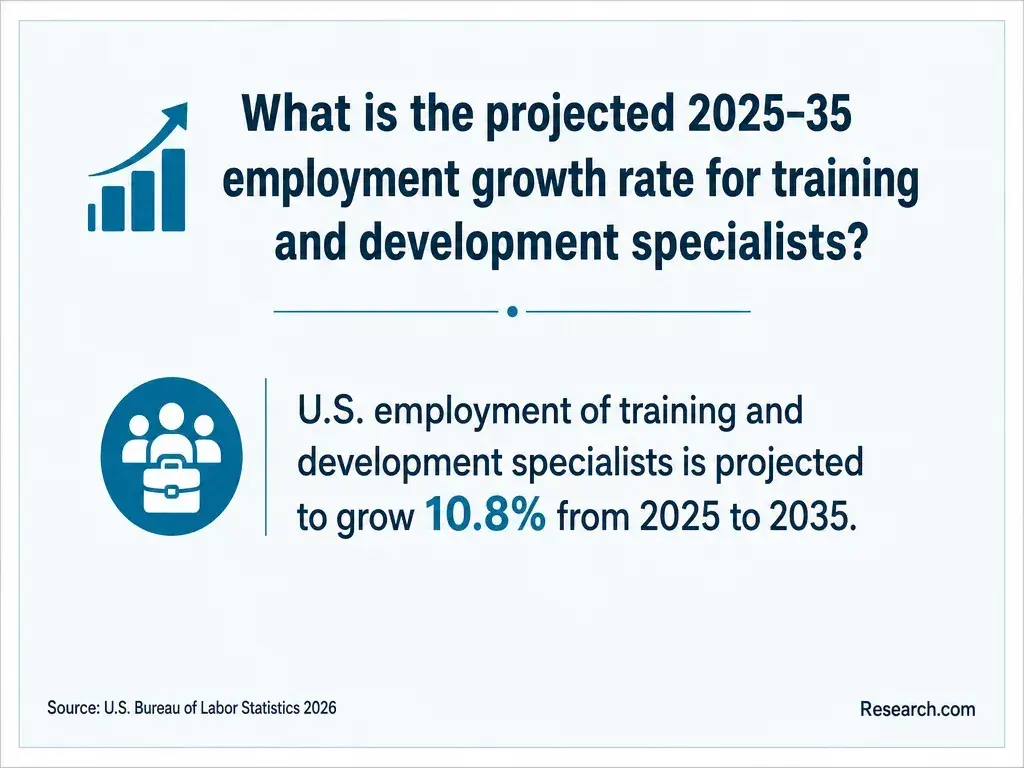
The U.S. Bureau of Labor Statistics reports a $133,000 median annual salary for training and development managers in May 2025 and projects 6.4% employment growth from 2025 to 2035. That occupation is the closest broad benchmark for many L&D leadership roles, but it covers workers with different titles, education levels, industries, and years of experience. It cannot show what an Ed.D. will add to one director's compensation.
Use the figures to understand the occupation, not to calculate a guaranteed return on tuition. For a personal decision, examine compensation and hiring requirements for the specific roles you want, whether your employer rewards doctoral preparation, and whether the degree would help you take on responsibilities you cannot already access through experience or targeted development.
Other Things You Should Know About EdD Leadership
Not automatically. Institutions set their own teaching and research expectations, which can differ by discipline and appointment type. Check actual postings and whether they value your professional expertise, teaching record, or research experience.
No. A doctoral degree and a certification are separately awarded credentials. Check the certifying organization's requirements if a particular certification matters to your role.
Only when your employer and program permit the disclosure. Remove confidential information as required, and obtain approval before sharing internal data, identifiable accounts, or conclusions derived from restricted records.
Use their careers as context, not proof that the credential caused their advancement. Ask what responsibilities those leaders held before earning the degree and whether your organization's actual promotion criteria reward the capabilities the program develops.
- Learning and development roles and competency domains in higher education: a content analysis of job announcements - PMC https://pmc.ncbi.nlm.nih.gov/articles/PMC8294246/
- Accreditation in the U.S. | ed.gov http://www.ed.gov/laws-and-policy/higher-education-laws-and-policy/college-accreditation/accreditation-in-the-us
- EdD vs. PhD in Education: Choosing the Right Program | Goodwin College of Professional Studies https://drexel.edu/soe/resources/career-path/edd-vs-phd/
- Ed.D. Online - UD-EDU https://educationonline.udayton.edu/blog/ed-d-online-4/
- Doctorate of Education in Leadership and Adult Learning in Organizations (EdD) - William Woods University https://www.williamwoods.edu/academics-programs/leadership-and-adult-learning-in-organizations-edd-online/
- Course Modes & Definitions - Office of the University Registrar https://registrar.washington.edu/classrooms/course-modes/
- What Do Directors of Learning and Development Do | Franklin University https://www.franklin.edu/career-guide/training-and-development-managers/what-do-directors-of-learning-and-development-do
- Online Doctor of Education (EdD) Program | University of Miami https://uonline.miami.edu/programs/doctor-of-education-applied-learning-sciences/
- Careers Leaders Can Pursue with an Ed.D. | Peabody Online | VU-EDU https://peabodyonline.vanderbilt.edu/edd-in-organizational-learning/edd-careers/
- Online Doctor of Education in Leadership and Innovation | Purdue Global https://www.purdueglobal.edu/degree-programs/education/doctor-education-leadership-innovation/