2027 Online Ed.D. in Leadership and Learning in Organizations: Degree Fit for Leaders Tackling A Construction Firm Developing Project Leaders
Audited and Verified:
Our Editorial and Data Verification Process
Research.com uses government datasets, official education statistics and primary institutional information to support its career and degree guides. Our review process checks factual accuracy, occupational definitions, source dates and the requirements associated with the credentials discussed.
How This Article Was Fact-Checked
Our editorial team verifies salary estimates, employment projections, education requirements and program information against original data providers and official organizations. Salary figures are checked against the relevant occupational definitions and reporting periods. Information about licensure, accreditation and required in-person training is reviewed separately.
Fact-checked and verified on:

Co-Founder and Chief Data Scientist
A construction firm may have excellent builders but too few people ready to lead projects across schedules, budgets, crews, clients, and subcontractors. For a leader responsible for developing that talent, an online Ed.D. in Leadership and Learning in Organizations could offer more than management coursework, but it is a substantial commitment, not a substitute for construction experience.
This article explains where doctoral study could strengthen a project-leader pipeline, where simpler interventions may work better, and what to verify before choosing a program.
Key Things You Should Know
- An Ed.D. fits best when the firm needs a leader who can diagnose, design, and evaluate a sustained project-leader development system, not simply deliver a training course.
- First check whether the bottleneck is learning or something else, such as limited delegation, inconsistent project procedures, or insufficient opportunities to lead.
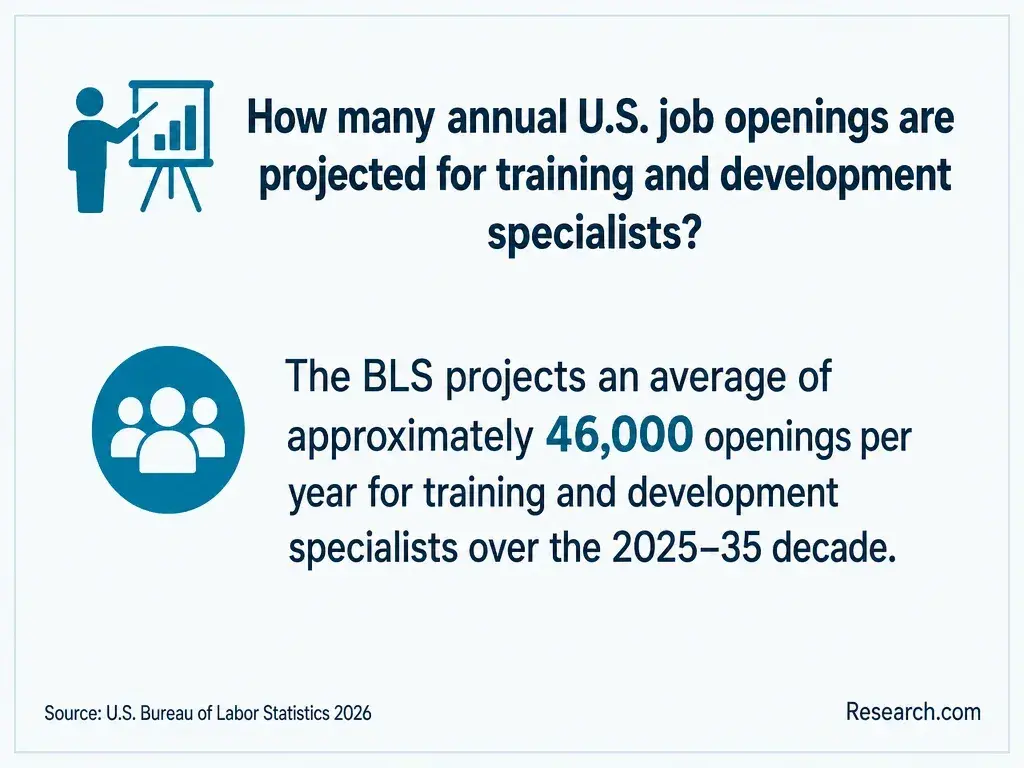
- The US Bureau of Labor Statistics reports a $133,000 median annual salary for training and development managers in 2025; that occupational figure is not a predicted salary or raise for Ed.D. graduates.
What is an online Ed.D. in Leadership and Learning in Organizations?
An Ed.D. is a practice-oriented doctorate. A program focused on leadership and learning in organizations typically studies how adults develop, how organizations change, and how leaders use evidence to improve practice. Online describes where much of the instruction takes place; it does not establish that classes are self-paced or that campus visits are unnecessary.
For a construction firm, the degree's potential value lies in building a repeatable way to develop people, not teaching estimating software, contract administration, or jobsite safety rules. Program names and curricula differ: a leadership course does not establish a formal construction or talent-development concentration.
Education doctorate specialization comparisons can help frame that distinction, but confirm each school's actual course catalog and degree requirements.
Is an online Ed.D. right for leaders developing construction project managers?
An online Ed.D. may be right but only if the leader's job includes improving how the firm develops project managers across projects. A promotion gap alone does not establish a training problem.
New project leaders may lack coaching, authority to make decisions, exposure to clients, or consistent handoff procedures. Training people on skills they cannot practice will have limited value.
A useful starting diagnosis compares the firm's expectations with observable work: Who leads owner meetings? Who handles change orders and subcontractor coordination? Where do promising employees first take responsibility for schedule, cost, and people decisions?
Review available role descriptions, project records, and supervisor feedback before selecting an intervention; do not treat any one measure as proof of its cause.
The options differ in what they primarily develop. This comparison helps separate the leader's educational goal from the firm's immediate staffing need.
| Pathway | Primary contribution | Important limit |
| Leadership and learning Ed.D. | Organizational diagnosis, adult learning, change implementation, and applied evaluation | Requires substantial study; does not supply construction-specific authority or experience |
| Employer-led rotations and mentoring | Supervised responsibility on actual projects | Needs capable mentors, time, and consistent expectations |
| Targeted management or technical training | Defined gaps in scheduling, contracts, communication, or financial controls | May not resolve weak succession systems or limited opportunities to practice |
An Ed.D. becomes more compelling if the reader has authority to coordinate operations, human resources, and senior project staff; access to an organizational problem suitable for supervised inquiry; and a long-term goal in leadership development.
If the firm needs project managers now, rotations, coaching, and process changes should not wait for a doctorate. A leader whose main gap is technical construction management may benefit more from targeted professional development.
What careers can an online Ed.D. in organizational leadership prepare you for?
For an experienced construction leader, the most plausible application is often an expanded role at the current firm: building a project-manager pipeline, leading workforce development, or evaluating leadership practices across offices.
Related roles include training and development manager, organizational development leader, and consultant. Each requires evidence of relevant work; the degree alone does not confer a director title or make someone qualified to run construction projects.
A construction professional changing careers should distinguish developing project leaders from being a project leader. The first emphasizes adult learning, coaching, and organizational systems.
The second also requires project delivery judgment, commercial knowledge, and credibility earned in the field. A portfolio showing a needs assessment, an implemented mentoring process, and a responsibly evaluated improvement effort may be more persuasive than the credential alone.
The most relevant curriculum connects adult learning with organizational change and applied research. For a construction-firm leader, that means studying why a supervisor can explain a concept in training yet struggle to use it during a live project; how incentives and reporting relationships shape behavior; and how to evaluate development without mistaking attendance for capability.
Look for coursework or supervised projects covering needs assessment, learning transfer, leadership coaching, qualitative and quantitative inquiry, and program evaluation. Ask whether the required doctoral project can address a workplace problem and what faculty approval it needs. Course titles alone cannot establish depth, and a capstone, dissertation in practice, and conventional research dissertation are not interchangeable.
A feasible applied question might examine whether a structured sequence of supervised responsibilities helps emerging managers demonstrate specified competencies. The leader would need defensible measures and an appropriate comparison or baseline.
Project outcomes can be influenced by project complexity, mentor quality, and assignment decisions, so a simple before-and-after result would not establish that the development program caused a change. Employee information also requires employer authorization, privacy safeguards, and whatever academic ethics review the program requires.
Online study can let a construction leader remain near active jobsites, but location flexibility is not schedule flexibility. Live cohort sessions, group work, research meetings, and required campus convenings may conflict with bid deadlines, travel, or project emergencies. Campus-based programs can make in-person collaboration easier but may demand a greater change to work or residence arrangements.
Compare programs using the actual class schedule, attendance policy, travel requirements, faculty access, and doctoral-project format, not the online label. Ask how group projects accommodate unpredictable work and what happens if an employer change removes access to the original project site.
For someone who has already completed doctoral coursework elsewhere, comparing education doctorate ABD completion routes is a separate decision from entering a new Ed.D. cohort; prior work should not be assumed to transfer.
Requirements vary by institution. Programs may request an appropriate prior degree, transcripts, recommendations, a statement of purpose, and evidence of professional leadership or research readiness.
Some set specific graduate-study or experience conditions. Construction experience can be relevant when an applicant can explain actual responsibility for developing people, changing practices, or making organizational decisions; a job title alone provides less evidence.
Applicants should ask admissions staff to distinguish formal eligibility from preferred experience and to confirm whether an education degree is required. They can then document a real development challenge, their authority to work on it, and the questions they hope to investigate without claiming results they have not measured.
Applicants with an education specialist degree can explore Ed.S.-to-Ed.D. admission and study options, while obtaining a written evaluation of any credits proposed for transfer. Credits considered during admission do not necessarily reduce doctoral coursework.
There is no reliable universal completion time or price: required credits, enrollment pace, dissertation or capstone milestones, and continuation rules differ.
Before committing, request the program's published curriculum and a personalized cost estimate covering tuition, mandatory fees, required travel, and charges that may continue during the final project. Ed.D. program costs for prospective doctoral students provide a starting point for comparison, not a substitute for a school's current charges.
For a construction leader, the economic test includes missed work and project travel as well as tuition. Check whether employer assistance is promised in writing, when reimbursement occurs, and whether repayment is required after departure. Compare that total commitment with the cost of mentoring, rotations, or focused training that could address the firm's immediate need sooner.
Check the institution, not just an advertisement, in the US Department of Education's accreditation database and confirm the accreditor's recognized status.
Then ask the university which institution awards the Ed.D., whether the advertised program is included in its accredited offerings, and whether any additional program-specific recognition is claimed. Institutional accreditation does not, by itself, establish a specialized credential or licensure outcome.
Use the university's current catalog to verify the exact degree name, delivery requirements, and completion rules for the intended entry term. If the employer has tuition-assistance eligibility rules, confirm that the school meets those rules before applying.
No salary figure represents all Ed.D. graduates or isolates the degree's effect. For one relevant occupation, the US Bureau of Labor Statistics reports a 2025 median annual salary of $133,000 and projected 2025-2035 employment growth of 6.4% for training and development managers. Those figures describe an occupation across industries and education levels; they are not a forecast for a construction employee completing an Ed.D.
A more useful financial question is whether the degree helps the reader take on responsibilities the firm actually values and whether comparable positions require demonstrated development leadership.
Compare likely duties and employer support with the full education commitment. Choosing an education doctorate with a manageable tuition budget may help narrow options, but neither a lower price nor an occupational median proves a positive return.
Do construction leaders need licenses or certifications after earning an Ed.D.?
An organizational leadership Ed.D. does not replace qualifications required for a particular construction role, regulated activity, or contract. Whether a credential is needed depends on the work, jurisdiction, employer, and client requirements, not on possession of the doctorate. Professional certifications in project management or construction may signal relevant expertise, but they are distinct from an academic degree.
Ask the firm which credentials its project leaders actually need, then check any applicable licensing authority or certifying organization directly. A general leadership Ed.D. also should not be mistaken for a state-approved pathway to school-administrator licensure.
Other Things You Should Know About EdD Leadership Programs
Possibly, but their employers, contractual roles, and access permissions matter. Do not include subcontractor performance information in doctoral work without the required organizational and academic approvals.
Ownership depends on university policies, employment agreements, and how the materials were created. Resolve intellectual-property and sharing permissions before using firm documents in coursework or a portfolio.
Set a limited coaching responsibility, identify when it can occur during project work, and account for mentors' workload. Coaching is unlikely to be sustained if it is added without time or managerial support.
Tell the faculty advisor promptly. A revised site or project may be possible, but it requires the program's approval; previously collected information still remains subject to applicable permissions and confidentiality rules.
- Cost of Attendance (Budget) | 2025-2026 Federal Student Aid Handbook https://fsapartners.ed.gov/knowledge-center/fsa-handbook/2025-2026/vol3/ch2-cost-attendance-budget
- Maximizing the Impact and ROI of Leadership Development | nih.gov https://pmc.ncbi.nlm.nih.gov/articles/PMC11505461/
- Online Ed.D. Curriculum - Vanderbilt Peabody College https://peabodyonline.vanderbilt.edu/edd-in-organizational-learning/curriculum/
- PhD vs. EdD vs. DBA: Which Doctorate Is Right for You? | National University https://www.nu.edu/blog/phd-vs-edd-vs-dba/
- What Is a Problem of Practice? | spalding.edu https://online.spalding.edu/blog/what-is-problem-practice
- EdD vs. PhD in Education: Choosing the Right Program | Goodwin College of Professional Studies https://drexel.edu/soe/resources/career-path/edd-vs-phd/
- What Topics Do EdD Students Research in the EdD Program? | Fairfield University https://www.fairfield.edu/news/insights/education-human-development/what-topics-do-edd-students-research.html