2027 Online Data Science Master's Options for Professionals in Bangor, Maine

Co-Founder and Chief Data Scientist
Professionals in Bangor can consider online data science master's programs well beyond Maine - but the best choice depends on more than distance. A nearby university may offer useful connections, while a national online program may better match your technical goals or work schedule.
This guide compares credible starting points and shows what to verify before you commit: remote access from Maine, curriculum, admissions preparation, total cost, and the kind of role you want next.
Key Things You Should Know
Key Things You Should Know
- Bangor residents can compare national online programs alongside nearby universities; confirm Maine enrollment eligibility and any required campus visits before applying.
- The University of Texas at Austin and University of Colorado Boulder offer online data science master's degrees; Georgia Tech's online analytics master's is a related option with a different degree title.
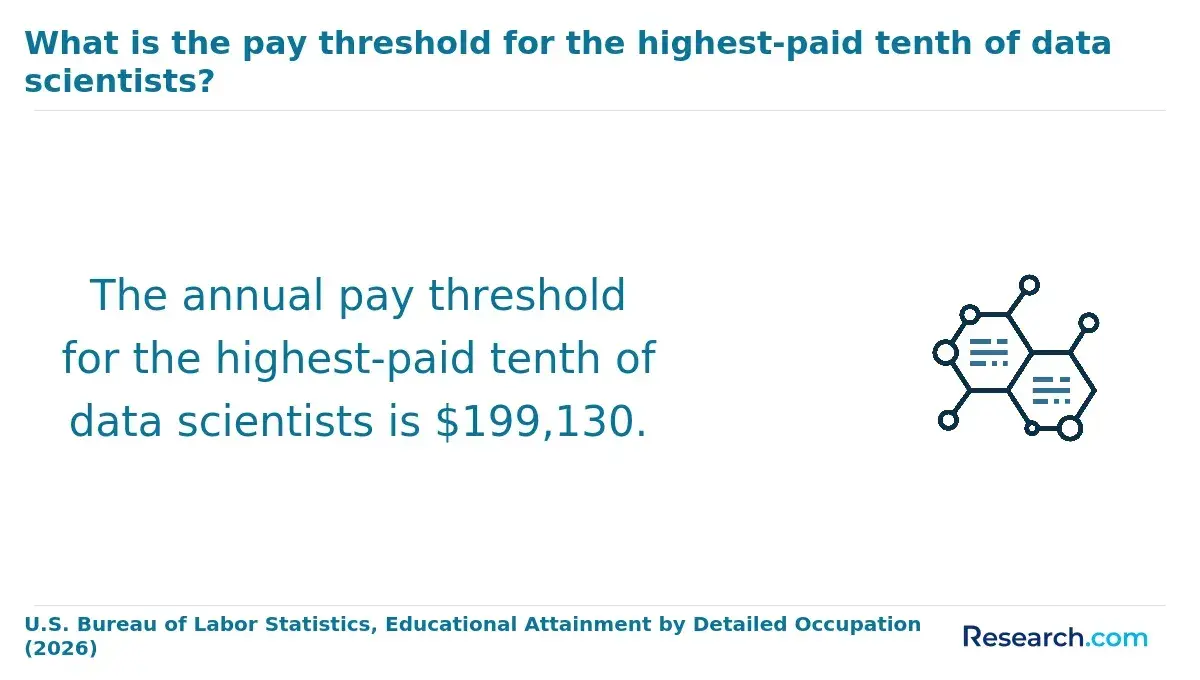
- The U.S. Bureau of Labor Statistics reports a $120,230 national median annual wage for data scientists in May 2025; that is not a Maine salary estimate or a predicted graduate outcome.
What is an online master's in data science?
An online master's in data science is a graduate degree completed primarily through remote coursework in statistical analysis, computing, and the use of data to answer practical questions. Programs differ substantially: some emphasize mathematical modeling and machine learning, while others focus on analytics systems or decisions within organizations.
The degree title is a useful starting point, not a complete description. For example, an analytics master's may be a strong fit for a Bangor professional who wants to improve forecasting and decision-making at work, even if it is not titled "data science." If that is your goal, compare data analytics master's degrees as well as data science degrees.
Which online data science master's programs serve professionals in Bangor, Maine?
Bangor does not limit your search to institutions within commuting distance. These established online degrees provide distinct starting points; their current catalogs and admissions offices should confirm program availability, Maine enrollment eligibility, and any in-person requirements for your intended start term.
The comparison separates degree titles from likely areas of emphasis so you can shortlist programs based on your intended work, not their location alone.
| Institution and online degree | Distinguishing consideration | Potential fit |
| University of Texas at Austin - Master of Science in Data Science | A degree explicitly titled data science | Someone seeking a data science curriculum and credential rather than an analytics-titled degree |
| University of Colorado Boulder - Master of Science in Data Science | Online study with a performance-based admissions pathway | Someone who wants to assess whether demonstrating readiness through coursework suits their background |
| Georgia Institute of Technology - Online Master of Science in Analytics | An online analytics degree rather than a data science-titled degree | Someone whose goals align with analytics methods and their application in organizations |
The University of Maine in nearby Orono is also worth investigating if access to local faculty or campus activities matters to you. Do not assume that a nearby graduate offering is fully online or that occasional attendance will fit your schedule; ask about the exact degree, delivery format, and required visits. Conversely, do not reject a national program merely because its campus is far away if its coursework and student services are accessible from Bangor.
How do you choose an accredited online data science master's program?
First, verify that the degree-granting institution holds recognized institutional accreditation. Then check the program itself: institutional accreditation does not establish that a particular curriculum has the technical depth you need, and a data science degree does not necessarily have separate programmatic accreditation.
For a Bangor resident, the most useful final checks are practical. Ask admissions to confirm that the institution enrolls students living in Maine, whether any residencies or proctored activities require travel, and whether live classes and office hours work in Eastern Time. Request a current degree plan, a tuition-and-fee estimate for your likely pace, and examples of projects. A common mistake is to use a ranking or the word "online" as a substitute for these checks.
What do online data science master's programs teach?
Expect a mix of programming, statistics, data management, machine learning, and communication of results. What matters is the depth and sequence: a course that briefly introduces machine learning is not equivalent to one requiring you to build, evaluate, and explain models using unfamiliar data. Look for substantial projects that test data cleaning, validation, reproducibility, and the limits of a result.
AI coursework deserves particular scrutiny. If you want to develop and evaluate AI systems, inspect required courses and advanced electives rather than assuming every data science program has the same focus. How to select the right artificial intelligence degree can help you distinguish an AI-focused path from a broader data science education.
What are the admission requirements for an online data science master's?
Requirements vary by institution. Programs may ask for an accredited bachelor's degree, transcripts, evidence of quantitative preparation, programming experience, recommendations, or a statement of purpose. An applicant's job title alone does not establish readiness, and a degree outside computer science does not automatically rule them out.
Colorado Boulder's performance-based route is one example of why it pays to check each school's current policy rather than assume every application follows the same model.
Before applying, compare your experience with the actual course prerequisites. If calculus, statistics, or Python is a gap, ask whether prior college credit is required or whether another form of preparation is acceptable. Preparatory courses can improve your ability to succeed without necessarily satisfying a formal admission requirement. Applicants considering an AI-focused alternative can also examine AI master's programs with preparatory coursework.
How long does an online data science master's take and cost?
Both depend on the program and your course load. Compare schools using the credits required to graduate, the courses you can realistically take while employed, and the maximum time allowed to finish. Ask whether required courses run every term; an advertised fast path is less useful if it depends on a workload you cannot sustain.
For cost, request a written estimate based on your residency, start term, and expected pace. Compare total tuition plus mandatory fees, then account for books or software, any travel, and interest if you borrow. Ask your employer about tuition assistance before treating the published price as your personal cost. Avoid comparing one school's tuition-only figure with another school's full estimated bill; current, equivalent quotes are more useful than an unverified price comparison.
How do online and campus-based data science master's programs compare?
Online study can let a Bangor professional keep working without routinely traveling to campus. Campus study may make in-person research, peer interaction, or use of facilities easier. Neither format automatically provides better instruction or career access; compare the actual courses, faculty contact, project support, and recruiting services available to students in each format.
Scheduling is the decisive distinction for many working adults. Ask whether lectures are recorded, attendance is required at set times, group projects involve live meetings, and exams have narrow windows.
An accelerated program may reduce calendar time while increasing weekly pressure. If speed matters more than a broad data science curriculum, a guide to faster online AI master's programs offers a separate path to evaluate - not a reason to assume an AI degree is interchangeable with data science.
What careers can you pursue with a data science master's degree?
Potential paths include data scientist, machine learning specialist, analytics professional, and data-focused roles within an existing industry. The realistic next step depends on prior experience. A Bangor professional who already understands healthcare, finance, or operations may have a stronger case for a data-focused role in that field than for an unrelated senior technical position.
Choose projects that show employers both technical judgment and domain understanding: define a useful question, document the data's limitations, evaluate the method, and explain the result to a nontechnical audience. A degree alone does not establish those abilities. For a closer look at how coursework connects with changing roles, see data science study options for emerging data roles.
What salaries can data science master's graduates expect in Maine?
There is no sound single salary figure for a new data science master's graduate in Bangor. The U.S. Bureau of Labor Statistics reports a $120,230 national median annual wage for data scientists in May 2025. That figure covers employed data scientists across backgrounds, experience levels, and locations; it is neither a Maine-specific offer nor evidence of what the degree itself adds to pay.
Use local job postings and conversations with employers to assess compensation for your target role and experience level. The BLS projects national data scientist employment to grow 35% from 2025 to 2035, but national growth does not establish the number of openings in Bangor. If you intend to stay local, weigh remote-work opportunities and roles with regional employers alongside the national outlook.
What certifications and professional standards apply to data scientists?
Data science is not generally a licensed profession in Maine, and a vendor certificate is not a substitute for a master's degree. Some employers value certifications tied to the cloud platforms or tools they use; others place more weight on demonstrated statistical reasoning, reliable code, and relevant projects. Check job descriptions for your intended role before paying for an additional credential.
Professional practice also requires careful treatment of privacy, security, bias, and reproducibility. Those expectations matter especially when a project uses employer or sensitive data. Look for coursework that requires students to explain where data came from, assess model limitations, and communicate results responsibly - not just produce a high-performing model.
Other Things You Should Know About Data Science
Only with your employer's permission and under the program's rules. Ask about confidentiality, data storage, and whether a public or synthetic dataset can satisfy the assignment instead.
Diploma wording is institution-specific. Ask the registrar for the exact diploma and transcript designation if that distinction matters to you or your employer.
Some institutions allow nondegree enrollment or offer other ways to try graduate coursework. Confirm eligibility, course access, and whether successfully completed credits could later count toward the degree.
Access varies. Ask whether online graduate students can book advising appointments, attend virtual recruiting events, and use the same job platform as campus students.
References
- DAPIP | Homepage - Office of Postsecondary Education (OPE) https://ope.ed.gov/dapip/
- Federal Government Data Science Jobs | USAJOBS https://data-science.usajobs.gov/
- Costs - Student Financial Services - University of Maine | Credit for Prior Learning https://umaine.edu/sfs/costs/
- Career Support | Online https://cps.unh.edu/online/why-unh-cps-online/career-support
- Online Master's in Data Science and Analytics | OU Online https://online.ou.edu/program/ms-in-data-science-and-analytics/
- MS in Data Science | Online | $9900 | Eastern University https://www.eastern.edu/academics/graduate-programs/ms-data-science
- Master's in Data Science - University of Notre Dame https://datascience.nd.edu/masters/
- Can I get a master's in computer science as a non-CS major? | tufts.edu https://onlinesoe.tufts.edu/news-events/news/can-i-get-masters-computer-science-non-cs-major
- Prerequisites for Consideration for Admission into... - OSU CSE https://cse.osu.edu/prerequisites-consideration-admission-graduate-program
- Online Data Science and Engineering Graduate Programs | UMaine Online https://online.umaine.edu/online-data-science-and-engineering-graduate-programs/