2027 Learning to Rank in an Online Data Science Master's: Courses, Projects, and Program Selection

Co-Founder and Chief Data Scientist
Learning to rank is a specialized skill, and an online data science master's may teach it in depth - or barely mention it. For prospective students interested in search, recommendations, or information retrieval, the decision is not simply whether a program offers machine learning. It is whether its courses, project opportunities, and support let you build and evaluate ranking systems. This guide shows you what to look for, what to ask before enrolling, and when a broader data science or AI program may be the better fit.
Key Things You Should Know
- Look for information retrieval or recommendation coursework alongside machine learning; a course title alone does not establish that learning to rank is taught.
- A strong ranking project evaluates ordered results with metrics such as NDCG and addresses biased feedback, not just model accuracy.
- The U.S. Bureau of Labor Statistics projects 35% employment growth for data scientists from 2025 to 2035, but that occupation-wide forecast does not measure demand for ranking specialists or promise a job after graduation.
What Is an Online Data Science Master's Degree?
An online data science master's is a graduate program delivered primarily through remote coursework in areas such as statistics, programming, data management, and machine learning. Its relevance to learning to rank depends on the curriculum, not the degree title or delivery method.
Learning to rank means training a system to order items—such as search results, products, or documents—for a particular query or user context. That differs from predicting an item's category or a single outcome in isolation. A ranking model must be judged by the quality of the resulting order, often across many different queries.
Some programs offer only broad predictive-modeling courses. Others may provide information retrieval, recommender systems, applied machine learning electives, or a flexible capstone. If you want a degree primarily for ranking work, establish that those opportunities will actually be available during your enrollment.
How Do You Choose an Accredited Online Data Science Master's Program?
First, verify that the university holds recognized institutional accreditation using the institution's stated accreditor and an official U.S. Department of Education or accreditor directory. Then check whether the program can enroll students in your state; accreditation and state authorization answer different questions.
For learning to rank, the more revealing test is academic access. Read current course descriptions and schedules, then ask whether relevant electives run online regularly, whether online students can complete ranking-related capstones, and whether faculty can supervise such work. An elective listed in a catalog is less useful if it is rarely offered or restricted to another program.
Compare programs using the same evidence: required courses, available electives, project rules, delivery requirements, and full estimated cost. If your goal is broader model development rather than ranking specifically, compare data science options with the best online artificial intelligence programs as well. Neither degree label establishes which program offers stronger retrieval or ranking depth.
What Courses Are Included in an Online Data Science Master's?
Programs vary, but statistics, programming, machine learning, and data engineering provide a foundation for ranking. The table distinguishes that foundation from evidence that a program teaches learning to rank substantively:
| Curriculum area | Connection to learning to rank | Evidence of useful depth |
| Statistics and experimental design | Supports uncertainty assessment and comparisons between ranking systems. | Assignments that address sampling, hypothesis testing, or online experiments. |
| Machine learning | Provides modeling, feature engineering, validation, and optimization skills. | Work with grouped observations or objectives beyond ordinary classification accuracy. |
| Information retrieval or recommender systems | Connects candidate retrieval, relevance, ordering, and user interaction. | Explicit coverage of ranking objectives and measures such as NDCG or mean reciprocal rank. |
| Data engineering and responsible AI | Supports scalable pipelines and scrutiny of behavioral data. | Projects addressing logging, leakage, privacy, or feedback bias. |
A passing mention of search is not the same as a ranking assignment; one course unit is not the same as a dedicated elective. Greater depth may include pointwise, pairwise, and listwise methods; boosted-tree or neural reranking models; query-level evaluation; and the distinction between offline metrics and user outcomes. Ask for a recent syllabus or assignment description when the catalog is ambiguous.
What Are the Admission Requirements for Online Data Science Master's Programs?
Requirements vary by institution. Programs may assess prior study or experience in programming, calculus, linear algebra, and statistics, but you should not treat that list as a universal prerequisite. Check the current admissions page for required degrees, documents, tests, deadlines, and any stated prerequisite policy.
For a ranking-focused applicant, preparation matters beyond eligibility. You should be comfortable using Python, working with tabular data, and explaining how to separate training and evaluation data. Coursework, work samples, or a small retrieval project can demonstrate readiness, but self-study does not automatically satisfy a formal prerequisite.
If your background is uneven, investigate whether a program offers foundation courses and how they count toward the degree; guidance on bridging skill gaps before graduate AI study can help frame those questions.
How Do Online and Campus-Based Data Science Master's Programs Compare?
Learning-to-rank outcomes depend more on course access, feedback, and project resources than on whether lectures happen online or on campus. An online program may better suit a working professional who can study remotely and apply methods at work; a campus program may be preferable if its relevant research group or project infrastructure is not available to remote students.
Check the operational details rather than assuming "online" means self-paced: live sessions, time zones, group work, exam arrangements, access to computing resources, and capstone supervision can affect whether you can complete a substantial ranking project. Faster study may reduce time away from other goals but leave less room for electives or project iteration. If pace is decisive, review accelerated data science master's pathways and verify their actual course sequence against the ranking opportunities you want.
How Long Does an Online Data Science Master's Take and Cost?
There is no reliable single duration or price for online data science master's programs. Credit requirements, course load, elective scheduling, residency-based pricing, and fees differ. A program's advertised minimum completion time may also assume continuous full-time enrollment or a fixed course sequence that does not include your preferred ranking elective.
Build a comparable estimate from the current tuition schedule: required credits multiplied by the applicable per-credit rate, plus mandatory fees. Add any required software, materials, travel, and financing costs, and consider the income or work time you would give up. Confirm whether tuition can change before completion and whether employer assistance or aid applies to your enrollment pattern. For financing options, see understanding aid for data science graduate programs.
A common mistake is choosing the lowest tuition figure without checking whether the relevant courses and project support are included. Compare total expected cost and the feasible path to a ranking-focused portfolio—not sticker price alone.
What Projects Build Job-Ready Data Science Skills?
A useful learning-to-rank project shows how you define relevance, construct a candidate set, train a ranking model, and test whether the ordering improves. A polished accuracy score on individual rows does not demonstrate those abilities. The following sequence makes a project easier for reviewers to assess:
- Define a specific task, such as ordering documents for queries, and document where the data and relevance labels came from.
- Build a simple baseline, such as a lexical retrieval method, before adding a learned reranker.
- Split data by query and, when appropriate, time; prevent records from the same evaluation query or future interactions from leaking into training.
- Report a ranking metric such as NDCG alongside performance by query type, and explain what the metric does not capture.
- Document reproducible code, data limitations, and what an online test would need to establish before deployment.
Interaction data requires particular care: clicks reflect which results users were shown and where they appeared, not just relevance. A stronger project discusses this exposure bias rather than treating every click as an unbiased label. Public or appropriately de-identified data can support a portfolio; do not publish private search logs or user information without authorization.
What Careers Can You Pursue With a Data Science Master's?
Ranking skills can support data scientist, machine learning engineer, search relevance, and recommender system work. Job titles differ by employer: some roles emphasize experimentation and analysis, while others require production engineering or large-scale retrieval systems. Read job descriptions for the actual mix of modeling, evaluation, software engineering, and domain knowledge.
Choose the project domain that fits your intended work. Product search may emphasize queries and catalog data; healthcare-related applications may require especially careful handling of sensitive information and expert judgments of relevance. If that is your target, review AI graduate programs for healthcare-related careers alongside data science programs, then examine whether their projects and data-access rules fit your goals. A master's can strengthen preparation, but relevant engineering experience and demonstrable projects may also matter in hiring.
How Much Do Data Scientists Earn After Graduate School?
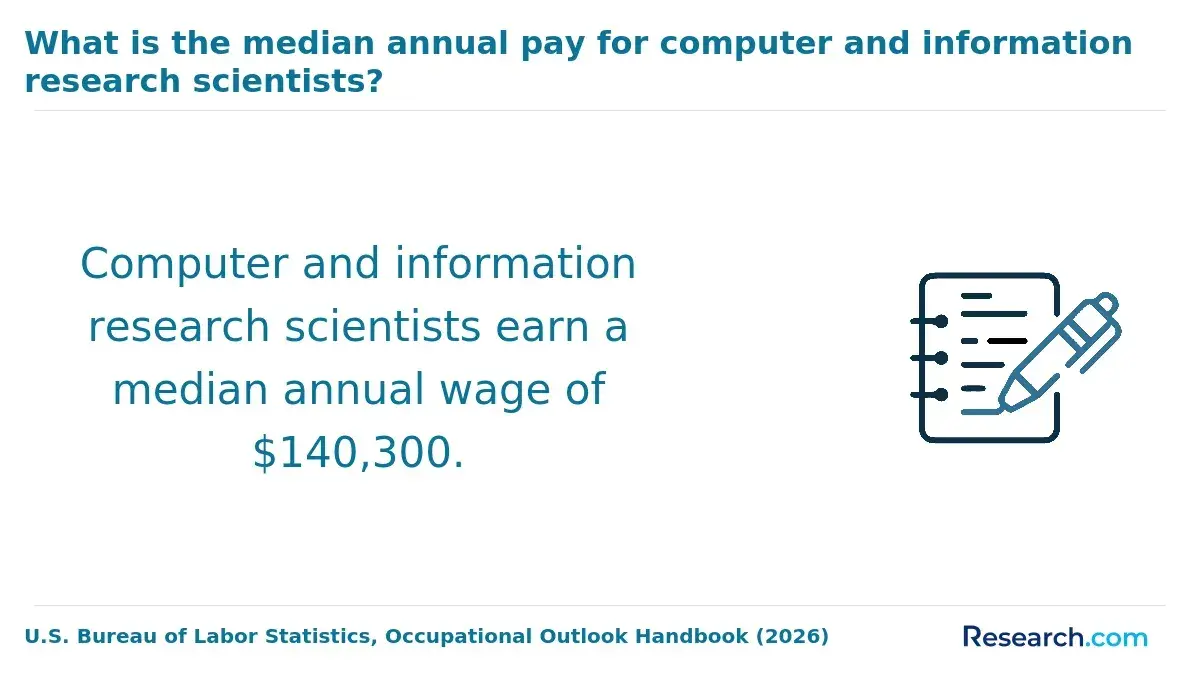
The U.S. Bureau of Labor Statistics reports a $120,230 median annual wage for data scientists in May 2025. That is an occupation-wide figure, not the starting salary of master's graduates or a learning-to-rank salary benchmark. Pay for a particular role can differ with experience, location, employer, and engineering responsibilities.
Use the median as labor-market context, not a return-on-investment forecast. When evaluating a program's graduate salary claims, look for the survey year, response rate, prior experience of respondents, and whether the figure represents salary after graduation or an actual increase. Neither the BLS median nor a graduate survey establishes that the degree caused an individual's pay.
What Certifications and Skills Support a Data Science Career?
No general certification replaces evidence that you can build and evaluate a ranking system. Complementary skills include Python and SQL, statistical testing, data pipelines, model evaluation, and software practices that make experiments reproducible. Depending on the target role, experience with search infrastructure or deployed machine learning systems may matter more than another general-purpose credential.
Choose a certification only if it addresses a documented gap in jobs you want—for example, a platform you will actually use. For program selection, prioritize access to substantial assignments and feedback over a promise that graduates will be "industry-ready." A useful final check is whether you can leave the program with a project that explains the ranking problem, baseline, evaluation design, limitations, and your own contribution.
Other Things You Should Know About Data Science
No. Projects can use editorial judgments or interaction signals, but the signals answer different questions. Clicks, for example, can be affected by result position and require careful interpretation.
Not necessarily. Smaller datasets and conventional machine learning methods can support rigorous experiments. More compute becomes relevant for larger collections or certain neural models.
Only if your employer authorizes the disclosure. A public explanation of methods may still expose confidential data or user behavior; use approved, de-identified, or public alternatives.
No. Ranking orders candidate items, while answer generation produces text. They can work together when a system retrieves and ranks evidence before generating a response.
References
- Choosing a School | Federal Student Aid https://studentaid.gov/resources/prepare-for-college/students/choosing-schools
- Master's Degree - Data Science - On Campus | Monroe University https://www.monroeu.edu/academics/king-graduate-school/masters-degree-data-science
- Online & On Campus Master's in Data Science: M.S. Program | University of North Dakota https://und.edu/programs/data-science-ms/index.html
- Online Program - UChicago Data Science Institute https://datascience.uchicago.edu/education/masters-programs/online-program/
- Curriculum - MU Institute for Data Science and Informatics https://muidsi.missouri.edu/academic-programs/m-s-data-science-and-analytics-program/masters/curriculum/
- Learning to Rank - xgboost 3.5.0-dev documentation https://xgboost.readthedocs.io/en/latest/tutorials/learning_to_rank.html
- The ABCs of Learning to Rank | lucidworks.com https://lucidworks.com/blog/abcs-learning-to-rank