2027 Data Versioning in an Online Data Science Master's: Courses, Projects, and Program Selection

Co-Founder and Chief Data Scientist
Data versioning can be easy to miss when comparing online data science master's programs: it may appear in a course description, a capstone rubric, or nowhere at all. For prospective students who want to build reproducible analyses and reliable machine-learning systems, that difference matters more than a list of software tools. This guide explains what meaningful instruction looks like, which projects demonstrate the skill, and how to weigh it alongside format, cost, and career goals.
Key Things You Should Know
- Look for assignments that connect a specific dataset version to code, model settings, and results; a course title or tool mention alone does not establish that depth.
- A strong project documents where data came from, what changed, and how someone else can reproduce an earlier result without exposing restricted data.
- Data versioning is career-relevant, but not a degree outcome guarantee: the U.S. Bureau of Labor Statistics projects 35% growth in data scientist employment from 2025 to 2035.
What Is Data Versioning in Data Science?
Data versioning is the practice of identifying, recording, and retrieving the particular state of data used in an analysis or model. It answers a practical question: if the source data changes tomorrow, can someone still explain and reproduce today's result?
Git can track code and small text files, but large, frequently changing, or sensitive datasets often need another approach. Teams may use immutable snapshots, object-storage versions, database snapshots, table histories, or dataset manifests that identify files and checksums. The method matters less than the ability to connect a result to the correct data state.
Versioning is not the same as backing up data. A backup helps recover files; a useful analytical version also records provenance, transformations, access constraints, and the relationship between data, code, and output. Students should be comfortable with basic file management, SQL, and programming before tackling these workflows in depth.
Why Does an Online Data Science Master's Teach Data Versioning?
Graduate projects often combine data cleaning, modeling, and repeated evaluation. Without a record of which observations and transformations produced a result, a student may be unable to tell whether a performance change came from a better model or a changed dataset. Versioning turns reproducibility from a promise into something a reviewer can test.
The skill also connects classroom work to professional practice. In a shared project, teammates need consistent inputs; in a regulated or sensitive setting, they may need to trace a result without making the underlying data public. As AI workflows increase the number of datasets, experiments, and model iterations a team can produce, clear lineage becomes particularly useful. A worthwhile master's program teaches students to make those decisions, not merely to run a versioning command.
What Courses Cover Data Versioning in an Online Master's Program?
Data versioning may be taught across several courses rather than in one bearing that name. The table distinguishes a passing reference from evidence that students actually practice the skill; catalog descriptions alone may not reveal which level a program reaches.
| Where it may appear | What substantive coverage looks like |
| Data engineering or databases | Students create repeatable ingestion and transformation pipelines and identify the source and output data states. |
| Machine learning or MLOps | Students tie training and evaluation results to dataset versions, code, and model settings. |
| Research methods or responsible AI | Students examine provenance, documentation, access controls, and the limits of reproducibility with restricted data. |
| Capstone or applied studio | Students deliver a project that another person can audit or rerun using documented inputs and procedures. |
A mention in a syllabus signals awareness; a graded exercise provides practice; a dedicated course can add depth; and a capstone can show whether the student can apply the ideas independently. Ask for a recent syllabus and assignment rubric. In particular, check whether students must recover an earlier dataset state and explain how a data change affected an analytical result.
Which Projects Build Practical Data Versioning Skills?
The best portfolio project makes a changing dataset part of the problem rather than adding a version number at the end. For example, a student could update a public dataset, rerun a forecast, and explain whether revised records or a code change caused the new result.
A strong submission should let a reviewer follow the chain from source to conclusion. These deliverables provide a useful test of a program's project expectations:
- A source-data record showing acquisition date, provenance, permitted use, and a stable identifier or checksum.
- A repeatable transformation pipeline that links cleaned data to its source version and records changes to the processing code.
- An experiment log linking each model result to the dataset state, evaluation split, and settings used.
- A short reproduction guide explaining how to recreate a result - or, when access is restricted, how an authorized reviewer could verify it.
Privacy changes the design. A healthcare-focused student, for instance, might use an approved or synthetic dataset and publish workflow documentation rather than patient records. Readers whose goal is specifically healthcare AI can also explore AI master's options for professionals in healthcare; data-access rules and domain coursework should shape that choice. Regardless of domain, avoid treating a polished prediction score as sufficient evidence of reproducibility.
How Do Online and Campus Data Science Master's Programs Compare?
Neither delivery format inherently teaches data versioning better. Online programs can support realistic distributed collaboration through shared repositories and remote reviews; campus programs may make in-person labs and team meetings easier. In either format, the decisive evidence is the same: graded work that requires students to preserve data lineage and reproduce results.
Choose an online option if its scheduling fits your life and it provides access to suitable computing resources, feedback on technical work, and workable group-project arrangements. A campus option may suit you better if you rely on scheduled in-person collaboration or access to particular facilities. Confirm live-session times, team expectations, and any required visits rather than assuming "online" means fully asynchronous.
Some applicants are also weighing data science against a more AI-focused degree. Compare required data engineering and reproducibility work against model-development depth, then consider selecting an AI program based on target roles. The stronger fit depends on the work you want to do, not the degree title alone.
What Are the Admission Requirements for an Online Data Science Master's?
Requirements vary by program, so no single background guarantees eligibility. Applicants should check the current admissions page for degree requirements, mathematics and programming prerequisites, application materials, and any permitted alternatives to formal coursework. Preparation for a data-versioning-heavy curriculum commonly includes Python or another programming language, SQL, statistics, and basic command-line or Git skills; these are readiness indicators, not universal admissions rules.
If you have domain experience but lack a stated prerequisite, ask whether the school accepts a credited course, placement assessment, or other evidence. Self-study can help you succeed even when it does not formally satisfy admission requirements. Applicants considering a more AI-centered curriculum can compare AI master's bridge options, while confirming directly what any foundation course fulfills and whether it adds time or cost.
How Long Does an Online Data Science Master's Take and Cost?
Completion time depends on required credits, course availability, enrollment pace, and whether a capstone has prerequisites or a fixed schedule. A faster route is not necessarily better for this topic: substantial versioning practice may require time for iterative projects and feedback. Ask for a sample plan based on the number of courses you can realistically take while working.
Compare the total expected cost for your plan, not one advertised tuition figure. Include required credits, tuition rules, mandatory fees, materials or computing charges, and any travel requirement; also check whether a slower pace changes the total. Published prices and policies can change, and employer assistance or aid is not assured. To build a shortlist, compare affordable data science master's programs, then verify each school's current official tuition schedule and course requirements before committing.
How Can You Verify an Online Data Science Program's Accreditation?
Verify the institution first, then ask whether the particular program makes any additional accreditation claim. Search the U.S. Department of Education's Database of Accredited Postsecondary Institutions and Programs or the Council for Higher Education Accreditation directory, and cross-check the institution's current listing with its official website. Do not assume that a technology-related master's needs a separate programmatic accreditor.
Accreditation does not establish curriculum quality in data versioning. Check that separately through syllabi, project requirements, and student work the school is authorized to share. If you will study from another state, also confirm with the school that it can enroll students where you reside; accreditation and state authorization are different questions.
What Careers and Salaries Can Data Science Master's Graduates Expect?
Data versioning supports work in data science, data engineering, machine-learning engineering, and model operations, but responsibilities and entry requirements differ by employer. It is particularly relevant when teams retrain models, investigate changed results, or maintain auditable data pipelines.
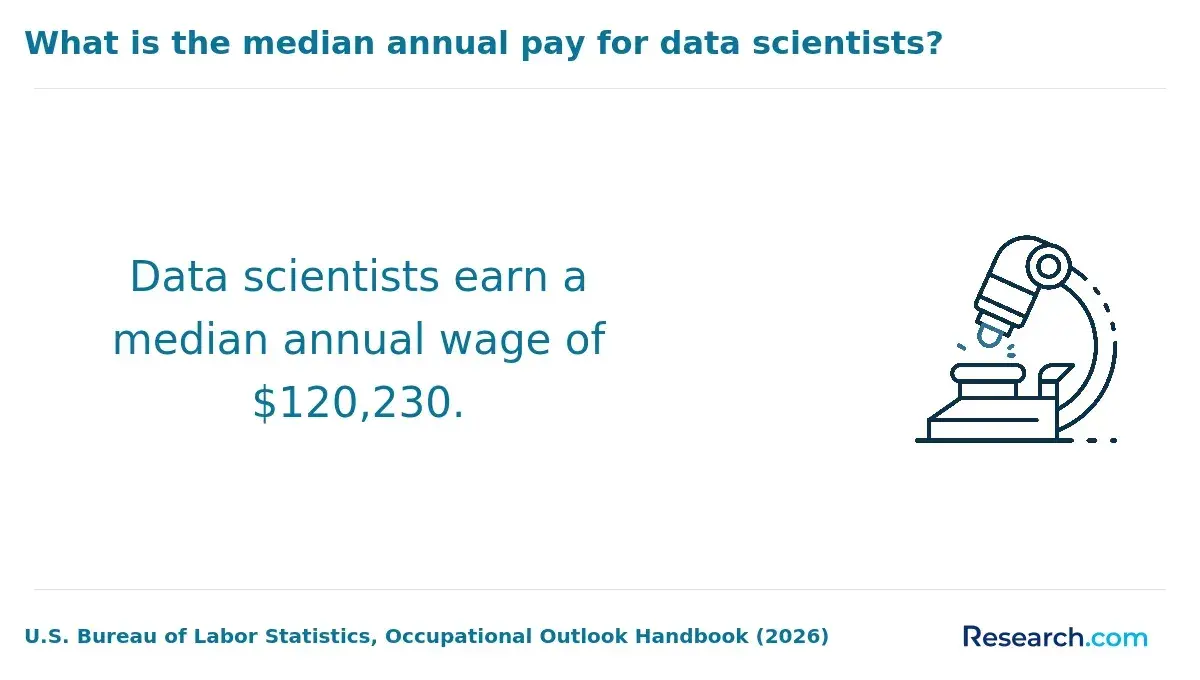
The U.S. Bureau of Labor Statistics reports a $120,230 median annual wage for data scientists in May 2025. That is a wage for people in the occupation, not a starting salary or an expected outcome for master's graduates. Prior experience, location, employer, and role all affect an individual offer. When judging a program's career claims, ask whether its reported outcomes separate new entrants from experienced professionals and identify who responded to its survey.
If speed is a major priority, consider shorter data science master's programs and career considerations. Check that a compressed schedule still gives you enough project time to produce evidence of the technical skills your target jobs request.
Which Certifications and Skills Complement a Data Science Master's?
No single certification substitutes for a reproducible project. Prioritize skills that let you trace an analytical result: Git for code, SQL for querying source data, a method for identifying dataset states, automated pipeline checks, and clear documentation. Cloud or platform training can be useful when it matches tools used in your target role, but a vendor credential alone does not show that you can manage data changes responsibly.
For a practical next step, select a changing dataset and preserve two identifiable states. Produce one result from each, document the code and inputs, and explain the difference. If a prospective program cannot show how students learn or demonstrate comparable work, ask what its capstone assesses before treating its software list as proof of depth.
Other Things You Should Know About Data Science
Not without permission. Employment agreements, privacy obligations, and data-use terms may restrict even de-identified records. Ask about approval, or demonstrate the same workflow with public or synthetic data.
No. Depending on the system, a version may be represented by a snapshot, a table history, or a manifest pointing to identifiable files. What matters is whether an authorized user can identify and recover the intended data state.
Record the source, retrieval date, and identifiers for the data you used, and document any correction you discover. Preserve a copy only if the provider's terms and applicable rules permit it.
Not necessarily. Small public datasets can support a local practice project. Before enrolling, ask whether a program supplies required computing access and whether students must pay for services used in coursework.
References
- Designing effective capstone experiences and projects... - PMC https://pmc.ncbi.nlm.nih.gov/articles/PMC7861568/
- Curriculum | Master's in Data Science - University of Notre Dame https://datascience.nd.edu/masters/curriculum/
- Online Program - UChicago Data Science Institute https://datascience.uchicago.edu/education/masters-programs/online-program/
- Data Science and Society (DATA) - UNC Catalog https://catalog.unc.edu/courses/data/
- MS in Data Science Curriculum & Course Descriptions | Eastern University https://www.eastern.edu/academics/colleges-seminary/college-health-and-sciences/departments/department-mathematical-5
- Profiling data scientists in the digital labour market | sciencedirect.com https://www.sciencedirect.com/science/article/pii/S0263237322000810
- Master's in Data Science | utexas.edu https://cdso.utexas.edu/msds
- Importance of Software Skills in Data Science | virginia.edu https://datascience.virginia.edu/news/importance-software-skills-data-science
- Online Master's in Data Science at UWF https://uwf.edu/programs/online/data-science-ms/
- How to Become a Data Scientist | Harvard SEAS https://seas.harvard.edu/news/how-become-data-scientist