2027 MPH Course Withdrawal: Effects on Scholarships and Completion Time

Co-Founder and Chief Data Scientist
Withdrawing from an MPH course can protect your academic record when finishing is no longer realistic, but it may also change your funding and graduation plan. This guide is for enrolled students deciding whether to stay, withdraw, or seek another accommodation.
It explains why dropping one course differs from leaving an entire term, how to check scholarship and financial-aid consequences, and when a missed prerequisite or practicum could add time to your degree. Use it to get the right answers from your school before the deadline passes.
Key Things You Should Know
- A withdrawal may leave a W on your transcript without lowering your GPA, but the course can still count as attempted, uncompleted credit under satisfactory academic progress rules.
- Dropping one course can change enrollment-based aid or scholarship eligibility; withdrawing from every course can also trigger a federal aid return calculation. The federal 60% point matters to that calculation, not to your school's refund deadline.
- Completion time depends less on the W itself than on when the course is offered again and whether it unlocks MPH fieldwork, advanced courses, or graduation.
What happens when you withdraw from an MPH course?
A course withdrawal is an official exit after the add/drop period, when removing a course may no longer erase it from the academic record. Schools commonly record a W for a timely withdrawal, but late withdrawals can receive a different notation or grade. The registrar's calendar and grading policy - not the date you stop attending - determine the result.
Withdrawing from one course while remaining enrolled is different from withdrawing from all courses in a term. Both can affect your degree audit and funding; a complete withdrawal raises additional federal aid questions. If the course is required, the W does not satisfy that requirement, even if you completed substantial work.
Before treating a difficult course as a reason to abandon the MPH, separate a short-term scheduling problem from a poor degree fit. If your goals have changed, comparing graduate public health degree types may clarify whether changing programs is worth more than retaking one course. A program change does not automatically erase an existing withdrawal or its financial consequences.
Can withdrawing from an MPH course affect scholarships and financial aid?
Yes, but the effect depends on which award you receive, your remaining credits, and when you withdraw. A scholarship might require a minimum enrollment load, continued progress, or a specific course sequence. An assistantship may have separate enrollment and work requirements. Ask the office administering each award for its written conditions; do not assume that keeping some courses preserves every source of funding.
For federal aid, a change in enrollment can require the school to reassess eligibility. If you withdraw from all eligible coursework in a payment period, federal Return of Title IV Funds rules may require a calculation of earned and unearned aid. Generally, completing more than 60% of the applicable payment period means you have earned all scheduled Title IV aid for that calculation, but modular courses and attendance dates require particular care. That rule does not promise a tuition refund or rule out a balance owed to the school.
Request a revised aid estimate showing tuition, fees, grants, loans, and any amount you may owe. If the decision reflects an ongoing affordability problem, low-cost public health master's degrees can provide comparison context, but transferring programs will have its own admission, credit, and funding rules.
Will an MPH course withdrawal delay graduation or increase completion time?
Not necessarily. An elective that runs again next term and fits your remaining schedule may have little effect. A required epidemiology or biostatistics course offered infrequently could block later work. A withdrawal from a course needed before an applied practice experience or integrative learning experience may postpone both the placement and the final assessment.
Ask your advisor to revise your term-by-term degree plan, including prerequisite approvals, course rotation, fieldwork eligibility, and the program's maximum time to degree. Working students should also check whether a replacement course conflicts with employment, caregiving, or site hours; "online" does not necessarily mean self-paced.
A delayed course can add another term of fees or change how many credits you can take while employed. When comparing a revised schedule with another program, comparing public health tuition and study length is more useful than comparing advertised completion times alone. Count only costs and credits the schools confirm for your situation.
Satisfactory academic progress, or SAP, is the school's academic standard for continued eligibility for federal student aid. Under federal rules, a school's SAP policy must assess grades, progress through attempted coursework, and a maximum timeframe for finishing. A W commonly leaves the GPA unchanged but reduces the share of attempted credits you complete. Your school defines how its published policy applies to withdrawals and when it evaluates your record.
One W does not automatically end aid eligibility. The risk rises when you already have incomplete, failed, or withdrawn courses, or when repeated attempts push you toward the program's maximum timeframe. Ask financial aid for a SAP review using your actual record, including how a retake would count. If you fall short, check the school's warning, appeal, probation, or academic-plan procedures rather than assuming an exception will be granted.
SAP rules also matter if you later pursue another degree, but do not treat MPH standing as a prediction of doctoral funding. Cost-conscious public health doctoral advancement requires a separate look at that program's charges, aid conditions, and completion policies.
There is no single MPH withdrawal deadline or refund schedule. Check your institution's academic calendar, registrar policy, billing schedule, and financial-aid calendar for your specific term or course session. The last day to drop without a W, the last day to withdraw, the tuition-refund cutoff, and the deadline for an exceptional withdrawal may all differ.
Short sessions and courses that start later in the term deserve special attention: their deadlines may not match the full-semester calendar. Obtain a written estimate before submitting a request, and keep confirmation that the withdrawal was processed. Stopping attendance or telling an instructor is not necessarily an official withdrawal.
If you are considering a different school instead, comparing online MPH admission requirements can help you assess that option. Applying elsewhere does not pause your present school's withdrawal or refund deadlines.
Usually you can seek to enroll again, but availability and approval are school-specific. Confirm whether the course is offered soon enough, whether it has changed, whether seats are restricted, and whether your program permits a substitute. A retake may satisfy the degree requirement while the original W remains on the transcript and in SAP attempted-credit calculations.
If the withdrawal arose because you lacked preparation for a quantitative or methods course, ask the instructor what skills to build before trying again. A targeted statistics refresher may be more useful than repeating the same material without support. For a missing formal prerequisite, review public health graduate prerequisite completion options, then get your own program's approval before paying for outside coursework.
Online students generally face the same institution-wide transcript and SAP framework as other students, but the course calendar and attendance documentation may differ. An accelerated online course can reach its withdrawal deadline quickly. In a program with multiple short modules, leaving one module or failing to begin a later one can complicate federal aid review; ask the aid office to evaluate your actual schedule.
Check whether participation is documented through coursework or other academically related activity rather than merely logging in. Also ask whether a retake has live sessions, group work, or fixed deadlines that caused the original scheduling conflict. If the withdrawn course is quantitative, online biostatistics program planning for workers may help you frame questions about workload and pacing; a separate program is not automatically a substitute for an MPH requirement.
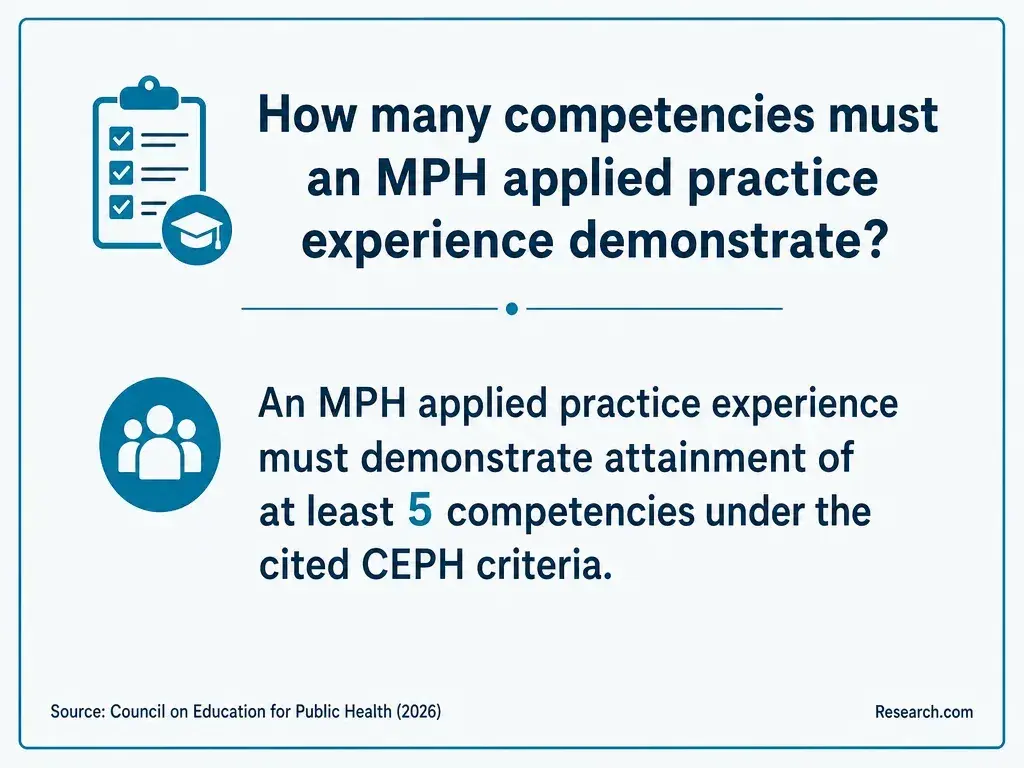
Accreditation does not usually determine whether you may withdraw from an individual course. Your institution controls that policy. The relevant accreditation question is whether your revised degree plan still satisfies the MPH program's approved curriculum and required learning experiences. A W cannot stand in for a competency, applied practice experience, or integrative learning experience that the program requires you to complete.
CEPH accreditation applies to a defined public health school, unit, or program; it is distinct from institution-level accreditation. Confirm that your particular MPH is within the stated scope, then ask the program which approved course or experience can replace the one you leave. This is especially important before assuming that coursework from another degree will count. Comparing budget-friendly online public health degrees can explain why similar course titles do not necessarily represent interchangeable degree requirements.
Speak with the MPH advisor about the degree plan and with financial aid about funding; neither office can reliably answer every question for the other. Bring your course schedule, award terms, and any relevant documentation. These questions will help you leave with a decision you can act on:
- If I withdraw on the proposed date, what notation will appear, and which deadline controls it?
- Is this course required or a prerequisite, and when is the next approved opportunity to complete it?
- Will this affect my practicum, integrative learning experience, graduation application, or time-to-degree limit?
- What will my revised tuition balance, aid eligibility, scholarship status, and SAP standing be?
- Are an incomplete, approved leave, reduced load, or course substitution available in my circumstances, and who must approve it?
If your advisor suggests transferring rather than withdrawing and returning, request a written evaluation of which credits would apply elsewhere. Admissions requirements can add time to that choice; public health master's reference requirement comparisons are relevant only if you are seriously preparing another application, not as a reason to miss your current deadline.
How can you compare MPH programs' withdrawal and completion policies?
For each MPH under consideration, request the policies that apply to your intended entry term and delivery format. Compare the same scenario at every school: a withdrawal from a required course partway through a term, followed by the earliest permitted retake. That reveals more than a headline completion time.
Compare the resulting W notation, refund timing, award-renewal terms, SAP treatment, course rotation, fieldwork sequencing, leave options, and maximum time to degree. Ask each school to identify which answer is published policy and which depends on individual approval. A school with cheaper tuition may be the costlier choice if a required course runs too rarely for your schedule.
Keep the comparison at the right degree level. Comparing public health undergraduate study options is useful for a separate bachelor's-level decision, but an undergraduate program comparison cannot establish an MPH school's graduate withdrawal, funding, or completion rules. For your current decision, rely on the MPH handbook and written answers from the responsible offices.
Other Things You Should Know About Public Health
An incomplete may allow you to finish agreed work later, but eligibility, deadlines, and the grade assigned if you do not finish vary by school. Ask the instructor and registrar for the written terms before choosing it.
Some schools offer medical or exceptional-withdrawal procedures. Documentation, academic-record changes, refunds, and aid adjustments are separate decisions; ask the appropriate offices what relief is available.
No. A W generally does not award credit or complete a degree requirement, even when the course remains visible on your transcript.
Yes. Employer plans may require course completion or a minimum grade and may seek repayment if those conditions are not met. Check your agreement with human resources before submitting the withdrawal.
- Foreign School Frequently Asked Questions - Students https://fsapartners.ed.gov/knowledge-center/faqs/foreign-school-frequently-asked-questions-students
- Satisfactory Academic Progress Policies | studentaid.gov https://studentaid.gov/understand-aid/eligibility/staying-eligible
- Satisfactory Academic Progress | Financial Aid & Scholarships https://financialaid.uoregon.edu/satisfactory_academic_progress
- Aid Recalculation Due to Registration Changes | About the University of Cincinnati https://www.uc.edu/about/financial-aid/starting/eligibility/aid-recalculation.html
- Federal Aid Policies | Johns Hopkins https://publichealth.jhu.edu/offices-and-services/office-of-student-affairs/financial-aid/federal-aid-policies
- Satisfactory Academic Progress Requirements for Federal and Pace Funded Financial Aid | Pace University New York https://catalog.pace.edu/undergraduate/general-university/financial-aid-scholarship-programs/important-policy-information/satisfactory-academic-progress-requirements-federal-pace-funded-financial-aid/
- Impact of Withdrawal on Students Receiving Federal Financial Aid | Student Account Services https://studentaccounts.ua.edu/impact-of-withdrawal-on-students-receiving-federal-financial-aid/
- Scholarship Renewal Requirements and Appeals | The University of Iowa https://financialaid.uiowa.edu/types-aid/scholarships/scholarship-renewal-requirements-and-appeals
- Maintaining Your Financial Aid - Current Students | Austin Community College District https://students.austincc.edu/financial-aid/maintaining-your-financial-aid/
- Return of Title IV Funds Policy | Financial Aid - Georgia Tech https://finaid.gatech.edu/return-title-iv-funds-policy