2027 MLIS Programs for Public Library Interlibrary Loan Careers

Co-Founder and Chief Data Scientist
Choosing an MLIS for interlibrary loan work means looking beyond a program's title. Public libraries need staff who can locate materials across institutions, manage requests, and help patrons obtain resources their local collection cannot provide.
The U.S. Bureau of Labor Statistics projects 2.6% employment growth for librarians and media collections specialists from 2025 to 2035, a modest outlook that makes relevant experience important. This guide shows prospective students and library employees which credentials, courses, work opportunities, and costs to compare before enrolling.
Key Things You Should Know
- An ALA-accredited master's is a strong choice for applicants seeking professional librarian positions, but many interlibrary loan assistant and technician jobs do not require one.
- Prioritize resource-sharing experience, catalog searching, copyright awareness, and patron service over an unverified "interlibrary loan concentration."
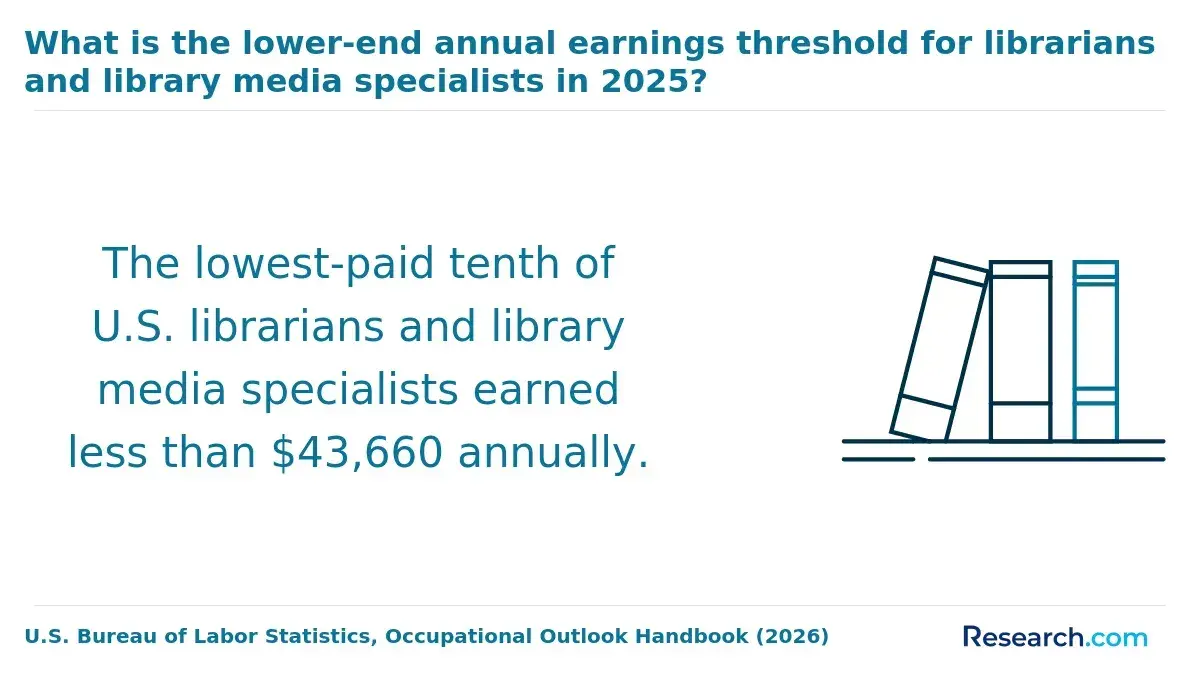
- The May 2025 median annual pay was $68,270 for librarians and media collections specialists, versus $44,580 for library technicians; neither figure is specific to interlibrary loan jobs.
What is an MLIS program for public library interlibrary loan careers?
It is a library and information science master's program whose coursework and applied opportunities prepare a student for resource sharing - not necessarily a degree with a formally named interlibrary loan track. Schools use titles such as Master of Library and Information Science (MLIS), Master of Library Science (MLS), and Master of Information. The degree name alone does not establish its accreditation or its fit for this work.
Interlibrary loan (ILL) lets a library request a loan or copy from another institution when it cannot supply a patron's requested item locally. Staff check citations and holdings, place and track requests, communicate with lending libraries, handle incoming materials, and explain availability or restrictions to patrons. In a small public library, this work may be one part of a broader circulation, reference, or collection-services position. A useful MLIS connects those workflows to cataloging, discovery, copyright, accessibility, privacy, and public service.
Is an ALA-accredited MLIS required for interlibrary loan librarians?
Not universally. Employers set qualifications for individual positions. An ALA-accredited master's is often an important credential for professional librarian openings, while ILL assistant, circulation, and library technician roles may accept other education and relevant experience. Read the actual posting rather than treating "ILL" as a single credential category.
The American Library Association accredits specific master's programs, not every degree offered by an accredited university. Before applying, check the current ALA directory for the specific program and confirm its status with the school. Accreditation does not establish that a school offers an ILL elective, a public library placement, or a particular online format.
If your immediate goal is an assistant position, library experience may be a less costly first step. If you want eligibility for a wider range of professional librarian roles or eventual department leadership, an ALA-accredited master's may be worth considering.
What degree pathways prepare you for interlibrary loan work?
The right pathway depends on the jobs you intend to pursue and the experience you already have. A general ALA-accredited MLIS or MLS with public-services and technical-services electives is often more useful than searching for a specialization whose name matches the job title. A related information degree can also develop relevant skills, but its eligibility for librarian postings must be checked program by program and employer by employer.
Current library employees can build experience with request processing before committing to graduate school. Career changers should look for a route into a public library - through paid work, a feasible placement, or an applied project - and compare its cost with their likely career options. Those weighing an online degree can also investigate a scholarship friendly online MLIS, while confirming actual eligibility and award terms with each school.
When reviewing a program, distinguish a documented concentration from relevant electives and from a self-designed project. Ask whether desired courses have run recently and whether a resource-sharing project can be completed with a public library; a course's presence in a catalog does not guarantee a seat when you need it.
Are online or campus-based MLIS programs better for interlibrary loan careers?
Neither format is inherently better. Online study can let an employed library worker keep gaining ILL experience, while campus study may make nearby placements and face-to-face collaboration easier. What matters is whether the format lets you complete relevant courses and obtain hands-on experience on a workable schedule.
Ask whether classes meet live, when essential electives are offered, and whether a practicum may take place at your current or a nearby library. Do not assume "online" means asynchronous, that an internship can be done remotely, or that residency-based tuition rules disappear. Applicants comparing regional options, for example, can use best value library programs in the South as a starting point, then verify each program's current tuition, fees, delivery rules, and accreditation directly.
What coursework should an MLIS program include for interlibrary loan?
Look for courses that explain how people find materials, how libraries describe and share them, and how staff make service decisions. The table connects common curriculum areas to actual ILL tasks; course titles and whether they are required or elective vary by program.
| Curriculum area | Why it matters for ILL |
| Reference and information services | Clarifying patron requests, checking citations, and explaining alternatives. |
| Cataloging, metadata, and discovery | Identifying the right edition or format and interpreting shared catalog records. |
| Collection development and resource sharing | Understanding when to borrow, purchase, refer, or use another access route. |
| Copyright and information policy | Recognizing when a copy request needs review under applicable rules and local procedures. |
| Library systems and assessment | Tracking requests, troubleshooting workflow problems, and using service data responsibly. |
A supervised placement or capstone can turn those subjects into evidence of ability. For example, a student might document a request workflow, analyze delays without exposing patron records, and propose an accessibility or communication improvement. Confirm that a program permits the project and that a host library can provide appropriate supervision.
What are the admission requirements for MLIS programs?
Applicants generally need a bachelor's degree and must submit the materials required by the particular graduate program. Depending on the school, those may include transcripts, a statement of purpose, recommendations, a résumé, or evidence of English-language proficiency. Minimum grades, test policies, deadlines, and prerequisite rules vary, so use the current admissions page rather than another school's checklist.
ILL experience can strengthen an application, but it should not be assumed to replace a required degree or document. In a statement of purpose, describe a concrete service problem you want to learn to solve - such as locating hard-to-find materials or making request updates clearer - and explain how the program's verified offerings support that goal. Applicants with unusual transcripts or other eligibility questions should request an individual review before paying an application fee.
How long do MLIS programs take and what do they cost?
Time to completion depends on required credits, course load, elective sequencing, and any practicum or capstone. Full-time study may take substantially less calendar time than studying alongside a library job, but a published completion estimate is not a promise that every needed elective will be available each term.
Compare programs using the same cost basis: required credits multiplied by the tuition rate that applies to you, plus mandatory fees. Then account for books, equipment, travel or placement expenses, and any additional term needed because of scheduling. Published tuition is not the same as total cost, and the amount you borrow may differ from both total cost and your out-of-pocket spending after aid or employer support.
A guide to library science masters cost can help frame comparisons, but obtain a current, itemized estimate from each institution. Ask its financial aid office which aid you qualify for at your intended enrollment level and start date; do not assume a scholarship, assistantship, or employer reimbursement is available. If you already work in ILL, compare the added career options an MLIS could provide with the cost and time away from paid work.
What interlibrary loan jobs can you get with an MLIS degree?
An MLIS can support professional librarian work involving ILL, but job titles do not map neatly to degrees. The table shows common role types and why checking each posting's duties and requirements matters.
| Role type | Typical ILL connection | Credential consideration |
| ILL or resource-sharing librarian | Coordinates requests, policies, partnerships, and service improvements. | Professional postings may require or prefer an ALA-accredited master's. |
| Public services or reference librarian | Helps patrons identify materials and access items beyond the local collection. | Master's requirements depend on the employer and position. |
| ILL assistant or library technician | Processes, tracks, ships, and receives requests. | Relevant experience may matter more than an MLIS; requirements vary. |
| Resource-sharing supervisor | Oversees staff, workflows, agreements, and service measures. | Supervisory experience and the posting's degree requirements both matter. |
For a first step, seek circulation, reference, or ILL processing experience and learn the request system your employer uses. Keep a portfolio example that shows sound judgment - such as a de-identified workflow improvement - rather than patron information. If you are still deciding among professional paths, compare library science jobs by specialization before paying for a degree aimed at work you may be able to enter without one.
How much do interlibrary loan and public library professionals earn?
The U.S. Bureau of Labor Statistics reports a May 2025 median annual salary of $68,270 for librarians and media collections specialists and $44,580 for library technicians. These are national occupational medians, not ILL-specific pay rates or starting salaries. They illustrate why the duties and classification of a target job matter when weighing graduate-school costs.
BLS projects 2025-2035 employment growth of 2.6% for librarians and media collections specialists and a 6.4% decline for library technicians. Neither projection predicts openings at a particular public library. Compare local postings, pay scales, benefits, and degree requirements with your current earnings; library science degree affordability and pay can provide additional context, but broad salary figures cannot establish your personal return on investment.
What certifications and skills improve interlibrary loan career prospects?
There is no single universal ILL certification that substitutes for a position's stated qualifications. Training in a library's resource-sharing system, shared-catalog searching, request verification, copyright procedures, shipping workflows, and accessible patron communication is more directly useful. Because systems and agreements differ, show that you can learn local procedures rather than relying on familiarity with one vendor.
Strong candidates also protect patron privacy, document exceptions clearly, and work constructively with lending partners when an item is unavailable. If you already have library access, ask to observe a request from patron inquiry through return or delivery, then practice explaining its status in plain language. That experience can help you test your interest in the work and identify the coursework you actually need.
Other Things You Should Know About Library Science
No. A hold usually reserves an item available through a library's own collection or system. Interlibrary loan typically requests an item from a separate participating institution. Local consortium arrangements can make the distinction less visible to patrons.
Do not assume so. Ebook licenses and lending arrangements differ from those for physical books, and a library may not be able to fill a particular request. Ask the library about its available digital-access alternatives.
Policies vary. Some libraries absorb costs, while others may pass on certain lending or replacement charges. Staff should explain any potential patron charge before proceeding under local policy.
Staff may verify the citation, try another eligible lender, suggest a different edition or format, or consider a purchase recommendation. The available options depend on the item, participating libraries, and local policy.
References
- Librarian 1 - Commonwealth Careers https://careers.employment.pa.gov/Home/GetJobNameInfo
- Library Jobs FAQ - State Library of North Carolina https://library.nc.gov/nc-libraries/current-library-jobs/library-jobs-faq
- School of Information Studies Department Courses | Queens College Catalog https://qc-graduate.catalog.cuny.edu/departments/GLIS-QC/courses
- Master of Library and Information Science (MLIS) | umd.edu https://info.umd.edu/academics/masters-programs/master-of-library-and-information-science/
- Accredited Programs | ALA https://www.ala.org/educationcareers/accreditedprograms
- The Skills You'll Actually Learn in an MLS / MLIS Program | mastersinlibraryscience.org https://www.mastersinlibraryscience.org/articles/skills-you-learn-in-mls-program/
- Home - Interlibrary Loans - LibGuides at American Library Association https://libguides.ala.org/Interlibraryloans
- Online vs. In-Person Library Science Programs | Librarian Certification https://www.librariancertification.com/online-vs-in-person-library-science-programs/
- State/Regional Certifications (primarily for public library staff) | ala-apa.org https://ala-apa.org/certification-news/stateregional-certifications/
- Can my ILS integrate with WorldShare ILL or Tipasa? | OCLC Support https://help.oclc.org/Resource_Sharing/WorldShare_Interlibrary_Loan/Troubleshooting/Will_my_ILS_integrate_with_WorldShare_Interlibrary_Loan