2027 MHA vs MS in Health Policy for a Government Career

Co-Founder and Chief Data Scientist
A government healthcare career can mean managing a public clinic, administering Medicaid operations, or evaluating whether a health policy works. Those jobs call for different preparation, even when their titles sound similar. An MHA usually emphasizes organizational leadership; an MS in Health Policy usually emphasizes policy analysis and research.
For current public-sector employees and career changers, this comparison explains where each degree fits, what employers may require beyond it, and how to assess an online program without assuming a graduate degree will secure a government job.
Key Things You Should Know
- Choose an MHA for healthcare operations, budgets, and leadership; favor an MS in Health Policy for policy research, evaluation, and legislative or regulatory analysis.
- Government hiring turns on the duties and qualifications in a specific posting, not the degree title alone; relevant experience and quantitative or program-management skills can matter more than the distinction between these degrees.
- Budget for the full program, not tuition alone. For salary context, the median wage across all management occupations was $126,520 in May 2025, not an expected salary for either degree's graduates.
What is the difference between an MHA and an MS in Health Policy for government careers?
A Master of Healthcare Administration (MHA) primarily teaches students to run healthcare organizations and programs. An MS in Health Policy primarily teaches them to examine how health systems are financed, regulated, and improved. Both can support government work, but the job's daily tasks should drive the choice.
The comparison below describes common emphases, not requirements shared by every university. Course catalogs and applied projects provide a more reliable test than the degree name:
| Decision factor | MHA | MS in Health Policy |
| Typical focus | Operations, finance, quality, and organizational leadership | Policy design, research methods, economics, and evaluation |
| Stronger fit | Managing a public hospital, clinic network, or health program | Analyzing Medicaid policy, regulations, access, or program results |
| Potential gap | May offer limited advanced research-methods training | May offer limited training in supervising staff and running services |
Neither degree is the same as health information management, which focuses more directly on health data, records, and information systems. If that is the work you want, consider healthcare leadership education compared with health information management before applying.
Which degree is better for federal, state, or local government jobs?
Neither is universally better. An MS in Health Policy often aligns more directly with policy analyst, research, and evaluation positions. An MHA often aligns more directly with agency operations, public healthcare delivery, contracts, and program leadership. Federal, state, and local employers may each hire for both kinds of work.
At the federal level, compare the duties and education language in the actual vacancy announcement; a posting may accept several fields or emphasize specialized experience instead.
State Medicaid and health departments combine policy development with implementation, while local health departments may value hands-on management of services and community partnerships. Government procurement rules, public budgeting, and accountability also mean that private-sector management training does not transfer unchanged.
If your goal is broader agency management rather than healthcare-specific administration, an MPA may be a closer match. An MBA can build finance and operations skills, but its private-sector orientation requires careful comparison with government hiring criteria.
For a cost-conscious comparison, review low-tuition MBA routes for healthcare management careers alongside MHA and public-administration options.
What careers can you pursue with an MHA or MS in Health Policy?
An MHA can support progression into public hospital administration, health department operations, quality improvement, or program management. An MS in Health Policy can support health policy analysis, program evaluation, legislative support, or research.
These are pathways, not jobs reserved for graduates of either degree; employers may also accept public health, economics, public administration, or related preparation.
Your starting experience matters. A clinic supervisor moving toward a county health program may be able to apply existing staffing and budget skills through an MHA. A data analyst moving toward Medicaid evaluation may gain more from an MS with strong quantitative methods. Someone entering healthcare from an unrelated field may first need relevant projects, internships, or entry-level work.
For roles centered on records governance or health data systems, review accredited online health information management programs rather than assuming either degree supplies that specialist training.
Look beyond course titles for assignments that resemble government work. An MHA program might have students build a service budget, improve access across clinics, or manage organizational change.
An MS program might require statistical analysis, a policy brief, or an evaluation plan. Government-focused electives in Medicaid, health law, population health, or public finance can strengthen either degree.
Ask whether students can complete a practicum or capstone with a public agency and whether working professionals can use their own agency as a project site. Also check the depth of methods training: interpreting an evaluation is different from designing one.
To examine MHA programs through a recognized healthcare-administration lens, compare CAHME-accredited master's programs in healthcare administration, then inspect each program's actual public-sector coursework.
Applicants generally need a bachelor's degree and may be asked for transcripts, a résumé, a statement of purpose, and recommendations. Test policies, prerequisites, and experience expectations vary by school.
An MS with substantial statistics or economics coursework may expect more quantitative preparation; an MHA may place greater weight on professional or leadership experience. Neither distinction is a universal admission rule.
Use your statement to connect past work to a specific government function - not simply to a desire to "improve healthcare." If you do not yet have a bachelor's degree, that comes before either master's application; rolling enrollment options for healthcare administration undergraduates may help you plan that earlier step.
Check each graduate program's published requirements before paying an application fee.
Many full-time master's programs are designed around roughly two academic years, while part-time study takes longer; accelerated formats may shorten the calendar by increasing course intensity. Do not infer the time commitment from the word "online."
A working applicant should check course sequencing, practicum hours, and whether required classes run every term. One-year master's options in healthcare administration can provide a comparison point, but speed is useful only if the schedule and curriculum fit your goal.
There is no reliable single price for either degree. Compare each school's total required credits and published tuition with mandatory fees, materials, any travel or practicum costs, and the cost of borrowing.
A public employee should ask whether the agency offers tuition assistance and whether it requires continued service afterward. Before enrolling, estimate the amount you must pay after employer support; public-sector salary schedules may limit how quickly that investment pays back.
An online degree can be a credible option when it comes from an appropriately accredited institution and develops the skills the vacancy requires. Do not assume that online delivery itself improves, or disqualifies, a candidate.
A hiring office may focus on the institution, degree field, coursework, and documented experience; read the announcement rather than relying on a school's marketing language.
For working public-sector professionals, scheduling fit is part of program quality. Ask about live classes, group-work hours, in-person visits, internship placement, and access to faculty and career services.
When comparing online master's options for faster healthcare management study, confirm that an accelerated pace leaves room to produce strong projects relevant to your intended government role.
Start with institutional accreditation recognized by the U.S. Department of Education. Then examine program-specific accreditation where applicable. The Commission on Accreditation of Healthcare Management Education (CAHME) accredits eligible healthcare management graduate programs; its absence from an MS in Health Policy does not, by itself, indicate a poor policy degree.
Some policy-focused programs sit within public health schools, where Council on Education for Public Health accreditation may be relevant to the school or program.
Check accreditation status directly with the accreditor and confirm which specific program and delivery format it covers. If you are comparing an undergraduate route first, the same institutional-accreditation check applies; this guide to choosing an accredited university for healthcare administration study addresses that earlier decision.
Most nonclinical health policy analyst and healthcare program-management roles do not carry a single profession-wide license. Specific jobs can differ: nursing, social work, and other clinical roles retain their own licensing rules, and certain facility-administrator positions may have state requirements. A graduate degree does not replace any license named in a vacancy.
Optional credentials in project management, healthcare management, or analytics may help demonstrate a skill, but check whether the employer actually values one before paying for it.
If you are still building the education required to apply for management-track positions, undergraduate healthcare administration programs with compressed terms are a separate pathway, not a substitute for a regulated professional license or for a required graduate degree.
What are the salaries and job outlooks for MHA and MS Health Policy graduates?
There is no defensible single salary or job-growth rate for graduates of either degree. Government policy analysts, program managers, and healthcare executives occupy different jobs and pay systems.
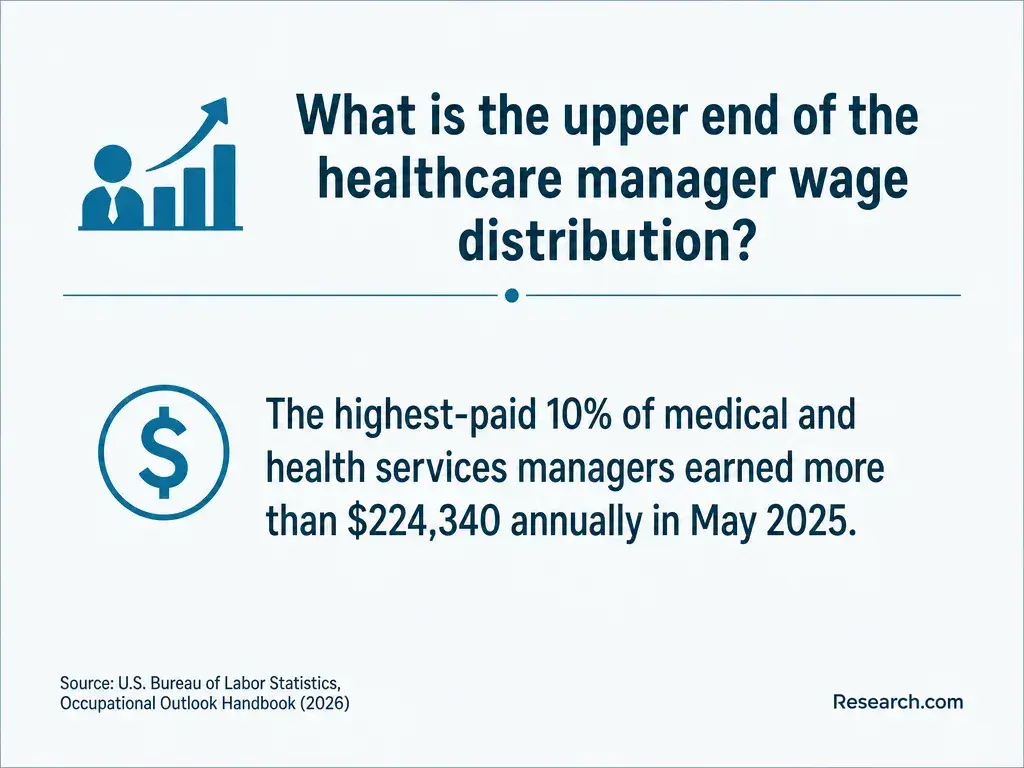
For broad context, the U.S. Bureau of Labor Statistics reports a May 2025 median annual wage of $126,520 across all management occupations and projects about 1.1 million management openings per year, on average, from 2025 to 2035. Those figures include many industries and experience levels; they are neither government-healthcare figures nor predicted outcomes for new graduates.
For a useful personal estimate, examine posted pay ranges for your target agency, location, and job level, then compare required qualifications with your résumé.
A doctorate may be relevant to a later research or executive goal, but it is not the default next step for government advancement. Compare the added expense through healthcare administration doctorate tuition comparisons only if the roles you want actually reward that credential.
Other Things You Should Know About Healthcare Administration
Some programs allow it with faculty and employer approval. Ask about data confidentiality, agency permissions, and whether the project meets academic requirements before assuming you can use workplace information.
Government employment may qualify for Public Service Loan Forgiveness, but eligibility also depends on the loan type, repayment plan, employer, and qualifying payments. Confirm the current rules before treating forgiveness as part of your financing plan.
Not for every position. Some federal jobs require a background investigation or clearance, while many state and local roles do not. The vacancy announcement should specify the condition.
Yes, but contractor experience does not automatically confer government employee status or hiring preference. Describe the agency-relevant results of your work and apply through the required hiring process.
- General Schedule Qualification Policies | U.S. Office of Personnel Management https://www.opm.gov/policy-data-oversight/classification-qualifications/general-schedule-qualification-policies/
- Understanding Evidence-Based Public Health Policy - PMC https://pmc.ncbi.nlm.nih.gov/articles/PMC2724448/
- Full article: Political Analysis for Health Policy Implementation | tandfonline.com https://www.tandfonline.com/doi/full/10.1080/23288604.2019.1625251
- 5 High-Paying Master's in Health Care Administration Jobs to Consider - Cornell Brooks Public Policy https://publicpolicy.cornell.edu/masters-blog/5-high-paying-masters-in-health-care-administration-jobs-to-consider/
- Are MPH Graduates Aligned with Today's Job Market? | Columbia University Mailman School of Public Health https://www.publichealth.columbia.edu/news/are-mph-graduates-aligned-todays-job-market
- How to Choose the Right Master of Public Health Program for You | Fairfield University https://www.fairfield.edu/news/insights/nursing-health-studies/how-to-choose-the-right-public-health-mph-program-for-you.html
- MHA vs MPA - NYU Wagner's Online MHA - New York University https://onlinemha.wagner.nyu.edu/insights/comparing-master-health-administration-vs-master-public-administration
- Public Health, Policy, and Foundations - Career Advancement https://careeradvancement.uchicago.edu/careers-in/healthcare-and-global-health/public-health-policy-and-foundations/
- Master of Science in Public Health (MSPH) in Health Policy | jhu.edu https://publichealth.jhu.edu/academics/msph-in-health-policy
- Congress and the Executive Branch and Health Policy | KFF https://www.kff.org/state-health-policy-data/health-policy-101-congress-and-the-executive-branch-and-health-policy/