2027 Is an Online Ed.D. in Leadership and Learning in Organizations a Good Fit for School System Learning and Development Managers?
Audited and Verified:
Our Editorial and Data Verification Process
Research.com uses government datasets, official education statistics and primary institutional information to support its career and degree guides. Our review process checks factual accuracy, occupational definitions, source dates and the requirements associated with the credentials discussed.
How This Article Was Fact-Checked
Our editorial team verifies salary estimates, employment projections, education requirements and program information against original data providers and official organizations. Salary figures are checked against the relevant occupational definitions and reporting periods. Information about licensure, accreditation and required in-person training is reviewed separately.
Fact-checked and verified on:

Co-Founder and Chief Data Scientist
School system learning and development managers often lead professional learning across schools without controlling staffing, schedules, or classroom practice. An online Ed.D. in Leadership and Learning in Organizations may help them study those organizational barriers and evaluate improvements - but it is a substantial commitment, not an automatic route to promotion. This guide is for district professionals deciding whether doctoral study matches their responsibilities and next career move. It explains what to look for in the curriculum, how the degree compares with other options, and which costs, credentials, and workplace constraints to verify before applying.
Key Things You Should Know
- Best fit: Managers who already lead districtwide learning or change initiatives and want stronger skills in organizational diagnosis, adult learning, and applied evaluation.
- Not a licensure shortcut: A broadly focused organizational learning Ed.D. does not, by itself, qualify someone for principal or superintendent licensure; state and program rules control eligibility.
- Career data needs context: The U.S. Bureau of Labor Statistics reports a $133,000 median annual salary for training and development managers in 2025, but that occupation spans sectors and does not predict a school district salary or an Ed.D. graduate's earnings.
Is an online Ed.D. in Leadership and Learning in Organizations a good fit for school system managers?
Yes, potentially - if your work centers on improving how adults learn and how a school system implements change. The strongest case is not that your position has "manager" in its title. It is that you have responsibility for problems such as uneven professional learning across schools, limited transfer of training into practice, or leadership development that must work within district budgets and governance.
A useful test is whether you can influence an organizational decision and examine evidence about it. For example, a manager coordinating teacher and staff development across departments might benefit from studying why participation, implementation, and outcomes differ among sites. That inquiry would still require district cooperation; a doctorate cannot grant authority over principals, employee schedules, or records.
The choice changes with your goal. If you mainly need stronger workshop design or a specific data-analysis skill, targeted coursework and a supervised district project may be faster and less expensive. If your goal is a regulated school leadership post, compare state-approved administrator preparation first. If you hope to conduct original research as a primary career activity, a research-oriented PhD may fit better than a practice-oriented Ed.D.
Before applying, write down one recurring district learning problem, the decisions you can actually influence, and the evidence you could access with permission. If those elements are unclear, gaining broader project responsibility may be more valuable than enrolling immediately.
What does an online Ed.D. in Leadership and Learning in Organizations teach?
A practice-oriented Ed.D. typically combines leadership study with adult learning and methods for investigating organizational problems. For a school system manager, its value lies in connecting those subjects: identifying a performance gap, considering whether learning is the appropriate response, working with stakeholders, and evaluating an intervention without overstating its effects.
Look beyond course labels. A useful program should help you distinguish a training problem from barriers such as inadequate planning time, conflicting policies, or weak implementation support. It should also develop your ability to select credible measures and explain findings to district leaders. An applied project may offer practice, but its format, faculty oversight, and approval requirements vary by institution.
If you already hold an education specialist degree, investigate Ed.D. pathways building on education specialist study. Ask each institution whether prior study meets an admission condition, fulfills a doctoral requirement, or neither; those are separate decisions.
What careers can this Ed.D. prepare school system learning managers for?
The degree is most relevant to advancement that builds on existing district experience, not an immediate switch into any senior role. The table separates related jobs by what employers may need the candidate to demonstrate.
| Potential role | Relevant experience and limits |
| District professional learning or talent development leader | Experience coordinating adult learning, managing resources, supporting implementation, and evaluating programs matters alongside the degree. |
| Instructional coordinator or curriculum leader | Curriculum expertise and, in some jurisdictions or positions, educator credentials may be more important than a general organizational learning doctorate. |
| Organizational development consultant | Evidence of diagnosis, facilitation, change implementation, and client work is important; district experience may transfer, but consulting skills must be demonstrated. |
| Higher education learning or administration leader | Some organizational learning skills transfer, while institution-specific operations and hiring expectations differ from those of K-12 districts. |
If moving beyond K-12 is your goal, explore higher education leadership through an organizational leadership Ed.D. while checking the experience requirements of actual vacancies. For internal advancement, a strong application pairs doctoral work with documented responsibility for a cross-school initiative, a defensible evaluation, and evidence of collaboration - not simply the new credential.
Online study can let a district manager remain employed and investigate problems in their own system. It does not necessarily mean self-paced study: programs may require live classes, cohort meetings, group projects, or campus convenings. Campus-based study may make regular in-person faculty interaction easier but impose commuting or relocation demands.
Compare programs on their actual calendars rather than delivery labels. Ask for live-session times, attendance rules, required travel, team-meeting expectations, and the periods when project work intensifies. Then check those commitments against board meetings, professional development days, and the start-of-year workload. If time is the deciding constraint, comparing the fastest online Ed.D. formats is a starting point, not proof that a shorter schedule will be manageable.
Course titles and required sequences vary, but relevant areas include adult learning, organizational culture and change, leadership, research methods, and program evaluation. Some programs also offer instructional design, learning analytics, or talent development; do not assume these are required - or available as electives - without checking the catalog for your entry term.
For a district manager, the important comparison is depth and application. An adult learning course should help you examine how staff use new practices after training. Methods coursework should prepare you to judge whether district evidence supports a conclusion, rather than treating attendance or satisfaction as proof of improved instruction. Ask to see recent course descriptions and the required doctoral project so you can tell whether the sequence builds toward work you expect to lead.
Requirements are program-specific. Applicants commonly need to document prior graduate study and professional experience, and may be asked for transcripts, recommendations, a statement of purpose, or an interview. A master's in education, a particular managerial title, a test score, or a fixed number of leadership years should not be assumed to be universal requirements.
A school system applicant can make the strongest case with specific evidence: the scope of learning initiatives led, decisions made, stakeholders engaged, and a problem suitable for doctoral inquiry. Describe results accurately; do not claim that training caused student or staff outcomes without adequate evidence.
If you have unfinished doctoral work, examine Ed.D. programs considering previous doctoral coursework, then request a written evaluation from each institution. Credits that support admission are not necessarily transferable credits that reduce the Ed.D.'s requirements, cost, or duration.
There is no reliable universal timeline or price. Required credits, cohort pacing, project rules, tuition structure, fees, and time away from work differ by program. A school district's reimbursement policy can also change the amount you ultimately pay without changing the university's charges.
Build a comparison using each school's published tuition and required credits or terms, then add mandatory fees and any campus-visit travel. Check whether the advertised schedule includes the doctoral project and what continued enrollment costs if it takes longer. Finally, obtain your employer's reimbursement rules in writing, including annual limits, eligible expenses, grade conditions, and repayment obligations. For an initial comparison, review education doctoral degrees by tuition level, but calculate the full cost of the specific programs you would attend.
Verify that the degree-granting institution holds recognized institutional accreditation and that the accreditation covers the institution offering the program. Check the institution's current status with its accreditor and confirm the exact degree designation with the university.
Accreditation is a baseline quality and eligibility check, not evidence that an organizational learning Ed.D. prepares graduates for a particular school license. If a program advertises specialized recognition or licensure preparation, identify its precise scope and ask the relevant state authority whether it meets the requirements for your intended position.
It depends on the position and state. A district role focused on employee training or organizational development may have different requirements from an instructional leadership, principal, or superintendent position. An Ed.D. in Leadership and Learning in Organizations should not be treated as a substitute for a state-approved administrator preparation pathway unless the institution and licensing authority confirm that eligibility.
Start with the written qualifications for your target district job, then check the relevant state education agency's rules and the program's licensure disclosure. Optional learning and development certifications may help demonstrate a particular skill, but they are distinct from educator licensure and should be assessed against the employer's actual preferences.
What salary and job outlook can Ed.D. graduates expect?
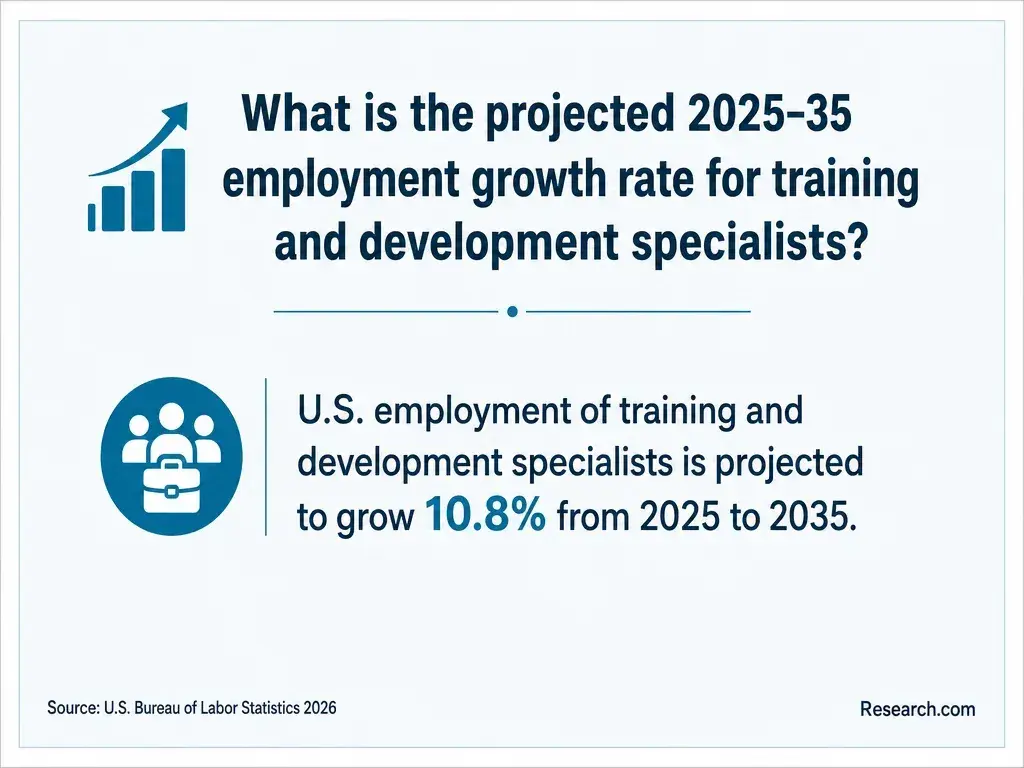
No occupational statistic identifies the salary of graduates from this degree. The U.S. Bureau of Labor Statistics reports a 2025 median annual salary of $133,000 for training and development managers and projects 6.4% employment growth for that occupation from 2025 to 2035. Those figures describe a broad occupation across employers, not a promised district salary or the effect of earning an Ed.D.
A school system's pay schedule, job classification, budget, and promotion rules are more useful for your personal estimate. Compare current openings and internal advancement policies with the total cost of study. If the roles you want do not require or reward a doctorate, a smaller investment in project leadership, evaluation skills, or administrator preparation may offer a clearer route.
Other Things You Should Know About EdD Leadership
Possibly. Discuss the project schedule with faculty early so data collection and district approvals do not depend on access during a break or a particularly busy term.
Potentially, but first clarify who owns the materials and data, what the vendor agreement permits, and whether the district will authorize the evaluation.
Ask your district and program before doing so. A useful board briefing may need to omit identifiable information and distinguish observed results from recommendations.
Tell your faculty advisor promptly. A narrower question, revised timeline, or different approved setting may be possible, but changes to an academic project require program approval.
- Cost of Attendance (Budget) | 2025-2026 Federal Student Aid Handbook https://fsapartners.ed.gov/knowledge-center/fsa-handbook/2025-2026/vol3/ch2-cost-attendance-budget
- Types of Financial Aid: Grants, Work-Study, and Loans | studentaid.gov https://studentaid.gov/understand-aid/types
- MSE vs. EdS vs. EdD in Ed Leadership: Which Do You Need? | Arkansas State University Online https://degree.astate.edu/online-programs/education/eds/mse-vs-eds-vs-edd-educational-leadership/
- Synchronous Online Courses - Academic Affairs | Coles College of Business https://campus.kennesaw.edu/faculty-staff/academic-affairs/curriculum-instruction-assessment/digital-learning-innovations/faculty-learning-scientists/course-facilitation/synchronous-online-courses.php
- How Do Online Classes Work? What to Expect as an Online Student - Online Degrees & Programs | Kent State University https://onlinedegrees.kent.edu/blog/how-do-online-classes-work-what-to-expect-as-an-online-student
- Doctor of Education in Organizational Leadership, Culture and Change | Thomas Edison State University https://www.tesu.edu/degrees-programs/doctoral/edd.php
- Online Ed.D. in Leadership and Learning in Organizations | VU-EDU https://peabodyonline.vanderbilt.edu/edd-in-organizational-learning/
- Ed.D. vs. Ph.D. in Education: What's the Difference? - TX Wes https://doctorofeducation.txwes.edu/articles/edd-vs-phd-in-education/
- Ed.S. vs. Ed.D.: Which Advanced Education Path Is Right for You? | University of the Cumberlands https://www.ucumberlands.edu/blog/eds-vs-edd
- UNC EdD Online: Organizational Learning and Leadership https://online.unc.edu/online-doctoral-programs/online-edd-organizational-learning-and-leadership/