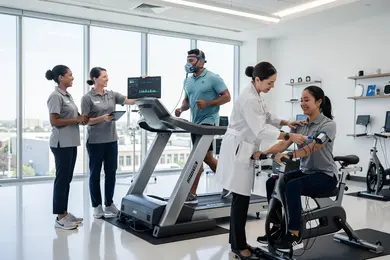
2027 Is an Exercise Science Master's Degree Worth It? ROI, Salary & Career Impact

Co-Founder and Chief Data Scientist
A master's degree in exercise science can strengthen your path into clinical exercise physiology, sports performance, wellness leadership, rehabilitation support, research, and related health fields—but it is not automatically worth the cost for every student. The decision depends on the program price, your current credentials, the jobs you are targeting, and whether the degree leads to higher pay, licensure eligibility, specialized certification, or a clearer promotion path.
The numbers matter. According to the Bureau of Labor Statistics, professionals with this advanced degree earn a median salary approximately 20% higher than those with only a bachelor's degree, while average student debt can surpass $40,000. Employment in related health and fitness occupations is projected to grow 11% by 2032, which creates opportunity but does not guarantee a high-paying role for every graduate.
This guide breaks down the cost, financial aid options, salary expectations, admissions requirements, online-versus-campus value, career paths, employer perceptions, and long-term return on investment for an exercise science master's degree. Use it to compare programs realistically and decide whether graduate study fits your career plan.
Key Things to Know About the Value of Exercise Science Master's Degree
- Programs typically require a bachelor's degree with prerequisites in biology or kinesiology, featuring 2-year curricula blending research, clinical practice, and elective specialization for career preparedness.
- Graduates see median salaries ranging $50k-$70k; roles include fitness directors, therapists, or researchers, with higher salaries linked to certifications and experience.
- Program cost, flexibility, and reputation affect ROI; assessing long-term growth potential and employer recognition aids in selecting the best fit for career ambitions.
How Much Does a Exercise Science Master's Degree Cost?
The cost of an exercise science master's degree depends mainly on school type, residency status, delivery format, program length, and whether you must pay for housing while enrolled. Because the field's projected employment growth is 15% by 2030, many students see graduate study as a way to move into higher-skill roles—but the degree only makes financial sense if the total cost aligns with your expected earnings and career goals.
When comparing programs, look beyond tuition. Fees, textbooks, lab supplies, technology charges, clinical or practicum travel, housing, and lost work hours can change the true price substantially.
- Public in-state exercise science programs: Resident tuition usually ranges from $8,000 to $20,000 annually. These programs are often the most cost-effective option, though students should still account for mandatory fees such as technology charges between $500 and $1,000 each year.
- Public out-of-state exercise science programs: Nonresident tuition generally ranges from $15,000 to $35,000 per year. Textbooks and lab supplies typically add $1,200 to $1,500 annually, and relocation can make the total cost much higher.
- Private exercise science programs: Tuition at private institutions commonly falls between $25,000 and $45,000 a year. Private programs may offer smaller cohorts, specialized labs, or stronger professional networks, but they rarely provide the same in-state tuition advantage as public universities.
- Online exercise science master's programs: Online tuition varies from $10,000 to $30,000 total. Online study may reduce housing and commuting costs, but students should check for technology fees, lab-kit costs, campus residency requirements, and practicum placement expectations.
- Housing and living expenses: Depending on location, living costs range from $12,000 to $20,000 annually. On-campus housing may cost more than off-campus options, while off-campus living can add transportation expenses.
- Program length and format: Most programs last two years. Part-time formats can make monthly costs easier to manage but may extend total fees and delay salary gains. Accelerated programs can shorten time to completion but may limit your ability to work while studying.
A practical cost comparison should include total tuition, required fees, living expenses, expected borrowing, and whether the curriculum supports the job you want. For example, a student seeking clinical exercise physiology may need strong practicum access, while a student focused on wellness leadership may prioritize affordability and flexible scheduling. Some students comparing different healthcare education timelines may also review an accelerated CMA program, but that route leads to a different credential and career track.
What Financial Aid and Scholarships Are Available for Exercise Science Master's Students?
Financial aid can significantly change the net cost of an exercise science master's degree. Nearly 85% of graduate students use some form of financial aid, so applicants should compare funding packages before committing to a program, not after enrollment.
Graduate aid usually comes from a mix of federal loans, university funding, assistantships, fellowships, employer support, and outside scholarships. The best strategy is to apply early, ask each department about discipline-specific funding, and calculate how much aid reduces actual borrowing rather than just delaying payment.
- Federal graduate loans: Graduate students commonly use federal loan options to finance tuition and approved education expenses. Review interest accrual, origination fees, repayment terms, and borrowing limits before accepting the full amount offered.
- Institutional grants and scholarships: Many universities offer merit-based or need-based awards for graduate exercise science students. These awards vary by institution, and some are tied to academic performance, research interests, faculty labs, or enrollment status.
- External scholarships: Professional organizations such as the American Kinesiology Association and National Strength and Conditioning Association provide discipline-specific scholarships. Competitive applications often require essays, recommendation letters, transcripts, and a clear explanation of career goals.
- Assistantships and fellowships: Graduate assistantships may provide stipends and tuition waivers in exchange for teaching, research, lab management, or administrative work. Fellowships typically provide financial support without the same work requirement and are often awarded based on academic merit.
- Employer tuition assistance: Students already working in fitness, wellness, healthcare, athletics, or rehabilitation settings should ask whether their employer reimburses graduate coursework. Employer support can be especially valuable for part-time or online students.
- Scholarship search resources: Websites like Fastweb and Scholarships.com can help identify awards, but applicants should prioritize exercise science, kinesiology, sports medicine, health promotion, and rehabilitation-related scholarships because they are more closely aligned with the degree. Students comparing allied health funding options may also look at medical coding classes to understand how shorter healthcare training programs handle affordability.
Before accepting an offer, ask the program three questions: how many students receive assistantships, whether funding continues into the second year, and whether online students qualify for the same awards as campus students. A lower-cost program with modest aid can be a better financial choice than a higher-priced program with a larger but incomplete scholarship.

What Is the Average Salary for Exercise Science Master's Degree Holders?
Salary outcomes for exercise science master's degree holders vary by role, employer, location, specialization, certification, and experience. The degree can improve earning potential, but it does not produce the same financial return in every job. Clinical, corporate wellness, sports performance, research, and leadership roles often pay differently even when they require similar academic preparation.
Based on data from sources such as the Bureau of Labor Statistics and LinkedIn Salary, master's-level graduates often see stronger salary progression than professionals who stop at the bachelor's level.
- Starting salary advantage: Graduates with a master's degree often begin around $50,000 to $60,000 annually, roughly 10-15% higher than peers with only a bachelor's degree who average near $45,000. The advantage usually comes from deeper training in physiology, assessment, research methods, program design, and evidence-based practice.
- Mid-career growth: By mid-career, master's degree holders can earn $65,000 to $80,000. Bachelor's degree holders typically earn 10-20% less at this stage, especially when they remain in general fitness or entry-level wellness roles.
- Senior-level earnings: Experienced professionals with a master's degree may surpass $90,000, particularly in leadership, clinical, research, corporate wellness, or specialized performance roles. Without graduate training, salary growth may plateau earlier in some organizations.
- Employment sector: Private industry positions often pay more than public or nonprofit roles. Sports performance companies, corporate wellness vendors, healthcare systems, and rehabilitation organizations may compensate advanced skills differently.
- Geographic variation: Compensation varies widely by location. Metropolitan coastal areas tend to offer higher salaries, while rural regions or areas with fewer specialized health and performance facilities generally pay less, even for master's-prepared candidates.
Students should compare salary by target occupation rather than relying on one broad average. A master's degree used for clinical exercise physiology, strength and conditioning, or wellness management may produce a different outcome than the same degree used for general fitness employment.
One graduate described the degree as valuable because it helped him move into a management role with a salary boost after balancing demanding coursework with part-time work. He reflected, "The degree wasn't just about pay-it transformed my approach to health sciences and opened opportunities I hadn't imagined." That experience shows an important point: the strongest salary outcomes usually come when the degree is paired with relevant experience, networking, and a clear career direction.
How Does a Exercise Science Master's Degree Impact Long-Term Career Advancement?
An exercise science master's degree can raise your career ceiling by qualifying you for roles that require advanced knowledge, research literacy, program leadership, or specialized clinical and performance skills. Its long-term value is strongest when the program aligns with a specific career track rather than serving as a general credential.
- Promotion rates: Master's graduates often advance faster than bachelor's-only candidates when employers need evidence of advanced training. This is especially relevant for mid-level and senior roles involving program design, supervision, data analysis, or clinical decision-making.
- Leadership roles: Many programs include coursework in leadership, assessment, research interpretation, and applied program development. These skills can support supervisory or managerial roles in clinical, athletic, corporate wellness, and community health settings.
- Access to senior positions: In fields such as physical therapy support environments, sports performance, health research, and clinical exercise physiology, graduate training can help candidates compete for senior roles or specialized responsibilities.
- Professional credibility: A master's degree can signal deeper subject-matter expertise to employers, clients, athletes, patients, and interdisciplinary teams. However, credibility also depends on certifications, experience, outcomes, and communication skills.
- Expanded networks: Graduate programs can connect students with faculty mentors, alumni, practicum sites, research teams, and local employers. These relationships can influence internships, job placement, and long-term career mobility.
- Employer preferences: Some organizations prefer or require master's-prepared candidates for specialized roles. Others place greater weight on certifications, licensure, or documented experience, so students should review job postings before enrolling.
- Industry variance: The degree is more important in clinical, research, sports performance, and leadership tracks than in general fitness instruction. For entry-level fitness roles, a master's may not provide enough salary lift to justify a high-cost program.
- Continuing education pathways: A master's can support later doctoral study or professional credentials such as CSCS or ACSM credentials. Students interested in clinical exercise physiology should also compare curriculum requirements, practicum support, and certification preparation when evaluating an exercise physiologist online degree pathway.
Students considering broader healthcare advancement may also research affordable graduate routes, including cheap online DNP programs, but those programs prepare learners for different nursing-focused roles. The key is to choose the graduate degree that matches the credential expectations of your intended profession.
What Is the Return on Investment (ROI) of a Exercise Science Master's Degree?
The return on investment of an exercise science master's degree depends on how much you pay, how much income you give up while studying, and whether the degree moves you into a better-paying or more stable role. A strong ROI is more likely when students choose an affordable program, avoid excessive debt, build experience during school, and target occupations that reward graduate training.
- Total program cost: Include tuition, fees, textbooks, lab costs, transportation, housing, and any required campus visits or practicum expenses. Public universities often cost less than private institutions, which can significantly improve financial return.
- Lifetime salary premium: Holding a exercise science master's degree typically raises earning potential by 15% to 30% over a bachelor's degree, depending on specialization and career path in areas such as kinesiology, physical therapy-related settings, or sports science.
- Payback period: The average time to recover education costs through increased earnings ranges from three to seven years. Clinical and research positions may offer faster returns, while administrative or less specialized roles may take longer to break even.
- Opportunity cost: Time spent studying can reduce full-time work income, especially for students who enroll in intensive campus-based programs. Part-time and online formats may lower opportunity cost, but they can also extend the time before you receive the full career benefit.
- Best-case ROI: Graduates from well-known public programs who enter high-demand clinical, performance, research, or corporate wellness roles may recover costs more quickly and see stronger long-term gains.
- Worst-case ROI: Students who borrow heavily for a less recognized program and then enter lower-paid jobs may face a payback period over a decade. This risk is higher when the degree is not tied to a specific job target or required credential.
A realistic ROI calculation should compare your expected post-graduation salary with your current salary, not just with national averages. It should also account for debt payments, certification costs, relocation, and whether the program offers internships or assistantships that improve employability.
One graduate described the decision as a trade-off: "It wasn't easy managing my schedule, but having access to flexible class times helped me stay on track." They emphasized that understanding the financial implications early made the commitment easier because the career growth potential outweighed the short-term sacrifices. That is the ideal approach—calculate the risk before enrolling, then choose the format and price point that make the degree sustainable.
What Are the Admission Requirements for a Exercise Science Master's Program?
Admission requirements for an exercise science master's program usually measure whether you have the academic foundation and professional focus needed for graduate-level study. Requirements vary by school, but most programs review GPA, prerequisite coursework, transcripts, recommendations, personal statements, and relevant experience.
- Undergraduate GPA benchmarks: Programs usually expect at least a 3.0 GPA on a 4.0 scale. More selective schools may favor applicants with a 3.5 or higher, especially when cohorts are small or faculty research placements are limited.
- Standardized test requirements: GRE scores may be optional or waived in many programs, though some competitive programs still use them to evaluate verbal, quantitative, and analytical readiness. The GMAT is seldom requested unless the curriculum includes a business-oriented focus.
- Prerequisite coursework: Common prerequisites include anatomy, physiology, kinesiology, and statistics. Applicants without these courses may need to complete them before enrollment or during a conditional admission period.
- Statement of purpose: A strong statement explains why you want the degree, what career path you are pursuing, and how the program's curriculum, faculty, labs, or practicum experiences fit your goals. Generic essays are less persuasive than focused, evidence-based narratives.
- Letters of recommendation: Most programs ask for two to three references from professors, supervisors, research mentors, or professionals who can evaluate your academic ability, work ethic, maturity, and readiness for graduate study.
- Relevant work or research experience: Experience in fitness, clinical, rehabilitation, athletic performance, wellness, or research settings can strengthen an application. It shows that you understand the field and can connect classroom learning to practice.
Competitive applicants do more than meet minimum requirements. They show a clear fit with the program, explain any weaknesses honestly, and provide evidence of preparation for advanced coursework. Less selective schools may offer conditional acceptance or preparatory coursework for students who need to strengthen their academic record before full admission.
What Is the Minimum GPA Requirement for a Exercise Science Master's Program?
The minimum GPA requirement for a exercise science master's program is commonly around a 3.0 on a 4.0 scale. More competitive or prestigious programs may expect GPAs closer to 3.3 or 3.5. However, a lower GPA does not always end an applicant's chances, especially when the rest of the application shows strong preparation and clear professional direction.
Admissions committees often review applicants holistically. Relevant work experience, strong recommendation letters, a focused personal statement, recent success in prerequisite science courses, and strong GRE scores where required can help offset a weaker undergraduate record.
- Minimum GPA benchmarks: Most exercise science master's programs expect at least a 3.0 GPA. Top-tier institutions may apply stricter standards above 3.5 because of program rigor and applicant competition.
- Holistic review: Candidates with lower GPAs can strengthen their applications by demonstrating field experience, academic improvement, research exposure, and a persuasive reason for pursuing graduate study.
- Conditional or probationary enrollment: Some universities allow conditional acceptance, giving students a chance to prove readiness through initial graduate coursework before receiving full standing.
- Strategies for low-GPA applicants: Consider completing post-baccalaureate or graduate-level coursework, earning high grades in anatomy, physiology, kinesiology, or statistics, gaining hands-on experience, and addressing academic weaknesses directly rather than ignoring them.
- Variation by program selectivity: Less selective and some online programs may offer more flexible GPA requirements, which can help applicants with nontraditional backgrounds or strong professional experience.
Students exploring flexible admissions models in other healthcare fields may also review a nursing school that doesn't require TEAS, though nursing admissions and exercise science admissions follow different standards. For exercise science applicants, the best approach is to identify the average GPA needed to enter exercise science graduate school at each target program and build an application that addresses both minimum requirements and competitive expectations.
Is an Online Exercise Science Master's Degree as Valuable as an In-Person Degree?
An online exercise science master's degree can be as valuable as an in-person degree when the program is accredited, academically rigorous, taught by qualified faculty, and includes appropriate hands-on or applied learning for your career goal. Employers increasingly focus on program quality and skills rather than delivery format, especially after COVID-19 expanded acceptance of remote learning.
The right format depends on what you need from the degree. Online programs are often better for working adults and students who cannot relocate. In-person programs may be stronger for students who need laboratory access, intensive mentoring, or frequent hands-on practice.
- Employer and industry perceptions: Employer acceptance of online degrees has increased significantly since COVID-19. Many hiring managers care more about accreditation, curriculum rigor, practicum quality, and demonstrated skills than whether coursework was completed remotely or on campus.
- Academic rigor and curriculum: Accredited online programs generally offer curricula and assessments similar to in-person programs. Students should still verify course content, faculty qualifications, research opportunities, and whether applied skill development is built into the format.
- Hands-on training: Exercise science is an applied field, so online students should ask how labs, assessments, practicums, internships, or clinical experiences are completed. A flexible online program is less useful if it cannot support the practical experience required for your target role.
- Networking opportunities: In-person study often provides easier access to labs, group projects, campus events, and informal faculty interaction. Online students can still network through virtual seminars, discussion groups, alumni events, and practicum placements, but they may need to be more intentional.
- Career services and support: Both formats may offer career advising, resume help, employer connections, and mentorship. Online students should confirm whether they receive the same services as campus students and whether the program helps arrange local placements.
- When online is a smart choice: Online study may be best for students balancing work, family, military service, or geographic constraints, provided the program has strong academic standards and relevant applied learning options.
- When in-person attendance provides an edge: Campus-based study may be better for students pursuing lab-heavy research, intensive sports performance work, clinical skill development, or close faculty mentorship.
Before choosing an online program, ask whether the diploma identifies the delivery format, whether online students qualify for assistantships, and how the program supports certification preparation, internships, and employer networking.
What Jobs Can You Get With a Exercise Science Master's Degree?
A master's degree in exercise science can lead to roles in healthcare, sports performance, rehabilitation support, corporate wellness, research, biomechanics, and health promotion. Some jobs require the degree or strongly prefer it, while others value it mainly when paired with certifications, licensure, or applied experience.
Because job titles vary by employer and state requirements, students should review actual job postings before choosing a specialization. Pay attention to required certifications, licensure language, practicum hours, and whether the employer wants clinical, research, coaching, or management experience.
- Clinical exercise physiologist: This role often involves creating therapeutic exercise plans for patients with chronic conditions in healthcare settings. A master's degree is commonly valued, and relevant certifications may include ACSM and NCCA. Annual salaries generally fall between $60,000 and $75,000.
- Physical therapy assistant: This is usually an associate degree role, but a master's background may provide a competitive advantage in specialized rehabilitation centers. Licensure is required, and median pay hovers around $60,000.
- Exercise science researcher: Researchers work in academic, clinical, government, or private-sector settings to study health, movement, performance, and human physiology. A master's degree is commonly required, and salaries range from $55,000 to $85,000 depending on funding and employer.
- Sports performance coach: This role supports athlete development at school, collegiate, private, or professional levels. Employers increasingly value a master's degree along with certifications such as NSCA CSCS. Experienced coaches can earn over $70,000 annually.
- Corporate wellness director: These professionals lead workplace health programs, often combining exercise science expertise with communication, analytics, and management skills. Compensation ranges from $75,000 to upwards of $100,000.
- Occupational therapist: This career requires a specialized master's and licensure. Exercise science preparation can strengthen a candidate's foundation in movement and rehabilitation concepts. Median salaries sit near $86,000, supported by strong job growth projections.
- Biomechanist or kinesiologist: These roles use technology and movement analysis to evaluate performance, ergonomics, injury risk, or rehabilitation outcomes. A master's degree is typically necessary, and salaries usually fall between $70,000 and $90,000 depending on the industry sector.
The strongest job outcomes usually come from combining the degree with a focused specialization. For example, students interested in clinical settings should prioritize practicum quality and certification alignment, while students targeting sports performance should build coaching experience and measurable athlete-development outcomes.
How Do Employers and Industries Value a Exercise Science Master's Degree?
Employers value an exercise science master's degree differently depending on the sector, role, and level of responsibility. In some settings, the degree signals advanced technical competence. In others, it is less important than licensure, certifications, coaching results, research experience, or management ability.
- Healthcare and clinical settings: Hospitals, rehabilitation centers, and clinical wellness programs often value master's-level training because these roles may involve chronic disease management, exercise testing, patient education, and interdisciplinary collaboration.
- Sports performance and athletics: Collegiate, professional, and private performance employers may view the degree as evidence of advanced knowledge, especially when paired with practical coaching experience and credentials such as CSCS.
- Corporate wellness and government roles: Large corporations and government agencies frequently regard an exercise science master's degree as a strong qualification for health program management, occupational wellness, and workforce productivity initiatives.
- Startup and nonprofit perspectives: Startups may prioritize hands-on experience and versatility, while nonprofits focused on community health and fitness may see the degree as valuable for leadership, program design, grant eligibility, or evidence-based service delivery.
- Research and academic environments: A master's degree can qualify graduates for research support or applied research roles, but senior academic research positions may require a doctorate.
- Disciplinary variation in credential value: In clinical exercise physiology and sports performance, the master's degree can be a key professional credential. In health administration or senior research leadership, employers may prefer doctorates, MBAs, or additional specialized credentials.
- Communicating degree value: Applicants should connect their coursework and projects to employer needs. Highlight assessment skills, data interpretation, program design, leadership, client outcomes, research literacy, and evidence-based decision-making. For administrative healthcare roles, some candidates may also compare how technical credentials such as a medical coding and billing certification are valued in different employment contexts.
The degree has the most impact when candidates can translate it into workplace results. A resume that simply lists the master's credential is weaker than one that shows applied projects, measurable outcomes, supervised experience, and relevant certifications.
Is a Exercise Science Master's Degree Worth It?
An exercise science master's degree is worth it for students who need graduate-level training to reach a specific career goal, qualify for specialized roles, increase earning potential, or prepare for doctoral study or professional certification. It is less likely to be worth it if the program is expensive, the student has no defined career target, or the intended job does not reward graduate education.
- Worth it for clinical and specialized roles: Students pursuing clinical exercise physiology, applied research, sports performance leadership, biomechanics, or wellness management may benefit from the advanced coursework and professional credibility of the degree.
- Worth it when the cost is controlled: ROI improves when students choose public in-state programs, lower-cost online options, assistantships, scholarships, or employer tuition support. High debt can weaken the value of the degree even when career outcomes are positive.
- Worth it for career changers with a plan: Students moving from general fitness, athletics, health education, or a related science background can use the degree to build specialized expertise, but they should choose programs with strong advising and applied experience.
- Not always necessary for entry-level fitness roles: General personal training, basic wellness coaching, and some entry-level fitness positions may not require a master's degree. In these cases, certifications and experience may provide a faster and cheaper path.
- Employer type matters: Large corporations and government bodies may value the master's degree for specialized health promotion and research roles. Startups and nonprofits may place more weight on practical experience while still recognizing the degree as useful for leadership.
- Credentials may matter more in some jobs: Healthcare and sports science employers often respect the master's degree, but technical certifications, licensure, or supervised hours may be more important for specific job functions.
- Higher degrees may be needed later: In academic research, senior administration, or advanced clinical fields, doctorates, MBAs, or specialized professional degrees may be preferred for top-level roles.
The best answer is conditional: the degree is worth it when it directly supports the career you want and when the total cost does not outweigh the likely salary and advancement benefits. Before enrolling, compare job postings, talk to recent graduates, verify accreditation and practicum options, and calculate a realistic payback period.
What Graduates Say About Their Exercise Science Master's Degree
- Marcia: "Applying for admission to the exercise science master's program was initially overwhelming, but reviewing the official academic catalogs helped me understand the prerequisites, deadlines, and required documents. Once enrolled, I learned how important accrediting agencies' standards were for evaluating program quality and professional relevance. After graduation, the program's industry connections and guidance on emerging career paths made the job search easier. Overall, it was a rewarding journey that exceeded my expectations."
- Jayne: "Federal education resources helped me make more confident decisions during my master's studies in exercise science, especially when I needed to understand degree requirements and financial responsibilities. The admission process became manageable once I knew which documents and criteria mattered most. Now that I am exploring job opportunities, I appreciate how the program prepared me to adapt to different industries seeking exercise science graduates."
- Colleen: "The exercise science master's admission process felt competitive, but researching official academic catalogs and accrediting agencies helped me build a stronger application strategy. After graduation, I found a job market that rewards adaptability, applied skills, and specialization. Federal education resources also helped me stay informed about continuing education and certification requirements, which made me feel better prepared for the next stage of my career."
Other Things You Should Know About Exercise Science Degrees
In 2027, an Exercise Science master’s degree provides comprehensive academic training and research skills, which can open doors to advanced roles. Professional certifications are often more specialized, offering narrower expertise and practical skills. The choice depends on career goals—advanced research and academic roles versus specialized application in specific areas.
In 2027, the ROI of an Exercise Science master's degree depends on factors like school reputation, cost, and career path. Graduates can expect various career opportunities, with salaries ranging from $50,000 to $80,000 annually, making it worthwhile for roles in academia, sports, or healthcare.
Most exercise science master's programs take between 1.5 to 2 years to complete on a full-time basis. Part-time options and online programs may extend this timeline to 3 or more years depending on the student's schedule. The duration can also vary based on thesis requirements or clinical practicum hours. Applicants should review program specifics to align the time commitment with their personal and professional needs.
References
- Sport and Exercise Science https://www.tum.de/en/studies/degree-programs/detail/sport-and-exercise-science-master-of-science-msc
- Exercise Science Careers: Paths with Degrees https://fitnessmentors.com/exercise-science-careers/
- University of Montevallo https://bulletin.montevallo.edu/preview_program.php
- University of Central Arkansas | UCA https://uca.edu/exss/careerprospects/
- Master of Science in Exercise Physiology https://www.walsh.edu/ms-exercise-physiology.html
- Exercise science: What exactly is it? https://www.scienceforsport.com/exercise-science/
- Benefits of an Exercise Science Degree https://exsci.cuchicago.edu/why-earn-your-exercise-science-degree/
- What can you do with a master's in exercise physiology? https://www.cmich.edu/blog/all-things-higher-ed/what-can-you-do-with-a-master-s-in-exercise-physiology
- 8 Rewarding Careers for Aspiring Exercise and Sport Scientists https://www.sacredheart.edu/news-room/news-listing/8-rewarding-careers-for-aspiring-exercise-and-sport-scientists/
- Is Grad School Worth It? A Comprehensive Return on Investment Analysis - FREOPP https://freopp.org/whitepapers/is-grad-school-worth-it-a-comprehensive-return-on-investment-analysis/