2027 From Climate Adaptation Planning to Public Health: Choosing a Graduate Pathway

Co-Founder and Chief Data Scientist
Climate adaptation planners already work on hazards that affect health, from extreme heat to flooding. Moving into public health means learning to identify who is affected, measure health risks, and design responses with health agencies and communities. This guide is for planners deciding whether an MPH, a research-focused degree, targeted training, or no new degree is the best next step.
The guide compares the preparation each route offers with the work you want to do, so you can avoid paying for a credential that does not close your actual skills gap.
Key Things You Should Know
- For planners seeking to design and evaluate population-health responses, an MPH with relevant environmental health, epidemiology, or policy coursework is usually the most direct graduate route; a degree is not essential for every cross-sector planning role.
- Choose a research-oriented MS for deeper exposure or health-data analysis, a DrPH for experienced practice leadership, or a PhD for an independent research career - not because one credential sounds more advanced.
- Compare programs using the exact degree's coursework, fieldwork access, accreditation status, total cost, and schedule. Occupational wage figures describe jobs, not what graduates of a particular program will earn.
What Is the Path From Climate Adaptation Planning to Public Health?
Climate adaptation planning reduces harm from changing environmental conditions. Public health adds a population-health lens: which groups face exposure, how that exposure may affect health, whether a response is equitable, and how its results will be assessed. A planner might move from mapping heat-vulnerable neighborhoods to working with a health department on outreach, cooling access, and measures of service reach.
Your existing strengths may include GIS, land-use policy, hazard assessment, public meetings, and interagency coordination. The likely gaps are epidemiology, health-data interpretation, evaluation, and health-sector governance. An adjacent move into a city resilience or health-department partnership role may require a project and targeted training rather than another degree; a substantial move into epidemiologic analysis will usually demand stronger methods preparation.
Graduate admission ordinarily requires a qualifying undergraduate degree. If you entered planning through a route without one, investigate a bachelor's completion pathway before comparing graduate offers. Public health bachelor's accelerated study schedules can be a starting point, but ask each school which prior credits apply to graduation requirements - not merely which credits it accepts.
Which Public Health Graduate Degree Best Fits Your Career Goals?
Start with the work product you want to own: a community heat-response program, an exposure model, an agency-wide strategy, or original research. The comparison below shows the usual orientation of each degree; individual curricula and admission rules vary.
| Pathway | Best fit for a climate adaptation planner | Key limitation to check |
| MPH | Designing, implementing, and evaluating population-health programs or policy | Depth of environmental health and quantitative electives |
| Research-oriented MS | Specialized exposure assessment, epidemiology, or quantitative research | Whether it provides the community practice experience your target role expects |
| DrPH | Leading public health practice and organizational change after substantial relevant experience | Practice-experience rules and access to an approved applied project |
| PhD | Developing an independent research agenda on climate-related health | Faculty fit, research funding, and dissertation feasibility |
| Targeted courses or certificate | Adding a defined skill while remaining in planning | Whether employers require a specific degree for the intended role |
An MPH is often the strongest pivot when your goal is to connect adaptation decisions with health programs. If you already lead cross-sector projects and seek senior public health leadership, examine public health doctorate eligibility comparisons, then verify each DrPH program's experience and project requirements. Do not substitute a PhD for practice training simply because its subject is climate and health.
What Are the Admission Requirements for Public Health Graduate Programs?
Programs generally assess an earned bachelor's degree, academic record, statement of purpose, and recommendations, but prerequisites, tests, experience expectations, and application systems differ. An unrelated undergraduate major does not automatically rule out admission. A methods-intensive MS may expect more statistics, mathematics, or programming than a practice-oriented MPH.
Present planning work as evidence, not just a job title: specify the hazard assessed, data or community input used, partners involved, your responsibilities, and any decision the work informed. If your transcript is uneven, strengthening a lower-GPA public health master's application may help you identify useful evidence of current readiness. Ask admissions staff whether a missing course is mandatory before application, can be completed before enrollment, or is only recommended.
An MPH typically builds foundations in epidemiology, biostatistics, environmental health, health policy, community engagement, and program evaluation. For climate-health work, look beyond a course title: can you practice interpreting exposure and health data, assessing unequal risk, communicating uncertainty, and evaluating an intervention with a community partner?
A useful learning sequence begins with statistics and epidemiologic reasoning, then adds environmental exposure or health-impact methods, policy and equity analysis, and a supervised project. A research-focused MS may go deeper into study design and analysis; an MPH may offer more structured practice experience. Neither a GIS elective nor a general environmental health course alone establishes specialist competence.
If you lack a prerequisite, distinguish an official admission condition from a skill you can build alongside the degree. Information on provisional entry criteria for public health graduate study can frame your questions, but only the admitting program can confirm whether conditional entry is available and when outstanding work must be completed.
Online study can let a working planner remain employed and apply coursework to local problems. Campus study may make it easier to join a research group or build relationships with a nearby health department. Neither format guarantees a suitable climate-health placement or close faculty supervision.
Before enrolling, request a term-by-term schedule and ask about live sessions, group-work hours, campus visits, fieldwork location rules, and who secures a practice site. Comparing accessible online public health master's options may help you build a shortlist, but admission accessibility is separate from the scheduling and applied-learning fit you need.
Time to completion depends on credit requirements, full-time or part-time enrollment, course sequencing, and whether a placement, thesis, or dissertation is required. Doctoral study generally entails a substantially longer commitment than a master's degree. Request the published plan of study for your intended enrollment pace rather than relying on an advertised fastest-completion time.
For cost, compare tuition and mandatory fees with travel, required software, potential unpaid fieldwork, and earnings you may forgo. Ask whether your employer will fund relevant coursework and whether a part-time schedule changes aid eligibility. Choosing a budget-friendly online MPH is useful only if the program also offers the methods, fieldwork, and schedule your intended role requires.
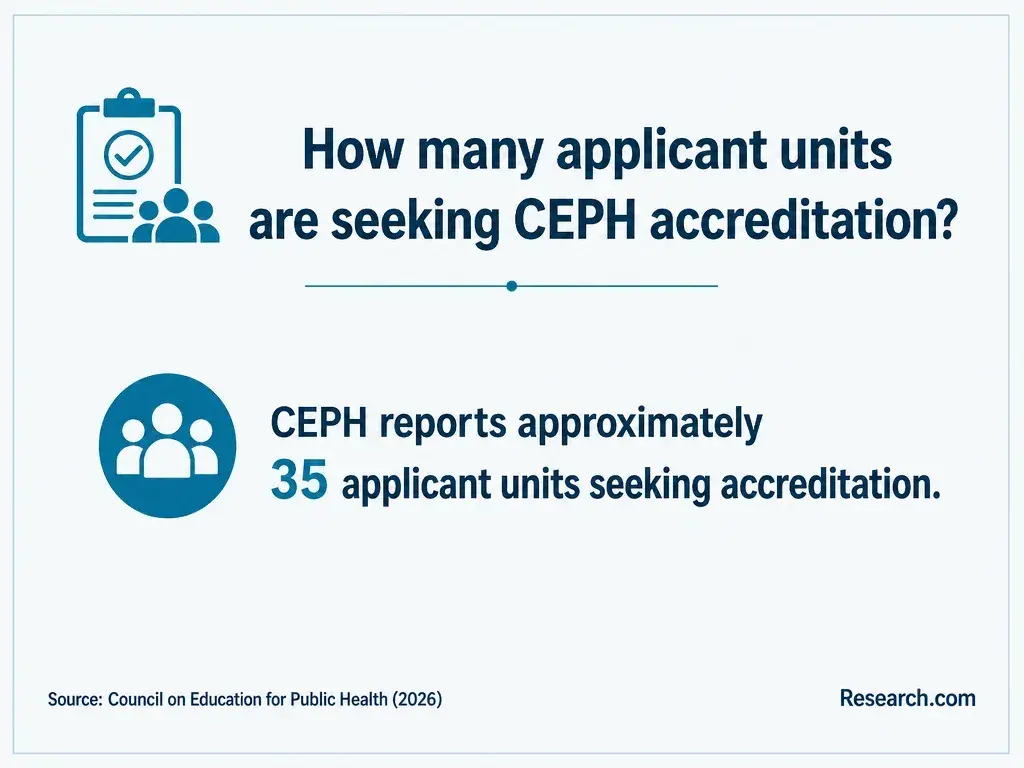
Check two distinct questions: whether the institution holds recognized institutional accreditation and whether the Council on Education for Public Health (CEPH) accredits the relevant school, unit, or individual public health program. Confirm that the specific degree you intend to earn is within the accredited scope; the university's general status or a related department's accreditation is not enough.
Use the accreditor's current listing and ask the program to identify the degree's coverage and effective status for your entry term. This matters particularly when screening low-cost public health master's degrees: a lower price does not establish equivalent accreditation, coursework, or credential eligibility.
A planner with public health preparation might pursue climate-and-health program coordination, environmental health policy analysis, preparedness planning, community resilience work, or evaluation of heat and flood responses. Epidemiologist or specialist research positions may require stronger analytic training and relevant experience. Senior program management usually requires a record of leading budgets, staff, or partnerships, not just a graduate credential.
Compare job descriptions by tasks rather than title: does the role ask you to convene partners, analyze health records, assess environmental exposures, or run a funded program? Build evidence for the missing task through supervised work. If a prospective colleague or project partner lacks a qualifying undergraduate degree, choosing an online public health bachelor's program addresses a different entry point; it is not a substitute for the graduate-level methods an analyst role may require.
There is no single salary or employment projection for "climate-health graduate." The US Bureau of Labor Statistics publishes occupation-level wages and projections for roles such as epidemiologists and health education specialists, but climate adaptation positions may sit in planning, environmental, emergency-management, or public health job families. An occupational median is not an offer to a new graduate.
For a useful comparison, identify the occupation that matches your target duties, check the latest BLS wage reference year and projection period, and compare actual vacancies in your region. Public-sector pay grades, required experience, and funding for a particular position may matter more to your decision than a national median. MPH-related occupations and earnings can provide context, provided you keep each occupation separate from degree-specific outcomes.
Do Public Health Careers Require Licenses or Certifications?
Most climate-health planning and program roles do not have one universal public health license. Requirements depend on the work: a clinical position requires its own professional license, while certain environmental health or education jobs may specify a state credential or professional certification. An MPH does not itself confer clinical authority or automatic certification.
For any vacancy, check the employer's stated requirements and the relevant state board or certifying organization's current eligibility rules. If you are considering the Certified in Public Health credential, verify its accepted education and experience pathways; comparing CEPH-accredited MPH options is a program-selection step, not proof that every graduate is automatically eligible for or awarded the credential.
Other Things You Should Know About Public Health
Describe a specific planning decision, your contribution, the evidence and partners involved, and a limitation you recognized. Avoid implying that a hazard map alone demonstrates a health outcome.
Possibly. Check employer permissions and program rules first; remove restricted locations, personal information, and unpublished partner materials unless their use is expressly authorized.
Search by responsibilities as well as titles: heat response, environmental health assessment, resilience, preparedness, exposure analysis, and program evaluation. Read the required tasks before judging fit.
Yes, if feasible. An informational conversation can reveal which local climate-health problems need staffing and whether your planning experience already meets some needs. It is not a promise of a placement or job.
- Eligibility Requirements | Federal Student Aid https://studentaid.gov/understand-aid/eligibility/requirements
- What Can Job Postings and an Employer Survey Tell Us? - PMC https://pmc.ncbi.nlm.nih.gov/articles/PMC7068354/
- Community-based internships to address environmental issues: a model for effective partnerships - PubMed https://pubmed.ncbi.nlm.nih.gov/21441671/
- The Role of Communities in Promoting Health Equity - NCBI https://www.ncbi.nlm.nih.gov/books/NBK425849/
- Climate change | who.int https://www.who.int/news-room/fact-sheets/detail/climate-change-and-health
- Climate and Health Program Evaluation | ncdhhs.gov https://www.dph.ncdhhs.gov/programs/epidemiology/occupational-and-environmental-epidemiology/climate-and-your-health/climate-and-health-program-evaluation
- Competencies for Public Health Professionals | cdc.gov https://www.cdc.gov/infrastructure/training-professional-development/competencies-for-public-health-professionals.html
- School-Determined Requirements - FSA Partner Connect https://fsapartners.ed.gov/knowledge-center/fsa-handbook/2025-2026/vol1/ch1-school-determined-requirements
- Core Competencies - M.S. in Climate, Environment, and Health https://ceh.georgetown.edu/curriculum/core-competencies/
- Public Health Career Fields Overview | Career Services https://sph.umich.edu/careers/explore-public-health-careers/public-health-career-fields-overview.html