2027 From an Associate Degree in Nutrition to a Public Health Bachelor's

Co-Founder and Chief Data Scientist
A nutrition associate degree can be a foundation for a public health bachelor's, but the number of credits that actually advance you toward graduation depends on the receiving school. That distinction matters before you commit to a program, especially if biology, statistics, or nutrition courses must be evaluated individually. This guide is for transfer and returning students who want to understand the likely pathway, compare programs without relying on advertised completion times, and decide whether public health fits their career goals better than continued nutrition study.
Key Things You Should Know
- A nutrition associate degree can support admission to a public health bachelor's program, but the university decides which courses satisfy general education, prerequisites, and major requirements.
- A common planning example is a 60-credit associate degree and a 120-credit bachelor's degree; even if all 60 credits transfer, course sequencing or university residency rules may extend the time needed.
- Before enrolling, request a course-by-course evaluation and a degree audit showing remaining requirements, projected terms, and total cost - not just the number of accepted credits.
Can you transfer an associate degree in nutrition into a public health bachelor's program?
Yes, many public health bachelor's programs consider applicants with nutrition associate degrees. Transfer admission, however, is not the same as transferring into the major, and an accepted course may count only as an elective. A degree audit is the useful document: it shows which requirements your prior work fulfills and what remains.
The type of associate degree matters. An Associate of Arts or Associate of Science designed for transfer may align more readily with university general education requirements than an Associate of Applied Science, though either can be considered.
Anatomy, biology, chemistry, statistics, and nutrition courses may need separate reviews for laboratory content, course level, or equivalence. The receiving institution - not the community college or an informal advisor estimate - has final authority.
Ask the transfer admissions office for its credit evaluation process and the public health department for a major-specific review. Submit official transcripts, course descriptions, syllabi for disputed courses, and any applicable transfer-agreement information.
If you are comparing affordable online public health colleges, compare credits applied to graduation rather than credits accepted; that difference can change the final bill substantially.
What are the admission requirements for a public health bachelor's degree?
Requirements vary by institution. A transfer applicant typically needs a recognized secondary-school credential, transcripts from every college attended, and the university's required academic standing.
Some schools admit students directly to public health; others require a separate application or completion of introductory courses before declaring the major. A nutrition background is relevant preparation, not an automatic admission preference or substitute for a stated prerequisite.
Check whether the program requires statistics, biology, a laboratory science, or a particular grade in prerequisite courses. Also ask whether a course can be in progress when you apply and whether older science coursework remains eligible. These answers affect both admission and your first-term schedule.
Keep undergraduate and graduate admissions rules separate. Advice about public health graduate applications without references, for example, does not establish what a bachelor's transfer application requires. Use the receiving university's current transfer and major-admission policies for your intended entry term.
How long does a public health bachelor's degree take after an associate degree?
Two years of full-time study is a reasonable planning scenario when a student transfers substantial applicable credit into a program built for upper-division completion. It is not a guaranteed timeline. A university may require courses taken on its campus or through its online program, and required classes may be offered only in certain terms.
The fastest way to test a proposed graduation date is to request a term-by-term plan after the credit evaluation. Ask the advisor to identify prerequisite chains, the next offering of each required course, any internship or capstone scheduling, and the minimum credits that must be completed at that university. A part-time schedule can make the pathway more manageable while extending it.
When reviewing online public health bachelor's term-length comparisons, distinguish a short course from a short degree. Accelerated terms do not eliminate prerequisite order, required credits, or fieldwork obligations.
Nutrition studies often emphasize food, nutrients, and individual or group dietary needs. Public health broadens the lens to population health: who faces a health problem, how social and environmental conditions shape risk, and how organizations design and evaluate prevention efforts. Your earlier coursework may provide useful context without replacing the public health major's methods and practice requirements.
Typical undergraduate subjects include epidemiology, introductory biostatistics, health behavior, environmental health, health policy, community health, and program planning.
The depth varies: an introductory statistics course develops data literacy but does not by itself prepare someone for advanced epidemiologic analysis. Look for assignments that let you apply both backgrounds, such as assessing a community nutrition program's reach or creating a culturally responsive health communication plan.
If graduate study is a later goal, public health graduate concentration selection can help you identify undergraduate electives worth prioritizing. A bachelor's elective, however, is not itself a graduate concentration or a professional credential.
An online bachelor's can be credible when the institution holds appropriate institutional accreditation and the program provides the coursework, assessment, and support needed to meet your goals. Delivery format alone does not establish quality or change whether a degree meets an employer's particular requirements.
For a nutrition-to-public-health transfer, examine what "online" means in practice. Ask about scheduled live sessions, group work, required campus visits, exam arrangements, and whether an internship or community project can be completed near you.
Confirm who helps students find placements and whether the experience can fit around employment. Check online tutoring, statistics support, and access to faculty as carefully as the course catalog.
These checks remain important at higher degree levels: students later comparing online public health doctoral programs also need to verify in-person and applied-work requirements. They are not, however, a reason to choose a doctoral pathway when the immediate goal is completing a bachelor's.
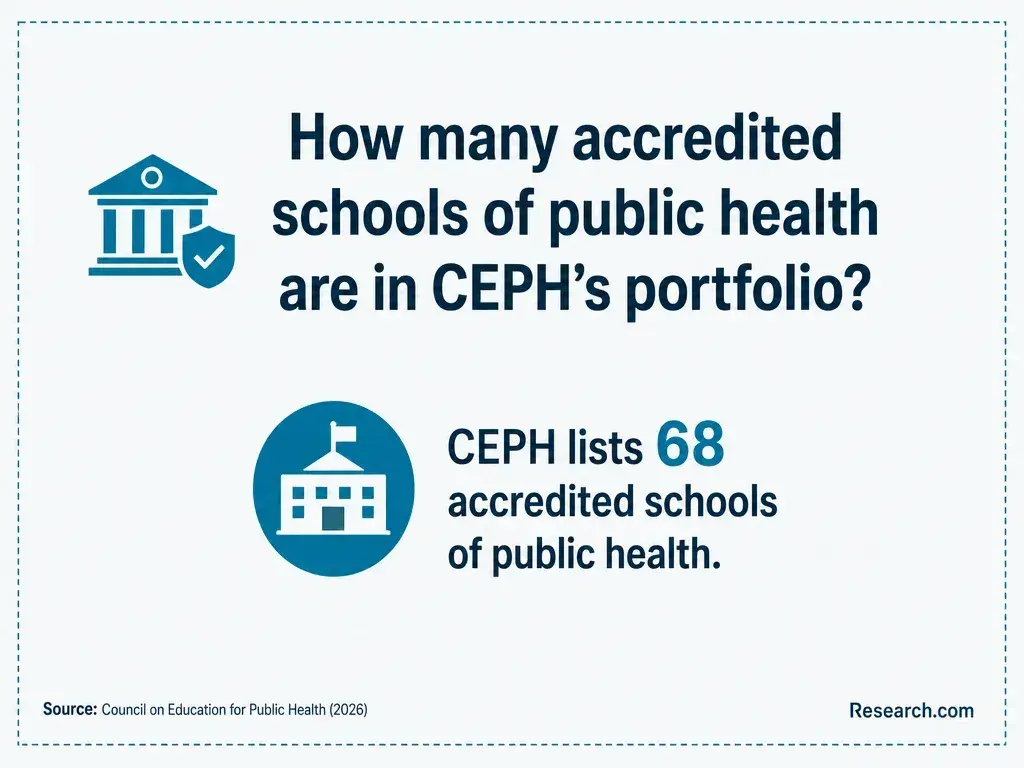
Start with the institution. Confirm its current institutional accreditation through the accreditor's directory and the U.S. Department of Education's recognized-accreditor information. Then check the Council on Education for Public Health (CEPH) directory if a school advertises public health-specific accreditation.
Record the exact accredited school, unit, or program and ask whether the bachelor's degree you plan to enter falls within that scope. Institutional accreditation and CEPH accreditation answer different questions.
A university's institutional status does not prove that its public health bachelor's is CEPH-accredited; likewise, a university with a CEPH-accredited graduate program should not lead you to assume its undergraduate degree has the same status. Ask the program to confirm its current status and coverage in writing before relying on an accreditation claim for a job or future credential.
The distinction also matters if you later consider comparing tuition for public health research degrees: verify each degree's accreditation scope separately rather than carrying assumptions forward from your bachelor's program.
There is no reliable price for this transfer pathway without a school-specific degree audit and aid offer. Tuition may be charged per credit or term, and the amount depends on residency classification, enrollment intensity, and the credits still required. Fees, books, technology, travel, and a potentially unpaid internship can add to the cost.
Use the audit to estimate the courses you must actually take, including prerequisites that transfer only as electives. Then request a written tuition and fee estimate for that course plan and compare financial aid offers using the same expected enrollment schedule. A lower advertised per-credit price can lose its advantage if the program requires more courses.
If you may pursue graduate education later, treat online MPH cost planning options as a separate decision. Do not take on extra undergraduate debt based on an assumed graduate scholarship or future salary increase.
A public health bachelor's paired with nutrition knowledge can support applications for community health, health education, outreach, and program-support roles. Employers also weigh experience, communication skills, data handling, and the populations a candidate has worked with.
A degree does not automatically qualify someone for an epidemiologist, licensed clinician, or program-director position. The role descriptions below show where the combined background may be useful and what to check in actual job postings.
| Possible role | Typical work | Important qualification check |
| Community health worker | Connects people with services and supports outreach | State or employer training and certification rules |
| Health education specialist | Develops and evaluates health education activities | Required degree field, experience, and any preferred credential |
| Public health program assistant | Coordinates activities, records, and partner communications | Software skills and experience with the program's community |
Use class projects, supervised fieldwork, or relevant employment to demonstrate what you can do - for example, summarize survey findings or explain how you adapted nutrition information for a particular audience.
If your target job consistently requires graduate preparation, compare that requirement with the costs and experience expectations before considering affordable graduate public health career preparation.
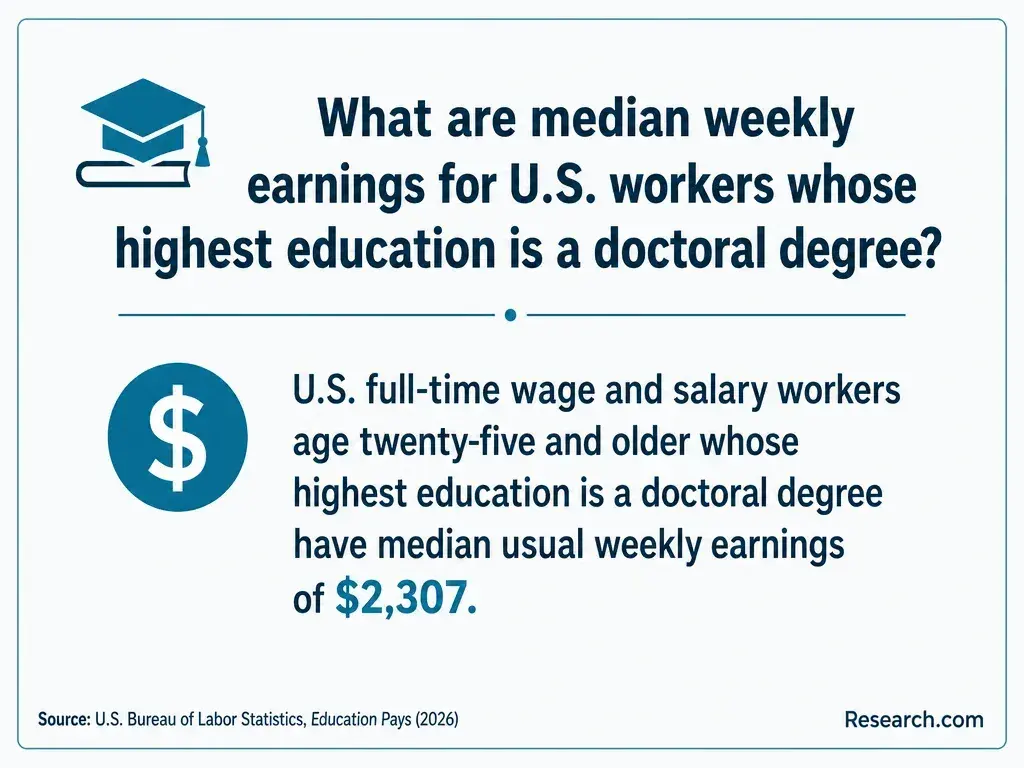
There is no single salary for public health bachelor's graduates. Pay depends on the occupation, location, employer, responsibilities, and prior experience. A nutrition background may help you compete for a relevant role, but it does not create a separate, predictable pay rate.
For a useful benchmark, find the precise occupation in the U.S. Bureau of Labor Statistics Occupational Outlook Handbook, check the wage reference year, and compare its national median with local job postings.
The published median covers workers across experience levels and educational backgrounds; it is not an entry-level offer or the expected earnings of graduates from a particular program. A community health worker wage should not be used to estimate pay for a health education specialist, or vice versa.
If you are weighing another degree partly for earnings, compare likely job requirements and borrowing before counting on higher pay. Even university-funded aid for online MPH programs depends on program-specific eligibility and an actual award; it should not be assumed in a bachelor's return-on-investment calculation.
Do public health careers require licenses or professional certifications?
Many entry-level public health support roles do not have a universal professional license, but requirements differ by occupation, employer, and state. Some community health worker positions involve state certification or employer training.
Health education employers may prefer a professional credential, while clinical and regulated nutrition work follows separate qualification rules. A public health bachelor's does not itself award certification or authorize clinical practice.
Before choosing a program for a specific job, read several postings in the state where you intend to work. Separate "required" from "preferred," then confirm any credential's eligibility and examination rules with its issuing organization or state authority.
That check may show that supervised experience or targeted training is more direct than another degree. When exploring low-cost fast-track public health study, do not assume a faster degree substitutes for a job's separate certification or license.
Other Things You Should Know About Public Health
Yes, if the program's schedule permits it. Ask about live classes, group meetings, and fieldwork hours before choosing a course load; online classes are not necessarily asynchronous.
Policies vary. Universities commonly review transfer grades for admission while calculating their own institutional GPA under separate rules. Ask how prior grades affect major admission and graduation honors.
Possibly, but only if the program approves the site, supervision, learning objectives, and work in advance. Existing duties may need to be expanded to meet the academic requirement.
Not by itself. Registered dietitian eligibility follows separate accredited education, supervised practice, examination, and applicable state rules. If that is your goal, check the current dietetics pathway before changing majors.
- Cost of Attendance (Budget) | 2025-2026 Federal Student Aid Handbook https://fsapartners.ed.gov/knowledge-center/fsa-handbook/2025-2026/vol3/ch2-cost-attendance-budget
- PUBLIC HEALTH STUDIES AS AN UNDERGRADUATE MAJOR | nih.gov https://pmc.ncbi.nlm.nih.gov/articles/PMC2556709/
- Transferring Credits - Cuyahoga Community College Catalog https://catalog.tri-c.edu/transfer-information/transferring-credits/
- Transfer Credits - Undergraduate - Policies - Campus Offices https://campus.collegeforcreativestudies.edu/policy/transfer-credits-undergraduate/
- School's Bachelor of Science in Public Health degree accredited by nationally recognized council | University of Miami https://news.miami.edu/sonhs/stories/2018/07/ceph-accredit.html
- Public Health-Global Health Admission | UW School of Public Health https://sph.washington.edu/phgh/application/prerequisites
- What Is a Public Health Major, and Is Public Health for You? | Northwest Media Center https://www.nwmissouri.edu/media/news/2025/04/what-is-a-public-health-major-and-is-public-health-for-you.htm
- Will an Associate's Degree Transfer? | University of Bridgeport https://www.bridgeport.edu/news/transfer-with-an-associates-degree/
- Public Health Degree Requirements: A Complete Guide | American Public University https://www.apu.apus.edu/area-of-study/nursing-and-health-sciences/resources/public-health-degree-requirements/
- Bachelor of Science (B.S.) Major in Public Health | Texas State University https://mycatalog.txstate.edu/undergraduate/education/health-human-performance/public-health-bs/