2027 From Agricultural Extension Assistant to Public Health: Planning a Bachelor's Pathway

Co-Founder and Chief Data Scientist
Agricultural extension work already involves education, community partnerships, and practical problem-solving. Moving into public health could build on those strengths, but a bachelor's degree is worthwhile only if its requirements and career outcomes fit your goal. This guide is for extension assistants considering that transition, particularly those returning to college or transferring credits. It explains how to evaluate a degree audit, choose relevant coursework and fieldwork, compare costs and formats, and decide whether a full degree—or a shorter route—will better prepare you for the work you want.
Key Things You Should Know
- Extension experience in outreach and community education is relevant, but it does not automatically replace public health courses, transfer credits, or approved fieldwork.
- Many bachelor's degrees require around 120 semester credits; the decisive number is how many credits an institution applies to your specific degree requirements, not how many it accepts.
- Choose a program around a target function—such as health education, food systems work, or program support—and request a written degree audit before estimating time or cost.
What Is a Public Health Bachelor's Degree Pathway From Agricultural Extension Work?
It is a move from helping agricultural communities apply research and resources to studying how organizations prevent disease and improve health across populations. Extension assistants may already coordinate workshops, explain technical information, support local partners, or document program activity. Public health study adds a framework for identifying health needs, examining evidence, designing interventions, and evaluating whether they work.
Your starting point matters. An assistant who has never earned a bachelor's degree may enter as a first-year student, transfer from a community college, or return with prior university credits. Someone who already holds a bachelor's degree should first check whether the desired job actually requires another one. Targeted coursework, supervised experience, or eventually graduate study may be more direct. Graduate admission follows different rules; pursuing MPH admission when some requirements are incomplete is a separate decision from finishing an undergraduate degree.
The closest bridge is often community health or health education: for example, adapting an extension workshop on food access into a community-informed nutrition outreach project. That example does not make agricultural education and public health interchangeable. A public health employer may also expect familiarity with health data, privacy, evaluation, and the local health system.
What Are the Benefits of Earning a Bachelor's Degree in Public Health?
A well-matched bachelor's program can make existing extension skills more useful in health settings. Coursework and supervised projects can help you move from delivering an established workshop to assessing a population need, selecting an evidence-informed approach, documenting participation, and interpreting results. The degree may also satisfy a bachelor's requirement for some employer-defined roles, although experience and specialized skills still affect hiring.
The benefit is strongest when you can name the work the degree will help you do. Public health may fit an assistant seeking health education or community-program responsibilities. If the goal is to remain in agricultural extension and advance in a specialty such as crop production, an agriculture-focused qualification or employer training may have greater value. If you already have a bachelor's degree and are considering a later MPH, use an MPH salary and career earnings outlook as context for occupations—not as a forecast of what another degree will pay you.
How Do You Choose an Accredited Public Health Bachelor's Program?
Start with institutional accreditation and confirm the institution's current status with the accreditor or school. Then check whether the public health degree is covered by Council on Education for Public Health (CEPH) accreditation. CEPH accredits specified schools, programs, or units; a university's accreditation or a different CEPH-accredited degree does not establish coverage for the bachelor's degree you are considering.
Accreditation is a starting point, not a measure of personal fit. Compare the exact BA, BS, or other degree requirements; the available community-health or environmental-health coursework; faculty support; and whether you can complete a supervised project with an appropriate local partner. Ask for examples of recent placements or projects, and confirm whether your employer could qualify as a site under the school's rules.
Keep future graduate plans separate from this decision. A resource on online MPH programs by admissions accessibility addresses a different degree level; neither an accessible MPH admission process nor a school's graduate accreditation establishes the requirements of its bachelor's program.
Public health bachelor's curricula typically introduce population health, epidemiology, statistics, environmental health, health systems, and health behavior. For an extension assistant, the most useful sequence connects those subjects to familiar tasks: identify a community concern, interpret relevant evidence, plan communication with partners, and evaluate a program without overstating its effects.
Suppose your extension work includes outreach about safe food handling. A suitable program could help you distinguish education from regulatory inspection, identify an appropriate audience with community input, select useful measures, and report limitations. Introductory epidemiology helps you interpret patterns; it does not, by itself, qualify you to conduct advanced disease surveillance or claim that a workshop caused a health improvement.
Review the course catalog rather than relying on a concentration label. Check whether statistics precedes methods or evaluation courses, whether desired electives run often enough to fit your schedule, and what data or community-based work requires approval. If a later analyst role is the goal, career-compatible online biostatistics study concerns substantially deeper preparation than a typical undergraduate statistics course.
Online study can help an extension assistant remain employed, especially when assignments are asynchronous. It is not automatically self-paced: scheduled discussions, group work, examinations, and field placements may still compete with seasonal outreach or travel. Campus study may provide easier access to local faculty, labs, and partner organizations, but commuting and daytime classes can make it impractical.
Ask each program for a sample term schedule and its fieldwork policy. Find out who secures a placement, whether activities at your current job can be proposed, whether a different supervisor is required, and when any campus visits occur. School approval, employer permission, qualified supervision, and permission to use organizational information are separate decisions.
Compare undergraduate programs with undergraduate programs. Guides to cost-conscious online MPH program choices may be useful later, but MPH tuition, admissions, and practice requirements should not be used to judge a bachelor's program's flexibility or price.
Requirements depend on whether you apply as a first-year, transfer, returning, or second-degree student. A school may admit you to the university before separately admitting you to the major. Prior college courses may be accepted as electives without satisfying general education, statistics, science, or public health major requirements.
For a returning student, the most useful preparation is documentary rather than speculative. Gather official transcripts and, where relevant, course descriptions or syllabi; request a program-specific degree audit; and ask the registrar or transfer-credit office who approves equivalencies, substitutions, and appeals. Confirm course recency, laboratory requirements, minimum grades, residency credits, and when the major admits students. The receiving institution has final authority over how earlier study applies.
Work accomplishments belong in an application or advising conversation, but experience does not automatically award academic credit. Some institutions assess prior learning under defined policies; ask whether that option exists before budgeting around it. Likewise, public health graduate applications without references describe a different admissions level and do not predict a bachelor's program's requirements.
Many US bachelor's degrees are structured around 120 semester credits and roughly four years of full-time study. A prior associate degree does not automatically cut that time in half: the school must determine which credits satisfy the new degree, and prerequisites or infrequently offered courses can extend the schedule. Part-time enrollment can make continued extension work feasible while increasing elapsed time.
Build a cost estimate from the written degree audit and the school's charges for your intended enrollment pattern. Include tuition, mandatory fees, books, travel or campus visits, and any unpaid fieldwork hours. Then ask the financial-aid office how enrollment intensity and satisfactory academic progress affect your eligibility. An advertised per-credit price is not a total degree cost.
A comparison of cost-conscious online public health undergraduate study can help you identify programs to investigate. Before choosing the lowest advertised price, calculate remaining required credits at each school and check whether your needed courses are offered when you can take them.
The most plausible transition builds on extension work rather than discarding it. Potential roles include health education specialist, community health program assistant, outreach coordinator, and program support positions involving food access or environmental health. Job titles vary, so compare postings by duties and stated qualifications. Some community health worker positions may not require a bachelor's degree; some specialist positions expect particular experience or credentials.
The distinctions below can help you identify which tasks to demonstrate in coursework or a supervised project. They are role descriptions, not guarantees that a particular degree meets an employer's hiring rules.
| Role direction | Connection to extension work | Likely preparation gap to check |
| Health education or outreach | Workshops, accessible communication, partner relationships | Health-specific planning, evaluation, and employer credential preferences |
| Program support | Scheduling, participant communication, activity records | Grant reporting, budgets, privacy, and health-agency procedures |
| Data or research support | Field observations and organized records | Statistics, data management, and supervised analysis |
An epidemiologist or independent research lead usually follows a different educational and experience path. If that is the long-term target, explore prerequisites and research opportunities first; an epidemiology doctoral education funding guide is relevant only much later, not as a requirement for entry-level public health work.
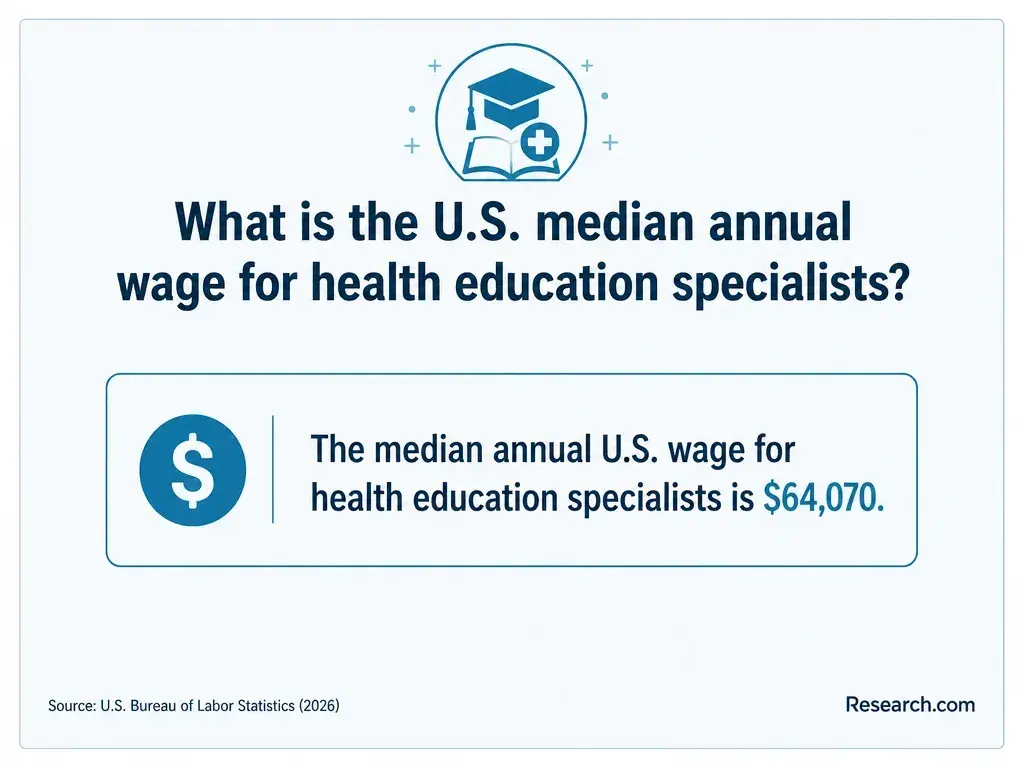
There is no single reliable salary for "public health bachelor's graduates." Pay follows the occupation, employer, location, responsibilities, and experience - not the degree title alone. The US Bureau of Labor Statistics Occupational Outlook Handbook provides occupation-level pay and outlook information for roles such as health education specialist and community health worker. Its medians include workers with varied backgrounds and career stages, so they are not expected starting salaries for former extension assistants.
For a useful estimate, collect local postings for positions you would actually qualify for after graduation. Compare their pay ranges with your current compensation, benefits, likely work hours, and the cost of finishing the degree. Public agencies and nonprofits may use pay scales or grant-funded positions that differ from private-sector offers. If graduate school is part of your plan, a public health master's affordability and earnings are a separate financial comparison; do not attribute graduate-level job pay to a bachelor's degree.
What Certifications and Licenses Do Public Health Graduates Need?
A public health bachelor's degree does not itself grant a clinical license or professional certification. Many outreach and program-support jobs have no universal public health license, but employers may specify a credential. For health education positions, check the current Certified Health Education Specialist (CHES) eligibility rules with the National Commission for Health Education Credentialing rather than assuming any public health degree qualifies. Community health worker certification or registration rules, where applicable, vary by state.
Choose a credential only after checking target job postings and the issuing body's education, examination, and experience requirements. Advanced degrees are different from certifications: cost-conscious public health PhD planning matters for a future research goal, not for obtaining permission to perform ordinary bachelor's-entry outreach work.
Other Things You Should Know About Public Health
Not automatically. Ask your employer and instructor what information may be used, whether it must be deidentified, and whether a data-use agreement or institutional review is needed. Do not put identifiable client or participant information in coursework or a portfolio without authorization.
Describe the tasks and evidence: audiences reached, partners coordinated, materials adapted, and activities documented. Explain your contribution without presenting attendance as proof of a health outcome.
It may count as relevant community education or outreach experience, but it is not automatically clinical or healthcare experience. Use the employer's definition and give specific examples rather than relying on your job title.
Only if that matches your interests and the opportunities available. Extension experience can be valuable in rural health work, but skills in partnership-building, communication, and program delivery can also transfer to other communities when you learn their priorities rather than assuming they are the same.
- General Schedule Qualification Policies | U.S. Office of Personnel Management https://www.opm.gov/policy-data-oversight/classification-qualifications/general-schedule-qualification-policies/
- Types of Financial Aid: Grants, Work-Study, and Loans | studentaid.gov https://studentaid.gov/understand-aid/types
- Competencies for Public Health Professionals | cdc.gov https://www.cdc.gov/infrastructure/training-professional-development/competencies-for-public-health-professionals.html
- Cost of Attendance (Budget) | 2025-2026 Federal Student Aid Handbook https://fsapartners.ed.gov/knowledge-center/fsa-handbook/2025-2026/vol3/ch2-cost-attendance-budget
- College of Public Health Competencies - Catalog Home | The University of Oklahoma Health Sciences Course Catalog https://catalog.ouhsc.edu/public-health/bulletin/competencies/
- Public Health & Community Health Degree | MCLA https://mcla.edu/academics/academic-departments/phch/
- Bachelor of Science in Public Health | Bowling Green State University https://www.bgsu.edu/health-and-human-services/programs/department-of-public-and-allied-health/bachelor-of-science-in-public-health.html
- 18 Public Health Skills Needed for Upskilling | 5 Public Administration Careers for MPA Graduates https://www.augusta.edu/online/blog/upskilling-public-health-skills
- Transfer Policies and Prior Learning Assessment for Advanced Standing | Columbia-Greene Community College https://catalog.columbiagreene.edu/transfer-policies-and-prior-learning-assessment-for-advanced-standing
- Extension Career Pathways https://careerpathways.ces.ncsu.edu/news/extension-career-pathways/