2027 Does a Public Health BS Prepare You for Community Health Outreach Assistant Work?

Co-Founder and Chief Data Scientist
A public health BS can teach you why communities face health challenges, but outreach employers also need people who can build trust, coordinate services, and work reliably in the field. If you are considering the degree - or already earning it - the key decision is whether its coursework and hands-on opportunities match the jobs you want. This guide connects typical outreach duties to academic preparation, explains when a degree is optional, and shows how to judge programs, costs, and job prospects before committing.
Key Things You Should Know
- Yes, with practical experience: A public health BS can prepare you for outreach assistant work, especially when you pair community health coursework with supervised outreach, service navigation, or program support.
- A bachelor's degree is not always required: Employers and states set different requirements; community health worker roles may offer a more direct entry route through training and experience.
- Use pay data carefully: The U.S. Bureau of Labor Statistics reported a $51,030 median annual wage for community health workers in May 2024, but that occupation-wide figure is not an entry-level outreach assistant salary.
Does a public health BS prepare you for community health outreach assistant work?
Usually, yes - but the degree is preparation, not proof of field readiness. A community health outreach assistant typically supports activities such as contacting residents, helping organize events, explaining available services, making referrals, maintaining records, and following up under a supervisor's direction. Titles and duties vary: some positions emphasize scheduling and data entry, while others involve substantial face-to-face community engagement.
A public health BS provides useful context for prevention, barriers to care, health communication, and program evaluation. Its strongest advantage over brief job training is that it can help you understand why an outreach strategy is used and how a team checks whether it reaches its intended population. Yet a graduate who has never practiced a respectful referral conversation or handled event logistics may be less ready for a particular opening than an experienced community volunteer.
Compare a few local job postings with your degree plan before enrolling. If the postings accept a high school diploma plus relevant experience, weigh the BS against a quicker work-and-training route; if you also want broader program responsibilities later, a bachelor's degree may be more useful. For a wider cost-and-timeline comparison, see public health degrees by price and completion time.
What jobs can you get with a public health bachelor's degree?
Outreach assistant is one possible entry point, not a job automatically awarded to BS graduates. Depending on the employer and your experience, related openings may include community health worker, program assistant, health promotion assistant, patient navigator assistant, or research and evaluation assistant. Read the duties rather than relying on titles: a "navigator" position might require extensive direct-service experience, while a "program assistant" position might mainly involve scheduling and reporting.
The distinctions below can help you target applications that fit the evidence you can actually show.
| Role | Typical focus | Evidence that strengthens an application |
| Outreach or program assistant | Events, follow-up, referrals, records, and team logistics | Community-facing service and accurate recordkeeping |
| Community health worker | Community relationships, education, and connections to services | Local knowledge, communication skills, and any required training |
| Health promotion assistant | Materials, campaigns, and educational activities | Accessible writing and supervised education projects |
| Research or evaluation assistant | Surveys, data quality, and project support | Methods coursework and careful data handling |
These are not interchangeable with epidemiologist, independent researcher, or program manager positions. If your longer-term goal requires more specialized study, public health master's fields of study can help you distinguish that later decision from entry into outreach work.
Do community health outreach assistants need a degree or certification?
There is no universal degree or certification requirement attached to the title "community health outreach assistant." A particular employer may ask for a bachelor's degree, accept equivalent experience, or provide training after hire. State rules can also matter when a position is classified as a community health worker or tied to a specific program. Check the posting and the relevant state requirements rather than assuming one rule applies nationwide.
A public health BS does not itself award community health worker certification, the Certified in Public Health credential, the Certified Health Education Specialist credential, or a clinical license. Those credentials have separate eligibility rules and purposes. For an assistant opening, a documented history of working respectfully with the community served may be more immediately relevant than an unrelated certification.
If you are considering graduate study because a listing mentions a degree preference, first ask the employer whether a bachelor's degree or equivalent experience meets it. Even public health graduate programs with accessible entry represent a much larger commitment than an assistant job may require.
Look for coursework you can connect to actual outreach tasks, not just a degree title. Community health and social determinants courses help you identify barriers to participation without blaming residents. Health communication courses can strengthen plain-language messages and listening skills. Program planning and evaluation courses can teach you to track activities, define appropriate measures, and report what a project did without claiming impacts it has not established.
Introductory epidemiology and statistics are useful for interpreting local health information and recognizing when a figure does not describe everyone in a community. An assistant generally needs data literacy and sound judgment, not advanced statistical modeling. If you later pursue a specialized analytic role, online biostatistics education for working learners addresses a different depth of preparation.
Most important, seek an internship, service-learning project, or supervised community placement where you can practice outreach and receive feedback. Before accepting a site, confirm that the school approves it, who will supervise you, what tasks you may perform, and whether you can describe a nonconfidential deliverable in your portfolio.
Check institutional accreditation first: it concerns the institution as a whole and can affect matters such as credit recognition and federal student aid eligibility. Then check whether the Council on Education for Public Health, or CEPH, accredits the relevant school, public health unit, or specific program - and whether your BS falls within that scope. Institutional accreditation and CEPH accreditation are not the same claim.
CEPH status can be a useful quality signal, but it cannot tell you whether students can secure outreach placements near home or whether required courses fit their schedule. Ask the department for the current degree plan, fieldwork arrangements, advising contacts, and examples of student work or reported outcomes. Those details matter more to this job decision than a general promise of "career readiness."
Accreditation scope becomes important again if you later consider an advanced degree. Explore public health doctoral programs and professional goals only if your aims develop well beyond entry-level outreach; a doctorate is not a prerequisite for assistant work.
They can be, provided the program gives you a credible way to build local, supervised experience. Online coursework can teach planning, communication, and data interpretation, but it cannot replace practicing with community partners. Ask how students find placements, whether local sites are permitted, who approves and supervises the work, and whether required meetings take place at fixed times.
Compare the format with your work and caregiving schedule rather than assuming "online" means self-paced. Group projects, live classes, and daytime fieldwork may still be required. If shorter terms would help you schedule coursework, review public health BS programs with shorter academic terms; accelerated classes can also concentrate the weekly workload. The best format is one you can complete while gaining the experience local employers value.
Requirements depend on the institution and whether you apply as a first-year or transfer student. Schools may review prior transcripts and general admission criteria, while some public health majors have additional entry requirements or prerequisites. Ask separately about admission to the university, admission to the major, and eligibility to begin required upper-level courses.
If you have college credit, request a written degree audit showing how each accepted course applies to general education, prerequisites, the major, and graduation requirements. A transferred course does not necessarily satisfy a required public health course. Confirm any remaining residency credits and when needed classes are offered before estimating your completion date.
Do not use graduate admissions comparisons to judge BS eligibility: comparing online doctorate admission routes in public health concerns a different academic level. Your prospective undergraduate institution has the final say on its own admission and credit decisions.
A bachelor's degree commonly follows a four-year full-time path, but transfer credit, course sequencing, part-time study, and fieldwork availability can change the time you need. Do not assume an accepted associate degree or a program's advertised pace establishes your personal graduation date; obtain a term-by-term plan based on your degree audit.
For cost, compare the school's published tuition and required fees with your actual remaining credits. Include books, transportation to outreach sites, possible unpaid fieldwork hours, and earnings you might give up to attend class. Ask the financial aid office for an individualized aid estimate and whether your expected enrollment pace affects eligibility. Public health degrees by price and completion time can help frame a comparison, but your net cost and remaining requirements should drive it.
If your immediate aim is an assistant position that does not require a BS, compare the full degree expense with applying now and taking targeted training while employed. The degree may be worthwhile for broader future options, but it need not be the fastest route into outreach.
The U.S. Bureau of Labor Statistics does not publish a separate national wage series for the exact title "community health outreach assistant." Its community health worker occupation is a useful, imperfect comparison: the median annual wage was $51,030 in May 2024. That is the midpoint for workers across the occupation, not a starting offer or a predicted salary for someone with a public health BS.
Assistant duties may be narrower, and pay can vary by location, employer, funding, hours, and experience. When judging a degree's financial value, compare actual local assistant postings with the program's net cost and with jobs available to you without the degree. If you later consider graduate school for a different career goal, budget-conscious MPH study and career outcomes should be evaluated separately; an MPH is not required merely to interpret this assistant-role wage figure.
What is the job outlook for community health outreach assistants?
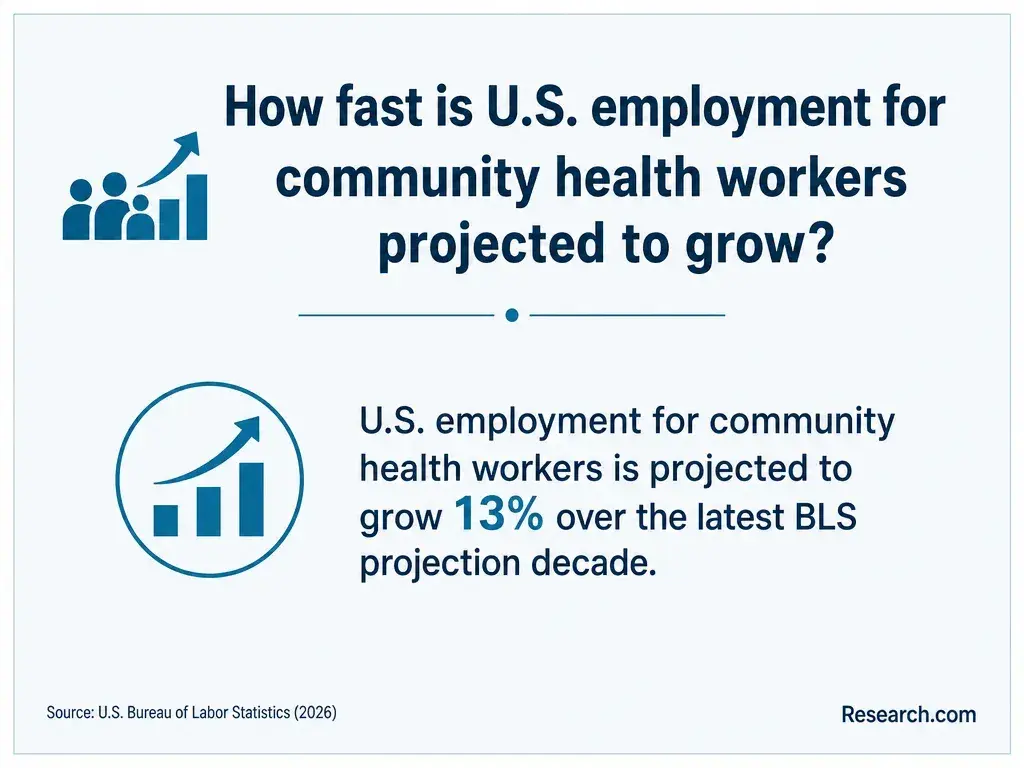
There is no federal projection for the exact outreach assistant title. For the related community health worker occupation, the Bureau of Labor Statistics projects 11% employment growth from 2024 to 2034. That indicates growth across a broader occupation, not a promise of openings in your area or at your preferred employer.
Local hiring may depend on health department budgets, grants, health systems, and community organizations. Check current postings for recurring requirements - such as languages used locally, reliable transportation, documentation skills, or experience with the population served - then build evidence for the requirements you can realistically meet. Apply to suitable entry-level roles while exploring school, volunteer, or employer-supervised opportunities rather than waiting for a degree alone to make you competitive.
If you eventually plan graduate study after gaining experience, investigate its funding on its own terms; institutional aid pathways for public health master's students do not describe the aid or job prospects attached to a BS.
Other Things You Should Know About Public Health
Not universally. Language requirements depend on the people served and the employer. If a posting asks for proficiency, describe your actual ability accurately; do not assume familiarity with a community replaces language access or qualified interpretation.
Some scheduling, follow-up, and documentation may be remote, but jobs centered on events or in-person relationships usually require time on site. Confirm travel, evening events, and location expectations before accepting an offer.
Usually you can describe your responsibilities and share materials you are authorized to use. Remove personal information and obtain approval before displaying an employer's documents, community-partner materials, or unpublished results.
Document relevant paid or volunteer work: the audience served, tasks you performed, supervision received, and tools you used. A concise example of an approved flyer, event plan, or deidentified tracking template can show practical ability without claiming outcomes you did not measure.
- 10 Essential Public Health Services | cdc.gov https://www.cdc.gov/infrastructure/public-health-systems-emerging-practices/10-essential-public-health-services.html
- Indiana community health workers: challenges and... - PMC https://pmc.ncbi.nlm.nih.gov/articles/PMC8792135/
- Community Health Worker (CHW) State Certification | utah.gov https://healthequity.utah.gov/chw-state-certification/
- Becoming a Community Health Worker | Texas DSHS https://www.dshs.texas.gov/community-health-worker/becoming-a-community-health-worker
- FREQUENTLY ASKED QUESTIONS FOR MEDI-CAL... - DHCS https://www.dhcs.ca.gov/providers-partners/frequently-asked-questions-for-medi-cal-community-health-worker-services-provider-requirements/
- Bachelor of Arts in Public Health - Academics | UT Dallas https://academics.utdallas.edu/fact-sheets/epps/bachelor-of-arts-in-public-health/
- Public Health Practicum | Pacific University https://www.pacificu.edu/public-health/practicum
- What Is a Public Health Degree? - apu.apus.edu https://www.apu.apus.edu/area-of-study/nursing-and-health-sciences/resources/what-is-a-public-health-degree/
- Career Guide: Community Health Worker | American College of Education https://ace.edu/student-success/career-guides/community-health-worker/
- What can you do with a public health degree? | About the University of Cincinnati https://www.uc.edu/blog/public-health-careers.html