2027 Direct Care vs Indirect Care Nursing: Responsibilities and Career Examples
Audited and Verified:
Our Editorial and Data Verification Process
Research.com uses government datasets, official education statistics and primary institutional information to support its career and degree guides. Our review process checks factual accuracy, occupational definitions, source dates and the requirements associated with the credentials discussed.
How This Article Was Fact-Checked
Our editorial team verifies salary estimates, employment projections, education requirements and program information against original data providers and official organizations. Salary figures are checked against the relevant occupational definitions and reporting periods. Information about licensure, accreditation and required in-person training is reviewed separately.
Fact-checked and verified on:

Co-Founder and Chief Data Scientist
Choosing between direct and indirect care nursing is less about avoiding or seeking the bedside than deciding how you want to improve patient care. A new nursing student may need supervised patient-care experience before pursuing either path; an experienced RN may already have the foundation for a move into education, informatics, or quality improvement.
This guide compares the work, credentials, preparation, and pay evidence behind each option so you can identify a realistic next step without assuming that every career change requires another degree.
Key Things You Should Know
- Direct care involves assessing and treating individual patients; indirect care supports care through work such as education, staffing, informatics, or quality improvement. Many RN jobs combine both.
- An ADN or BSN can prepare a graduate to seek initial RN licensure, but graduation is not a license. Some indirect roles require substantial RN experience; others are open to professionals without an RN license.
- Pay is tied to the occupation and job, not the direct-or-indirect label. The U.S. Bureau of Labor Statistics reported a $93,600 median annual wage for registered nurses in May 2024; that figure covers RNs across many settings and duties.
What Is the Difference Between Direct and Indirect Care Nursing?
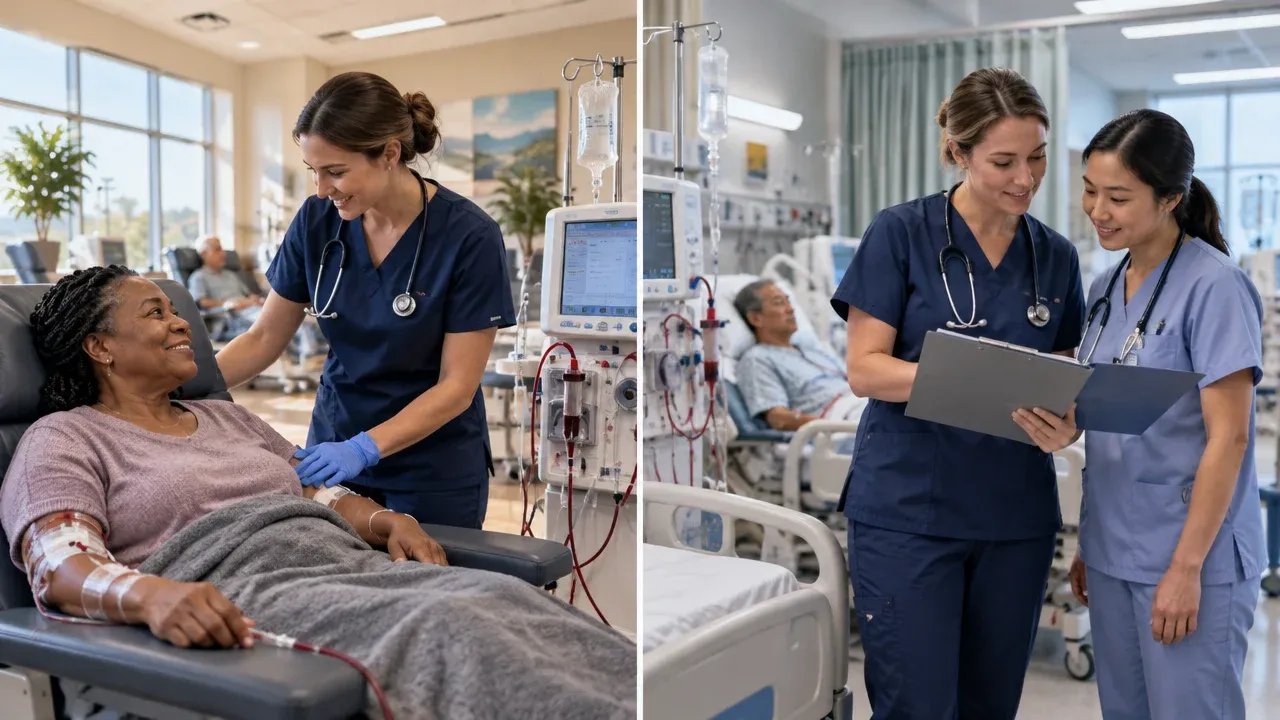
Direct care nursing involves professional nursing services delivered to an individual patient or family: assessment, clinical judgment, interventions, education, and evaluation. Indirect care nursing influences patient care without necessarily delivering those services during the work in question. Examples include improving an electronic health record workflow, teaching staff, managing a unit, or analyzing safety events.
The distinction describes what someone does, not a separate RN license or a permanent label on a job. A bedside RN provides direct care while documenting, coordinating services, and helping improve a unit process. A nurse manager may spend most of the week on indirect work but occasionally respond to clinical needs within their license, competence, and employer policy. Likewise, an RN-to-BSN program advertised as having no traditional clinical rotations may still require applied learning; BSN completion pathways with alternative practice experiences should not be confused with prelicensure programs that prepare students for supervised direct care.
For a career decision, compare the actual job description: the frequency of patient contact, responsibility for individual clinical decisions, and whether success is measured through patient encounters, staff performance, or system-level outcomes.
What Responsibilities Do Direct Care Nurses Have?
Direct care RNs assess patients, recognize changes in condition, plan and deliver nursing interventions, administer medications when authorized, document care, educate patients and families, and coordinate with other clinicians. They also escalate concerns and delegate appropriately under state law and workplace policy. The mix varies sharply between an inpatient unit, clinic, home health service, and emergency department.
Direct care does not mean only bedside hospital work. Ambulatory nurses may assess symptoms and support treatment plans; community nurses may provide individual services in homes or clinics. Nurse practitioners also provide direct care through an advanced practice role, but require role- and population-focused preparation, certification, and applicable state authorization beyond RN licensure. Someone considering short-format family NP degree and certificate routes should verify the specific program's entry requirements and supervised clinical preparation rather than treating a short advertised timeline as proof of NP eligibility.
For new graduates, the key question is not simply whether a position offers patient contact. Ask how orientation, preceptors, patient assignments, escalation support, and competency checks will help you progress from supervised learning to the responsibilities of that setting.
What Careers Are Available in Indirect Care Nursing?
Indirect roles use clinical knowledge to improve how care is taught, organized, documented, or evaluated. Many employers prefer nurses who have practiced with the patients and workflows they will support, though experience expectations differ by position.
The following comparison separates typical work from common entry considerations. A job title alone does not establish whether a position is entirely nonclinical.
| Career example | Typical indirect responsibilities | Common preparation considerations |
| Nurse educator or staff development specialist | Design learning activities, support orientation, and assess staff learning | Clinical experience is often important; academic faculty positions may require a graduate degree |
| Nurse informaticist | Improve documentation, EHR workflows, and use of clinical data | RN experience and workflow or technology skills can matter more than a degree title alone |
| Quality or patient safety nurse | Review processes, investigate patterns, and support improvement projects | Clinical judgment, data literacy, and experience with organizational processes are useful |
| Nurse manager | Oversee staffing, operations, budgets, and team performance | Usually requires nursing experience and demonstrated leadership ability |
A career changer with teaching, analytics, or management experience may already have useful skills. If the target job does not require nursing practice, a non-nursing qualification or targeted training could be faster than qualifying as an RN. If it requires RN judgment, starting nursing education after another career means choosing a prelicensure route and building clinical experience, not merely adding a nursing credential to an existing résumé. Psychiatric-mental health nurse practitioner work, despite its potential for telehealth or administrative duties, remains an advanced direct care role when the NP evaluates and treats patients.
To enter RN direct care, students generally complete an approved prelicensure nursing program, meet their state board's requirements, pass the NCLEX-RN, and receive an RN license. ADN, diploma, and prelicensure BSN routes can serve this purpose where accepted by the relevant board. Schools and employers may set additional requirements.
Indirect care has no single educational threshold. An RN moving into unit-based quality work may build on practice experience and employer training. A faculty position may require graduate education under institutional and state rules. An analyst or administrator position that does not require RN practice may be accessible through another discipline, although its holder should not present themselves as a nurse without the required license.
Applicants with a previous non-nursing degree should check whether each option leads to initial RN preparation. In particular, direct-entry MSN admission planning requires checking prerequisites, program sequence, clinical arrangements, and the exact point at which graduates become eligible to apply for RN licensure. A postlicensure MSN that requires an active RN license is a different route.
Choose a degree by the role it actually prepares you to pursue, rather than assuming a higher credential is necessary for indirect work or that every graduate degree authorizes advanced clinical practice.
This comparison shows the usual starting point and career relevance of common routes; individual program outcomes and employer requirements still need verification.
| Route | Usual entry point and purpose | Relevance to direct or indirect work |
| Prelicensure ADN or BSN | Entry into RN education for an applicant who is not yet an RN | Builds a foundation for direct care and, with experience, many indirect RN roles |
| RN-to-BSN | Degree completion for an already-licensed RN | Can support advancement but does not replace the initial RN license |
| Non-APRN MSN or DNP | Graduate study in areas such as education, leadership, or informatics | May fit specific indirect roles; does not by itself qualify a graduate as an NP |
| APRN-focused graduate program | Role- and population-focused advanced practice preparation | Supports a regulated direct care pathway, subject to certification and state requirements |
| PhD in nursing | Research-focused doctoral preparation | Most relevant to research-intensive scholarship and faculty careers |
An ADN-prepared RN interested in education or leadership can compare employer requirements with ADN-prepared RN graduate study options; an MSN is not automatically necessary for a first quality-improvement assignment. Conversely, an RN seeking NP practice needs an appropriate APRN track, not a general leadership MSN.
Prelicensure programs commonly teach anatomy and physiology, pharmacology, health assessment, patient-centered care, clinical judgment, and nursing across patient populations. Skills labs and simulation let students practice and receive feedback. Program-approved, supervised clinical experiences then assess how students apply knowledge with patients; simulation or prior employment should not be assumed to replace clinical experiences required by a school or regulator.
For someone entering nursing with a prior bachelor's degree, the academic challenge may start before nursing courses. Programs set their own science prerequisites, laboratory rules, minimum grades, and course-age policies. Understanding ABSN admission barriers can help applicants distinguish admission requirements from the clinical workload that follows admission.
Postlicensure education usually shifts emphasis. An RN pursuing informatics might study workflow design, data quality, and privacy; an educator might study teaching and assessment. An APRN student needs supervised experiences aligned with the intended role and patient population. Before enrolling, ask which experiences involve individual patient care, who arranges sites and preceptors, and how competence is evaluated.
They can, if the program provides the required hands-on preparation and meets the requirements for the student's intended licensing jurisdiction. "Online" generally describes some coursework, not an exemption from skills labs, simulation, supervised clinical placements, or campus visits. A postlicensure online RN-to-BSN program serves an RN who already completed initial clinical preparation; it is not a first-license substitute.
Compare online programs by their actual weekly schedule and placement rules. Recorded lectures may be flexible, while live sessions, labs, and clinical shifts may not be. Applicants should also confirm where they may enroll and complete placements. Online delivery does not eliminate admissions screening: entrance exam policies for nursing applicants vary by school and can change by application cycle.
Before paying a deposit, request written answers about required in-person dates, clinical-site responsibility, geographic restrictions, and whether the program meets the educational requirements for licensure in the state where you intend to apply.
A direct care RN needs a valid RN license and must practice within applicable law, employer policy, and demonstrated competence. An indirect position advertised specifically as a nurse position may also require an active RN license, even if daily tasks rarely involve patients. Some nursing-adjacent informatics, research, or administrative jobs do not require nursing licensure; check the actual job description.
Licensure, specialty certification, and employer competency validation do different things. NCLEX-RN passage is part of the initial licensing process, not a specialty credential. An APRN role adds program, national certification, and state authorization requirements specific to the role and population. For example, a guide to accelerated post-master's FNP study is relevant only if the nurse's prior education and the certificate's preparation can meet the applicable FNP requirements; an unrelated MSN does not itself confer FNP authority.
For an indirect transition, read job postings before purchasing certification training. A credential may strengthen an application, but it cannot substitute for a required license, relevant experience, or employer onboarding.
There is no reliable national "direct care nurse" versus "indirect care nurse" pay rate: those descriptions span different occupations, settings, schedules, and levels of responsibility. As a reference point, the U.S. Bureau of Labor Statistics reported a $93,600 median annual wage for registered nurses in May 2024 and projected 5% RN employment growth from 2024 to 2034. Those occupation-wide figures do not predict an individual offer or isolate bedside, educator, manager, or informatics pay.
Compare compensation for the specific job you might take. A direct care offer may include shift differentials or overtime; an indirect role may have a different schedule, bonus structure, or advancement path. Location, experience, employer type, and responsibilities affect both. If considering graduate preparation, compare its full cost and forgone earnings with local postings rather than assuming a degree produces a raise. That applies when comparing budget-friendly psychiatric NP programs as a potential direct care pathway: tuition is only one cost, and an NP salary should not be treated as the expected return from an indirect nursing job.
How Can You Choose an Accredited Nursing Program?
Start with the exact outcome you need: initial RN eligibility, degree completion as an RN, preparation for a particular APRN role, or skills for an indirect position. Then verify three separate matters with the responsible sources: the institution's accreditation, applicable nursing program accreditation such as ACEN or CCNE, and state board approval or recognition relevant to licensure. These are not interchangeable.
For a prelicensure program, ask the school and intended state board whether your specific track and location support RN license eligibility. For a postlicensure or indirect-care track, confirm that its coursework and practical experiences match the jobs you want. Compare published completion and exam outcomes only when the reporting period and student group are clear; a schoolwide claim may not describe your program.
Finally, obtain the program's written prerequisites, total estimated costs, clinical or applied-experience requirements, and attendance schedule. Comparing prerequisite and GPA policies in nursing schools is useful for narrowing a list, but an easier application process does not establish program quality, clinical availability, or eligibility in your state. The best next step is the least burdensome verified route to the role - not necessarily the highest degree.
Other Things You Should Know About Nursing
Yes. An RN might care for patients, teach a colleague, and help improve a documentation process in the same position. Classify the work by its actual duties, not the job title alone.
No. Some informatics, education, or review positions offer remote work, but others require on-site meetings, observation, teaching, or access to clinical teams. Check the employer's location and schedule requirements.
No. It may reduce physical demands or shift work, but deadlines, staffing decisions, organizational change, and responsibility for safety can create different pressures. Ask how workload and performance are measured.
Describe relevant work you can substantiate - such as precepting, approved process-improvement participation, or EHR training - without claiming unverified results or disclosing patient information. Match that evidence to the duties in each posting.
- Educating Nurses for the Future - NCBI - NIH https://www.ncbi.nlm.nih.gov/books/NBK573912/
- Quality and Safety in Nursing: Recommendations From... - PMC https://pmc.ncbi.nlm.nih.gov/articles/PMC11198958/
- Nursing and Patient Safety | PSNet https://psnet.ahrq.gov/primer/nursing-and-patient-safety
- Care Coordination | Agency for Healthcare Research and Quality https://www.ahrq.gov/ncepcr/care/coordination.html
- Practice - Texas Board of Nursing Position Statements https://www.bon.texas.gov/practice_bon_position_statements_content.asp.html
- Patient safety | who.int https://www.who.int/news-room/fact-sheets/detail/patient-safety
- Chapter 09 Standards of Practice for Registered Nurses | Library of Maryland Regulations https://regs.maryland.gov/us/md/exec/comar/10.27.09/index.full.html
- Thinking About a Career Change to Nursing? Consider This. | Baylor University Online https://onlinenursing.baylor.edu/news/thinking-about-nursing-career-consider
- 14.2 Types of Interventions - Fundamentals of Nursing | OpenStax https://openstax.org/books/fundamentals-nursing/pages/14-2-types-of-interventions