
2027 Customer Experience Careers: Skills, Education, Salary & Job Outlook

Co-Founder and Chief Data Scientist
Choosing a customer experience career means deciding whether you want to work at the intersection of service, business strategy, communication, and technology. These roles are not limited to answering complaints. Customer experience specialists help organizations understand what customers need, fix friction in the customer journey, and turn feedback into better products, services, and processes.
The field can be appealing if you enjoy solving problems, communicating with different types of people, and improving how organizations serve their customers. It can also be demanding. Employers may look for experience in customer service, business administration, communications, psychology, marketing, data tools, or customer relationship management systems. Automation is also changing the work, making routine support less central and increasing the value of analytical, technical, and cross-functional skills.
This guide explains what customer experience specialists do, what skills and credentials matter, how salaries and job outlook compare, and how to build a practical path from entry-level service work into specialist, management, or leadership roles.
Key Things You Should Know About Customer Experience Careers
- Typical earning potential in customer experience roles averages $56,000 per year nationally, with hourly wages near $20 and salaries ranging from about $47,900 to $67,000 depending on experience and location.
- Information on the 10-year growth outlook for customer experience specialists is currently unavailable, so reviewing local market trends may provide additional insight.
- Standard entry-level degree or certification requirements are not specified, suggesting that employers may value relevant experience and skills alongside formal education.
- Details on the key technical and soft skills required for success in customer experience roles are not provided, highlighting the importance of researching specific job listings and industry expectations.
- Career advancement can lead from customer experience representative roles earning $35,000-$50,000 annually up to management and executive positions such as customer experience manager at $85,500 and director or VP roles reaching around $140,000 per year.
What do customer experience specialists do?
Customer experience specialists improve the way customers interact with a company before, during, and after a purchase or service interaction. They listen to customer concerns, identify recurring problems, support resolution efforts, and recommend changes that make the customer journey smoother and more consistent.
The role often sits between frontline service and business strategy. A customer service representative may focus mainly on resolving individual issues. A customer experience specialist usually goes further by asking why those issues happen, how often they occur, what impact they have on satisfaction or retention, and which teams need to help fix them.
A day in the life of customer experience specialists
A typical day may include reviewing customer feedback, responding to escalated cases, updating records in a CRM system, tracking satisfaction trends, and meeting with teams such as product, marketing, sales, operations, or support. Specialists may also help create customer journey maps, write service process documentation, test new support workflows, or train staff on better communication practices.
The work is both people-focused and process-focused. Strong specialists know how to calm a frustrated customer, but they also know how to turn that interaction into useful insight for the business. The best outcomes are not just solved tickets; they are fewer repeat problems, clearer customer communication, and service improvements that customers can actually feel.
What are the key responsibilities of customer experience specialists?
Customer experience specialists are responsible for improving customer interactions across channels and helping the organization act on customer feedback. The exact duties vary by employer, but most roles combine direct communication, issue resolution, documentation, analysis, and process improvement.
Common responsibilities include:
- Responding to customer questions through phone, email, chat, social messaging, help desk platforms, or in-person channels.
- Resolving complaints, billing concerns, product issues, delivery problems, account questions, or service failures while following company policies.
- Escalating complex or sensitive cases to the right team and following up so customers are not left without a clear next step.
- Documenting customer interactions accurately in CRM, help desk, or case management systems.
- Collecting and reviewing customer feedback to find patterns, recurring pain points, and opportunities for service improvement.
- Working with marketing, sales, product, operations, IT, or leadership teams to remove friction from the customer journey.
- Supporting training, scripts, knowledge base articles, service standards, and internal procedures that improve consistency.
- Helping implement changes that improve satisfaction, retention, loyalty, or customer trust.
The most challenging vs. the most rewarding tasks
The most challenging part of the work is often handling emotionally charged conversations while staying calm, accurate, and professional. Customers may be upset before the specialist ever enters the conversation. The specialist still has to listen carefully, explain options clearly, avoid overpromising, and balance customer expectations with company rules.
The most rewarding part is seeing a negative experience become a better one. A resolved complaint, a clear explanation, or a process fix can restore trust. Over time, specialists can also see broader impact when repeated customer problems decline because the organization acted on their insights.
If you are still planning your education path, a fast track college degree may be one option to consider if it fits your budget, schedule, and career goals.
What are the key skills for customer experience specialists?
Customer experience specialists need a mix of interpersonal judgment, business awareness, and technical fluency. Entry-level roles may emphasize communication and service skills, while more advanced roles often require data analysis, customer journey improvement, CRM systems, and cross-team influence.
Technical skills
- CRM and help desk tools: Tracking cases, updating customer records, managing follow-ups, and keeping communication history accurate.
- Data analysis: Reviewing survey results, complaint themes, support volume, satisfaction trends, and recurring issues.
- Omnichannel support: Managing customer communication across phone, email, chat, messaging, social platforms, and self-service tools.
- Product or service knowledge: Explaining features, policies, limitations, troubleshooting steps, and next actions in plain language.
- Digital literacy: Working with chatbots, knowledge bases, analytics dashboards, ticketing systems, and customer feedback platforms.
- Process documentation: Creating or improving scripts, workflows, FAQs, escalation guides, and internal service procedures.
Soft skills
- Clear communication: Explaining information accurately without confusing, blaming, or overwhelming the customer.
- Empathy: Understanding the customer’s frustration or urgency while still focusing on a practical solution.
- Problem-solving: Identifying the real issue, not just the first symptom the customer mentions.
- Adaptability: Moving between systems, channels, customer personalities, and shifting priorities.
- Patience and emotional control: Staying composed during repetitive, stressful, or high-stakes interactions.
- Attention to detail: Recording accurate information and avoiding errors that create more customer frustration later.
The overlooked skill that separates good from great
Cross-functional collaboration is one of the most important skills in customer experience. A specialist who only closes cases may help one customer at a time. A specialist who can work with product, billing, marketing, IT, operations, or leadership can help prevent the same issue from affecting many customers.
For example, if customers repeatedly complain about confusing onboarding instructions, a strong specialist does more than explain the steps again. They document the pattern, share examples, recommend clearer language, and help the right team improve the process. That is how customer experience work becomes business improvement work.
Some people enter the field through business, communications, marketing, psychology, or related programs. Others start in frontline support and build skills on the job. If you are comparing education options, reviewing the easiest bachelor's degree to obtain can help you think through workload, flexibility, and fit, but the best choice should still match your long-term career goals.
Customer Experience Careers: A Step-by-Step Guide to Getting Started
A customer experience career is usually built in stages. You do not need to begin in a perfect role. Many professionals start in customer service, retail, sales, hospitality, call centers, technical support, or administrative roles, then move into broader customer experience work as they build skills and evidence of impact.
- Build a practical education foundation. Coursework in business administration, marketing, communications, psychology, data analysis, or information systems can help you understand customers and organizations. A degree may be useful for advancement, but employers also value relevant experience and measurable results.
- Gain frontline customer exposure. Entry-level service roles teach you how customers think, what frustrates them, how policies affect real interactions, and how to communicate under pressure. Treat this stage as field research, not just a first job.
- Learn the tools and language of CX. Build comfort with CRM systems, help desk software, survey tools, customer journey maps, service metrics, escalation workflows, and knowledge bases. Keep examples of problems you helped solve.
- Move from reacting to improving. Look for chances to analyze feedback, identify patterns, recommend process changes, update scripts, improve documentation, or help train teammates. These activities show you are ready for specialist-level work.
- Validate your skills selectively. Certifications and training can help if they align with your target roles, but they are most valuable when paired with hands-on experience. Choose credentials that employers in your industry actually recognize.
- Specialize or pursue leadership. As you advance, you can focus on customer insights, customer success, CX strategy, service operations, training, UX, or management. The right path depends on whether you prefer data, people leadership, process improvement, or client relationship work.
The strongest early-career strategy is to document outcomes. Save examples of improved response times, resolved escalations, clearer processes, better customer feedback, or training materials you helped create. These examples make your resume more convincing than a list of generic service duties.
What education, training, or certifications are required?
Customer experience roles do not usually have a single required degree, license, residency, or supervised-hour pathway. Requirements depend on the employer, industry, seniority level, and whether the position is focused on frontline service, analytics, customer success, operations, or strategy.
For entry-level roles, employers may accept a high school diploma, associate degree, relevant certificate, or equivalent work experience. For specialist, analyst, manager, or corporate CX roles, many employers prefer or require a bachelor’s degree in a field such as business administration, marketing, communications, or psychology.
Relevant certifications may include the Certified Customer Experience Professional (CCXP) from the Customer Experience Professionals Association and the Certified Customer Experience Specialist (CCXS) from the CX Institute. These credentials can help demonstrate commitment to the field, but they do not replace practical experience with customers, systems, and process improvement.
Training that matters most
The most valuable training is usually job-connected. Experience with CRM tools, project management software, analytics platforms, ticketing systems, customer surveys, escalation processes, and knowledge bases can directly improve employability. Internships, customer service roles, sales associate positions, support jobs, and operations roles can all provide useful preparation.
| Career goal | Helpful preparation | What to watch for |
| Entry-level customer experience or support role | Customer service experience, communication skills, basic CRM familiarity, product knowledge | Do not assume a certificate alone will outweigh poor communication or lack of service experience. |
| Customer experience specialist role | Feedback analysis, escalation handling, journey mapping, process documentation, cross-team collaboration | Employers may expect proof that you can improve systems, not just answer customer questions. |
| Customer experience manager role | Team leadership, reporting, training, service standards, project management, business communication | Management roles require decision-making and accountability, not only strong individual performance. |
| Strategic or senior CX role | Advanced business knowledge, analytics, CX strategy, customer research, stakeholder management | Advanced credentials are most useful when they support a clear leadership or specialization plan. |
Are advanced degrees or niche certifications worth the investment?
Advanced degrees, such as an MBA with a marketing or CX focus or a Master of Science in Marketing, may be helpful for professionals targeting leadership, strategy, consulting, or senior corporate roles. Specialized credentials such as the Certified Customer Experience Management Professional and Certified Net Promoter Associate may also support advancement when they match the role you want.
The return on investment is usually strongest when a credential fills a specific gap. If you already have strong customer-facing experience, a certification in analytics, CX management, or customer research may help you move toward specialist work. If you want executive-level responsibility, broader business education may carry more value. If you are aiming for mid-level roles, experience, measurable outcomes, and tool proficiency may matter more than additional degrees.
If graduate study is part of your plan, compare cost, flexibility, accreditation, and employer recognition carefully. Some professionals explore the shortest online masters degree options to reduce time away from work, but speed should not be the only factor in choosing a program.
What is the earning potential for customer experience specialists?
Customer experience pay varies by job title, industry, location, company size, experience level, and whether the role is primarily frontline support, specialist work, account management, analytics, or leadership. Salary figures should be treated as planning benchmarks rather than guarantees.
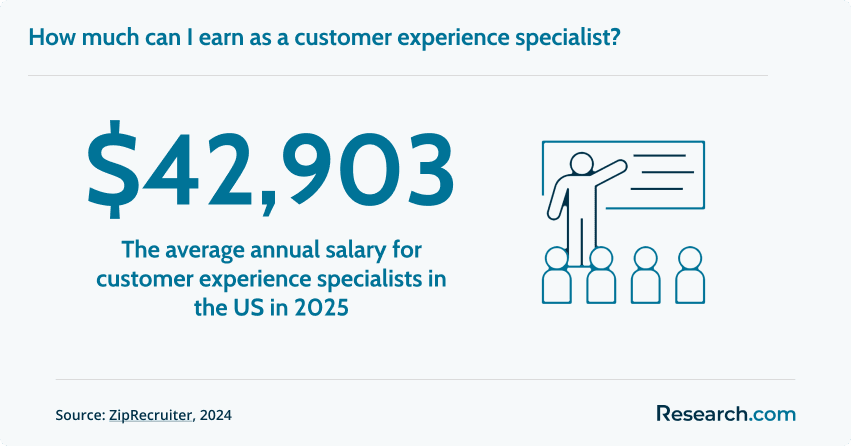
Newcomers can expect to earn around $39,250 per year. The median annual salary for a mid-level customer experience specialist stands at $48,000. At the senior level, with extensive experience and advanced skills, salaries can reach $57,250 or higher.
| Career stage | Annual salary benchmark | What typically affects movement upward |
| Entry level | $39,250 per year | Frontline experience, reliability, communication skills, CRM familiarity, and ability to handle customer issues accurately. |
| Mid level | $48,000 | Stronger product knowledge, feedback analysis, escalation handling, process improvement, and cross-functional coordination. |
| Senior level | $57,250 or higher | Advanced CX skills, leadership, specialization, industry knowledge, and measurable impact on service quality or retention. |
Higher earnings are often tied to roles with greater business responsibility. Specialists who can analyze customer data, lead service improvements, manage teams, work with enterprise clients, or connect CX initiatives to revenue and retention may have stronger advancement potential than those who remain in narrow support roles.
When evaluating a job offer, look beyond base pay. Schedule expectations, remote or hybrid options, bonus eligibility, benefits, promotion paths, workload, support tools, and emotional demands can all affect whether a role is a good long-term fit.
What is the job outlook for customer experience specialists?
The employment outlook for customer experience specialist roles aligns closely with customer service representatives, with no overall growth projected from 2024 to 2034 in the U.S. This 0% growth rate is slower than the average 3% growth expected across all occupations.
That does not mean the field is disappearing. It means the work is changing. Routine questions, simple transactions, and repetitive support tasks are increasingly handled through automation, chatbots, self-service portals, and AI-assisted tools. At the same time, employers still need people who can manage complex issues, interpret customer feedback, improve processes, and deliver service in situations where trust, judgment, and empathy matter.
The key factors shaping the future outlook
- Automation is reducing routine work. Basic inquiries may require fewer human agents, especially when customers can solve simple problems through digital tools.
- Complex support is becoming more valuable. Customers still need skilled professionals for escalations, sensitive issues, technical problems, and situations that require judgment.
- Customer expectations are rising. Many customers expect fast, personalized, multi-channel service and consistent information across every touchpoint.
- Specialized industries still need knowledgeable support. Healthcare, fintech, e-commerce, and travel can require higher-touch service, industry knowledge, and careful handling of customer concerns.
- Tech-savvy professionals may be better positioned. Specialists who can work with CRM systems, analytics tools, AI-assisted workflows, and feedback platforms may be more competitive.
To remain employable, build skills that automation does not easily replace: empathy, judgment, relationship management, escalation handling, customer research, data interpretation, and process improvement. If you need an affordable education route, comparing low tuition schools online that accept financial aid may help you evaluate accessible options.
What is the typical work environment for customer experience specialists?
Customer experience specialists work in a range of settings, including corporate offices, call centers, customer service departments, retail or service locations, and remote or hybrid teams. The environment depends heavily on the industry and whether the role is focused on direct support, customer success, operations, analytics, or strategy.
Many roles involve frequent communication with customers through phone, email, chat, help desk tickets, video calls, or face-to-face interaction. Specialists may also work closely with marketing, sales, product development, IT, billing, operations, and leadership teams to address recurring issues and improve the customer journey.
Schedules vary. Some customer experience jobs follow standard business hours, Monday through Friday. Retail, e-commerce, travel, healthcare, technical support, and call center roles may require evenings, weekends, holidays, or rotating shifts. Remote and hybrid work options are increasingly common for roles that rely on digital systems, although some employers still prefer on-site work for training, collaboration, security, or access to specialized equipment.
Work conditions to evaluate before accepting a role
- Customer volume: High-volume support roles can be fast-paced and repetitive, while strategic CX roles may involve more project work.
- Escalation load: Some positions handle mostly routine questions; others focus on difficult complaints or high-risk accounts.
- Tools and systems: Poor systems can make even simple customer issues harder to resolve.
- Performance metrics: Ask whether success is measured by speed, satisfaction, retention, quality, case closure, or a mix of factors.
- Team support: Strong supervisors, clear policies, and good escalation paths can reduce stress and improve performance.
What are the pros and cons of customer experience specialist careers?
Customer experience careers can be satisfying for people who like solving problems, helping customers, and improving systems. They can also be stressful because the work often involves complaints, competing priorities, and pressure to deliver fast answers even when the underlying issue is complicated.
| Pros | Cons |
| You can make a direct difference in how customers feel about a company. | You may deal with upset, impatient, or emotionally charged customers. |
| The role builds transferable skills in communication, problem-solving, data, and operations. | Some work can be repetitive, especially in high-volume support environments. |
| There are paths into customer success, CX management, training, operations, analytics, and strategy. | Performance metrics can create pressure to be both fast and highly accurate. |
| You can influence business improvements by identifying recurring customer pain points. | You may have limited authority to solve problems caused by policy, product, pricing, or systems. |
| Remote and hybrid options may be available depending on the employer and role. | Some positions require evenings, weekends, holidays, or shift work. |
Who is this career best suited for?
This career may fit you well if you are patient, clear under pressure, curious about why problems happen, and comfortable working with both customers and internal teams. It may be less ideal if you strongly dislike conflict, repetitive communication, performance tracking, or situations where you must enforce policies customers do not like.
If you are comparing career paths with different work styles, you may also want to explore what are some good trade jobs to see whether a more hands-on route better matches your strengths.
What are the opportunities for advancement for customer experience specialists?
Customer experience can lead to several advancement paths. Some professionals move into people management. Others specialize in analytics, customer success, training, research, operations, or strategy. Advancement usually depends on your ability to show that you can improve customer outcomes, not just complete daily tasks.
Advancement path
- Customer Experience Associate / Agent: Handles direct customer interactions, documents issues, answers questions, and learns how customers experience the company.
- Customer Experience Specialist: Resolves more complex issues, analyzes feedback, identifies pain points, improves touchpoints, and works with other teams.
- Customer Success Manager / Customer Experience Manager: Manages customer relationships, leads initiatives, supports retention, supervises teams, or coordinates CX projects across departments.
- Director of Customer Experience / Head of Customer Experience: Oversees broader CX strategy, sets standards, manages teams, tracks performance, and influences organization-wide decisions.
- Chief Experience Officer (CXO): Leads experience strategy at the executive level and aligns customer experience with organizational goals.
Specialization areas
- Customer Insights & Analytics: Uses data, surveys, feedback, and behavior patterns to guide service and product improvements.
- User Experience (UX) Design: Improves digital or physical journeys so customers can complete tasks more easily.
- Customer Experience Strategy: Designs broader plans for improving customer interactions across multiple channels and touchpoints.
- Training & Development: Builds onboarding, coaching, and service training programs for customer-facing teams.
- Customer Success Management: Focuses on retention, adoption, relationship management, and helping customers achieve their goals after purchase.
- Customer Research & Voice of Customer Programs: Conducts qualitative and quantitative research to understand customer needs, expectations, and behavior.
How to position yourself for promotion
- Track measurable accomplishments, such as improved satisfaction, better documentation, fewer repeat issues, or successful process changes.
- Volunteer for projects that connect customer feedback with business improvements.
- Learn the systems your organization uses to manage customer data, tickets, surveys, and reporting.
- Build relationships with product, operations, sales, marketing, and technical teams.
- Ask managers what evidence is required for promotion before you assume strong performance alone will be enough.
What other careers should you consider?
If you are interested in customer experience but unsure whether the specialist path is the best fit, compare it with related careers that use similar strengths. The right alternative depends on whether you prefer relationship building, training, operations, sales, marketing, or long-term account support.
- Sales Representative or Account Manager: A strong option if you enjoy relationship-building, persuasion, and helping clients choose solutions. These roles may involve sales targets and revenue pressure.
- Training and Development Specialist: A good fit if you like teaching, creating learning materials, coaching employees, and improving team performance.
- Customer Success Manager: Best for people who prefer proactive relationship management, customer retention, onboarding, and long-term account health rather than one-time issue resolution.
- Operations Manager: A practical path if you are more interested in improving workflows, reducing friction, coordinating teams, and making service delivery more efficient.
- Marketing Assistant: A related option if you want to use customer insights to support campaigns, messaging, content, research, or brand communication.
When comparing options, pay attention to your preferred type of pressure. Customer experience roles often involve service pressure. Sales roles may involve revenue pressure. Operations roles may involve efficiency and staffing pressure. Marketing roles may involve campaign deadlines and performance goals. Matching the pressure type to your strengths can help you make a better long-term career decision.
Here's What Professionals Say About Their Customer Experience Careers
- Naomi: "I love being a customer experience specialist because I get to truly be the voice of the customer inside our company. Every interaction feels meaningful, especially knowing that how I handle each case can turn someone's entire day around. Whether it's solving a complaint or making a process smoother, I see the direct impact on customer trust and loyalty. It's fulfilling to know that by listening closely and advocating for their needs, I'm helping real people feel heard and valued."
- Julian: "The hardest part of my job is managing conversations when customers are already upset through no fault of my own. I've learned to stay calm, listen carefully, and focus on finding a solution rather than just offering apologies. Sometimes it's emotionally taxing, but I remind myself that turning a difficult moment into a positive experience is part of what defines excellent service. Those challenging calls have taught me resilience and patience more than anything else."
- Iris: "There's nothing more rewarding than following up with a customer who started out frustrated and hearing them say, 'Thank you, you really helped me today.' I once helped a customer untangle a billing problem that took several hours of careful attention and empathy. When it was resolved, their appreciation made every tough minute worth it because I could tell they felt genuinely cared for. Those moments of connection prove that every single interaction matters a great deal."
Key Findings
- Customer experience specialists improve customer interactions by resolving issues, analyzing feedback, and helping organizations fix recurring pain points.
- The role requires both soft skills and technical skills, including communication, empathy, problem-solving, CRM use, feedback analysis, and cross-functional collaboration.
- There is no single required degree or license for this career, but employers may value education in business administration, marketing, communications, psychology, or related fields.
- Recognized credentials such as the Certified Customer Experience Professional (CCXP) and Certified Customer Experience Specialist (CCXS) can support career growth when combined with practical experience.
- Salary benchmarks include around $39,250 per year for newcomers, $48,000 for a mid-level customer experience specialist, and $57,250 or higher at the senior level.
- The employment outlook aligns with customer service representatives, with no overall growth projected from 2024 to 2034 in the U.S.; the 0% growth rate is slower than the average 3% growth expected across all occupations.
- Automation is changing the field, making routine support less secure while increasing demand for professionals who can handle complex issues, use technology, interpret data, and improve customer journeys.
- Advancement can lead to roles in customer success, CX management, analytics, UX, training, operations, strategy, and executive leadership.
Other Things You Should Know About Customer Experience Careers
The rise of AI and automation is shifting the customer experience specialist's focus away from routine inquiries, which are now handled by chatbots and self-service tools. Their role increasingly centers on solving complex, emotionally charged issues that require empathy and critical thinking. This change demands stronger emotional intelligence and advanced problem-solving, as genuine human connection and nuanced judgment remain beyond AI's reach.
In 2027, essential skills for customer experience careers include data analysis, emotional intelligence, customer journey mapping, and technological proficiency with CRM and AI tools. These skills enable specialists to personalize interactions, anticipate customer needs, and enhance overall customer satisfaction.
The most valued certifications are CXPA’s Certified Customer Experience Professional (CCXP), Medallia training, and Salesforce certifications for CRM work. CCXP requires 3,500 hours of customer experience work, while Salesforce credentials show skill in service and analytics platforms used in many CX roles.
References
- Exploring Effective Paths for Career Growth in Customer Experience - E3 Customer Experience Conference 2025 https://e3cx.live/exploring-effective-paths-for-career-growth-in-customer-experience/
- What Are Customer Experience (CX) Jobs? Skills You Need to Succeed https://www.renascence.io/journal/what-are-customer-experience-cx-jobs-skills-you-need-to-succeed
- Clarify - Exploring Customer Success Careers: Opportunities and Growth Paths https://www.clarify.ai/blog/exploring-customer-success-careers-opportunities-and-growth-paths
- How to start a new career in Customer Experience https://www.knowledgeowl.com/blog/posts/how-to-start-a-new-career-in-cx/
- Seven Career Tips For Young Customer Experience Professionals https://www.forbes.com/sites/blakemorgan/2020/01/09/seven-career-tips-for-young-customer-experience-professionals/
- Trusted By Thousands Of Graduates Across The Globe https://thecxacademy.org/our-testimonials/page/2/
- 12 Best Customer Experience Certification Programs for 2025 https://thecxlead.com/career/best-customer-experience-certification-programs/
- 10 Alternative Career Paths for Customer Service Professionals [2025] https://digitaldefynd.com/IQ/customer-service-alternative-career/
- Soft skills and hard skills for workplace success | Puig Careers https://careers.puig.com/en/blog/importancia-habilidades-blandas-duras
- The 25 Most Common Customer Experience Managers Interview Questions https://www.finalroundai.com/blog/customer-experience-manager-interview-questions


