2027 Computer Science Degree vs. Certificate: Which Should You Choose?

Co-Founder and Chief Data Scientist
Choosing between a computer science degree and a certificate is really a decision about scope, speed, cost, and career risk. A degree is usually the stronger option for students who want broad preparation for software engineering, data, systems, graduate study, or long-term advancement. A certificate is usually better for learners who need a faster, narrower credential in areas such as programming, web development, cloud computing, cybersecurity, or IT support.
The right path depends on what you need the credential to do. About 70% of tech employers value a degree for complex roles, but certificates can still help workers prove targeted skills quickly, especially when paired with projects, experience, or prior education. This guide compares computer science degrees and certificates by time, credits, admissions, online availability, tuition, accreditation, transfer options, jobs, and starting salary so you can choose the option that fits your goals and constraints.
Key Points About Computer Science Degree vs. Certificate Programs
- Computer science degrees offer comprehensive knowledge and higher salary potential, with graduates earning a median annual wage of $91,250 compared to certificates' lower range.
- Certificates focus on specific skills, enabling faster entry into the workforce but may limit long-term professional growth compared to degrees.
- Degree programs encourage critical thinking and theory understanding, while certificates emphasize practical, job-ready competencies suited for career changers or skill boosters.
What Are the Differences Between Computer Science Degree and Certificate Programs?
A computer science degree and a computer science certificate can both strengthen your resume, but they serve different purposes. A degree is a broad academic credential that builds theory, problem-solving ability, and technical depth over several years. A certificate is a shorter credential focused on a defined skill set, tool, language, or specialization.
| Factor | Computer Science Degree | Computer Science Certificate |
| Best for | Students seeking broad preparation, long-term advancement, or roles that expect deeper technical training | Learners who need targeted upskilling, career switching support, or proof of a specific technical skill |
| Depth of learning | Covers programming, algorithms, systems, math, databases, software engineering, theory, and general education | Focuses on a narrower area such as web development, cybersecurity, cloud tools, programming, or data skills |
| Time commitment | Usually requires multiple years of study | Often completed in weeks, months, or up to 18 months depending on format and intensity |
| Career use | Better suited for software development, data, systems, architecture, graduate study, and leadership tracks | Useful for entry-level IT roles, junior technical roles, skill refreshes, or specialization within an existing career |
| Cost | Usually higher because of the number of credits, program length, and institutional fees | Usually lower overall, though cost varies widely by provider and level |
The main trade-off is breadth versus speed. A degree takes longer and costs more, but it can support a wider range of roles and advancement paths. A certificate is faster and more focused, but it may not substitute for a degree when employers require formal academic preparation or when the role demands strong foundations in algorithms, architecture, mathematics, and large-scale software design.
- Choose a degree if you are starting your education, want maximum career flexibility, plan to pursue graduate school, or are targeting roles where a bachelor’s or graduate degree is commonly requested.
- Choose a certificate if you already have a degree, need to learn a specific technology quickly, want to test whether tech is a good fit, or need a lower-cost credential for near-term career movement.
- Consider both over time if you want to enter the field quickly with a certificate and later build toward a degree, provided the credits are transferable.
How Long Does It Take to Complete a Computer Science Degree vs. a Certificate Program?
A computer science degree usually takes much longer than a certificate because it includes more credits, broader academic requirements, and a deeper curriculum. A bachelor’s degree in computer science usually takes about four years of full-time study. Master’s and doctoral programs require additional years. By contrast, a certificate may take a few weeks, several months, or up to 18 months, and some intensive bootcamps last just two or three months.
- Typical degree timeline: A bachelor’s degree usually takes about four years when pursued full time. Part-time enrollment can make the program more manageable for working adults, but it extends the completion timeline.
- Typical certificate timeline: Certificates are shorter because they concentrate on a limited subject area. Some are self-paced; others follow a fixed academic term or bootcamp schedule.
- Accelerated options: Degree timelines may be shortened through accelerated tracks, transfer credits, prior college coursework, or summer enrollment. Students who want a faster academic credential may also compare options such as the quickest associate degree programs.
- Prior experience: Learners with programming experience may move faster through certificate coursework, while students new to coding may need extra time for practice, portfolio work, and foundational study.
- Schedule intensity: A short program is not always easier. A two- or three-month bootcamp can require daily work, while a longer certificate may be more realistic for someone balancing employment or caregiving.
If speed is the top priority, a certificate is usually the more practical route. If you want a credential with broader academic and career value, a degree is usually worth the longer timeline.
Can You Complete a Computer Science Degree or Certificate Entirely Online?
Yes. Many students can complete either a computer science degree or a computer science certificate entirely online, depending on the institution and program design. Online study is now common in computer science because much of the work involves programming, systems analysis, databases, software projects, and virtual collaboration.
Universities like Oregon State University, Arizona State University, Southern New Hampshire University, and Western Governors University offer fully online bachelor's degrees in computer science, delivering all core courses remotely. Many online degree programs use the same or similar curriculum as campus-based programs, but students should still verify accreditation, faculty support, course format, and whether any in-person requirements apply.
Some online degree programs may require certain general education, lab science, or transfer courses to be completed separately. Certificate programs are often easier to complete fully online because they are shorter and more skills-focused. Students considering shorter online pathways can also review easier online associate degree options when comparing academic alternatives.
What to check before enrolling online
- Accreditation: Confirm the school’s accreditation status before assuming credits, financial aid, or employer recognition will transfer smoothly.
- Course delivery: Check whether classes are asynchronous, live, self-paced, or term-based. This affects how well the program fits a work schedule.
- Hands-on learning: Look for coding projects, virtual labs, capstones, GitHub-ready portfolio work, and practical assignments.
- Career support: Online learners should compare advising, tutoring, internship access, employer partnerships, and job-search support.
- Networking: Fully online programs can be flexible, but students may need to be more intentional about connecting with classmates, faculty, and professional communities.
Online degrees are a good fit for students who want a recognized academic credential without relocating. Online certificates are a good fit for professionals who need targeted skills quickly. Hybrid or campus programs may be better for students who want in-person labs, local internships, or stronger face-to-face networking.
What Are the Admission Requirements for a Computer Science Degree vs. a Certificate Program?
Computer science degree programs usually have more formal admission requirements than certificate programs. That is because degrees involve a longer academic sequence, more advanced coursework, and institutional degree standards. Certificates are often designed for broader access, including working adults and career changers.
Admission Requirements for Computer Science Degree Programs
- Educational background: Applicants usually need a high school diploma for bachelor's programs or a bachelor's degree in computer science or a related field for graduate studies.
- Coursework prerequisites: Degree programs often expect mathematics preparation such as calculus and statistics, along with foundational computer science topics such as programming, data structures, algorithms, and computer architecture.
- Minimum GPA: Many institutions set a minimum GPA requirement, typically between 2.75 and 3.0, for both undergraduate and graduate admissions.
- Transcripts and documentation: Official transcripts are usually required. Graduate applicants may also need statements of intent or letters of recommendation.
- Standardized tests: Most bachelor's programs do not require SAT or ACT scores, while GRE scores for graduate programs are often optional.
- International student requirements: International applicants may need proof of English proficiency and additional supporting documents.
Admission Requirements for Computer Science Certificate Programs
- Educational background: A high school diploma or GED is often enough, although some advanced or graduate certificates may require prior college coursework or a degree.
- Technical readiness: Some certificates expect basic computer literacy or introductory programming knowledge. Others are built for beginners.
- Application materials: Requirements are often limited to an application form and proof of educational background.
- Flexible entry: Many certificate programs use open, rolling, or frequent admissions cycles, which can be useful for working professionals who do not want to wait for a traditional academic term.
Applicants should not assume that “certificate” always means beginner-friendly. A cybersecurity, data science, or graduate-level programming certificate may require prior technical knowledge. Before applying, compare prerequisites with your current skills and career target. Students still deciding on a major may also find it useful to review college majors with strong earning potential.
How Many Credits Do You Need to Complete a Computer Science Degree vs. a Certificate?
Computer science degrees require far more credits than certificates. That credit difference explains why degrees take longer, cost more, and cover a wider range of academic and technical subjects.
- Bachelor's degree: Typically requires between 120 and 124 semester credits. This usually includes computer science core courses, mathematics, science, electives, and general education requirements.
- Certificate program: Usually requires between 12 and 18 credits. The curriculum is narrower and built around a specific technical outcome, such as learning a programming language, preparing for a technical role, or strengthening an existing skill set.
The credit load affects more than graduation timing. It also affects financial aid eligibility, transfer planning, workload, and how much academic context you gain. A 120- to 124-credit degree can expose students to theory, team projects, writing, quantitative reasoning, and advanced electives. A 12- to 18-credit certificate is more efficient, but it usually cannot provide the same depth.
One student pursuing a computer science certificate described the smaller credit requirement as the reason the program felt realistic while working. The focused course sequence helped him build practical skills without committing to the broader requirements of a degree. That is the main advantage of a certificate: it can be targeted and manageable. The limitation is that fewer credits also mean fewer opportunities to build the full academic foundation that many advanced computing roles expect.
What Is the Average Tuition for a Computer Science Degree vs. a Certificate?
A computer science degree usually costs more than a certificate because it requires more credits and a longer enrollment period. However, the best value depends on your goal. A lower-cost certificate may be the right investment for quick upskilling, while a higher-cost degree may deliver broader long-term career options.
Average Tuition for Computer Science Degree Programs
- Tuition range: Bachelor's degree programs in computer science usually range from $6,000 to $40,000 per year, depending on school type and residency status.
- Public vs. private: Public universities tend to offer lower tuition prices, averaging $10,154 per year for in-state students and about $33,606 for out-of-state students; private schools can charge significantly more, sometimes over $60,000 annually.
- Online options: Affordable online programs can cost between $2,500 and $11,250 per year, though prices vary by institution and program structure. Students comparing remote programs should review the full online computer science degree cost, including fees and technology expenses.
- Graduate degrees: Master's programs generally fall between $20,000 to $40,000 on the lower end, with some exceeding this range.
- Additional fees: Tuition may not include fees, textbooks, software, equipment, transportation, or living expenses, which can raise the total cost.
Average Tuition for Computer Science Certificate Programs
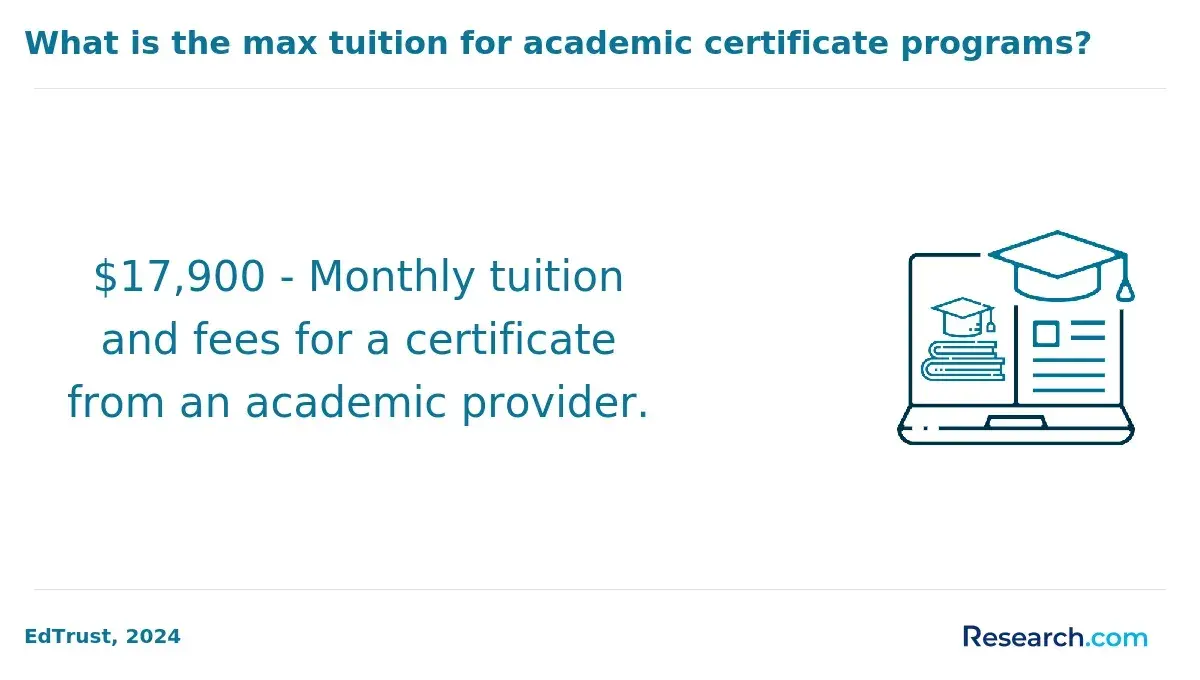
- Tuition range: Certificate programs usually cost less overall, with undergraduate certificates averaging about $11,691 total tuition for the program duration.
- Program length: Most certificates last months to a year, which helps keep the total cost below that of a full degree.
- Graduate certificates: Graduate-level certificates range from $12,000 to $14,000 total tuition, depending on credits and school reputation.
- Online certificates: Online certificates may offer flexible or reduced pricing, with some reputable programs starting under $5,000.
- Cost influencers: Price varies by institution, provider reputation, curriculum depth, certificate level, and whether the program is credit-bearing.
Cost comparisons should include more than tuition. Ask whether the program qualifies for financial aid, whether credits can transfer, whether employer tuition assistance applies, and whether the credential is likely to help you reach a specific job outcome. Learners who want short training options with strong employment potential can also compare quick programs that may lead to well-paying careers.
Can You Transfer Certificate Credits Toward a Computer Science Degree Later On?
Sometimes, but transfer is never automatic. A college may accept certificate credits toward a computer science degree if the courses were completed at an accredited institution, match the degree curriculum, carry academic credit, and meet grade and recency rules. Noncredit bootcamps and private training certificates are less likely to transfer into a degree, even when they teach useful skills.
Common transfer limits apply. Many schools restrict how many certificate credits can count toward a degree, such as up to 18 for graduate programs or 30 for undergraduate degrees. Grades also matter; schools may require a minimum of a "B" for graduate credits or a "C" for undergraduate credits. Credits may also need to be recent, typically earned within the last five to ten years.
How to protect your credits before enrolling
- Ask whether the certificate is credit-bearing: A certificate of completion is not the same as transcripted academic credit.
- Confirm accreditation: Credits from accredited institutions are more likely to be reviewed for transfer.
- Request written guidance: Admissions, the registrar, or an academic department can explain whether specific courses may apply.
- Save course materials: Keep syllabi, catalog descriptions, assignments, and learning outcomes in case the school requests documentation.
- Check residency requirements: Some colleges require a certain number of credits to be completed directly through their institution.
One student who earned a certificate before pursuing a computer science degree found that the transfer process required follow-up with the registrar and academic advisors. Some courses transferred easily, while others required course descriptions and additional review. Her experience highlights the key lesson: verify transferability before enrolling if your long-term plan includes a degree.
Are Certificate Programs Accredited the Same Way as Computer Science Degrees?
No. Computer science certificates are generally not accredited in the same way as degree programs. Associate, bachelor's, and master's degrees are typically offered by institutions accredited by recognized regional or national agencies approved by the U.S. Department of Education. Some STEM programs may also hold specialized accreditation from organizations like ABET.
Certificate programs vary more widely. Some university-issued certificates are part of an accredited institution’s academic offerings. Others are offered by private training providers, bootcamps, or technology education companies and may not go through the same formal accreditation process. Many certificates verify that a student completed a course sequence, but they do not necessarily indicate that the program met comprehensive academic standards.
Accreditation matters because it can affect credit transfer, financial aid eligibility, graduate school acceptance, and employer confidence. For a degree, confirm institutional accreditation and, when relevant, specialized accreditation. For a certificate, evaluate the provider’s reputation, whether credits appear on an official transcript, curriculum quality, instructor qualifications, employer partnerships, and whether the skills align with current job requirements.
- For degrees: Prioritize recognized institutional accreditation and review whether the program has specialized accreditation if that matters for your goals.
- For certificates: Look for a reputable university, employer-recognized provider, or program with clear outcomes, transparent pricing, and strong student support.
- For transfer plans: Choose a credit-bearing certificate from an accredited institution whenever possible.
A certificate can still be valuable without degree-style accreditation, especially if it teaches marketable skills. But students should be clear about what the credential does and does not guarantee.
What Jobs Can You Get with a Computer Science Degree vs. a Certificate?
A computer science degree usually prepares graduates for a wider set of technical roles, including jobs that involve software design, data analysis, systems thinking, and long-term project responsibility. A certificate is more commonly used for entry-level support roles, junior technical roles, or specialization within an existing career.
Jobs You Can Get with a Computer Science Degree
- Software developer: Designs, builds, tests, and maintains software applications for web, mobile, enterprise, or systems environments.
- Systems analyst: Evaluates an organization’s technology systems and recommends improvements that support business goals.
- Data scientist: Uses programming, statistics, and analytical methods to interpret large datasets and support decision-making.
- Network architect: Plans and implements complex network infrastructure with attention to performance, reliability, and security.
- IT project manager: Coordinates technology projects, timelines, stakeholders, budgets, and technical teams.
Jobs You Can Get with a Computer Science Certificate
- Help desk technician: Troubleshoots hardware, software, access, and user support issues in an entry-level IT environment.
- Junior web developer: Builds and maintains websites or web features, often under the supervision of more experienced developers.
- IT support specialist: Helps maintain workplace systems, resolves technical problems, and supports users across hardware and software tools.
- Network administrator: Handles day-to-day network operations, connectivity, account management, and basic security tasks.
- Cybersecurity analyst (entry-level): Monitors systems, reviews alerts, documents incidents, and helps implement security controls under supervision.
The credential alone rarely guarantees a job. Employers also look for evidence of ability: projects, internships, certifications, code samples, problem-solving performance, communication skills, and experience with relevant tools. Degree graduates should build portfolios and practical experience rather than relying only on coursework. Certificate holders should be especially deliberate about showing hands-on work because the credential is shorter and more specialized.
What Is the Average Starting Salary for a Certificate vs. Computer Science Degree Graduates?
Starting salary is usually higher for computer science degree graduates than for certificate holders, but actual pay depends on role, location, employer, experience, portfolio strength, and technical specialization. A degree tends to support access to higher-paying technical roles earlier, while a certificate more often leads to support, junior, or narrowly focused roles at the start.
- Typical salary range for degree graduates: Computer science degree holders typically start with salaries ranging from $66,000 to $84,960 per year, with some sources reporting median early-career salaries near $80,000.
- Typical salary range for certificate holders: The average starting salary for computer science certificate holders generally falls between $40,000 and $55,000 per year, reflecting roles such as technical support or junior IT positions.
- Factors influencing salary: Industry sector, geographic location, internships, prior experience, coding portfolio, interview performance, and in-demand skills can affect offers for both degree and certificate holders.
- Career outlook: Degree graduates tend to have stronger long-term advancement opportunities and higher earning potential. Certificate holders may need additional education, certifications, or experience to reach similar levels.
- Regional salary variations: Urban tech hubs and states like California and Massachusetts typically offer higher salaries overall, which matters when comparing cost of living with expected pay.
- Additional resources: Learners comparing shorter training routes can review high-paying trade school career options.
The salary comparison should be tied to your target job, not only the credential name. A certificate in a high-demand technical area may improve pay for someone who already has experience. A degree may be more valuable for someone starting from scratch and aiming for software engineering, systems, data, or graduate-level pathways.
Here's What Graduates of Computer Science Programs Say About Their Degree or Certificate
-
: "I chose the computer science certificate program because I wanted to quickly upskill and land a job in tech without the long commitment of a full degree. The faster pace kept me engaged, and the lower cost made it a practical choice compared to the average degree expenses. It was a fantastic stepping stone for me to break into the industry.
Lawrence"
-
: "Pursuing a computer science degree was a deep dive into both theory and practical applications, which I appreciated despite it taking longer and costing more. The comprehensive curriculum prepared me well for diverse career paths, and the investment felt worth it given the doors a degree can open. For anyone weighing options, consider how much you value the detailed learning experience versus speed.
Yitzchok"
-
: "I completed both the certificate and degree programs, and it gave me a well-rounded perspective on their differences. The certificate helped me quickly gain foundational skills and enter the workforce, while the degree expanded my knowledge and boosted my long-term career prospects. The cost difference was notable, but balancing both was key for my personal growth and career goals.
Cameron"
Other Things You Should Know About Computer Science Degrees
Computer science certificates are generally recognized by employers, especially for specialized skills such as cybersecurity or data analysis. However, their acceptance often depends on the employer and the relevance of the certificate to the job role. Certificates tend to demonstrate practical knowledge but may not carry the same weight as a full degree in competitive or research-focused positions.
Many regionally accredited universities accept 6 to 18 certificate credits toward a computer science bachelor’s degree, but only if the courses match the degree plan and were earned with a grade of C or better. The final decision rests with the receiving institution’s registrar or transfer office.
By 2026, degree holders often access more diverse job opportunities in fields like data science or software engineering, while certificate holders may focus on specialized or entry-level roles. Degree programs typically provide broader exposure, which can lead to greater career flexibility and advancement potential.
A computer science degree provides broad and in-depth knowledge, covering theoretical foundations, algorithms, systems, and software development. In contrast, certificate programs focus on specific skills or technologies, offering a narrower but more targeted education. The degree is better suited for roles requiring comprehensive understanding, while certificates are ideal for skill enhancement.
References
- Fast-track Your Degree by Transffering Relevant Credits https://www.eccu.edu/student-services/transferring-credit/
- Certificate and post-baccalaureate https://engineering.tufts.edu/cs/prospective-students/certificate-and-post-baccalaureate
- IT Certifications vs. Degree: Which Is Right for You? https://www.coursera.org/articles/it-certifications-vs-degree
- IT Certifications vs. Degree: What’s the Difference? - Per Scholas https://perscholas.org/news/it-certifications-vs-degree-whats-the-difference/
- Computer Science AS | North Hennepin C.C. https://www.nhcc.edu/academics/degree-pathways/physical-sciences-engineering-mathematics-and-technology/computer-science
- Certificates vs Diplomas in Computer Science https://blog.boot.dev/computer-science/compsci-certificate-vs-degree/
- How much does an IT program cost? | WCC - Western Community College https://wcc.ca/blog/how-much-does-an-it-program-cost/
- How Much is a Computer Science Course? https://www.nobledesktop.com/learn/computer-science/how-much-is-a-computer-science-course
- Benefits of a Computer Science Degree vs. Bootcamps https://online.nyit.edu/blog/benefits-of-a-computer-science-degree-vs-bootcamps
- Degrees vs. Certifications: Which is Better for an IT Career? https://www.acitechacademy.com/blog/degrees-vs-certifications-which-is-better-for-an-it-career/