2027 Clinical Deterioration vs an Abnormal Test Result: Nursing Observation Concepts
Audited and Verified:
Our Editorial and Data Verification Process
Research.com uses government datasets, official education statistics and primary institutional information to support its career and degree guides. Our review process checks factual accuracy, occupational definitions, source dates and the requirements associated with the credentials discussed.
How This Article Was Fact-Checked
Our editorial team verifies salary estimates, employment projections, education requirements and program information against original data providers and official organizations. Salary figures are checked against the relevant occupational definitions and reporting periods. Information about licensure, accreditation and required in-person training is reviewed separately.
Fact-checked and verified on:

Co-Founder and Chief Data Scientist
An abnormal result deserves attention, but it does not always mean a patient is getting worse. Conversely, a patient may deteriorate before a test result changes. For nursing students and early-career nurses, recognizing that difference is central to safe observation, prioritization, and communication. This guide explains how to compare findings with the patient's baseline, respond within your role, and evaluate whether a nursing program provides the supervised practice needed to develop clinical judgment. It is an educational framework, not a substitute for patient-specific assessment or facility policy.
Key Things You Should Know
- Clinical deterioration is a worsening patient condition; an abnormal test result is one piece of information whose significance depends on the patient, trend, timing, and reliability of the result.
- Assess the patient as well as the result. A concerning change in breathing, circulation, consciousness, or overall appearance may require prompt escalation even before a new result is available.
- Clinical judgment develops through supervised practice. The NCLEX clinical judgment framework describes six cognitive operations, from recognizing cues through evaluating outcomes; knowing the framework is not the same as demonstrating competence with patients.
What Is Clinical Deterioration Versus an Abnormal Test Result?
Clinical deterioration is a meaningful decline in a patient's condition, such as a worsening pattern of respiratory, circulatory, or neurologic function. An abnormal test result is a measurement outside a reference range or an expected finding. The result may signal deterioration, reflect a longstanding condition, or need confirmation. Neither a normal-looking number nor a single abnormal number replaces assessment.
This comparison shows why nurses interpret results alongside observations rather than treating every flagged value as an identical emergency.
| Finding | What it tells the nurse | What remains uncertain |
| New change in the patient's condition | The patient may be deteriorating, even if recent tests were unremarkable. | The cause and appropriate response require assessment and escalation. |
| Isolated abnormal result | A measurement needs interpretation and may require prompt follow-up. | Whether it is new, accurate, clinically significant, or already addressed. |
| Worsening trend in results and observations | Multiple cues strengthen concern about deterioration. | The full significance still depends on patient context and clinical judgment. |
Behavioral and mental-status changes illustrate the distinction: new confusion is a patient finding, not merely an unusual score. A nurse exploring short online psychiatric nursing certificates should still distinguish specialty education from the immediate bedside responsibility to assess and report a new change within their current scope.
How Do Nurses Recognize Signs of Patient Deterioration?
Nurses look for change from baseline and concerning patterns, not just values outside a printed range. Observations may include breathing effort, skin appearance, responsiveness, pain, urine output, vital-sign trends, and what the patient or family says is different. The patient's diagnosis, recent treatment, medications, and expected recovery course affect interpretation.
For example, a patient whose breathing effort and alertness are worsening needs timely attention even if an earlier oxygen reading appeared acceptable. Conversely, a flagged measurement should be considered in light of the patient's presentation and the possibility of measurement error. Unit-specific early-warning tools can support recognition, but they do not override assessment or escalation criteria.
Students should practice stating both the observation and the change: "This finding differs from the documented baseline, and these other cues concern me." Advanced roles require further education and authorization; comparisons of family NP programs organized by duration do not replace the supervised bedside assessment skills an RN must develop first.
How Should Nurses Respond to Abnormal Test Results?
An abnormal result calls for a timely, context-aware response. The nurse's responsibilities depend on the result, the patient's condition, the applicable critical-result policy, orders, scope of practice, and available supervision. A flagged value should not be dismissed because the patient appears comfortable, nor should a student independently diagnose or treat on the basis of a number.
A practical learning sequence helps separate checking information from making unauthorized treatment decisions:
- Identify the result, its collection time, reference or critical designation, and whether an earlier result provides a useful comparison.
- Assess the patient and relevant trends promptly, using the level of supervision required by the setting and the student's role.
- Follow facility policy for critical results and escalation; communicate the finding, patient assessment, and concern to the appropriate licensed clinician.
- Confirm that the message was received, carry out authorized directions, reassess as indicated, and document according to policy.
If the patient appears acutely unwell, seek help through the unit's emergency pathway rather than waiting to complete every information check. Additional NP study is not a prerequisite for an RN to follow an abnormal-result escalation policy; nurses considering expanded practice can assess cost-focused nurse practitioner study options separately from this immediate competency.
Baseline, trend, acuity, and uncertainty are more useful together than any one measurement alone. Airway, breathing, circulation, and changes in consciousness help identify threats needing immediate attention. A newly developing problem may take priority over a longstanding abnormality, while a critical reported result can require prompt follow-up even without obvious symptoms. The correct priority remains patient- and setting-specific.
Nursing students can organize their thinking with the six operations used in the NCLEX clinical judgment framework: recognize cues, analyze cues, prioritize hypotheses, generate solutions, take action, and evaluate outcomes. This is a reasoning aid, not permission to make decisions beyond one's role. In a case exercise, students should explain which cues support concern, what information is missing, who must be notified, and how they would determine whether an authorized response helped.
An experienced RN pursuing a new advanced practice population focus may review online family NP certificate coursework comparisons. That pathway adds role-specific preparation; it does not make the foundational distinction between a concerning patient trend and an isolated result optional.
Programs commonly combine case discussions, skills labs, simulation, and supervised clinical experiences. A useful case does more than ask students to label a laboratory result "high" or "low": it asks them to assess the patient, notice changes over time, explain priorities, communicate concern, and reassess after an intervention. Faculty and clinical instructors can evaluate both reasoning and observable behaviors, including timely escalation and accurate documentation.
Simulation permits practice and feedback without exposing a patient to a novice's first attempt. It does not, by itself, establish independent bedside competence. Students should ask how a program evaluates performance with actual patients, what happens when they miss an important cue, and how remediation works. Already-licensed RNs considering RN-to-BSN project-based learning options should distinguish academic projects from the supervised patient assessments required in initial RN preparation.
Anatomy and physiology establish what body systems normally do; pathophysiology explains how illness can change them. Health assessment teaches students to collect and describe findings. Pharmacology helps them recognize how treatments and adverse effects may alter a patient's condition, while clinical nursing courses bring those subjects together in patient cases. Programs vary in course names and sequence.
To study effectively, connect each reported result to the patient's symptoms, baseline, medications, and recent care rather than memorizing an isolated reference range. Instructors can help students test their reasoning: Which finding is new? Which needs verification? Which change requires immediate reporting? For applicants with a prior non-nursing degree, understanding ABSN admission barriers can inform route selection, but the receiving school must determine whether prior science coursework meets its prerequisites.
Online coursework can teach terminology, case interpretation, and clinical reasoning, but patient assessment also requires evaluated, hands-on practice. A prelicensure program described as online may still require in-person labs, simulation, campus visits, and supervised clinical placements. An RN-to-BSN program serves already-licensed nurses and should not be mistaken for a route to initial RN licensure.
Before enrolling, ask who arranges clinical sites, where placements may occur, whether attendance is scheduled on weekdays or weekends, and how faculty evaluate changes in a patient's condition. These details matter particularly when work or caregiving limits availability. The same caution applies when reviewing online coursework formats in practical nursing programs: online classes do not remove required in-person preparation or change the LPN/LVN scope of practice.
Check three different matters before relying on a program's claims: the institution's accreditation, any applicable nursing program accreditation, and the state board's approval or recognition of the prelicensure program. Also confirm that the school can enroll students and arrange required clinical experiences in the student's location. These reviews serve different purposes and should not be treated as interchangeable.
For an initial RN or LPN/LVN pathway, ask the school and the relevant state board whether completion can meet that jurisdiction's educational requirements for examination eligibility. Graduation, NCLEX eligibility, passing the examination, and receiving a license are separate steps. A postlicensure doctorate has a different purpose: listings of accessible nursing practice doctorate pathways should not be interpreted as initial RN-licensure options or proof of eligibility for a particular advanced practice role.
For someone seeking an RN role involving ongoing patient assessment, the relevant starting point is a prelicensure RN pathway, commonly an ADN/ASN or BSN, followed by meeting state licensing requirements. An LPN/LVN pathway also involves observing and reporting patient changes, but duties and required supervision differ by state and setting. A postlicensure RN-to-BSN builds on an existing RN license rather than granting an initial one.
Career goals can change the appropriate next step. An RN who wants stronger assessment skills in a specialty may benefit more directly from supervised orientation, mentoring, and employer training than from another degree. Graduate study can serve an advanced practice, education, or leadership goal, but a non-APRN degree does not authorize NP practice. For an ADN-prepared RN planning academic advancement, ADN-to-MSN degree progression is one option to compare against RN-to-BSN and later graduate study; verify what credential and role each track actually prepares graduates for.
What Career Outlook and Salary Can Nurses Expect After Graduation?
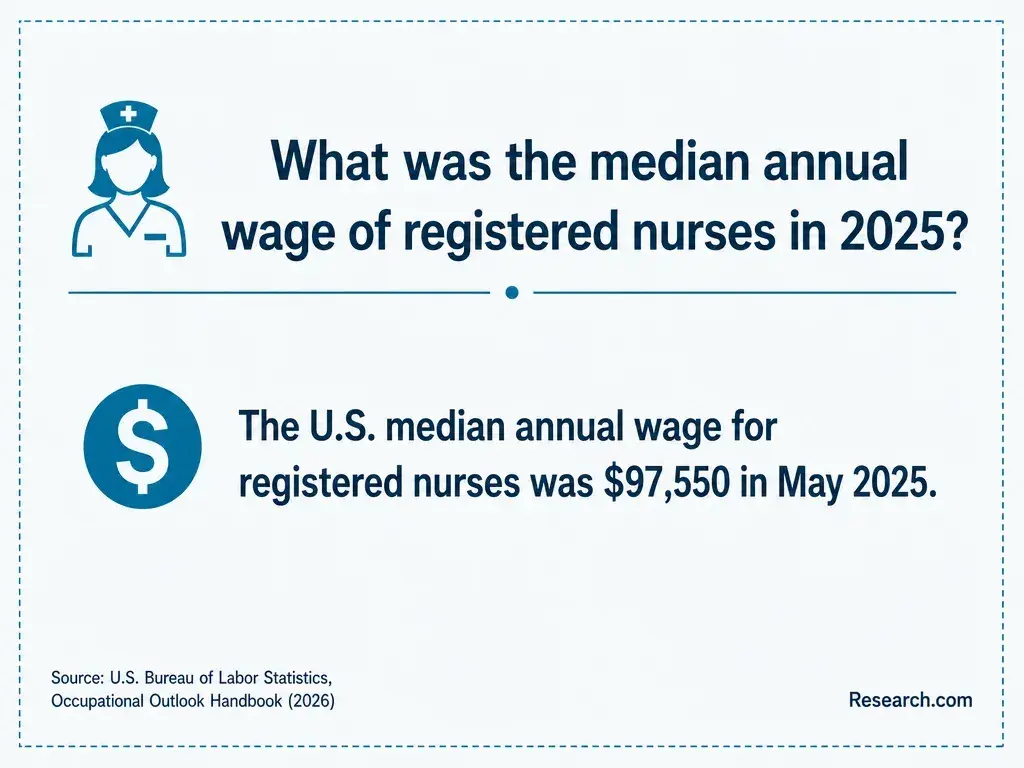
Registered nursing is a broad US occupation, not a single job with one salary or assessment workload. Hospital, ambulatory, community, and long-term care positions differ in acuity, schedules, orientation, and opportunities to observe patients over time. US Bureau of Labor Statistics occupational wage and projection figures are useful for comparing broad career prospects, but an occupation-wide median is not a new graduate's offer or a guaranteed return on a degree.
For a practical comparison, review current BLS registered nurse wage and employment projections alongside local job postings, then ask employers about starting pay, shift differentials, patient assignment expectations, preceptor support, and escalation resources. A new graduate should weigh the quality of supervised orientation heavily. Later graduate education may support a different role, but online DNP timelines for working nurses do not predict pay or replace a role-specific review of licensure, experience, and employer requirements.
Other Things You Should Know About Nursing
Yes. A family member may recognize a change from the patient's usual behavior. The nurse should consider the concern, assess the patient, and communicate relevant findings through the appropriate clinical pathway.
Check the patient, the equipment, and the reading according to unit policy. Do not assume an alarm is false solely because the displayed value seems unlikely.
Students should distinguish their own observations from information reported by others and follow instructor, facility, and documentation policies. They should never chart an assessment they did not perform.
Continue reassessment and use the facility's escalation pathway, including a charge nurse or rapid response process when indicated. Clear communication includes what has changed and why the concern remains.
- The Result Stopped Here | PSNet https://psnet.ahrq.gov/web-mm/result-stopped-here
- Improving escalation of deteriorating patients through... - PMC https://pmc.ncbi.nlm.nih.gov/articles/PMC10882274/
- Tool: SBAR | Agency for Healthcare Research and Quality https://www.ahrq.gov/teamstepps-program/curriculum/communication/tools/sbar.html
- Recognising and Responding to Acute Deterioration Standard | safetyandquality.gov.au https://www.safetyandquality.gov.au/national-standards/nsqhs-standards/recognising-and-responding-acute-deterioration-standard
- Vital Sign Assessment - StatPearls - NCBI Bookshelf https://www.ncbi.nlm.nih.gov/books/NBK553213/
- Strengths and limitations of early warning scores | sciencedirect.com https://www.sciencedirect.com/science/article/abs/pii/S0020748917302109
- Early Warning Signs of Clinical Deterioration Every Nurse Should Know | Nurse.com https://www.nurse.com/blog/early-warning-signs-clinical-deterioration-nursing-interventions/
- Blood Test Interpretation for Nurses: What to Notice, Clarify and Escalate | iatroX https://www.iatrox.com/blog/blood-test-interpretation-nurses-notice-clarify-escalate