2027 Choosing Healthcare Administration BS Coursework for Work in Retail Health Clinics

Co-Founder and Chief Data Scientist
A healthcare administration bachelor's degree can prepare you to coordinate the business side of a retail health clinic, but the course titles alone will not tell you whether a program fits the job. Clinics located in pharmacies and other retail settings need people who understand patient access, outpatient billing, privacy, staffing, and performance across locations. This guide is for prospective students and career changers comparing healthcare administration BS programs. It explains which coursework matters most, what the degree can and cannot qualify you to do, and how to weigh format, cost, and career opportunities before enrolling.
Key Things You Should Know
- Prioritize outpatient operations, healthcare finance and billing, privacy, analytics, and workforce management over a program's broad "healthcare leadership" label.
- A bachelor's program commonly requires about 120 semester credits and takes four years of full-time study; transfer credits and enrollment pace can change both time and cost.
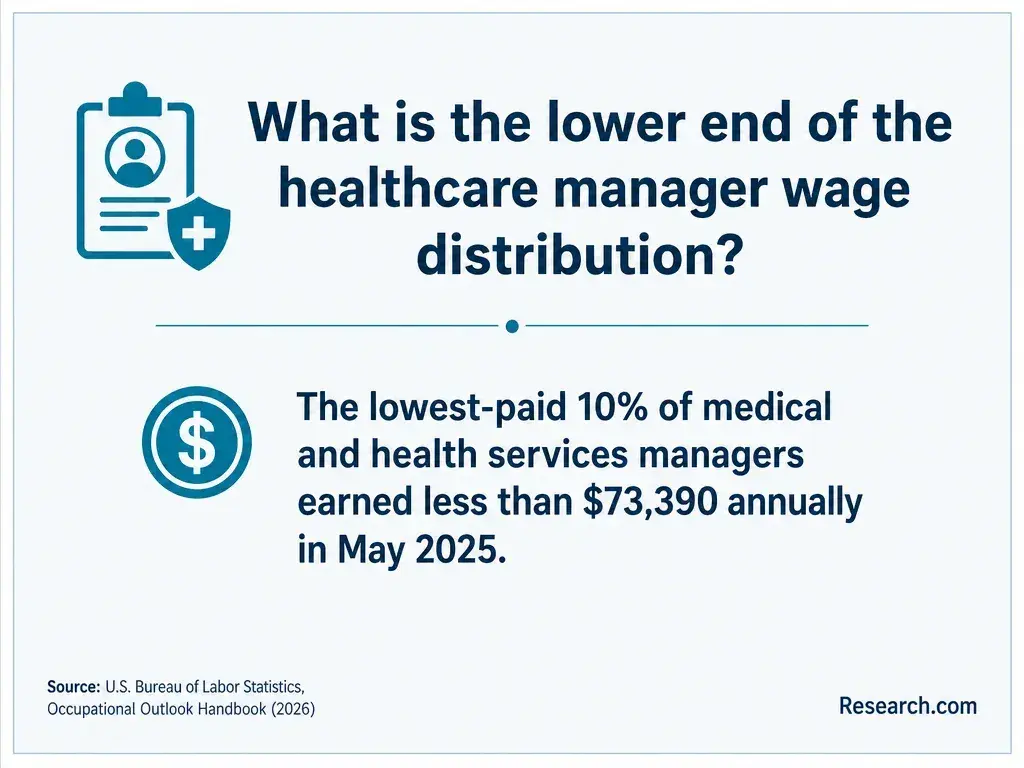
- Retail clinic jobs have no single salary scale. The $126,520 May 2025 median for all U.S. management occupations is a broad benchmark, not an expected starting salary for a clinic administrator.
What does a healthcare administration bachelor's degree prepare you to do in retail health clinics?
A healthcare administration BS develops the organizational and business skills used to support care delivery. In a retail clinic, that may mean coordinating appointment access, monitoring wait times, helping staff follow documentation procedures, reviewing budgets, or reporting operational results to a regional team. The employer may be a retailer, a health system, or another organization operating within a retail location; its structure affects who controls staffing, clinical policies, and finances.
The degree does not prepare you to diagnose patients, prescribe treatment, or perform duties reserved for licensed clinicians. It also differs from health information management, which generally places greater emphasis on health records, coding, and information governance. Compare degree choices for healthcare operations and health information careers if you would rather specialize in data and records than run clinic workflows.
What degree requirements are needed to work in retail health clinic administration?
There is no universal bachelor's-degree requirement for every retail clinic administrative job. Employers may consider healthcare administration, business, public health, or related degrees alongside relevant experience. An entry-level coordinator position may be accessible without a bachelor's degree, while a manager posting may request one plus experience supervising people, managing budgets, or working in outpatient care. Read actual job postings in your area before treating any credential as mandatory.
For a career changer, the key distinction is between qualifying to apply and being ready to manage a clinic. Retail customer-service or scheduling experience can transfer, but healthcare billing, patient privacy, and clinician-facing workflows may still be gaps. A bachelor's degree is generally a more direct educational starting point for these roles than a doctorate. Healthcare management doctoral study and program requirements are worth considering only for a substantially different long-term goal, such as research, teaching, or advanced organizational leadership.
Which healthcare administration courses are most valuable for retail clinic careers?
Look beyond course names to assignments and learning outcomes. The most useful curriculum connects healthcare rules and financial decisions to the short visits, shared systems, and multi-site coordination common in retail clinics. This comparison shows what each course area contributes.
| Course area | Retail clinic application | What to look for in the syllabus |
| Outpatient operations and quality | Patient flow, access, service recovery, and improvement across sites | Process mapping or a measurable quality-improvement project |
| Healthcare finance and revenue cycle | Budgets, payer rules, claims, and the financial effects of scheduling or documentation errors | Outpatient billing examples rather than only hospital finance |
| Health law, ethics, and privacy | Appropriate handling of patient information and escalation of compliance concerns | Applied privacy scenarios and clear boundaries between administrative and clinical decisions |
| Analytics and information systems | Interpreting demand, wait times, capacity, and operational dashboards | Spreadsheet or data-analysis work using healthcare examples |
| Human resources and organizational behavior | Scheduling, communication, and coordination among administrative and clinical staff | Team-based cases involving supervision and conflict resolution |
A practicum or capstone involving an outpatient setting can make these courses more useful, but confirm whether a retail clinic placement is possible. If records and coding courses dominate the program, examine program options for accredited HIM study before assuming the curriculum is designed for clinic operations.
Online and campus-based degrees can cover similar subjects, but delivery changes how you build experience. Online study may help someone keep a job near local clinics; campus study may make scheduled meetings and local internship connections easier. Neither format automatically provides a placement or direct access to retail healthcare employers.
Check whether online courses are asynchronous, whether live sessions or group projects have fixed times, and where students complete practicums. A program with healthcare administration bachelor's pathways with flexible entry dates may let you begin sooner, but a flexible start does not necessarily mean flexible deadlines. Ask how the school supports students seeking an outpatient project in their own community.
First, verify that the institution is accredited by an agency recognized by the U.S. Department of Education. Institutional accreditation matters for factors such as federal student-aid eligibility and may affect credit-transfer and graduate-school decisions, although another school still decides whether to accept particular credits.
Then distinguish institutional accreditation from any program-specific recognition. Do not assume a bachelor's degree needs the same specialized accreditation as a graduate healthcare management degree. CAHME, for example, accredits graduate healthcare management programs; CAHME-accredited MHA universities and program options are relevant if you later consider a master's, not a substitute for checking a BS program's institutional status. Ask what evidence the bachelor's program offers of curriculum quality, applied learning, and employer engagement.
Requirements depend on whether you apply as a first-year or transfer student. Schools commonly ask for a high school record or equivalent for first-year entry and college transcripts for transfer entry; some set minimum grades or prerequisites. An online program may also have state-based enrollment restrictions. None of these should be assumed to be identical across schools.
If you have prior college credit, request a written transfer evaluation before committing. It should identify which credits meet general education, major, and elective requirements - not merely how many credits the school accepts. Shorter healthcare administration bachelor's pathways are most useful when the shortened timeline still leaves room for the outpatient coursework and applied experience you need.
A traditional bachelor's degree commonly takes four years of full-time study and about 120 semester credits. Transfer credit, prior learning, part-time enrollment, and course availability can change the timeline. An accelerated schedule saves calendar time only if you can sustain its workload and obtain the required courses when needed.
There is no responsible single price for this degree across U.S. schools. Compare the cost of credits you still need, mandatory fees, books or software, and any travel or lost work time tied to a practicum. Ask each school for a degree plan and estimated total charges based on your transfer evaluation; a low per-credit rate may not be the lowest-cost route if fewer credits transfer. If you are comparing a bachelor's with later graduate study, examine graduate healthcare administration degree costs and options separately rather than folding an unneeded master's into today's decision.
Possible roles include patient access coordinator, clinic operations coordinator, practice administrator, site manager, and regional operations analyst. Titles are not standardized: a "clinic manager" at one employer may oversee schedules and service measures, while another may require substantial clinical operations experience or a professional license.
If you already supervise retail staff, your customer-service and staffing experience may support a move into site operations once you learn healthcare-specific rules. If you are new to both healthcare and management, a coordinator or analyst role with an outpatient project may be a more credible first step than applying directly for regional leadership. For a later transition into broader healthcare management, MHA programs open to applicants with other professional backgrounds are an option to investigate - but a master's does not replace relevant work experience.
There is no reliable nationwide salary figure that isolates healthcare administration bachelor's graduates working in retail clinics. Pay depends on the actual role, employer, location, supervisory responsibility, and prior experience. The U.S. Bureau of Labor Statistics reports a $126,520 median annual wage for all management occupations in May 2025. That broad figure includes many industries and senior roles; it should not be used as an expected salary for a new retail clinic coordinator or manager.
For a useful personal estimate, compare local postings for the specific job title and experience level you could realistically obtain, then weigh likely pay against the degree's remaining cost. An MBA may become relevant if you move toward multi-site financial or strategic leadership, but it is not a shortcut to that salary benchmark. Compare low-tuition MBA routes for healthcare management careers only after identifying a role for which broader business training would add value.
Do retail health clinic administrators need licenses or professional certifications?
Nonclinical retail clinic administrators generally do not need a professional clinical license simply to perform administrative work. A job that also requires nursing, another regulated clinical function, or a particular licensed facility-administrator role is different; check the posting and applicable state rules. Employers may require role-specific privacy, safety, or systems training even when no license is required.
A certification can help demonstrate a specific skill, but it should address a gap an employer actually values. If you need deeper preparation for healthcare leadership rather than a narrow credential, accelerated online healthcare management master's options may be worth comparing after you gain experience. For most people entering retail clinic administration, relevant coursework and demonstrated outpatient work matter more than collecting credentials without a target role.
Other Things You Should Know About Healthcare Administration
Possibly, if the school approves an appropriate healthcare-focused project and supervisor. Ordinary retail duties may not meet a practicum's learning objectives; obtain approval before relying on your current job.
No. Services, staffing, hours, and organizational structures can differ. Check the particular employer's model before assuming experience in one setting transfers directly to the other.
Not necessarily. Programs may teach information-system concepts, while employers train staff on their own software and access rules. Review course descriptions if hands-on systems practice matters to you.
Review local clinic job descriptions and seek an informational conversation or entry-level patient-access experience. Compare what you observe with the proposed program's courses and practicum opportunities.
- Health IT & Health Information Exchange Basics https://healthit.gov/health-it-basics/
- Standards and Evaluation of Healthcare Quality, Safety... - NCBI https://www.ncbi.nlm.nih.gov/books/NBK576432/
- Bachelor of Science in Health Care Administration | azjobconnection.gov https://www.azjobconnection.gov/etp/public/institution_programs/21079
- Section 2: Explanation of Key Team Leadership Concepts and Tools | Agency for Healthcare Research and Quality https://www.ahrq.gov/teamstepps-program/curriculum/team/tools/index.html
- Practicum and Capstone: COPHP MPH | Health Systems and Population Health https://hspop.uw.edu/cophpmph/program-experience/practicum-capstone/
- Healthcare Finance & Reimbursement | Online Course | Washington Technical Institute https://www.washingtontech.edu/online-course/healthcare-finance-reimbursement/
- Regulatory Healthcare Compliance | MLS at Western State https://www.wsulaw.edu/news/why-regulatory-compliance-in-healthcare-is-more-important-than-ever/
- Entry-Level Healthcare Administration Jobs | Campus.edu https://campus.edu/blog/healthcare/entry-level-healthcare-administration-jobs
- Healthcare Finance 101: What Every Administrator Needs to Know | Nebraska Methodist College https://blog.methodistcollege.edu/healthcare-finance-101-what-administrator-needs-to-know
- Data Analytics in Healthcare: How to Apply Your Skills | Bouvé College of Health Sciences https://bouve.northeastern.edu/news/data-analytics-in-healthcare/