2027 Choosing an Online Ed.D. in Leadership and Learning in Organizations for Leadership in Financial Technology Companies
Audited and Verified:
Our Editorial and Data Verification Process
Research.com uses government datasets, official education statistics and primary institutional information to support its career and degree guides. Our review process checks factual accuracy, occupational definitions, source dates and the requirements associated with the credentials discussed.
How This Article Was Fact-Checked
Our editorial team verifies salary estimates, employment projections, education requirements and program information against original data providers and official organizations. Salary figures are checked against the relevant occupational definitions and reporting periods. Information about licensure, accreditation and required in-person training is reviewed separately.
Fact-checked and verified on:

Co-Founder and Chief Data Scientist
Fintech leaders must help teams learn new systems while managing risk, customer trust, and organizational change. An online Ed.D. in leadership and learning could strengthen those capabilities, but it is not a substitute for financial-services expertise or leadership experience.
This guide is for fintech managers, learning professionals, and experienced career changers considering doctoral study. It explains what to look for in a program, how to assess its cost and practical demands, and when a different qualification would better support your next move.
Key Things You Should Know
- Choose a leadership and learning Ed.D. for evidence-based workforce development and organizational change - not as a shortcut into technical, risk, or executive roles.
- Check the institution's accreditation, required live sessions, final project rules, and total costs; "online" does not establish that a program is self-paced or fully remote.
- The U.S. median annual pay for training and development managers was $133,000 in May 2025, but that occupational figure is not a fintech salary or an expected Ed.D. graduate outcome.
What Is an Online Ed.D. in Leadership and Learning for Fintech Leaders?
An Ed.D. is a doctorate generally oriented toward applying research to problems of professional practice. In leadership and learning, that may mean studying how organizations develop people, implement change, evaluate training, and use evidence to improve decisions. Fintech is a potential setting for that work, not necessarily a formal concentration. Check the degree and concentration recorded by the university rather than inferring a specialization from one course or project.
The degree is most relevant to a leader who can identify a substantial organizational learning problem: for example, how teams adopt a new payment platform or how managers assess whether compliance training changes day-to-day practice. Ed.D. concentration planning for doctoral applicants can help distinguish a broad organizational leadership curriculum from a formally designated specialty.
How Can an Ed.D. Prepare You for Leadership in Financial Technology Companies?
A strong program can help a fintech leader diagnose a performance problem before prescribing training. Low adoption of a new tool, for instance, might reflect unclear workflows, incentives, access, or supervision - not a knowledge gap. Coursework in adult learning, organizational change, and evaluation can help a leader test those explanations and coordinate a response across product, operations, people, and risk teams.
Applied doctoral work may offer a way to examine a real workplace challenge, but an employer project is not automatically an approved doctoral project. Ask the program what its final deliverable requires and ask your employer who can authorize access to employee or customer information. Faculty oversight, privacy review, and restrictions on sharing results may shape the project. Compare education doctorates with applied final projects by their actual requirements; "no dissertation" does not mean no rigorous research or evaluation.
An Ed.D. does not teach every capability a fintech executive needs. Product strategy, financial regulation, cybersecurity, and technical architecture may require separate experience or training.
Is an Online Ed.D. in Leadership and Learning Accredited?
Accreditation belongs first to the institution, not to the phrase "online Ed.D." Confirm the university's institutional accreditation through the accreditor's directory and the U.S. Department of Education's recognized-accreditor information. Then confirm that the advertised degree is awarded by that institution and ask whether any additional programmatic accreditation is claimed or relevant.
Institutional accreditation does not establish fintech-specific quality, guarantee employer acceptance, or confer a professional license. A general leadership Ed.D. also should not be mistaken for a state-approved school-administrator preparation program. Request the university's disclosures if licensure is part of your goal.
Course titles differ, but the most useful curriculum for fintech leadership connects organizational diagnosis with learning design and credible evaluation. Look for substantive work in adult learning and learning transfer, change implementation, leadership ethics, qualitative and quantitative methods, and program evaluation. A technology or analytics course is valuable only if its assignments build skills you can use; its presence alone does not establish advanced technical preparation.
Examine the sequence, not just the catalog. Methods courses should prepare you for the required final project, while electives should be offered often enough to fit your study plan. If your target role involves regulated operations or product management, determine whether you can address that context through approved assignments or a project partner - and obtain the necessary permissions before relying on workplace data.
Requirements vary by university. Programs may ask for a completed master's degree, transcripts, a statement of purpose, recommendations, a résumé, or an interview. They may evaluate professional responsibility and readiness for applied research rather than require an education degree or a particular job title. Check the requirements for your intended entry term, including any test, grade, or experience rules.
A fintech applicant can make a stronger case by describing a problem they have helped address, the decisions they actually owned, and what they still need to learn. Separate evidence of leadership from claims of results you cannot substantiate. If you have unfinished doctoral work, ask admissions and the doctoral program separately whether it affects eligibility and whether any credits can apply to the new degree. Ed.D. pathways for students with prior doctoral study are worth examining, but prior coursework does not automatically shorten the program.
Expect a multi-year commitment, with timing determined by the published course sequence, enrollment pace, and final-project milestones. Ask for a term-by-term plan showing when courses are offered and what happens if you pause, change employers, or need a new project site.
There is no reliable single price for an online Ed.D. Calculate your likely total from the program's stated tuition basis and required credits or terms, then add fees, materials, any campus travel, and costs associated with reduced work hours. Compare that amount with the support your employer has actually approved, including reimbursement limits and repayment conditions. A lower advertised tuition rate may not mean a lower completion cost. Use organizational leadership doctoral fees and total costs as a comparison starting point, then request a written, program-specific estimate.
Online study can let an employed fintech leader remain near their team and continue working, but location flexibility is not the same as schedule flexibility. Confirm live-class attendance, group meetings, residency or campus-convening requirements, and the hours of faculty access. These obligations matter if your work includes incident response, launches, or meetings across time zones.
A campus-based program may offer easier in-person collaboration and access to local partners, but commuting or relocation can increase its practical cost. Neither format is inherently better for applied research. Compare the specific programs' faculty guidance, project requirements, and your ability to participate consistently before treating delivery mode as the deciding factor.
The clearest fit is advancement from work you already know into broader responsibility for organizational learning, leadership development, talent strategy, change implementation, or internal consulting. A learning leader might oversee onboarding across product and risk teams; an organizational development leader might support a merger or operating-model change. In each case, hiring decisions still depend on demonstrated results, sector knowledge, and scope of prior responsibility.
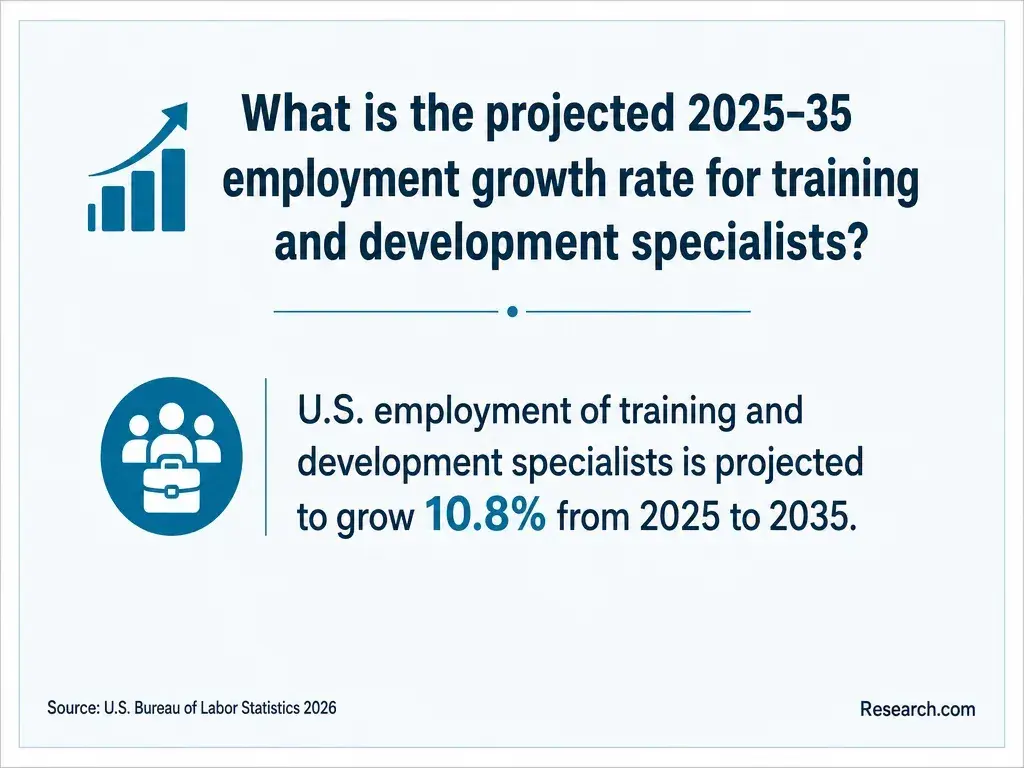
Moving from education or another sector into fintech is a larger transition. A doctorate may demonstrate skill in learning and evaluation, but it will not replace familiarity with financial products, regulated operations, or the target function. Build that knowledge through relevant projects, mentorship, and experience before expecting the degree to carry a sector switch. The U.S. Bureau of Labor Statistics projects 6.4% growth for training and development managers from 2025 to 2035; that outlook describes the occupation broadly, not fintech openings or positions reserved for Ed.D. holders.
There is no defensible single salary expectation for a fintech leader with this degree. Pay varies with the role, employer, location, business scope, and prior experience; the doctorate itself does not set compensation. As one U.S. benchmark, the Bureau of Labor Statistics reports a May 2025 median annual salary of $133,000 for training and development managers across industries. Use that figure to understand an occupation, not to forecast a fintech offer, executive pay, or a return on doctoral tuition.
For a personal decision, compare posted compensation for roles you could realistically qualify for before and after study. Consider whether the employer values doctoral training for those roles and whether a promotion or sector move would require experience the program cannot supply.
How Do You Choose the Best Online Ed.D. Program for Fintech Leadership?
The best choice depends on the work you want to do next. This comparison separates the Ed.D.'s likely contribution from alternatives that may address a different gap more directly.
| Pathway | Best-aligned goal | Key limitation for a fintech leader |
| Leadership and learning Ed.D. | Lead organizational learning or change using applied inquiry | May offer limited finance or technical depth |
| DBA or MBA | Develop business strategy or management capability | May place less emphasis on adult learning and workforce evaluation |
| Targeted training or employer development | Close a specific product, risk, analytics, or management gap | Offers less extensive doctoral research preparation |
Before applying, use the same questions with each shortlisted program so the comparison reflects requirements rather than marketing:
- Confirm the exact degree, accreditation, curriculum, available electives, and whether your fintech interests can fit approved assignments or the final project.
- Request written details on live attendance, campus visits, project supervision, completion rules, and the full expected cost.
- Ask how faculty support projects involving restricted workplace information and what alternatives exist if your employer will not approve access.
- Compare those answers with the qualifications in target job postings and with a shorter, employer-supported development route.
Program fit is specific to the target sector. For example, organizational leadership doctoral options for college administrators may serve an education-sector goal well without being the strongest match for fintech operations. If your primary gap is technical or regulatory knowledge rather than leading learning and change, address that gap first.
Other Things You Should Know About EdD Leadership
Usually, coding is not the central preparation for a leadership and learning doctorate. Check the program's methods prerequisites, and build enough data literacy to work responsibly with technical colleagues.
It may meet a degree requirement for some positions, but departments set their own standards for subject expertise, teaching, and research. The degree alone does not secure a faculty appointment.
Only within your employer's confidentiality and intellectual-property rules and the university's requirements. Obtain permission before sharing documents, data, or findings; a redacted description may be more appropriate.
No degree alone qualifies someone for board service. Organizations assess governance judgment, relevant industry expertise, and the experience needed for the particular board.
- Types of Financial Aid: Grants, Work-Study, and Loans | studentaid.gov https://studentaid.gov/understand-aid/types
- Maximizing the Impact and ROI of Leadership Development | nih.gov https://pmc.ncbi.nlm.nih.gov/articles/PMC11505461/
- An Overview of Accreditation of Higher Education in the United States | Congress.gov | Library of Congress https://www.congress.gov/crs-product/R43826
- DAPIP | Homepage - Office of Postsecondary Education (OPE) https://ope.ed.gov/dapip/
- Cost of Attendance (Budget) | 2025-2026 Federal Student Aid Handbook https://fsapartners.ed.gov/knowledge-center/fsa-handbook/2025-2026/vol3/ch2-cost-attendance-budget
- Course Index - NYU Stern - New York University https://www.stern.nyu.edu/programs-admissions/masters-programs/ms-fintech/overview-academics/course-index
- Walden University's Guide to Doctoral Capstone Projects https://www.waldenu.edu/online-doctoral-programs/resource/guide-to-doctoral-capstone-projects
- Graduate Admissions | NYU SPS - New York University https://www.sps.nyu.edu/join/graduate-admissions.html
- Regional vs. National Accreditation: Which is Better? | Drexel University Online https://www.online.drexel.edu/news/national-vs-regional-accreditation.aspx
- Advance Your Leadership Career with an Online Ed.D. | UMass Global https://www.umassglobal.edu/blog-news/advance-your-leadership-career-online-edd