2027 Choosing an Online Ed.D. in Leadership and Learning in Organizations for Leadership in University Student Services Organizations
Audited and Verified:
Our Editorial and Data Verification Process
Research.com uses government datasets, official education statistics and primary institutional information to support its career and degree guides. Our review process checks factual accuracy, occupational definitions, source dates and the requirements associated with the credentials discussed.
How This Article Was Fact-Checked
Our editorial team verifies salary estimates, employment projections, education requirements and program information against original data providers and official organizations. Salary figures are checked against the relevant occupational definitions and reporting periods. Information about licensure, accreditation and required in-person training is reviewed separately.
Fact-checked and verified on:

Co-Founder and Chief Data Scientist
Leading university student services means improving how teams support students while working within budgets, institutional policies, and competing campus priorities. An online Ed.D. in Leadership and Learning in Organizations may strengthen that work, but a broad organizational doctorate is not always the best route into senior student affairs roles.
This guide is for higher education professionals weighing doctoral study against experience and shorter training. It explains which program features matter, what the degree can - and cannot - do for your career, and what to verify before committing.
Key Things You Should Know
- Choose a program with applied research, organizational change, and higher education relevance - not just a leadership-focused title.
- For context, the U.S. Bureau of Labor Statistics reports a $104,590 median annual salary for postsecondary education administrators in May 2025; that occupational median is not an Ed.D. graduate salary.
- Before enrolling, confirm the total cost, live-session and travel requirements, and whether you can complete the doctoral project with authorized access to an appropriate setting.
What is an online Ed.D. in Leadership and Learning in Organizations?
An Ed.D. in Leadership and Learning in Organizations is a practice-oriented doctorate focused on how people learn, lead, and implement change within institutions. Depending on the university, study may combine leadership theory, adult learning, organizational improvement, and applied research. "Online" describes where much instruction occurs; it does not establish that classes are self-paced or that campus visits are unnecessary.
For a student services leader, the central distinction is broad organizational preparation versus higher education specialization. A broad Ed.D. can help you lead cross-functional improvement, while a higher education or student affairs program may offer more direct study of campus governance, student development, and education policy. Compare the actual curriculum and awarded credential when reviewing Ed.D. specializations and degree fit; a higher education elective does not necessarily constitute a formal concentration.
How can this Ed.D. prepare you for university student services leadership?
The strongest connection is between organizational learning and the work of coordinating services across admissions, advising, financial aid, accessibility, and student engagement. A relevant program can help you diagnose a service gap, engage staff and students, test an improvement, and evaluate whether it works.
For example, a leader concerned about advising handoffs might examine procedures, staff training, and student feedback before proposing a workshop. That distinction matters: training alone will not fix unclear decision authority or incompatible systems. Applied research courses can help you choose credible measures, but using student-level records may require institutional permission, privacy safeguards, and review under applicable policies, including FERPA.
Assess whether faculty can supervise work in a university setting and whether the required project format fits a problem you have authority to investigate. A capstone, dissertation in practice, and traditional dissertation are different deliverables; obtain the program's written requirements before treating a workplace idea as an approved doctoral project.
Is an online Ed.D. in organizational leadership worth it for higher education professionals?
It may be worth pursuing if you already manage substantial student services work, want to lead institution-wide change, and can use doctoral inquiry in your role. It is less likely to be the most direct investment if your immediate goal is a first supervisory position or a specific technical skill. Hiring committees may value the doctorate, but they will still assess your budget responsibility, staff leadership, campus collaboration, and results.
Compare the Ed.D. with the gap you actually need to close. A higher education master's may better serve a sector entrant; an MPA may fit someone focused on public-institution finance and policy; a PhD may better fit a sustained academic research goal. Mentorship, a cross-campus assignment, or targeted evaluation training may offer a faster route to the next responsibility.
For a financial decision, request the program's full charges and your employer's written tuition-assistance terms, then compare those costs with the advancement opportunities realistically available at your institution. Inexpensive organizational leadership doctoral pathways are worth examining, but a lower advertised tuition rate does not establish a lower total cost or a better fit for student services.
Start by confirming that the university holds institutional accreditation recognized by the U.S. Department of Education or the Council for Higher Education Accreditation. Check the accreditor's directory and the institution's current status, then confirm that the Ed.D. is an awarded degree at that institution. Accreditation of the university should not be mistaken for accreditation of a particular program or approval for professional licensure.
Next, examine evidence of fit that accreditation alone cannot supply: faculty experience in higher education, access to research support, published project requirements, and clear disclosures about online attendance and campus convenings. Ask the program which requirements apply to your intended entry term and whether it publishes completion or career outcomes with enough context to interpret them.
Course names and requirements vary, but relevant study may include organizational leadership, adult learning, change implementation, qualitative and quantitative methods, program evaluation, and an applied doctoral project. For student services work, examine course descriptions rather than relying on these labels: an evaluation course should help you assess a service or intervention, while a change course should address implementation across units with different priorities.
Look for a sequence that moves from defining a campus problem to collecting appropriate evidence, interpreting limitations, and communicating a decision. Ask which courses are required, which are merely offered as electives, and how faculty support the final project. Prior doctoral students with substantial completed coursework may find comparing education doctorate ABD completion routes more useful than repeating a full curriculum; eligibility and accepted credits require an individual institutional review.
Requirements are institution-specific. Programs may request a completed master's degree, transcripts, professional experience, recommendations, a statement of purpose, and evidence of readiness for applied research. Do not assume that an education master's, a particular job title, or a fixed number of years in student affairs is universally required.
Use the application to explain a real leadership responsibility: what decision you owned, whom it affected, what evidence you used, and what you still need to learn. If you hold an Ed.S., education specialist graduates considering a doctorate should ask separately whether that degree satisfies admission requirements and whether any courses can count toward the Ed.D. Admission eligibility does not guarantee transfer credit or a shorter program.
Completion time and price depend on required credits, course sequencing, enrollment pace, the final project, and whether the program requires travel. An online format may reduce relocation costs without reducing live-class commitments or project workload. Request a term-by-term plan and a written cost estimate for your entry term rather than relying on a prominently advertised tuition figure.
Compare tuition and mandatory fees alongside travel and lodging, books or technology, and any income lost to reduced work hours. Check whether employer reimbursement has annual limits, grade conditions, or a repayment obligation if you leave. When evaluating shorter online Ed.D. degree pathways, ask whether the stated timeline includes the final project and what happens if a course is unavailable or workplace access changes.
An experienced professional might pursue director-level responsibility in advising, student success, enrollment services, or student engagement, or compete for broader student affairs leadership. These jobs differ: a director may oversee a defined service and its staff, while a senior administrator may coordinate multiple units, budgets, and institutional priorities. An Ed.D. can support that progression but does not substitute for the relevant management record.
If you currently work as an advisor or program coordinator, seek opportunities to supervise, manage a budget, lead a cross-campus initiative, and document improvements before assuming the doctorate will open executive roles. If you already lead a unit, assess whether the degree would strengthen your ability to evaluate services and influence change across the university. Hiring criteria vary by institution and position.
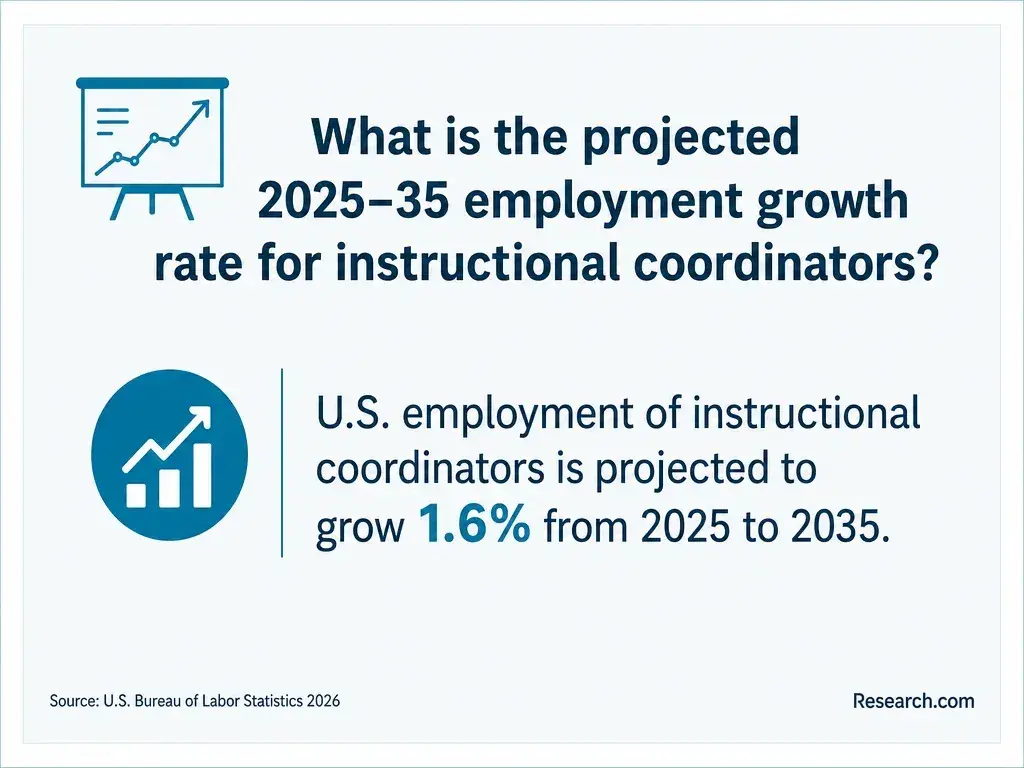
The U.S. Bureau of Labor Statistics reports a $104,590 median annual salary for postsecondary education administrators in May 2025 and projects 1.8% employment growth for that occupation from 2025 to 2035. The category covers multiple administrative functions and career levels; neither figure describes the pay or prospects of online Ed.D. graduates specifically.
For a useful personal estimate, compare posted salary ranges for roles you could qualify for now with ranges for roles requiring responsibilities you expect to gain. At public universities, published pay bands and hiring rules may constrain increases. Treat a possible promotion as an opportunity - not a guaranteed return on doctoral tuition.
Do university student services leaders need licensure or professional certification?
General student services leadership roles typically do not require a state administrator license simply because they are based at a university. An organizational leadership Ed.D. does not itself confer teacher, school-principal, counseling, or other professional licensure. Requirements can change when a position includes regulated clinical or counseling work.
Read the qualifications for the exact role you want and ask the institution or relevant licensing board about any regulated duties. Optional professional development or certification may help demonstrate a targeted skill, but it should be judged against the job's actual responsibilities - not treated as a substitute for experience or a license.
Other Things You Should Know About EdD Leadership
Possibly. An approved project might use authorized aggregate data, public reports, or staff processes instead. Ask the program and project site what evidence is acceptable; do not assume that removing names resolves every privacy or approval requirement.
Ask how the program handles a change of project site, sponsor, or data access before you enroll. A new employer's willingness to participate does not automatically approve a revised doctoral project.
Propose a specific schedule, explain how the study relates to your duties, and ask which tuition assistance, leave, and project-access arrangements can be documented. Keep financial support separate from permission to conduct research.
It can, particularly when coursework and applied work address the institution's students and operations. Compare faculty expertise and project flexibility with your community college's needs rather than assuming examples from four-year universities transfer unchanged.
- Cost of Attendance (Budget) | 2025-2026 Federal Student Aid Handbook https://fsapartners.ed.gov/knowledge-center/fsa-handbook/2025-2026/vol3/ch2-cost-attendance-budget
- Types of Financial Aid: Grants, Work-Study, and Loans | studentaid.gov https://studentaid.gov/understand-aid/types
- What Is a Capstone Project? Types, Examples, and Tips | SCU https://www.scu.edu/business/blog/business-concepts/what-is-a-capstone-project/
- JSAIII 7(1) General Issue - IU Indianapolis https://journals.indianapolis.iu.edu/index.php/jsaiii/article/download/28006/25768
- What Is a Problem of Practice? | spalding.edu https://online.spalding.edu/blog/what-is-problem-practice
- EdD vs PhD: What's the difference? | American International College https://online.aic.edu/blog/edd-vs-phd
- Internship, Capstone, Thesis and Dissertation Information | ucdenver.edu https://publicaffairs.ucdenver.edu/current-students/internship-capstone-and-dissertation-information
- PhD vs. EdD in Education: Nine expert tips to help you choose | USC Rossier https://rossier.usc.edu/news/phd-vs-edd-in-education-nine-expert-tips-to-help-you-choose/
- Admission Requirements https://graduate.appstate.edu/graduate-admissions/apply-graduate-school/application-requirements
- EdD vs. PhD in Education: Choosing the Right Program | Goodwin College of Professional Studies https://drexel.edu/soe/resources/career-path/edd-vs-phd/