2027 Choosing an Online Ed.D. in Leadership and Learning in Organizations Around a Sabbatical Limited to One Academic Term
Audited and Verified:
Our Editorial and Data Verification Process
Research.com uses government datasets, official education statistics and primary institutional information to support its career and degree guides. Our review process checks factual accuracy, occupational definitions, source dates and the requirements associated with the credentials discussed.
How This Article Was Fact-Checked
Our editorial team verifies salary estimates, employment projections, education requirements and program information against original data providers and official organizations. Salary figures are checked against the relevant occupational definitions and reporting periods. Information about licensure, accreditation and required in-person training is reviewed separately.
Fact-checked and verified on:

Co-Founder and Chief Data Scientist
A one-term sabbatical can create valuable space for doctoral study, but it cannot make a cohort-based online Ed.D. self-paced. If you work in organizational leadership, learning and development, or education, the key decision is whether a program lets you use that term for a defined milestone and continue after returning to work.
This guide shows how to test program schedules, applied-project requirements, costs, and career fit before committing your leave to a doctorate.
Key Things You Should Know
- Choose a program around the work you can complete after your one-term sabbatical; confirm live attendance, course sequencing, and project milestones in writing.
- Use the sabbatical for an approved, bounded milestone - not an assumed fast track through the entire Ed.D. Employer permission, data access, and faculty approval are separate requirements.
- Compare the full cost of study and leave against your career goal. The U.S. Bureau of Labor Statistics reports a $133,000 median annual salary for training and development managers, not an expected salary for Ed.D. graduates.
What Is an Online Ed.D. in Leadership and Learning in Organizations?
It is a practice-oriented education doctorate focused on how people learn, lead, and implement change within organizations. Depending on the program, students may study adult learning, leadership, organizational development, and applied inquiry while completing a dissertation in practice, capstone, or another approved doctoral project. The exact degree title and final requirement vary by institution.
For a leader with one academic term of leave, the degree is best understood as a multiyear commitment with a temporary period of greater availability. A sabbatical might support research preparation or a project phase, but it does not replace required courses, cohort participation, or work that continues after the leave ends. If your only goal is to learn a particular change-management or evaluation method during that term, targeted professional development may be more direct.
How Does an Online Ed.D. Compare With a Campus-Based Doctorate?
Online delivery changes where you participate, not necessarily when you must participate. The comparison below focuses on obligations that can make a one-term sabbatical useful - or leave you with an unworkable schedule afterward. These are possibilities to verify, not features shared by every program.
| Decision factor | Online Ed.D. | Campus-based doctorate |
| Participation | May combine recorded work with required live classes and group meetings | May require recurring in-person classes and meetings |
| Travel | May still require campus convenings | Typically requires regular access to campus |
| After the sabbatical | May allow study from your workplace, subject to fixed attendance and workload | May be practical if you live near campus or can maintain a compatible work arrangement |
Request a sample schedule covering both your leave term and a term after you return. Include live sessions, group work, travel, and major submission dates. A format that works beautifully during paid leave is a poor fit if you cannot attend its required meetings during an ordinary workweek.
How Do You Choose an Accredited Online Ed.D. Program?
Start by confirming the institution's recognized accreditation, the exact degree awarded, and any applicable state authorization for your location. Then ask the program - not just a general admissions office - which requirements apply to your proposed entry term. Institutional accreditation does not establish that a leadership doctorate qualifies you for a regulated education position.
For this decision, request the published course sequence and ask where your sabbatical would fall within it. Confirm required live attendance, campus visits, project approval points, faculty supervision, leave-of-absence rules, and what happens if a required course is unavailable after you return to work. Compare programs using the same assumptions about enrollment and travel; a lower advertised price alone is not enough. A guide to comparing affordable education doctorate pathways can help frame that cost comparison.
Choose for the post-sabbatical schedule. If you need an exception to an attendance or progression rule, obtain the authorized office's written decision before relying on it.
Relevant study often connects adult learning and learning transfer with organizational diagnosis, change leadership, and evidence-based improvement. Research and evaluation courses may help you define a workplace problem, select appropriate measures, interpret findings, and communicate limitations. Check the actual curriculum: a course mentioning analytics or leadership does not establish advanced technical training or a formal concentration.
Map your leave to the program's sequence. An early-term sabbatical might be useful for methods coursework and a carefully scoped proposal; a later one might support data collection or analysis if approvals and access are already in place. Schools differ in their applied-project routes through an education doctorate, so confirm the required deliverable and when you become eligible to begin it. Do not assume a workplace assignment will count as doctoral research or that sabbatical time alone grants access to employee or learner records.
Requirements vary, but programs commonly evaluate prior graduate education, professional experience, academic records, recommendations, and a statement explaining the applicant's goals. Some may request an interview or evidence of research readiness. A master's in education, a particular managerial title, and a fixed number of leadership years are not universal requirements.
Explain what you have led, what organizational learning problem you hope to investigate, and why the doctorate remains feasible once your sabbatical ends. If you hold an education specialist degree, examine online doctoral program choices after an Ed.S., but ask each school separately whether that credential supports admission or applies to degree requirements. Admission eligibility and transferable credit are different decisions; neither guarantees a shorter doctorate.
Expect study to extend beyond one academic term. The relevant timeline is the program's required sequence of courses, advancement checkpoints, and final project - not simply the number of hours you can devote during leave. Cohort scheduling, course availability, research permissions, revisions, and continued enrollment can all affect completion.
Ask an advisor to mark your sabbatical on the program's term-by-term plan and identify the milestone you could realistically finish before returning to work. Then test the remaining plan against your normal schedule and any program time limit. If you previously completed doctoral coursework elsewhere, investigate policies for returning to Ed.D. study after reaching ABD status; prior progress does not automatically satisfy a new program's requirements.
Without a named program and entry term, no responsible total price can be quoted. Obtain the school's current tuition basis - per credit, term, or program - and add mandatory fees, required travel and lodging, technology, and any continuing-enrollment charges. Compare that total with your employer's actual sabbatical pay and tuition policy, rather than assuming leave or reimbursement is fully funded.
The consequential calculation is what you can afford after the sabbatical: remaining charges, ordinary work and household commitments, and the cost of extra terms if progress slows. Ask whether employer assistance requires continued employment or repayment, and whether your enrollment pattern affects financial aid. Readers whose work centers on colleges may find additional context in paying for a doctorate in higher education leadership; its funding possibilities still require program- and employer-specific verification.
Potential directions include learning and development leadership, organizational development, workforce development, consulting, and some education-administration roles. Fit depends on your existing responsibilities: a training specialist moving toward program leadership needs evidence of needs assessment, implementation, and evaluation, while an experienced manager may use doctoral study to improve cross-functional change work.
A one-term sabbatical is most valuable professionally when it produces a defensible milestone or skill you can continue using at work - not when it is treated as a shortcut to a senior title. Before enrolling, compare job postings in your target sector with your experience. If the main gap is supervised leadership practice or a specific technical skill, an employer-sponsored project, mentorship, or focused course may offer better value than a doctorate.
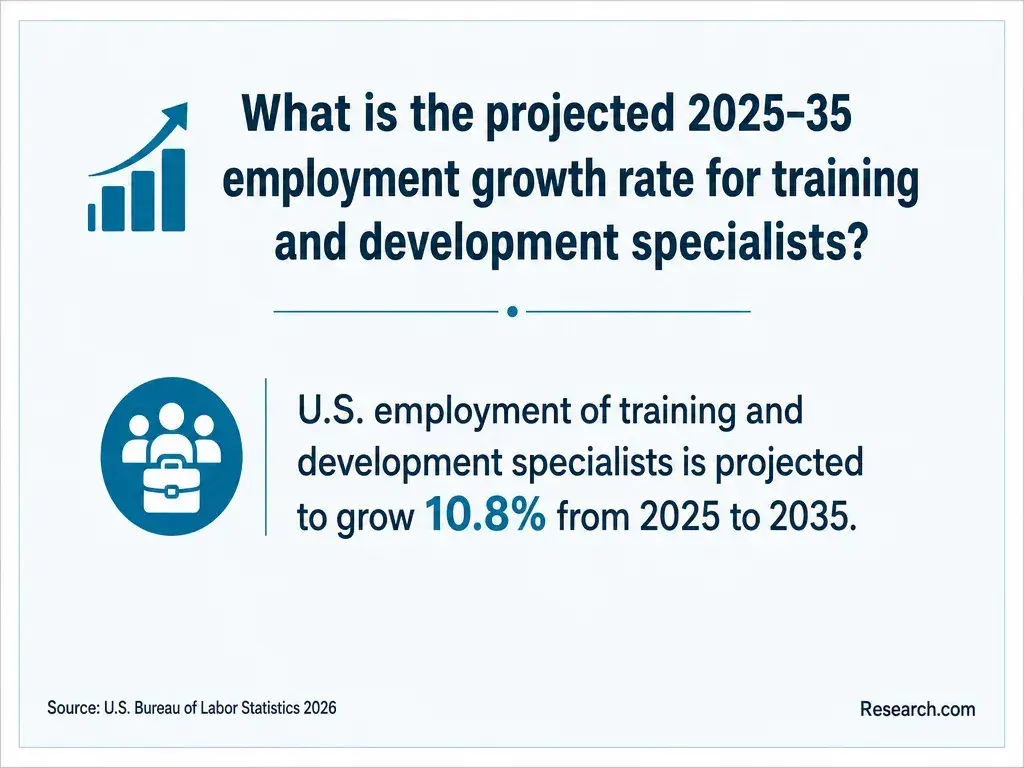
The U.S. Bureau of Labor Statistics reports a median annual salary of $133,000 for training and development managers in May 2025 and projects 6.4% employment growth for that occupation from 2025 to 2035. Those are occupation-wide figures, not outcomes for Ed.D. graduates; management jobs generally require substantial relevant experience.
Use the occupation that matches your intended work, location, and level of responsibility when assessing potential earnings. Do not count on a promotion or salary increase to repay tuition or offset time away from work. For a sabbatical decision, the more reliable question is whether the degree develops capabilities your current employer or target roles actually value.
Do Ed.D. Graduates Need Licensure or Professional Certification?
Organizational learning and development roles generally do not require a license solely because an Ed.D. graduate holds them. Specific jobs may have separate credential rules, however. A broadly focused leadership and learning Ed.D. should not be presumed to qualify someone for teacher, principal, or superintendent licensure.
If you seek a regulated role, ask the program for its written licensure disclosure and check the relevant state authority's requirements before enrolling. For an unregulated role, evaluate whether an employer values a particular professional certification, demonstrated project experience, or the doctorate itself. The answer depends on the job, not the degree's leadership label.
Other Things You Should Know About EdD Leadership
It can provide a starting point, but the audiences may require different scope and evidence. Describe the proposed problem honestly, and check whether the doctoral program expects a particular research or project format.
Ownership and sharing depend on employer agreements and university policies. Review both before promising to publish a project, reuse internal materials, or include organizational findings in a public portfolio.
Only if the institution permits it and the course is open to auditors. Ask whether auditing is available, what it costs, and whether it carries any credit; do not assume it will later count toward the doctorate.
Keep permitted notes on decisions, methods, feedback, and next steps. Store organizational information only under applicable employer and university rules, and do not retain identifiable records merely because they might be useful later.
- Academic Years, Academic Calendars, Payment Periods, and Disbursements | 2024-2025 Federal Student Aid Handbook https://fsapartners.ed.gov/knowledge-center/fsa-handbook/2024-2025/vol3/ch1-academic-years-academic-calendars-payment-periods-and-disbursements
- Qualified Ed expenses | Internal Revenue Service https://www.irs.gov/credits-deductions/individuals/qualified-ed-expenses
- Accreditation in the U.S. | ed.gov http://www.ed.gov/laws-and-policy/higher-education-laws-and-policy/college-accreditation/accreditation-in-the-us
- Faculty Sabbatical and Educational Leave Policy | stevenson.edu https://www.stevenson.edu/human-resources/policies-forms/policy-manual/faculty-development/
- What's the Difference Between Asynchronous and Synchronous Learning? | Ohio State Online https://online.osu.edu/content-hub/blogs/whats-the-difference-between-asynchronous-and-synchronous-learning/
- Rule R6-314A: Faculty Sabbatical Leaves | The University of Utah https://regulations.utah.edu/academics/rules/r6-314a.php
- What Is a Problem of Practice? | spalding.edu https://online.spalding.edu/blog/what-is-problem-practice
- Student-Led Research Projects | SMU https://www.smu.edu/provost/research/compliance/human/student-research
- Synchronous Online Courses - Academic Affairs | Coles College of Business https://campus.kennesaw.edu/faculty-staff/academic-affairs/curriculum-instruction-assessment/digital-learning-innovations/faculty-learning-scientists/course-facilitation/synchronous-online-courses.php