2027 Online Ed.D. in Leadership and Learning in Organizations: How to Evaluate Team-Based Research Milestones
Audited and Verified:
Our Editorial and Data Verification Process
Research.com uses government datasets, official education statistics and primary institutional information to support its career and degree guides. Our review process checks factual accuracy, occupational definitions, source dates and the requirements associated with the credentials discussed.
How This Article Was Fact-Checked
Our editorial team verifies salary estimates, employment projections, education requirements and program information against original data providers and official organizations. Salary figures are checked against the relevant occupational definitions and reporting periods. Information about licensure, accreditation and required in-person training is reviewed separately.
Fact-checked and verified on:

Co-Founder and Chief Data Scientist
Team-based research can make an online Ed.D. more relevant to organizational practice, but it also makes completion depend on shared deadlines, access to evidence, and clear individual responsibilities. For working leaders and learning professionals, the important question is not simply whether a program has a group project. It is whether its milestones provide enough guidance and accountability to turn collaboration into an achievable doctoral deliverable. This guide shows what to request from programs, how to assess research checkpoints, and which risks to resolve before enrolling.
Key Things You Should Know
- Ask for the actual milestone schedule, assessment rubrics, and rules for individual contributions; "team-based capstone" alone does not explain how students advance or graduate.
- Evaluate academic approval, organizational permission to use data, and any required ethics review separately. Approval from a workplace sponsor does not replace university oversight.
- Favor a program with documented options for team conflict, lost data access, and partner withdrawal - especially if your employment or project site could change during the degree.
What is an online Ed.D. in Leadership and Learning in Organizations?
An online Doctor of Education in leadership and learning focuses on using research and organizational evidence to improve practice. Students may study adult learning, organizational change, leadership, and evaluation while completing an applied doctoral project. "Online" describes where much instruction occurs; it does not establish that classes are asynchronous, that campus visits are optional, or that research can be completed independently.
The degree is generally a better fit for a professional who wants to investigate and improve a workplace learning or leadership problem than for someone whose primary goal is a research-intensive academic career. Program names and award requirements differ, however. Before comparing schools, confirm the exact degree and project model; education doctorate specialization comparisons can help distinguish a broad organizational program from a concentration designed for a particular sector.
How do team-based research milestones work in an online Ed.D. program?
A research milestone is a checkpoint at which students submit work, receive approval or required revisions, and establish readiness for the next stage. A team-based capstone may divide the work among students, but the program should still identify what each person must demonstrate. Some Ed.D. programs instead require an individual dissertation in practice or another deliverable; do not assume the stages below are a particular school's rules.
The following comparison shows what common checkpoints can establish and what a prospective student should look for in a program's published requirements.
| Possible milestone | Evidence of progress | Quality question |
| Problem and partner approval | Defined organizational problem, feasible scope, sponsor responsibilities, and faculty approval | Who can reject or require a new project site? |
| Design and access | Research questions, measures, data plan, permissions, and required ethics determination | Must access be confirmed before data collection begins? |
| Collection and analysis | Documented methods, secure data handling, analysis, and limitations | How are methods and individual contributions reviewed? |
| Final deliverable | Findings, defensible recommendations, written work, and any presentation or defense | Is completion assessed jointly, individually, or both? |
Strong milestones prevent a team from investing months in a question that cannot be studied. For example, a proposed evaluation of a staff-development program needs an outcome the organization can reasonably measure, a realistic observation period, and permission to use the relevant records. A sponsor's enthusiasm does not establish data access or prove that the project meets doctoral standards.
To judge whether the sequence is workable, request the program handbook and a sample milestone rubric, then ask the coordinator or faculty advisor:
- Which submissions must pass before the team may collect data, and who grants each approval?
- How are team roles, authorship, peer feedback, and individual grades documented?
- What happens if a team member leaves, the employer changes its position, or the proposed data are unavailable?
- How many revision opportunities are available, and can a delayed milestone postpone graduation?
How can you evaluate online Ed.D. program accreditation and academic quality?
First, confirm the institution's recognized accreditation and that the Ed.D. is an authorized degree at that institution. Accreditation of a university does not, by itself, establish the quality of a particular team project, specialized certification, or eligibility for school-administrator licensure.
For this decision, academic quality is visible in the project rules. Ask to see the current curriculum, capstone or dissertation handbook, milestone rubrics, faculty supervision arrangements, research-methods support, and policies for research review and data security. Find out whether students receive feedback before high-stakes submissions and whether the school publishes clearly defined completion outcomes. A completion figure without its cohort, time period, and treatment of students who stopped out is difficult to interpret.
Compare documents for your intended entry term rather than relying on a promotional description. The program office can explain academic requirements; the university's research-review office determines its review procedures; and an organization controls whether its records or personnel may be used.
Relevant coursework commonly spans leadership and organizational change, adult learning, qualitative and quantitative methods, and applied evaluation. The important distinction is between exposure to a topic and preparation to use it in the required project. A team studying learning transfer, for instance, needs more than a leadership theory course: it needs suitable measures, a defensible plan for collecting evidence, and a way to interpret results without claiming that training caused every observed change.
Examine the course sequence against milestone dates. Research design should arrive before a proposal is due, and methods support should remain available during analysis - not only in an early course. If you already conduct workplace evaluations, look for advanced feedback on validity, ethics, and implementation rather than assuming familiar course titles add new capability.
Requirements vary by institution and entry term. Programs may consider prior degrees, graduate academic work, leadership or professional experience, recommendations, a statement of purpose, and an interview. Some assess whether applicants can identify a plausible organizational problem; that is different from requiring an approved employer project at admission.
Describe decisions you have influenced, learning or change initiatives you have helped lead, and the evidence you used - without presenting a proposed project as approved research. Ask admissions whether prior graduate credits establish eligibility, whether any can actually count toward the Ed.D., and who makes those decisions. Applicants returning after unfinished doctoral study can separately investigate resuming doctoral education through an Ed.D. completion route; neither admission nor shortened study should be assumed without a written evaluation.
For team research, the meaningful difference is how reliably students can meet, obtain faculty feedback, and work with a project partner - not simply where lectures take place. An online cohort may combine recorded coursework with mandatory live meetings and campus convenings. A campus-based program may offer easier in-person collaboration but require regular travel or a less compatible work schedule.
Request the actual live-class calendar, attendance policy, residency dates, expected team-meeting practices, and accessibility arrangements. If you work shifts, care for family members, or live outside the program's time zone, test those commitments against a normal week and a proposal-deadline week. Compare travel and lodging as well as tuition; readers considering higher education roles can also examine higher education leadership doctoral costs after financial aid while checking whether a program's research format fits their schedule.
Time to completion depends on required coursework, enrollment pace, milestone approvals, revisions, and the availability of a viable project site. A published program length may describe an uninterrupted sequence, not the time needed if a team changes scope or loses data access. Ask for the maximum completion period and what happens to tuition, enrollment status, and advising during a delayed project.
Calculate a personal total using the school's current tuition schedule and required credits or terms, then add fees, technology, convening travel, and any costs associated with collecting or presenting research. Check employer reimbursement conditions before treating that support as available. Comparing affordable organizational leadership doctorates can help form a shortlist, but the lowest advertised tuition is not necessarily the lowest completion cost when required travel or extra terms differ.
The strongest connection is to work that combines leadership responsibility with learning, change, or evaluation: learning and development management, organizational development, workforce initiatives, consulting, and certain higher education leadership roles. A well-executed team project may provide evidence of stakeholder coordination and applied inquiry, but employers will also assess your prior responsibility, sector knowledge, and ability to implement decisions.
Choose a project that builds credible evidence for your target role without assuming confidential findings can become a public portfolio. If your goal is university administration, comparing Ed.D. organizational leadership study for higher education may be more useful than comparing programs solely by their general leadership titles. If you need one specific evaluation skill rather than a doctoral credential, supervised workplace experience or targeted training may be the more direct route.
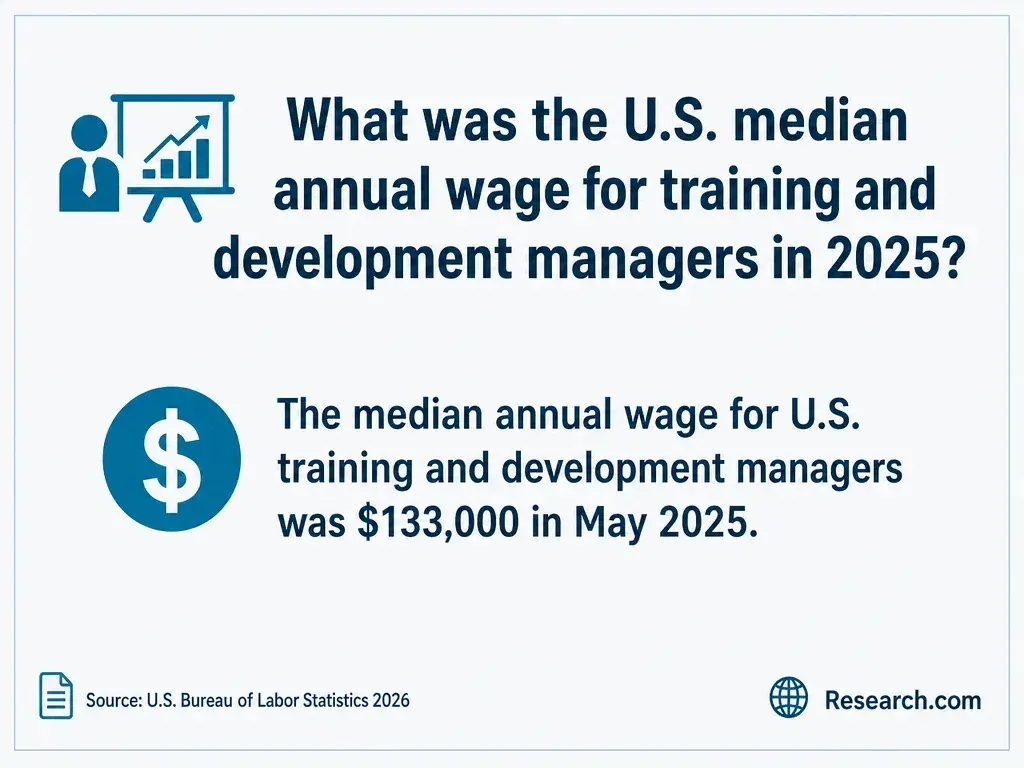
There is no single Ed.D. salary: occupation, experience, employer, and location matter more than the degree title alone. The U.S. Bureau of Labor Statistics reports a May 2025 median annual salary of $133,000 for training and development managers and projects 6.4% employment growth for that occupation from 2025 to 2035. That is an occupational benchmark, not a starting salary or a forecast for graduates of a particular program.
Use the occupation that matches the work you actually intend to do when assessing potential returns. A specialist considering a management position should also ask whether they have - or can obtain - budget, staff, and program leadership experience; doctoral research alone does not supply those job qualifications.
Do Ed.D. graduates need licenses or professional certifications?
Organizational learning and development roles generally do not require a license simply because a practitioner holds an Ed.D. Employers may value role-specific certifications, but a doctorate does not automatically confer one. Regulated education positions are different: a general leadership and learning Ed.D. should not be treated as preparation for teacher, principal, or superintendent licensure unless the institution and relevant state authority confirm the applicable pathway.
If licensure is your goal, request the program's written disclosure for your state and check it with the licensing authority before enrolling. If your goal is a nonregulated organizational role, compare any optional certification against the specific skills and hiring requirements you still need.
Other Things You Should Know About EdD Leadership
Possibly, if the approved project remains coherent and each student can meet individual learning and assessment requirements. Ask how the program permits distinct responsibilities within a shared deliverable.
Ownership and reuse depend on university policy, team agreements, and any partner agreement. Clarify authorship, intellectual property, and publication rights before sharing a report outside the program.
Only within the permissions granted by the organization and university. A redacted account of methods and your contribution may be safer than displaying internal data or an unpublished report.
Document the evidence and differing interpretations, then seek faculty guidance rather than forcing a stronger conclusion than the data support. A defensible report can acknowledge uncertainty and limitations.
- TCPS 2 (2022) - Chapter 5: Privacy and Confidentiality https://ethics.gc.ca/eng/tcps2-eptc2_2022_chapter5-chapitre5.html
- Online group projects in higher education - PMC https://pmc.ncbi.nlm.nih.gov/articles/PMC10038701/
- IRBs | ORI https://ori.hhs.gov/content/chapter-3-The-Protection-of-Human-Subjects-IRBs
- Measuring Student Success In IPEDS: Graduation Rates (GR), Graduation Rates 200% (GR200), And Outcome Measures (OM) https://nces.ed.gov/ipeds/use-the-data/measuring-student-success-in-ipeds
- Do You Need IRB Review... and Why? - Harvard CUHS https://cuhs.harvard.edu/do-you-need-irb-review-and-why
- Employees as Participants | virginia.edu https://hrpp.research.virginia.edu/teams/irb-sbs/researcher-guide-irb-sbs/employees-participants
- Guidance for Students - Division of Research https://www.research.txst.edu/orc/irb-resources/student-guidance.html
- Doctoral Learning and Resources - Section 7. Learning Modalities and Resources - Academics at Walden University https://academics.waldenu.edu/handbook/learning-modalities/doctoral-research-resources
- Assessing by Group Work | UNSW Staff Teaching Gateway https://www.teaching.unsw.edu.au/assessing-group-work
- Information for Faculty Advisors of Student Researchers | Seattle University https://www.seattleu.edu/institutional-review-board-and-office-of-research-oversight/information-for-faculty-advisors/