2027 Choosing a BS in Business Administration When You Want to Move from a Trade into Business Ownership
Audited and Verified:
Our Editorial and Data Verification Process
Research.com uses government datasets, official education statistics and primary institutional information to support its career and degree guides. Our review process checks factual accuracy, occupational definitions, source dates and the requirements associated with the credentials discussed.
How This Article Was Fact-Checked
Our editorial team verifies salary estimates, employment projections, education requirements and program information against original data providers and official organizations. Salary figures are checked against the relevant occupational definitions and reporting periods. Information about licensure, accreditation and required in-person training is reviewed separately.
Fact-checked and verified on:

Co-Founder and Chief Data Scientist
Being good at a trade and running a profitable trade business require different skills. An electrician, HVAC technician, mechanic, or contractor may know the work but still need to price jobs, manage cash, win customers, and supervise employees. If you are considering a BS in Business Administration, the decision is whether its broad education is worth the time and cost compared with targeted training and hands-on experience.
This guide shows what the degree can contribute, where it falls short, and how to choose a path that fits your ownership plans.
Key Things You Should Know
- You generally do not need a business degree to own a trade business; occupational licensing, business registration, insurance, and local rules are separate matters to verify.
- A BS in Business Administration is most useful when you need broad preparation in finance, marketing, operations, and managing people - not just help with one immediate problem.
- Compare the degree's remaining cost and study time with targeted courses, mentoring, and the cash your business will need. Occupation-wide business salaries are not forecasts of an owner's income.
What is a BS in Business Administration for aspiring business owners?
A BS in Business Administration is an undergraduate degree covering several business functions. For a tradesperson, its value is learning to make decisions beyond the job site: whether a quote covers overhead, which customers are profitable to serve, when to buy equipment, and how to build processes that do not depend entirely on the owner.
The degree does not teach or authorize trade work. A BS, BBA, and specialized management degree may overlap, but their required courses and quantitative depth differ by school. Compare actual curricula rather than degree initials. If your main goal is supervising an established crew, undergraduate leadership programs with shorter timelines may be worth comparing; check whether they also provide enough accounting and finance for ownership.
Is a business administration degree required to start a business?
No general US rule requires a business administration degree to start a trade business. The requirements that matter are specific to your trade, location, and activities. Confirm who may perform or supervise licensed work, what registrations and permits apply, and what insurance or bonding customers and contracts require. Owning a company does not itself qualify you for a trade license.
Choose education according to the gap you need to close. These pathways solve different problems:
| Pathway | Best fit | Main limitation |
| BS in Business Administration | You want broad business skills and a bachelor's credential, perhaps as a career option beyond ownership. | More coursework, time, and expense than a narrow skill gap may justify. |
| Targeted courses and mentoring | You need near-term help with pricing, bookkeeping, sales, or hiring. | Less structured breadth and no bachelor's credential. |
| Specialized degree or certificate | Your intended company depends heavily on one function, such as logistics or project coordination. | May leave other ownership skills for you to learn separately. |
For someone whose immediate challenge is coordinating complex jobs, affordable college choices for aspiring project managers offer a comparison. A full project management degree may still be more education than a new owner needs; compare its cost with a course and supervised experience first.
How can trade professionals transition into business ownership?
Start with evidence from the work you already do. Customer communication, estimating, scheduling, purchasing, and quality control are transferable skills. Owning the business adds responsibility for collections, payroll, taxes, staffing, and decisions when jobs are scarce or costs rise.
A practical transition sequence helps you test the business before committing to either a degree or a full-time launch:
- Define the service and customer: specify the work you can legally deliver, your service area, and who approves purchases.
- Test job economics: estimate labor, materials, travel, overhead, payment timing, and a margin for errors or rework. Revenue is not take-home income.
- Map obligations: check applicable licensing, registration, insurance, tax, employment, and contract requirements with the responsible authorities and qualified advisers.
- Identify your weakest business function: use a course, mentor, experienced hire, or degree coursework to address it, then reassess as the company grows.
A tradesperson planning a materials-intensive business should examine purchasing and inventory, not just sales. Supply chain undergraduate programs with shorter terms may fit a long-term logistics goal, but first establish whether a specialized degree would address a problem you cannot solve through supplier experience and targeted training.
Business administration programs commonly include accounting, finance, marketing, management, operations, and quantitative analysis, alongside general education. For an aspiring trade-business owner, the test is whether assignments let you apply those subjects to decisions you will make: building an operating budget, comparing equipment financing, evaluating customer acquisition costs, or planning crew capacity. Check the catalog and sample syllabi; course titles alone do not show the depth of practical work.
An entrepreneurship concentration can be useful if it adds relevant courses and an approved applied project without extending graduation. It is not necessary simply to call yourself an entrepreneur. If hiring and retaining technicians is the larger challenge, compare the available people-management coursework with human resources degree costs and options. HR study may deepen that function, but it does not replace legal advice on employment obligations.
A class business plan is a learning exercise, not proof that customers will buy or that a lender will finance the venture. Mark projections as assumptions and use real records only with permission and appropriate privacy protections.
Online study may let you keep earning while preparing to launch, but online does not always mean self-paced. Ask about live meetings, fixed deadlines, team projects, proctored exams, software, and any required campus visits. Compare those obligations with peak-season work, on-call shifts, and family commitments - not just the advertised delivery format.
Campus study may offer easier access to local business contacts and face-to-face project work, but commuting and scheduled classes can reduce billable hours. When reviewing business administration programs supporting continued employment, request a sample term schedule and the policy for reducing your course load during a busy season. The better format is the one you can complete without undermining your income or business preparation.
Requirements vary by school and by whether you apply as a first-time or transfer student. Schools typically request evidence of prior education, and some business majors have separate entry rules or prerequisites. Trade training, an applied associate degree, or years of work may strengthen your application, but none automatically satisfies college credit or business-major requirements.
Gather transcripts from every college attended, details of any apprenticeship or evaluated training, and course descriptions for subjects you hope to transfer. Then ask admissions what establishes eligibility and the transfer office which accepted credits actually satisfy general education, business core, or elective requirements. For questions to raise before applying, see understanding business administration entry standards. Request a degree audit before relying on an estimated completion date.
A bachelor's degree commonly takes about four years of full-time study from the start; part-time enrollment can take longer. Prior college work may shorten the path, but only after the school determines how it applies. Published tuition alone cannot tell a working tradesperson what finishing will cost.
Use the same cost categories for each school you compare. The table separates school charges from the business and income effects that a tuition quote may miss.
| Cost category | What to verify |
| Tuition and required fees | Charges for your enrollment status, including online, technology, or proctoring fees. |
| Remaining coursework | Credits still required after an official evaluation, plus course availability and residency rules. |
| Financing | Grants, loans, employer assistance, payment timing, and potential borrowing costs. |
| Opportunity cost | Hours away from paid work, launch preparation, or the business itself. |
Compare online business programs for cost-conscious students using your remaining requirements and likely schedule, not a headline tuition figure. A lower-priced program can cost more overall if it requires additional courses or delays completion.
First, confirm the institution's current accreditation through its stated accreditor and the US Department of Education's recognized-accreditor information. Then check separately whether an AACSB, ACBSP, or IACBE claim covers the business school or the specific program and location you intend to attend. Institutional accreditation and business-specific accreditation are not interchangeable, and neither proves the program will help your company succeed.
For ownership preparation, inspect required accounting and operations courses, access to small-business projects, faculty support, course availability, and the rules for using your own venture in an assignment. If you explore fast-track online business programs, verify how compressed terms affect weekly workload and whether courses you need run often enough to support the advertised pace.
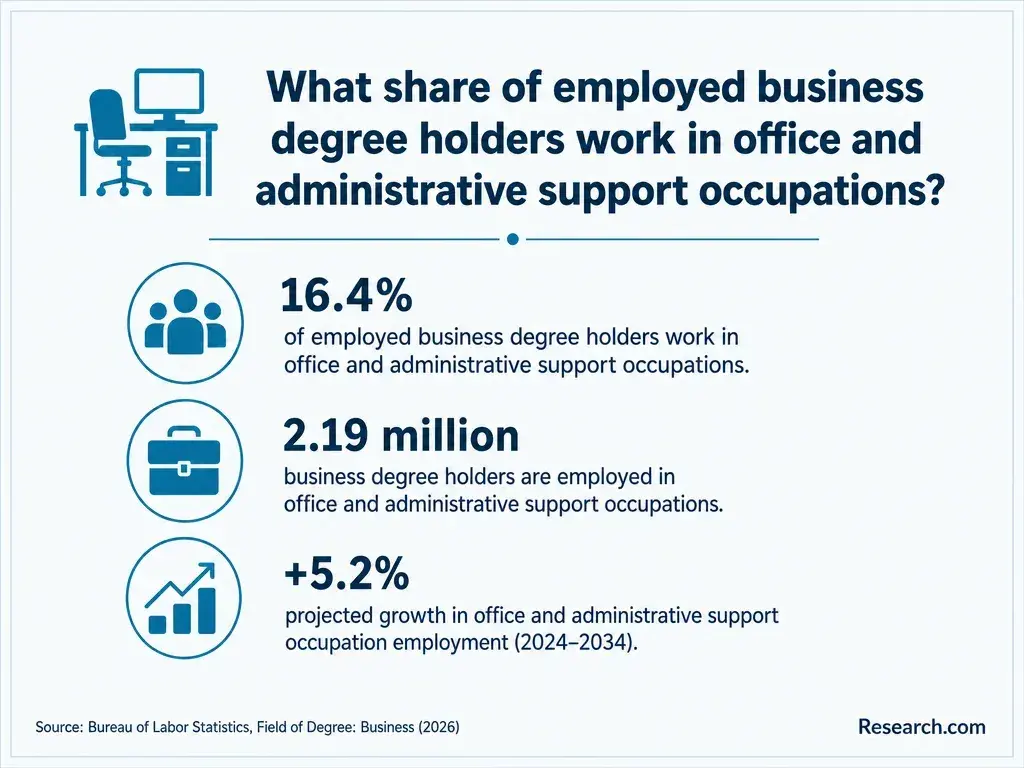
Ownership is one path, but the degree can also support an employed role while you build capital or test a business idea. Your trade background may be particularly relevant to operations coordination, purchasing, sales for technical products, service scheduling, or project coordination. Employers will still evaluate your function-specific skills and results; graduation does not make someone a manager.
Choose work that closes an ownership gap. A coordinator role can build scheduling and reporting experience; purchasing work can teach supplier evaluation; technical sales can strengthen customer discovery and quoting. If you would rather specialize in recruiting or workforce operations than run the whole company, evaluate transfer-friendly online HR colleges against a general business degree. Ask each school how your existing credits apply before comparing time to completion.
What are the salary and job outlook for business administration graduates?
There is no single salary or job-growth rate for BS in Business Administration graduates, and owner income depends on business performance rather than a wage scale. For one related employed occupation, the US Bureau of Labor Statistics reports a $102,320 median annual wage for project management specialists in May 2025 and projects 7% employment growth from 2025 to 2035. Those figures cover workers across experience levels and industries; they are not a starting salary or an estimate of what a trade-business owner will earn.
Use occupational data as a check on an alternative employed career, not as a promised return on tuition. If you compare ranked accelerated undergraduate business schools, weigh the verified cost and workable study schedule against the skills and credential you actually need. A faster degree is not a better investment merely because a related occupation has a high national median wage.
Other Things You Should Know About Business Administration
Possibly. Ask the instructor whether a proposed venture meets the assignment rules. Label forecasts as estimates, and do not present a classroom plan as an operating business or approved financing proposal.
A partner may bring missing financial or sales skills, but you still need to understand decisions you share. Agree on responsibilities, decision authority, and an exit process, with appropriate legal advice.
No. Franchise training may explain that company's systems, while you remain responsible for evaluating the agreement, local demand, financing, and day-to-day performance. Review the required disclosures and seek qualified advice before committing.
Check your employment agreement and applicable law first. Avoid using your employer's customer information, equipment, paid time, or confidential pricing without authorization, and resolve potential conflicts before taking clients.
- Accreditation in the U.S. | ed.gov http://www.ed.gov/laws-and-policy/higher-education-laws-and-policy/college-accreditation/accreditation-in-the-us
- Fast Facts: Tuition costs of colleges and universities (76) | ed.gov https://nces.ed.gov/fastfacts/display.asp
- Free small business counseling & local mentoring | Small Business Administration https://www.sba.gov/counseling/
- Business School Internships: Gaining Practical Experience | Pepperdine Graziadio Business School https://bschool.pepperdine.edu/personal-growth/article/business-school-internships-gaining-practical-experience.htm
- What Should I Major in If I Want to Start My Own Business? | Southeast Missouri State University https://semo.edu/blog/blog-posts/what-should-i-major-in-if-i-want-to-start-my-own-business
- What Internships Should Business Students Look For? | Lasell University https://www.lasell.edu/academics/lasell-insights/what-internships-should-business-students-get.html
- What Is an Accredited University? Understanding Accreditation | National University https://www.nu.edu/blog/what-is-an-accredited-university/
- Certificate vs. Degree: Which Is Right for You? | UC San Diego Division of Extended Studies https://extendedstudies.ucsd.edu/news-events/extended-studies-blog/certificate-vs-degree-making-the-right-education-decision
- How Colleges Can Simplify Transfer Credit Policies | American College of Education https://ace.edu/blog/how-the-college-credit-transfer-process-works-and-how-it-can-be-improved/
- Online Trade Schools and Other Options | InterCoast Colleges https://www.intercoast.edu/articles/online-trade-schools/