2027 Can Your AAS in Medical Assisting Transfer into an Online BS in Business Administration?
Audited and Verified:
Our Editorial and Data Verification Process
Research.com uses government datasets, official education statistics and primary institutional information to support its career and degree guides. Our review process checks factual accuracy, occupational definitions, source dates and the requirements associated with the credentials discussed.
How This Article Was Fact-Checked
Our editorial team verifies salary estimates, employment projections, education requirements and program information against original data providers and official organizations. Salary figures are checked against the relevant occupational definitions and reporting periods. Information about licensure, accreditation and required in-person training is reviewed separately.
Fact-checked and verified on:

Co-Founder and Chief Data Scientist
Your medical assisting AAS may give you a head start on an online BS in business administration, but an accepted course will not necessarily satisfy a business degree requirement. That distinction matters if you want to move from clinical support into healthcare operations without paying to repeat coursework. This guide explains how schools evaluate applied associate degrees, which business courses may remain, and how to compare completion plans before you enroll.
Key Things You Should Know
- Yes, an AAS in medical assisting can transfer into some online business administration bachelor's programs; the receiving school decides which courses it accepts and where they apply.
- There is no universal number of transferable AAS credits. Compare official degree audits, not advertised transfer-credit maximums, to see what remains for graduation.
- For a healthcare operations goal, favor a program that applies your prior credits efficiently while providing accounting, analytics, and management coursework you have not already studied.
Can an AAS in medical assisting transfer into an online BS in business administration?
Yes, potentially. An Associate of Applied Science (AAS) in medical assisting is designed largely for occupational preparation, while a BS in business administration includes general education and a business core. A receiving university may accept your AAS courses, but it may apply some only as electives rather than toward required business courses.
Separate four decisions: admission to the university, admission to its business major, acceptance of individual credits, and application of those credits to graduation requirements. None automatically establishes the next. Your clinical experience can also strengthen your case for healthcare operations roles, but work experience earns academic credit only through a school's approved process.
If your goal is advancement without leaving a healthcare job, compare business administration programs for advancement while working against your actual degree audit and schedule. A program that accepts more credits on paper may still require more courses before graduation.
How many AAS medical assisting credits transfer to an online business degree?
There is no reliable standard number. The answer depends on the receiving school's transfer policies, course equivalencies, degree requirements, and any agreement with your AAS institution. The useful figure is credits that satisfy your chosen BS requirements, not merely credits appearing on a transfer transcript.
The categories below show why two schools can accept the same coursework yet produce different completion plans.
| Possible treatment | Medical assisting AAS example | Effect on the BS |
| Required course equivalency | English composition matches a writing requirement | May satisfy that requirement |
| General education or elective credit | Anatomy or medical terminology is accepted without a business equivalent | Adds credit but may leave business requirements untouched |
| Credit accepted beyond an applicable limit | Additional technical coursework exceeds a degree's available elective space | Appears in the record without shortening the path to graduation |
| No transfer credit | A course does not meet the receiving school's policy | Does not count toward the degree |
Do not assume that clinical or administrative training substitutes for accounting, economics, or statistics. If you are comparing a different destination degree, such as project management, the rules for using prior college credits in a project management bachelor's may differ from those for business administration.
What determines whether a medical assisting AAS transfers successfully?
The strongest transfer plan begins with course-level evidence. Institutional accreditation, grades, credit hours, course content, and the age of coursework can affect evaluation. So can the BS program's general education, business-major, upper-level, and residency requirements. A statewide agreement or transfer partnership may help, but confirm that it covers your AAS and intended BS.
Before committing, use this sequence to turn an initial credit estimate into a workable completion plan:
- Request official transcripts and gather catalog descriptions or syllabi for courses whose equivalencies are unclear.
- Ask the transfer office for a course-by-course evaluation and the business adviser for a degree audit showing where every accepted course applies.
- Check the catalog for required accounting, economics, math, statistics, and upper-level courses, including prerequisites and residency rules.
- Request a written review of any plausible equivalency or substitution the first evaluation missed, then confirm the revised audit before enrolling.
An application-fee waiver can lower the cost of comparing schools, but it says nothing about credit applicability. If application costs limit your options, a guide to online colleges without application fees can help you identify schools to investigate; the degree audit should still decide which offer is useful.
First, verify that the institution holds recognized accreditation and that it awards the specific online BS you intend to enter. Institutional accreditation matters when evaluating the standing of the degree and future transfer or graduate-study options. Check the institution and accreditor directly rather than relying solely on a program advertisement.
Business-school accreditation through AACSB, ACBSP, or IACBE is a separate question. If a school claims it, check the accreditor's listing for the actual institution, academic unit, and program scope; do not assume every degree offered by the university is covered. Such accreditation does not guarantee that your AAS credits will apply or that graduates will get a particular job.
If you are considering a specialized degree instead, apply the same checks to it. For example, when reviewing project management schools with competitive tuition, verify both the awarded credential and its accreditation rather than treating a business elective and a project management degree as interchangeable.
Expect a broader business foundation than a medical assisting AAS usually provides: accounting and financial statements, economics, marketing, organizational management, operations, business law, and quantitative work such as statistics or analytics. Requirements vary by school. A student who has scheduled patients and handled records may recognize operational problems, yet still need to learn budgeting, spreadsheet analysis, and how to evaluate a process change.
Healthcare-related electives or projects may let you apply business concepts to staffing, patient access, or practice operations. Confirm whether a healthcare focus is an official concentration, a set of electives, or simply an available project topic. Likewise, an HR course is not an HR credential. If staffing is your intended function, understanding human resources degree levels can help you compare a broad business BS with more focused study.
Schools commonly request prior college transcripts and assess academic standing; some set separate requirements for entry into the business major. An AAS in a non-business field does not inherently bar admission. A school may admit you before you finish business prerequisites, while another may require particular courses or grades first.
Ask admissions which documents establish eligibility, then ask the business department which courses must be completed before upper-level study. Those are different questions. Use a business administration applicant eligibility checklist to prepare your questions, but rely on the receiving program's current rules for your application term.
Both depend primarily on the remaining requirements in your official audit, course availability, and how many courses you can complete while working. An accelerated calendar does not remove prerequisites, upper-level credit rules, or the hours needed for assignments. Compare a proposed course sequence, not just a school's advertised shortest completion time.
For cost, ask each school for tuition and required fees for the courses you still need, plus books, software, technology or proctoring charges, and any travel requirement. Check financial-aid eligibility and employer reimbursement rules before assuming either will cover a course. A comparison of project management fees, books, and aid considerations illustrates cost categories worth checking, although its program prices should not be used as a quote for a business BS.
If one school accepts more AAS credits but applies fewer to requirements, its seemingly shorter or cheaper offer may be misleading. Request an itemized remaining-course plan and estimated charges from each institution.
Online study may be easier to combine with medical assisting shifts, but delivery mode does not change which AAS courses satisfy the degree. The better choice is the program with a sound transfer audit and a schedule you can sustain. Online courses may have fixed deadlines, live discussions, group presentations, proctored exams, or an approved internship or capstone.
Ask for sample course schedules and assessment policies before enrolling, especially if your shifts change. Campus study may be preferable when in-person tutoring, local recruiting, or a predictable class schedule provides more support. If speed matters, explore accelerated online degree programs only after confirming that the required business courses are offered in a sequence you can actually take.
For a medical assistant, the most credible transition often builds on healthcare experience rather than starting over in an unrelated business function. Depending on job requirements, possibilities include practice-operations coordination, patient-access supervision support, healthcare project coordination, or administrative roles involving scheduling, budgets, and process improvement. Your clinical background helps you understand workflows and patient-facing constraints; business coursework can help you explain costs and operational choices.
A BS alone does not qualify you to manage a practice or oversee staff. Employers may expect demonstrated responsibility, supervisory experience, or knowledge of their systems. Seek approved class projects or workplace assignments that produce evidence of a skill - such as an anonymized scheduling analysis - without disclosing patient or employer information. If you intend to keep working while building that evidence, compare accelerated study schedules for business majors with the time your job and projects require.
What salary and job outlook can business administration graduates expect?
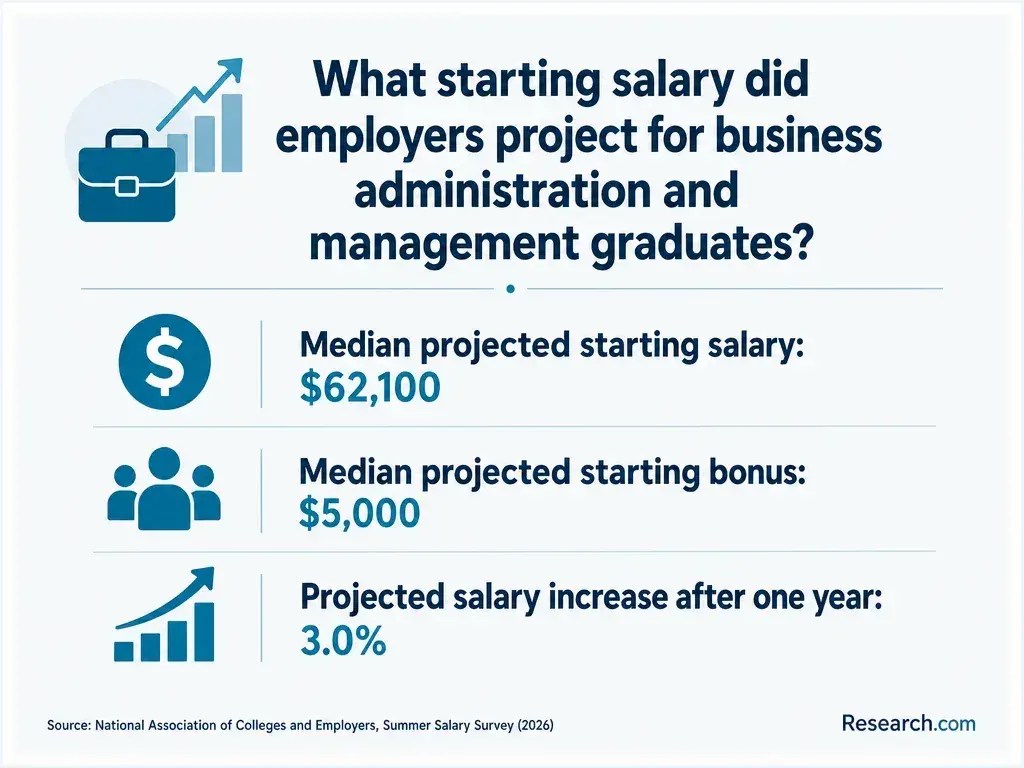
There is no single salary or job-growth figure for "business administration graduates." Pay depends on the occupation, location, employer, and experience - not simply the degree title. For one possible longer-term path, the U.S. Bureau of Labor Statistics reports a May 2025 median annual wage of $75,940 for human resources specialists and projects 6% employment growth from 2025 to 2035. Those are occupation-wide figures, not an expected starting salary or a forecast for medical assistants changing careers.
Evaluate a program's return against roles you could realistically pursue next, including their experience requirements. US rankings for accelerated business bachelor's degrees may help you find programs to examine, but a faster format does not establish better wages or offset credits that fail to satisfy graduation requirements.
Other Things You Should Know About Business Administration
Possibly. Ask whether the university accepts applications with an in-progress AAS and when it needs a final transcript. Admission and the final transfer-credit award may occur at different times.
It may, if the receiving school accepts the specific exam for a requirement you still need. Obtain written approval before paying for or taking an exam.
No. A business degree is separate from medical assistant certification. Check your certifying organization's renewal rules if you want to maintain that credential.
Ask for a new degree audit first. Credits that fit one concentration may become electives under another, changing your remaining courses, cost, or completion date.
- Transfer Resources - Texas Higher Education Coordinating Board https://www.highered.texas.gov/transfer-resources/
- A.A.S. in Business Administration Online Degree Program | Franklin University https://www.franklin.edu/degrees/associates/business-administration/applied
- How Do Transfer Credits Work When You Go Back to School? | Whitworth Online https://online.whitworth.edu/news-articles/how-do-transfer-credits-work-when-you-go-back-to-school/
- Online Bachelor's Degree in Healthcare Management | Colorado Technical University https://www.coloradotech.edu/degrees/bachelors/business-administration/healthcare-management
- Healthcare Administration Degree Program | Home of Syracuse University's part-time students https://professionalstudies.syracuse.edu/academics/online/healthcare-administration/
- Transfer Credit | University of Alabama - UA Academic Catalog https://catalog.ua.edu/undergraduate/about/academic-regulations/policies/transfer-credit/
- BS Business Healthcare Management - Online Hybrid Program | Hallmark University https://hallmark.edu/schools/business-management-healthcare-management-bachelors-program/
- Transfer Student Information - College of Staten Island - CUNY https://www.csi.cuny.edu/students/registrar/transfer-student-information
- Health Administration (BS) - Mason Online https://masononline.gmu.edu/programs/health-administration-bs/
- Time-Cost Calculator - Tuition & Aid | UMass Global https://www.umassglobal.edu/tuition-and-aid/time-cost-calculator