2027 Building a Retention Proposal for Medical Office Staff

Co-Founder and Chief Data Scientist
When a medical office loses experienced staff, remaining employees absorb the work while patients may face longer waits and disrupted service. A retention proposal turns that operational problem into a decision leaders can evaluate: what is driving departures, which changes are worth funding, and how will the office measure results? This guide is for practice managers, team leads, and aspiring healthcare administrators. It explains how to build the proposal, choose credible evidence, and decide whether additional management education would help you lead the work.
Key Things You Should Know
- Build the proposal around your office's departure patterns, workload and employee feedback - not a generic list of perks.
- Compare the full cost of proposed changes with documented vacancy, hiring and coverage costs; set a review date before requesting permanent funding.
- A management certificate may be enough for a focused skills gap, while an MHA or MBA makes more sense when your responsibilities extend to broader budgets, operations and organizational change.
What Is a Medical Office Staff Retention Proposal?
A medical office staff retention proposal is a written recommendation for reducing avoidable employee departures. It identifies the affected roles, explains the likely causes, requests specific changes and funding, assigns owners, and defines how the practice will judge results. Its purpose is to help an owner or leadership team choose an action - not simply acknowledge that turnover is a problem.
Define the scope before proposing solutions. Front-desk coordinators, billers, medical assistants and nurses may encounter different pressures, and clinical staffing decisions can involve separate supervision or regulatory requirements. Include a budget for training or career development only if employees have identified it as a meaningful need. If formal education is part of the request, compare tuition for online healthcare administration degrees alongside paid study time and coverage costs; tuition alone is not the full expense to the office.
Why Is Staff Retention Important in Medical Offices?
Turnover can leave appointment scheduling, referrals, prior authorizations, billing and patient messages with fewer experienced people to handle them. Vacancies may also require overtime or temporary coverage. These are potential costs, not proof that every departure is preventable: a credible proposal connects specific staffing changes to observed effects in the practice.
Retention also preserves institutional knowledge. Employees who understand a practice's workflows can help train colleagues and identify process problems. For staff seeking advancement, a visible path beyond their current role may matter; reviewing potential career destinations for healthcare administration students can help managers discuss possibilities without promising a promotion the office cannot offer.
How Do You Build an Effective Medical Office Retention Proposal?
Write for the person who must approve the change. Start with a specific operational problem, then show why your proposed response is more appropriate than a cheaper or simpler alternative.
- Define the scope. Name the affected roles, locations and period under review; separate voluntary departures from layoffs or planned temporary positions.
- Test the causes. Compare departure and workload records with confidential employee feedback, rather than assuming pay explains every exit.
- Choose targeted actions. Specify what will change, who will implement it and how scheduling, patient coverage and supervision will work during the transition.
- Build the business case. Itemize new spending and available funding; compare these costs with documented hiring, overtime and temporary-coverage expenses without counting the same expense twice.
- Request a decision. Propose a pilot or approval period, a review date and the measures that would justify continuing, revising or ending the intervention.
For example, if employee feedback and schedules both point to unpredictable shifts, test a scheduling change before requesting a broad tuition benefit. If a documented lack of advancement is the stronger issue, review affordable graduate healthcare administration degrees as one possible development benefit - but fund them only within a clear eligibility and coverage policy.
Use a small set of measures that can establish a baseline and show whether the proposed change addresses the diagnosed problem. The comparison below distinguishes outcomes from warning signs; neither should be interpreted without the context of staffing levels and patient demand.
| Measure | What it can show | Important limitation |
| Voluntary turnover by role | Where departures are concentrated | Small teams can show large swings after one departure |
| Time to fill and onboarding time | How long vacancies and replacement training affect operations | Hard-to-fill roles may reflect the local labor market |
| Overtime and temporary-coverage spending | Direct costs associated with staffing gaps | Some spending may also reflect seasonal demand |
| Schedule changes, workload and employee feedback | Potential causes to investigate | Survey results need confidentiality and follow-up |
| Patient access or billing backlogs | Possible service effects | Other workflow changes may affect these measures |
For a consistent turnover measure, divide voluntary departures during a defined period by average headcount for the same group and period. Report the underlying counts as well: in a small office, a rate alone can mislead. Compare results by role where privacy permits, and do not present a correlation between turnover and patient delays as proof of causation.
If education assistance is proposed, track participation, time away from work and whether employees can apply new skills. A one-year health administration degree program comparison may help estimate scheduling demands, but completion time is not evidence that a degree benefit will improve retention.
Common problems include unpredictable schedules, chronic understaffing, unclear responsibilities, inadequate onboarding, difficult patient interactions, limited advancement and compensation that employees see as uncompetitive. The mix varies by office. An exit interview may reveal a concern, but current employees' feedback and operational records can help determine whether it is widespread.
Distinguish problems a manager can address promptly from those requiring an owner, clinician or human resources decision. A clearer handoff for referrals may be within a manager's control; changing pay bands or clinical staffing models may not be. Recruitment from another sector can fill a vacancy, but it will not fix conditions that prompt existing staff to leave. If the office is developing an administrative career path for such recruits, MHA degree options for applicants changing sectors can inform the education discussion without replacing role-specific onboarding.

The best strategy follows the diagnosed problem and fits the practice's capacity. Employee engagement matters, but a pleasant workplace initiative will have limited value if staff lack adequate coverage to do their jobs.
- For workload pressure: rebalance assignments, improve handoffs or adjust coverage at predictable peak times.
- For schedule instability: publish schedules more consistently and establish a fair process for changes.
- For weak onboarding: define role competencies, assign a trainer and check progress after the employee begins independent work.
- For limited growth: offer cross-training, transparent promotion criteria or relevant education support tied to actual responsibilities.
A development benefit should be usable as well as affordable: an employee cannot benefit from classes if the office cannot release them for required sessions. Faster online master's programs in healthcare management may suit some schedules, but an accelerated pace can increase the weekly demands on an employee already handling a full workload.
Healthcare administration education can help a manager turn a staffing concern into an operational and financial proposal. Relevant study may cover workforce planning, budgets, quality improvement, healthcare operations and organizational change. The practical test is whether a student can apply those tools to decisions such as staffing coverage, training investment and performance measurement.
An MBA generally provides a broad business-management core; a healthcare-focused concentration or elective adds context but is not necessarily the same as a specialized Master of Health Administration (MHA). An MHA may offer more sustained attention to healthcare organizations. Neither degree substitutes for clinical licensure or hands-on experience managing a medical office. Prospective students considering an MHA can examine online CAHME-accredited MHA programs, verifying the accreditation status of the specific program rather than assuming institutional accreditation means the same thing.
Choose a program for the responsibilities you want to take on, not for its credential alone. A first-time office manager may need budgeting, supervision and applied improvement projects more urgently than advanced theory. Compare the courses and assignments with the retention problems you expect to lead.
Verify institutional accreditation, the exact degree and any programmatic accreditation that matters to you. Then ask about total tuition and mandatory fees, course sequencing, live-session requirements, employer reimbursement rules and opportunities to work on a real operational project. If your long-term goal is research, teaching or senior-level leadership rather than a near-term office-management role, review doctoral education options in healthcare administration as a separate decision; a doctorate is not a prerequisite for writing a retention proposal.
Professional certifications can demonstrate focused knowledge in areas such as medical practice management, healthcare administration, coding or revenue-cycle work. Their value depends on the role: a practice manager may prioritize operations and supervision, while a billing lead may benefit more from a revenue-cycle credential. Check the issuing organization's current eligibility, examination, renewal and continuing-education rules before paying for preparation.
A certificate course, a professional certification and an academic degree are different credentials. For a manager who needs a specific skill to improve onboarding or billing workflows, targeted training may be faster and less costly than graduate study. Even shorter healthcare administration doctorate options and requirements address a substantially different educational goal; they are not substitutes for an office-management certification.
What Salaries and Job Outlook Apply to Medical Office Managers?
"Medical office manager" job titles do not always map neatly to a single occupation. Duties may range from supervising a small front desk to overseeing multiple sites and substantial budgets, so compare compensation with local postings that match the role's actual responsibilities.
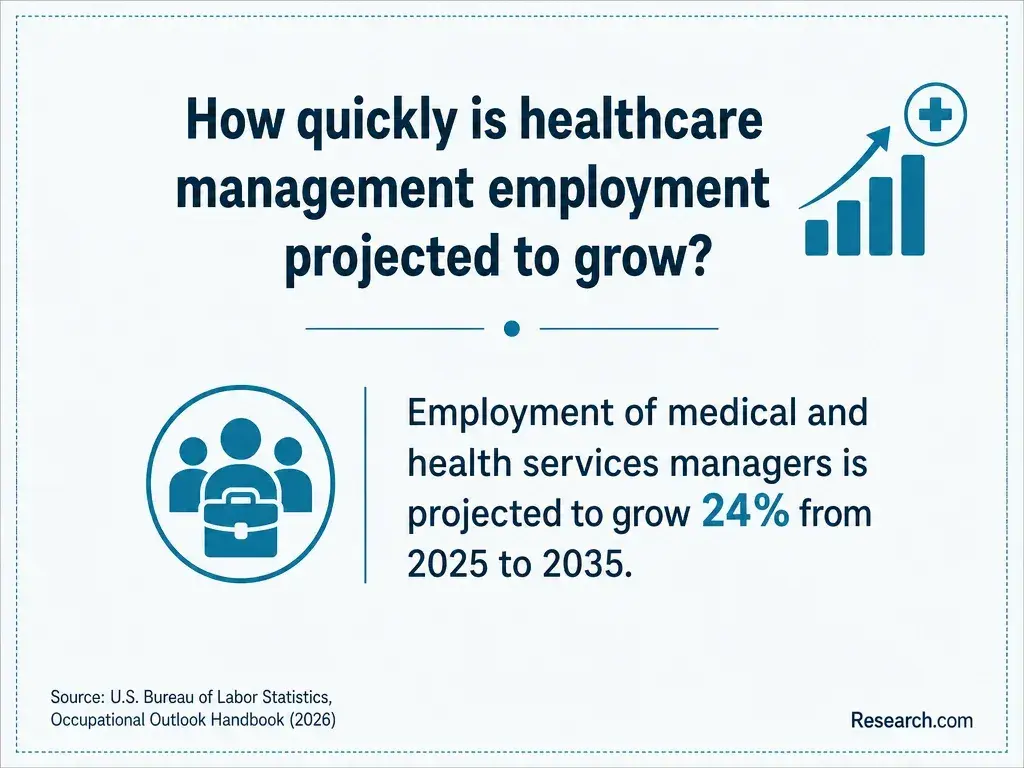
The U.S. Bureau of Labor Statistics reports a $126,520 median annual wage for management occupations in May 2025. That is a broad occupational-group figure - not a medical office manager salary, an entry-level expectation or an earnings estimate for MBA or MHA graduates. BLS also projects overall management employment to grow faster than the average for all occupations from 2025 to 2035, but that group-wide outlook does not predict openings at a particular practice.
Use local job descriptions and pay ranges when deciding whether further education is worth its cost. Advanced degrees may support a later move into broader healthcare leadership, but experience and the target employer's requirements remain important. Someone considering planning an accelerated healthcare leadership doctoral pathway should evaluate that longer-term goal separately from the immediate task of improving retention in one office.
Other Things You Should Know About Healthcare Administration
Yes. A practice manager can organize staffing records and employee feedback, then ask the owner or an external HR adviser to review proposed pay, policy or employment-law changes before implementation.
They can share an overall business case, but distinguish their causes of turnover, coverage needs and proposed interventions. A single remedy may not work for both groups.
Explain who will see responses and avoid promising anonymity if a person could be identified from their role or comments. Consider a neutral interviewer and report themes without unnecessary identifying detail.
Involve the practice's clinical leadership and any other required decision-makers before changing clinical staffing, duties or supervision. Administrative approval alone may not cover clinical responsibilities.
- The Role of Continuing Professional Training or Development in Maintaining Current Employment: A Systematic Review https://pmc.ncbi.nlm.nih.gov/articles/PMC10647344/
- The impact of scheduling on nurses' intent to stay | drexel.edu https://researchdiscovery.drexel.edu/view/pdfCoverPage
- Healthcare Employee Retention: 3 Listening Strategies to Adopt Today | Perceptyx https://blog.perceptyx.com/healthcare-employee-retention
- What are the recent trends in health sector employment? | Peterson-KFF Health System Tracker https://www.healthsystemtracker.org/chart-collection/what-are-the-recent-trends-health-sector-employment/
- The Hidden Costs of Understaffing in Private Practices | Interim HealthCare https://www.interimhealthcare.com/blog/hidden-costs-of-understaffing-in-private-practices
- Employee turnover - how do you compare? https://www.mgma.com/articles/employee-turnover-how-do-you-compare-
- Nurse retention strategies for a stronger healthcare workforce | Circles https://www.circles.com/resources/nurse-retention-strategies-for-a-stronger-healthcare-workforce
- 7 Hidden Costs Of Healthcare Call Center Staff Turnover | American Health Connection https://americanhealthconnection.com/healthcare-call-center-staff-turnover-costs/
- How to Improve Staff Retention in Healthcare | Relias https://www.relias.com/blog/how-to-improve-staff-retention-in-healthcare
- What is the Cost of Employee Turnover to Your Business? | cigna-me.com https://www.cigna-me.com/en/your-health-plan/cost-to-business/what-is-the-cost-of-employee-turnover-to-your-business