2027 BS in Business Administration Program Choice: An ERP Business Requirements Project as a Capstone Option
Audited and Verified:
Our Editorial and Data Verification Process
Research.com uses government datasets, official education statistics and primary institutional information to support its career and degree guides. Our review process checks factual accuracy, occupational definitions, source dates and the requirements associated with the credentials discussed.
How This Article Was Fact-Checked
Our editorial team verifies salary estimates, employment projections, education requirements and program information against original data providers and official organizations. Salary figures are checked against the relevant occupational definitions and reporting periods. Information about licensure, accreditation and required in-person training is reviewed separately.
Fact-checked and verified on:

Co-Founder and Chief Data Scientist
An enterprise resource planning (ERP) capstone can turn business coursework into a concrete work sample, but only if the project is small enough to finish and specific enough to support a decision.
For BS in Business Administration students considering an analyst or operations career, the strongest option is usually a requirements study for one business process, not a plan to replace an entire system.
This guide explains the deliverable, the academic and data-access checks to make before choosing it, and how to judge whether the degree program will support the work.
Key Things You Should Know
- Scope the capstone around one decision-maker and one process, such as purchase approvals or inventory replenishment; document requirements rather than promise an ERP implementation.
- Confirm faculty approval, stakeholder access, and permission to use business information before committing to a workplace-based project; a fictional case is a viable alternative if access is limited.
- The U.S. Bureau of Labor Statistics projects 10% employment growth for management analysts from 2025 to 2035, but an undergraduate ERP work sample does not by itself qualify a student for that experience-dependent role.
What is an ERP business requirements project capstone in a BS in Business Administration?
An ERP system connects business functions - often accounting, purchasing, inventory, sales, and human resources - through shared processes and data.
A business requirements project describes what users and decision-makers need a process or system to do, why they need it, and how they would know whether it works. In a capstone, the student analyzes those needs; the student does not need to buy, configure, or deploy an ERP platform.
A manageable example is a purchasing team whose requests move through email and spreadsheets. The capstone could examine how requests are submitted, approved, recorded, and reported, then propose requirements for an ERP-supported workflow.
The intended reader might be a purchasing manager deciding which needs to prioritize. The project should state whether its evidence comes from an authorized organization, a published case, or clearly labeled hypothetical assumptions.
A useful academic deliverable has a traceable structure. These components help a faculty assessor distinguish analysis from a software wish list:
- Decision and scope: The process, organizational objective, decision-maker, and boundaries of the study.
- Current state: A process map, known pain points, and the sources and limitations of the evidence.
- Stakeholder needs: Documented perspectives from authorized interviews or, in a fictional case, explicitly assumed user roles.
- Requirements: Prioritized functional needs, reporting needs, access controls, and relevant constraints such as budget or data retention.
- Validation: Acceptance criteria, open questions, risks, and a recommendation for the next decision - not a claim of measured improvement.
If your main interest is warehouse or logistics practice rather than cross-functional requirements, compare the project with the subject focus of online supply chain degrees with cost and outlook details. A specialized curriculum may offer more depth in that function than a general business capstone.
Why choose an ERP business requirements project for your business administration capstone?
Choose this option when you want to show how a business decision crosses departmental boundaries. A purchase approval, for example, affects operations, budgets, accounting records, and the people who authorize spending. Requirements work makes those competing needs visible without assuming that new software is the answer.
The fit depends on the evidence you can obtain and the work you want to demonstrate. The comparison below separates three plausible capstone directions rather than treating ERP as the default choice:
| Capstone focus | Best evidence of learning | Principal limitation |
| ERP business requirements | Process analysis, stakeholder trade-offs, prioritized needs, and acceptance criteria | Can become speculative without reliable process evidence or a narrow boundary |
| Process improvement without a system change | Workflow analysis and an operational recommendation | May show less information-systems analysis |
| ERP configuration or prototype | Demonstration of a particular tool or workflow | May require software access and technical support beyond a business capstone |
An employee may be able to study a familiar process, but familiarity is not permission to use internal records. Ask the faculty supervisor whether an employer-approved, de-identified case meets the rubric, then ask the employer who can authorize interviews, data use, and any external presentation.
Students comparing degree formats around an existing job can also examine business administration programs for advancement while working; project access and supervisor availability matter as much as class scheduling.
What does a BS in Business Administration program teach about ERP systems?
A BS in Business Administration commonly provides the business context for ERP analysis, but the degree title does not guarantee an ERP course or software lab.
Accounting helps a student understand transaction controls and reporting; operations explains workflows and handoffs; information systems introduces shared data and system requirements; and statistics supports the interpretation of baseline measures.
Check the actual catalog, assignments, and available electives rather than inferring technical depth from a course title.
For a requirements capstone, the most useful preparation is being able to explain how a transaction moves across functions. An inventory request, for instance, may affect purchasing authorization, receipt of goods, and accounting entries.
A student should be able to identify where information is entered, who can change it, and what decision the resulting report supports. That is different from learning to administer an ERP platform.
Human resources can be another ERP module, but employee records call for particular care with permissions and privacy. Students interested mainly in HR practice should compare the business curriculum with human resources degree requirements rather than assuming an ERP-focused assignment supplies specialist HR preparation.
Requirements work develops analyst skills when each proposed feature can be traced to a business need and checked against evidence. The student has to separate a stakeholder's suggested solution, "add a dashboard," from the underlying need, such as seeing which purchase requests are awaiting approval. That distinction prevents a polished list of features from replacing analysis.
A practical sequence also makes the work assessable. Each stage should leave an artifact that another reader can review:
- Define the decision, process boundary, stakeholders, and what evidence is available.
- Map the current workflow and record uncertainty or disagreements in the account of how it works.
- Translate needs into testable requirements, including data fields, user permissions, and exception handling.
- Prioritize requirements against value, effort, risk, and constraints; document who has authority to make the final choice.
- Review the draft with permitted stakeholders or the faculty supervisor and revise the recommendation.
Keep a record of revisions: it demonstrates listening and judgment more convincingly than a flawless-looking first draft. If your goal is primarily to demonstrate coaching or organizational change rather than systems analysis, a leadership-focused project may be a better fit; fast-track undergraduate organizational leadership study offers a different curriculum comparison.
Capstones are often scheduled near the end of a degree so students can apply earlier business coursework. The governing requirements, however, are the institution's current catalog, degree audit, and capstone course rules, not a general description of what business majors usually take.
Check whether the course requires specific accounting, operations, statistics, or information-systems classes; senior standing; a proposal; or an approved workplace sponsor.
Admission to the BS program is separate from eligibility to enroll in its capstone. Transfer credit may be accepted by the institution without satisfying a prerequisite or residency rule. If previous coursework is central to your plan, review credit and eligibility rules for business administration admission, then obtain an official degree audit from the school.
Before registering, send the capstone instructor a short scope statement: the process, decision-maker, proposed evidence, intended deliverable, and permissions still needed. Ask whether a simulated case is allowed if an employer cannot approve access. That answer can prevent a project from stalling after the course begins.
Either format can support a strong requirements project. What matters is access to a faculty reviewer, an appropriate case or organization, and enough time for feedback and revision.
Campus courses may make scheduled workshops easier; online courses may help students work around a job. Neither format automatically supplies ERP software, stakeholder interviews, or a flexible group schedule.
For an online program, ask whether presentations are live, teams must meet at fixed times, software runs on an ordinary home computer, and assignments require an on-site visit. For a campus program, ask how often the capstone meets and whether workplace-based research can happen outside class hours.
Students considering accelerated study formats for bachelor's students should check how much time the capstone allows between a first draft and stakeholder or faculty feedback; a shorter term can make that cycle harder to complete.
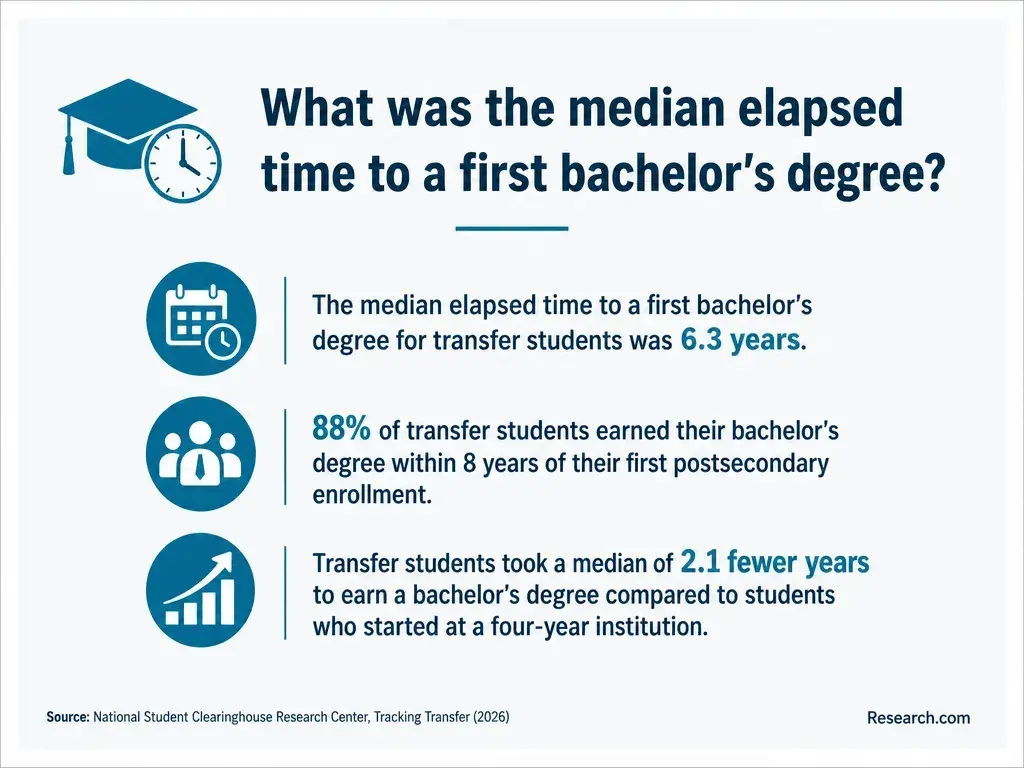
Time to completion depends on credits that apply to the degree, remaining prerequisite sequences, course availability, and enrollment pace. A transfer student near the capstone may still need a required course offered only in a particular term. Get a term-by-term plan from an adviser before treating an advertised completion timeline as your own.
For cost, compare the price of the remaining degree rather than the capstone alone: tuition, mandatory fees, books, software, travel or campus visits, and any term added by course sequencing.
A workplace project may reduce the need to find an outside case, but it can introduce time and permission costs. Use the official aid offer and degree audit to compare options; online business administration school cost comparisons can help identify programs to investigate, not establish your final bill.
First, verify the institution's accreditation and current status with the institution and the accreditor. Then check whether any claimed business accreditation, such as AACSB, ACBSP, or IACBE, actually covers the school or program offering the BS you would enter.
Institutional accreditation and business accreditation have different scopes; neither confirms that an ERP capstone is available or that its projects meet your career goal.
Ask the program to identify the capstone course in its catalog, provide the applicable project rubric, and explain whether students may use a simulated or employer-based case.
Confirm that these policies apply to your enrollment term. If application expenses are part of your school search, a guide to online colleges without application fees may narrow an initial list, but verify both fees and accreditation directly before applying.
The capstone is most useful as evidence for roles involving process documentation, user needs, reporting, or systems coordination. Depending on prior experience and the employer, that may include business analyst assistant, ERP support coordinator, operations analyst, or project coordinator positions.
In an interview, the student should be able to explain the decision, the evidence used, a trade-off between requirements, and what remained unverified.
It is not a substitute for implementation experience. The U.S. Bureau of Labor Statistics reports a May 2025 median annual wage of $101,860 for management analysts and projects 10% growth in their employment from 2025 to 2035.
That occupation-wide median includes experienced workers; it is not an entry-level salary forecast for a new business graduate. Students changing careers should pair the project with relevant employment, an internship, or other supervised work that shows how they handle real stakeholders and constraints.
If completing the bachelor's degree is the immediate barrier to applying, business degrees through accelerated online learning are worth comparing. Favor a schedule that still leaves room to produce and revise a credible work sample over a faster calendar alone.
Which ERP and business analysis certifications complement this degree?
A certification is useful when it closes a specific gap. Vendor training can introduce the terminology and workflows of an ERP product an employer uses; business analysis training can add structure to elicitation, requirements, and validation.
Neither makes a student an experienced implementer, and vendor-specific learning may transfer less directly to organizations using other systems.
Check the certifying organization's current eligibility rules, exam scope, fees, renewal requirements, and whether a course completion badge is actually a certification. For someone who already holds a bachelor's degree and needs only a particular platform skill, targeted training plus relevant work may be more direct than a second degree.
For someone who still needs broad undergraduate business preparation, compare certification spending with cost-effective paths to a business degree using the credits and requirements that would apply to you.
Before choosing the capstone or an add-on credential, confirm the course rubric and permissions, draft a one-process proposal, and ask a faculty reviewer whether its evidence and acceptance criteria are achievable within the term. That check is more valuable than selecting an ERP brand first.
Other Things You Should Know About Business Administration
Possibly, if the course permits team projects. Agree early on who owns each artifact and how individual contributions will be assessed; a shared final report may not show what each student did.
Record the competing needs and their reasons rather than hiding the conflict. State the decision criteria and identify the person authorized to resolve it; the student should not imply that a recommendation has been approved.
Follow the course's AI policy and the organization's data rules. Do not enter confidential records into an unapproved tool, and verify every generated requirement against the actual process and permitted evidence.
A vendor-neutral study of processes, data needs, permissions, and acceptance criteria can remain useful. Confirm any change of scope with the instructor before revising the approved project.
- Partnering with Students to Develop a Capstone for a... - PMC https://pmc.ncbi.nlm.nih.gov/articles/PMC11732519/
- Frequently Asked Questions | Protecting Student Privacy https://studentprivacy.ed.gov/frequently-asked-questions
- Principles and Best Practices for Protecting Participant Privacy | Grants & Funding https://grants.nih.gov/policy-and-compliance/policy-topics/sharing-policies/dms/privacy/best-practices
- Confidentiality at IU School of Social Work https://socialwork.iu.edu/professional-standards/confidentiality.html
- B.S. Business Administration-Project Management Degree | Franklin University https://www.franklin.edu/degrees/bachelors/business-administration/project-management
- Business Administration, DBA - Capstone Project Track https://catalog.baker.edu/preview_program.php
- BS in Business Administration, General Business | Chapman University https://www.chapman.edu/business/academic-programs/undergraduate/business-administration.aspx
- Online MBA Enterprise Resource Planning (ERP) Program | Lamar https://degree.lamar.edu/online-programs/business/mba/enterprise-resource-planning/
- What Is Enterprise Resource Planning (ERP)? | Syracuse University https://ischool.syracuse.edu/what-is-enterprise-resource-planning/
- Establishing Learning Outcomes for UCLA Capstone Majors https://learningoutcomes.ucla.edu/process-guidelines/establishing-learning-outcomes-for-ucla-capstone-majors/index.html