2027 BS in Business Administration and Accounting: Can Concentration Requirements Add an Extra Term?
Audited and Verified:
Our Editorial and Data Verification Process
Research.com uses government datasets, official education statistics and primary institutional information to support its career and degree guides. Our review process checks factual accuracy, occupational definitions, source dates and the requirements associated with the credentials discussed.
How This Article Was Fact-Checked
Our editorial team verifies salary estimates, employment projections, education requirements and program information against original data providers and official organizations. Salary figures are checked against the relevant occupational definitions and reporting periods. Information about licensure, accreditation and required in-person training is reviewed separately.
Fact-checked and verified on:

Co-Founder and Chief Data Scientist
An accounting concentration can fit inside a BS in Business Administration - or push graduation into another term. The difference often comes down to which prior courses satisfy requirements, when advanced accounting classes are offered, and whether prerequisites fit your remaining schedule. For students choosing a concentration or returning to finish a degree, that delay can affect tuition, work plans, and career preparation.
This guide shows how to test a proposed course plan before committing, including when a specialized accounting degree may better serve your goal.
Key Things You Should Know
- An accounting concentration can add a term if required courses exceed your remaining elective space or cannot be completed in the available sequence - even when the degree's total-credit minimum stays the same.
- A 120-credit bachelor's degree plan does not mean every 120 accepted credits satisfy graduation requirements. Check the official audit for concentration courses, prerequisites, minimum grades, and residency rules.
- Before declaring the concentration, ask an adviser for a term-by-term plan and a backup schedule. A business administration degree with accounting courses does not, by itself, establish CPA eligibility.
What Is a BS in Business Administration With an Accounting Concentration?
It is a business administration bachelor's degree with a formally defined group of accounting requirements. Students generally complete a broad business core alongside more focused accounting courses. The credential awarded remains a BS in Business Administration unless the institution specifies otherwise; a concentration is not a separate accounting degree or professional license.
That distinction matters when comparing programs. One school may allow accounting courses to fill existing business electives, while another requires additional upper-level courses. Check the catalog for the exact degree title and concentration rules rather than assuming that similar program names mean identical study plans. A US online business college selection guide can help you identify programs to investigate, but the school's catalog and your degree audit control your requirements.
Can an Accounting Concentration Add an Extra Term?
The concentration adds time when its remaining courses cannot fit into the terms you already need for the degree. A required class offered only in certain terms can delay completion even if you need no credits beyond the degree minimum.
The situations below show why a credit count alone cannot predict your graduation date.
| Situation | Likely effect on timing |
| Accounting requirements fit open elective slots, and courses are available in sequence | The concentration may fit the existing graduation plan. |
| Required courses exceed open slots or do not satisfy another unmet requirement | Additional coursework may be necessary. |
| A prerequisite must be completed before a required advanced course | The sequence may extend across another term. |
| A required course is unavailable in the planned final term | Graduation may be delayed despite sufficient credits. |
Ask your academic adviser to compare two term-by-term schedules: one with the concentration and one without it. Have the department confirm course availability and any approved substitutions in writing. If calendar speed is a priority, online undergraduate business rankings for shorter study paths can provide options to examine, but an advertised program length cannot resolve a missing prerequisite or unavailable course.
How Many Credits Does an Accounting Concentration Require?
There is no universal credit requirement. The relevant number is not just the concentration's published credit total; it is how many of those credits remain after approved coursework is applied to your specific degree. A school may count a course toward both the business core and concentration, restrict that overlap, or require a minimum number of upper-level accounting credits taken there.
For transfer and returning students, accepted credits must be distinguished from credits that satisfy a named requirement. A prior accounting class might enter the transcript as elective credit without replacing the school's required course. The same issue can arise in other concentrations, including when evaluating prior college coursework toward an HR bachelor's.
Request an official degree audit showing general education, business core, accounting concentration, free electives, and residency requirements separately. If a course appears in the wrong category, send its syllabus to the transfer office or academic department and ask whether a formal equivalency or substitution review is available. Do not count a proposed exception in your graduation plan until it is approved.
Requirements vary, but a concentration may build from introductory financial and managerial accounting into intermediate accounting, auditing, taxation, cost accounting, or accounting information systems. Business law and finance may sit in the general business core rather than the concentration. Course titles alone do not establish equivalent content or satisfy prerequisites.
Sequence is often more consequential than the course list. An advanced class may require a particular intermediate course and minimum grade. Review the catalog's prerequisite language alongside the published course schedule, including whether required sections are offered online or in your preferred term. Short-term classes toward a bachelor's degree may help with scheduling, but a shorter class does not remove a prerequisite or guarantee that the next course will be offered when needed.
CPA licensure is determined by the jurisdiction's accountancy board, which evaluates education and other requirements under its applicable rules. An accounting concentration may supply relevant courses without meeting every required accounting or business subject, total-credit rule, examination requirement, or experience requirement. Rules can change, so do not rely on a general statement that a concentration is "CPA-ready."
If CPA licensure is your goal, identify the jurisdiction where you intend to apply and compare its published education rules with a course-by-course plan. Ask the program for documentation of course content, but seek eligibility guidance from the appropriate board. Institutional accreditation, business-program accreditation, and aid eligibility address different questions; a resource on accredited online business administration study with aid eligibility should not be treated as a CPA-eligibility determination. A specialized accounting bachelor's may be a better fit if the business administration concentration leaves substantial subject requirements unmet.
For graduation timing, the decisive issue is whether required accounting courses are available in a usable sequence - not whether the program is labeled online or campus-based. An online course can still have fixed deadlines, live meetings, proctored exams, or group work. A campus program may offer a predictable sequence but require travel or daytime attendance.
Working students should compare actual section schedules, exam arrangements, access to instructors, and the availability of advanced accounting courses in their intended format. Ask whether switching formats changes tuition or requires separate approval. Degree options for working business administration students can help frame that comparison; confirm the accounting concentration's own schedule before relying on general program flexibility claims.
Admission to a university, entry into its business major, and declaration of an accounting concentration may be separate steps. Depending on the school, students may need prerequisite coursework, a qualifying grade in introductory accounting, or approval to enroll in upper-level classes. Transfer applicants should also ask when the institution will issue a final credit evaluation.
Before applying, request the requirements for your intended entry term and ask when you can declare the concentration. If you hope to move quickly, compare admission conditions with the first available accounting course: an outstanding prerequisite can postpone the entire sequence. When you compare fast-paced online business degrees, check those entry and progression rules rather than comparing advertised completion times alone.
Cost and duration depend on the school's charges, accepted and applicable transfer credit, enrollment pace, and whether the concentration changes your final term. An added term can bring tuition or term fees, books and software costs, and a longer period before graduation. Conversely, a concentration that fills existing electives without changing the schedule may add no coursework, though course-specific charges can still differ.
Compare written degree plans and itemized cost estimates using the same assumptions about transfer credit and enrollment intensity. Ask financial-aid staff how a schedule change affects aid eligibility and borrowing, and ask your adviser whether a required course is reliably available in the proposed final term. Lists of the cheapest online business administration degrees are a starting point, not a substitute for your remaining-degree cost estimate.
The concentration can help a graduate present relevant preparation for entry-level accounting-support, bookkeeping, accounts payable or receivable, payroll, and some staff-accounting opportunities. Employers may expect different levels of accounting coursework, spreadsheet skill, software experience, or supervised work. Staff accountant roles in particular may favor an accounting major or a course record that meets the employer's specific requirements.
Choose the concentration for the work you want to demonstrate, not just the label. An accounting internship, relevant job experience, or approved project may provide evidence of reconciliations, financial reporting support, and careful handling of records. If your goal is primarily leading teams rather than accounting work, compare the incremental accounting courses with alternatives such as three-year organizational leadership bachelor's options. Neither route makes a new graduate automatically qualified for management.
What Are the Salary and Job Outlook for Accounting Graduates?
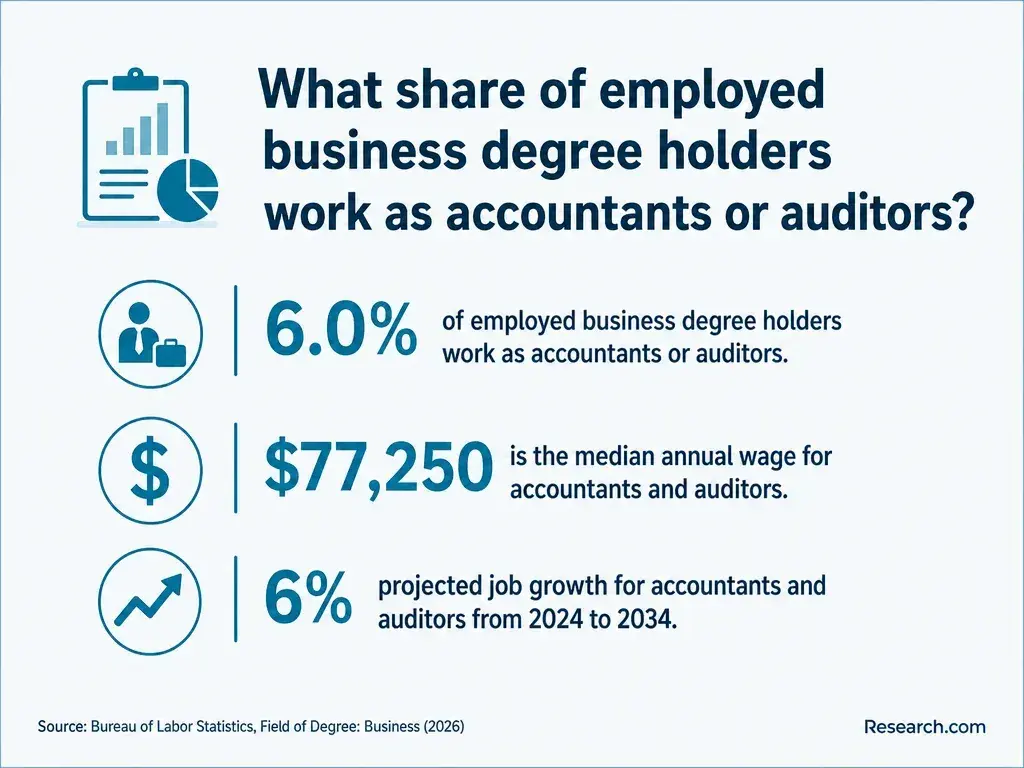
The U.S. Bureau of Labor Statistics reports a $83,680 median annual wage for accountants and auditors in May 2025 and projects 5% employment growth from 2025 to 2035. These occupation-wide figures are not starting salaries or outcomes specifically for business administration graduates with an accounting concentration. They include workers with different experience, duties, and education.
Use occupation data to assess the field, then examine local postings for the roles you could realistically enter and the courses they require. Weigh those requirements against any extra term and its cost. A broader look at business administration tuition time commitment and career value may help frame the trade-off, but the strongest decision rests on your approved graduation plan and target jobs - not a national median alone.
Other Things You Should Know About Business Administration
That depends on the institution. Ask the registrar whether it appears on the diploma, official transcript, both, or neither.
Possibly, but schools set their own overlap limits. Ask for an audit showing how the course applies to each credential before relying on double counting.
Only if the program permits it and approves the role under its academic requirements. Employment alone does not award internship credit.
Check the school's repeat, minimum-grade, and financial-aid policies. Passing a repeated course may resolve a prerequisite without erasing its effect on your schedule or academic record.
- Education Requirements | texas.gov https://www.tsbpa.texas.gov/applicants/education/
- NYS Public Accountancy - Typical 150-hour program https://www.op.nysed.gov/professions/certified-public-accountants/license-requirements/150-hour-education-requirement
- Education requirements - Virginia Board of Accountancy https://boa.virginia.gov/cpa-exam/requirements/
- BA in Business Administration | fullerton.edu https://business.fullerton.edu/programs/undergraduate/ba_businessadministration
- Advantages of Summer | CSU Summer https://summer.colostate.edu/advantages-of-summer/
- How to Read a College Degree Plan Before You Enroll | Florida National University (FNU) https://www.fnu.edu/how-to-read-college-degree-plan/
- Degree Requirements Glossary - CourseLeaf CIM - Penn State https://cim.psu.edu/user-guides/program-management/glossary/
- Understanding Your Degree Audit | University College Online Degree Programs https://basbls.uc.uiowa.edu/advising/degree-planning/understanding-your-degree-audit
- Using Degree Audit | A-State Knowledge Base https://kb.astate.edu/books/about-degree-works/page/using-degree-audit
- Academic Regulations | troy.edu https://catalog.troy.edu/content.php