2027 BS in Business Administration Curriculum: How to Evaluate Preparation in Global Supply Chains
Audited and Verified:
Our Editorial and Data Verification Process
Research.com uses government datasets, official education statistics and primary institutional information to support its career and degree guides. Our review process checks factual accuracy, occupational definitions, source dates and the requirements associated with the credentials discussed.
How This Article Was Fact-Checked
Our editorial team verifies salary estimates, employment projections, education requirements and program information against original data providers and official organizations. Salary figures are checked against the relevant occupational definitions and reporting periods. Information about licensure, accreditation and required in-person training is reviewed separately.
Fact-checked and verified on:

Co-Founder and Chief Data Scientist
A business administration degree can introduce supply chain concepts without preparing you to analyze a supplier delay, compare sourcing options, or interpret inventory data. For students considering global supply chain work, the distinction is in the curriculum and the opportunities to apply it.
This guide shows you how to assess courses, projects, program quality, cost, and career fit so you can choose a degree path that develops more than general business knowledge.
Key Things You Should Know
- Look for an operations foundation plus coursework in procurement, logistics, global trade, analytics, and risk - not just an international business elective.
- Ask for the degree audit and course schedule: an advertised concentration is useful only if its required classes fit your timeline and produce relevant work samples.
- The U.S. Bureau of Labor Statistics projects 18% employment growth for logisticians from 2025 to 2035, but that occupation-wide forecast does not guarantee a job for a new graduate.
What Is a Business Administration Degree With Global Supply Chain Preparation?
A BS in Business Administration typically combines accounting, economics, finance, management, and quantitative coursework. Global supply chain preparation adds study of how organizations source materials, move goods, manage information, and respond to disruptions across borders. A school might provide that preparation through an official concentration, a minor, a group of electives, or applied projects. Those options are not interchangeable: only the school's catalog and transcript rules establish whether a concentration is formally awarded.
Global does not mean simply taking an international business survey. Useful coverage connects supplier selection and demand planning to customs processes, transportation choices, currency exposure, regulations, and ethical sourcing. A specialized supply chain bachelor's may offer more required technical depth; a general business BS may suit students who want broader options or have substantial transferable business credit.
Check the actual degree title and required courses rather than assuming a BBA, BS in Business Administration, and specialized degree teach the same material. If your goal is mainly managing people rather than moving products and information, choosing a degree in human resources may be a more direct comparison than adding supply chain electives to a broad business program.
What Courses Should a Business Administration Curriculum Include for Global Supply Chains?
A strong curriculum progresses from business fundamentals to supply chain decisions and then to applied work. The table identifies what to look for in course descriptions and assignments; course titles alone cannot establish depth.
| Curriculum area | Evidence of useful preparation | Gap to watch for |
| Business and quantitative core | Managerial accounting, statistics, spreadsheets, and economics applied to costs, forecasts, and trade-offs | Conceptual coverage without data interpretation |
| Operations and supply chain | Inventory, capacity, demand planning, purchasing, transportation, and supplier performance | A single introductory operations course |
| Global context | Trade documentation, cross-border risk, sourcing ethics, and regional regulatory differences | International marketing presented as supply chain specialization |
| Applied assessment | A supervised case, simulation, internship, or capstone that requires a defensible recommendation | Projects without clear methods, feedback, or permission to use organizational data |
Ask whether students work with spreadsheet models, enterprise-system concepts, process maps, or appropriately authorized datasets. A valuable assignment might compare inventory policies under uncertain demand and explain the service, cost, and risk consequences. It should not imply that a classroom model proves savings at a real company.
Also inspect sequencing: statistics or accounting may precede analytics, while an operations course may precede advanced logistics. If you are missing foundational coursework, a business administration admissions preparation guide can help you frame questions for an adviser, but the school's catalog and degree audit determine your requirements.
How Can You Evaluate Accreditation for a Business Administration Program?
First, confirm that the institution holds recognized institutional accreditation and that it covers the institution awarding your degree. Then check whether the business school or program holds applicable AACSB, ACBSP, or IACBE accreditation. These are separate questions: business-specific accreditation does not replace institutional accreditation, and its scope may not include every program or location.
Use the institution's catalog and the accreditor's directory to verify the exact degree, delivery format, and accreditation scope. Ask the school whether its supply chain concentration is included in the accredited business offering; do not infer coverage from a logo on a general admissions page. Accreditation supports a quality-review decision, but it does not establish that required electives run regularly or that graduates find supply chain jobs.
Application cost is another, separate selection factor. If you are considering no-application-fee online college choices, verify accreditation and curriculum fit just as carefully as you would for a school that charges to apply.
Entry-level supply chain work often involves tracking orders, investigating discrepancies, comparing supplier information, preparing reports, and communicating changes to other teams. Employers' tools and requirements differ, so assess a program by the evidence of work students can produce, not a promise that one course makes them specialists.
Strong preparation combines spreadsheet analysis and basic forecasting with cost awareness, clear written recommendations, and careful handling of uncertain data. Students should be able to explain why a cheaper purchase price might lead to higher total cost after freight, delays, or quality problems. They should also practice working across purchasing, finance, sales, and operations without treating every stakeholder's priority as identical.
Leadership matters, but it is not a substitute for functional knowledge. Students primarily seeking supervisory preparation could compare accelerated organizational leadership degrees; students targeting supply chain analysis should favor programs that assess planning, sourcing, and logistics decisions directly.
Requirements vary by school and by whether you apply as a first-year, transfer, returning, or second-degree student. Schools commonly review prior academic records; some business majors also require particular courses or academic standing before students enter upper-level coursework. Admission to the university, admission to the business major, and approval of transfer courses are distinct decisions.
Request a written evaluation showing which previous courses satisfy general education, business core, prerequisites, and supply chain electives. An accepted credit may count only as a free elective. This distinction matters if you have studied another function: when you compare credit acceptance at online HR schools, for example, remember that an HR course accepted by a business program may still leave its operations requirement unmet.
Before applying, ask admissions which records it needs, ask the business department when major requirements take effect, and ask the transfer office for an official course-by-course evaluation. If you studied outside the United States, confirm credential-evaluation and English-language rules with the institution rather than assuming domestic transfer policies apply.
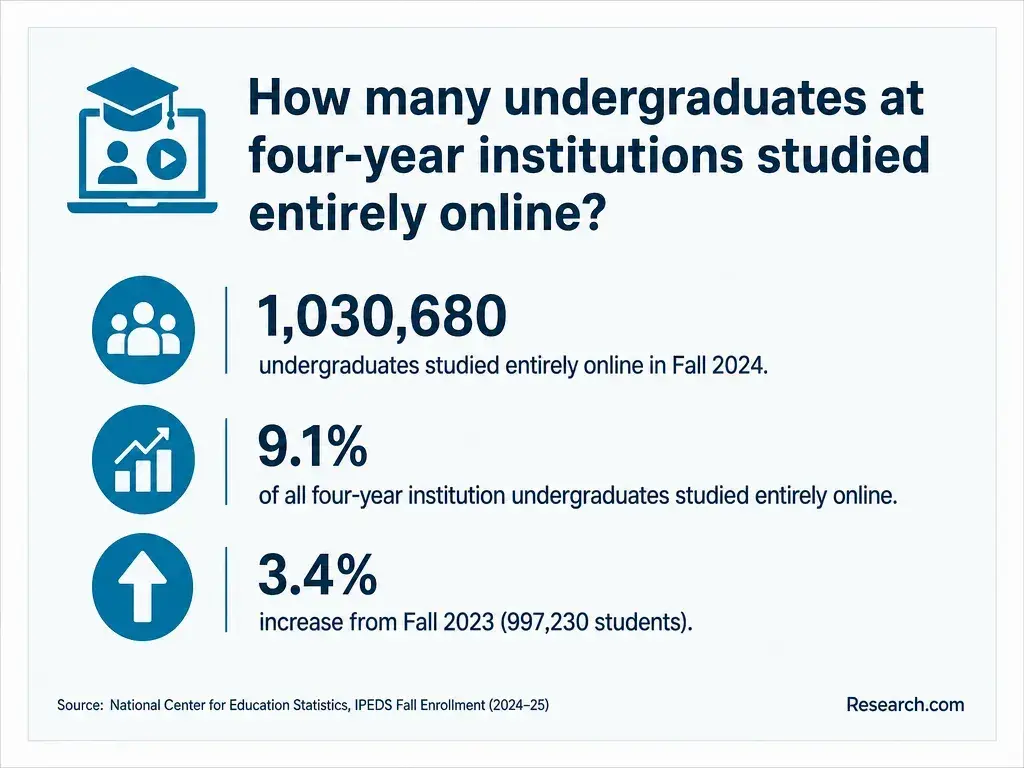
Neither format is inherently better for supply chain preparation. Compare access to the required courses, software, faculty feedback, internships, and employer contacts. Campus programs may make in-person recruiting and team simulations easier to access; online programs may reduce travel but can still require live meetings, scheduled exams, group projects, or fixed internship hours.
Ask for a recent course rotation and sample syllabi for the supply chain electives - not just the business core. An online concentration that lists advanced logistics but rarely offers it could delay graduation. Conversely, a campus program with limited evening sections may be difficult for a working student to complete.
If shorter sessions appeal to you, business degree options with shorter sessions provide a starting point for comparing formats. Confirm weekly workload, prerequisite order, and when each required supply chain class actually runs; compressed terms do not remove the work.
A bachelor's degree commonly requires about four years of full-time study from the start, but your remaining time depends on approved transfer credit, enrollment pace, prerequisites, and course availability. A concentration may fit within existing electives or add requirements. Get an official degree audit before relying on an advertised completion timeline.
Compare total cost to completion, not tuition per credit alone: include required fees, books, software, travel or campus visits, and the cost of any extra term caused by an unavailable course. Ask whether internship credit has separate tuition or supervision requirements. For a broader price comparison, low-cost online business degree programs are useful candidates only after you check how their credits and supply chain courses apply to your plan.
Graduates may seek roles such as logistics coordinator, purchasing assistant, inventory analyst, supply chain analyst, or operations coordinator. Titles overlap across employers: a purchasing role may focus on orders and supplier records, while a logistics role may focus on shipments, delivery exceptions, and transportation data. Read job tasks and required tools rather than assuming identical duties from a title.
For an early-career applicant, internships, relevant employment, and well-documented projects can demonstrate readiness beyond the degree. A work sample that explains a planning assumption and its limitations is more informative than a claim of general "global business expertise." Management and major supplier-contract responsibility usually require additional experience and employer trust.
Some supply chain teams organize improvement work as formal projects. If that function interests you more than sourcing or logistics, project management degrees with prior-credit pathways offer a comparison; inspect the target jobs before choosing a less supply-chain-specific route.
The U.S. Bureau of Labor Statistics reports a May 2025 median annual wage of $82,320 for logisticians and projects 18% employment growth for that occupation from 2025 to 2035. The forecast suggests demand for the occupation, but neither figure represents the starting salary or hiring odds of a new BS in Business Administration graduate.
Pay and access to roles depend on duties, experience, industry, location, and technical skills. When weighing tuition against possible earnings, compare the entry-level jobs you could credibly pursue with the program's full completion cost, rather than treating the occupation-wide median as your expected first offer.
Students focused on finishing sooner can also examine supply chain undergraduate programs with shorter terms. A shorter academic calendar is valuable if required courses remain available in sequence; it is not, by itself, a lower-cost or lower-workload pathway.
Which Supply Chain Certifications Can Business Administration Graduates Earn?
Voluntary professional certifications can signal focused learning, but they are separate from a BS, a concentration, and a course-completion certificate. Examples to investigate include ASCM's Certified in Planning and Inventory Management and Certified Supply Chain Professional credentials and the Institute for Supply Management's Certified Professional in Supply Management. Each organization controls its current eligibility rules, exams, fees, and renewal requirements.
Choose a credential by the work you want to do: planning and inventory, broader end-to-end supply chain activity, or sourcing and procurement. Check the certifier's current requirements before budgeting or enrolling. For someone who already holds a bachelor's degree and needs one functional skill, targeted training, relevant work, or a certification may be more direct than a second undergraduate degree.
For a student still choosing a degree, certification should complement - not excuse - a thin curriculum. Compare the course assignments, applied opportunities, and cost first; supply chain program tuition time and earnings context can inform a separate degree-versus-credential cost discussion.
Other Things You Should Know About Business Administration
Not universally. Language ability can help in particular markets or supplier-facing roles, but job postings are the best guide to an employer's requirements. Analytical and cross-cultural communication skills remain important even when everyone uses English.
No. U.S. customs broker licensing is a separate federal process with its own eligibility and examination rules. Check the responsible regulator's current requirements if that is your goal.
Only with the necessary employer permission and in line with confidentiality and academic rules. If approval is unavailable, use public or synthetic data and label the project accurately.
Some support and coordination roles offer other entry routes, depending on the employer. Relevant experience and targeted training may be a better first step if you are testing the field; check postings for the responsibilities and credentials you want to grow into.
- Program: Supply Chain & Operations Management, BS | purdue.edu https://catalog.purdue.edu/preview_program.php
- Import/Export Specialist | wctc.edu https://www.wctc.edu/WCTC/Academics/Program-List/Import-Export-Specialist
- CSU Supply Chain Management Concentration: Curriculum | CSU College of Business https://biz.colostate.edu/academics/undergraduate-programs/bsba/concentrations/supply-chain-management/curriculum
- Capstone Experiences | Assessment and Curriculum Development Office https://manoa.hawaii.edu/assessmenttest/resources/how-to/capstone-experiences/
- Supply Chain Management Major - Rutgers Business School https://www.business.rutgers.edu/undergraduate-new-brunswick/supply-chain-management
- Supply Chain Risk Management: How Businesses Prepare | Fitchburg State University Online https://online.fitchburgstate.edu/degrees/business/mba/supply-chain-management/risk-mitigation-strategies-guide/
- Operations, Supply Chain and Logistics Management, B.S. | University of New Hampshire https://www.unh.edu/program/bachelor-science/operations-supply-chain-logistics-management
- Operations & Supply Chain Management BSBA | Drexel University Catalog https://catalog.drexel.edu/undergraduate/collegeofbusiness/operationandsupplychainmanagement/
- Supply chain resilience: A review from the inventory management perspective - ScienceDirect https://www.sciencedirect.com/science/article/pii/S2667325824003108
- What Is Supply Chain Management? A Guide to Careers, Salaries & Certifications | UW-Stout Polytechnic https://www.uwstout.edu/programs/bs-supply-chain-management/what-is-supply-chain-management-guide