2027 Choosing a BS in Business Administration When You Have a Low GPA and Strong Recent Work Experience
Audited and Verified:
Our Editorial and Data Verification Process
Research.com uses government datasets, official education statistics and primary institutional information to support its career and degree guides. Our review process checks factual accuracy, occupational definitions, source dates and the requirements associated with the credentials discussed.
How This Article Was Fact-Checked
Our editorial team verifies salary estimates, employment projections, education requirements and program information against original data providers and official organizations. Salary figures are checked against the relevant occupational definitions and reporting periods. Information about licensure, accreditation and required in-person training is reviewed separately.
Fact-checked and verified on:

Co-Founder and Chief Data Scientist
A low GPA can make a bachelor's application feel uncertain, especially when your recent work shows far more ability than your old transcript. For an experienced employee considering a BS in business administration, the key is to find out which admissions decisions are flexible, which requirements are not, and whether the degree will support a specific career goal.
This guide explains how to present your work history, evaluate programs and prior credits, and compare the time and cost of finishing before you apply.
Key Things You Should Know
- Strong recent work experience can strengthen a low-GPA application, but it does not automatically override a published minimum GPA or a separate requirement for admission to the business major.
- Ask each school how it evaluates older grades, recent coursework, transfer credits, and conditional admission; obtain a degree audit before relying on an estimated completion date.
- Career value depends on the role you want, not the degree title alone. The U.S. Bureau of Labor Statistics reports a May 2025 median wage of $75,940 for human resources specialists, an occupation-wide figure - not a starting salary for business graduates.
Can strong work experience offset a low GPA when applying for a business administration degree?
Sometimes, but only within the school's admissions rules. An admissions office may consider sustained employment, increasing responsibility, recent training, and an explanation of past academic difficulties when it reviews applicants holistically. It may not be able to waive a firm minimum GPA. Admission to the university and admission to its business major may also be separate decisions.
Make your experience specific. A job title says less than evidence that you managed a schedule, trained colleagues, monitored expenses, improved a process, or reported results. Describe your own contribution and its scope accurately; you need not disclose confidential employer figures. A supervisor's recommendation can corroborate responsibility, reliability, and readiness for academic work.
Experience is most persuasive when paired with evidence that the circumstances behind the low GPA have changed. A recent, successfully completed course - particularly one in writing, accounting, algebra, or statistics if relevant to the program - can address academic readiness more directly than a résumé alone.
Before paying to apply broadly, ask admissions whether the GPA threshold is mandatory and whether an appeal or individualized review exists. Where application costs matter, you can also investigate colleges with no upfront application payment; a waived application fee says nothing about admission flexibility or total tuition.
What admission requirements should low-GPA applicants expect for a BS in business administration?
Requirements vary by institution and applicant category. A first-time college applicant, a transfer student, and someone returning after academic dismissal may face different reviews. Schools may calculate cumulative, transferable-credit, or recent-coursework GPAs differently, so ask which measure governs your application.
The distinctions below help you determine whether your record meets a rule or simply strengthens a discretionary review.
| Admissions factor | What to verify | How work experience may help |
| University admission | Required transcripts, applicable GPA calculation, and any minimum or appeal process | Supports a holistic review if the policy allows one |
| Business-major admission | Separate GPA, prerequisite, or application requirements | Shows motivation but may not replace required courses or grades |
| Academic preparation | Required mathematics, statistics, accounting, or other introductory courses | Identifies relevant skills; documented employment rarely substitutes for a course without an approved credit process |
| Previous academic standing | Readmission, dismissal, repeat-course, or academic-renewal policies | Provides context for a petition, subject to institutional rules |
Request official transcripts from every prior college, even if you would rather not use those credits. Then take this sequence to the admissions office and a business-program adviser:
- Ask which GPA the school calculates, whether a minimum is binding, and whether business-major admission is separate.
- Identify missing prerequisites and ask when they must be completed.
- Prepare a brief explanation of the older grades, supported by recent coursework or specific workplace responsibilities.
- Confirm application deadlines and obtain the school's written decision before enrolling on the assumption that an exception will be granted.
An accelerated schedule does not necessarily mean easier admission. If you are considering one, use an accelerated business college program guide to identify candidates, then check each school's actual entry and course-sequencing rules.
How can you choose an accredited business administration program with flexible admissions?
Begin with institutional accreditation from an accreditor recognized by the U.S. Department of Education. Then confirm the exact degree offered: a BS in Business Administration is not automatically interchangeable with a BBA, a BS in Management, or a specialized business degree. If a school advertises AACSB, ACBSP, or IACBE accreditation, verify what that business accreditation covers rather than assuming every program is included.
For a low-GPA applicant, useful flexibility is a published policy you can actually use: individualized review, consideration of recent academic performance, conditional admission, or a defined route into the major. Ask what conditions must be met, when you must meet them, and what happens if you do not. An informal assurance is less useful than a written admissions decision and an official degree audit.
Compare support as carefully as selectivity. Advising access, required-course availability, tutoring, and clear transfer-appeal procedures can matter more to completion than an easy application. You can compare leading American online business degree schools to build a shortlist, but verify accreditation scope, current catalog requirements, and admissions policies directly with each institution.
Choose the format that accommodates your actual work schedule and helps you complete the required courses - not the one described most broadly as "flexible." Online classes may still require live meetings, timed exams, group presentations, or fixed weekly deadlines. Campus classes add commuting but may provide scheduled contact and easier access to in-person support.
Ask for a sample course calendar covering the business core, not just an introductory class. Check evening or weekend obligations, exam proctoring, group-work expectations, required visits, and whether part-time students can take prerequisites in sequence. If your shifts change, an asynchronous course with predictable deadlines may be more workable than a live online class; if you learn best through scheduled discussion, a campus or hybrid section may be worth the travel.
Accelerated terms can shorten the calendar while increasing weekly demands. A guide to accelerated bachelor's study can help you assess the format, but confirm the expected workload, leave policy, and availability of required business courses before committing.
A BS in business administration typically combines general education with accounting, economics, finance, marketing, management, operations, business law or ethics, and quantitative work. The precise mix differs by school. A program may also require an internship, simulation, or capstone; current employment does not automatically satisfy any of them.
Use the curriculum to test whether the degree fills gaps your experience has not covered. Someone who supervises staff but rarely works with budgets may benefit from accounting and finance. Someone experienced in sales but aiming for operations may need statistics, process analysis, and spreadsheet-based decision-making. Check prerequisites and course order if your earlier grades were weakest in quantitative subjects.
A concentration provides an official area of focus only if the school awards and records it as such; a few related electives may not. If your goal is specifically HR, compare the general business curriculum with a dedicated program using a human resources program selection guide. Neither route by itself establishes eligibility for every HR role or credential.
Your timeline and cost depend on requirements remaining after evaluation, not simply the number of credits a school accepts. Prior courses may transfer as electives without satisfying accounting, statistics, the business core, or residency requirements. A repeated or prerequisite course can also delay access to later classes.
Request an official degree audit and compare offers using the same categories: remaining required courses, tuition and mandatory fees, books or software, travel or proctoring, and the number of terms needed at a realistic work-compatible pace. Ask whether the school charges per credit or per term. If your employer reimburses tuition, check grade rules and payment timing; reimbursement may arrive after you have paid the bill.
Do not select the lowest advertised tuition without checking the credits still required. Online business administration program cost-and-time comparisons can provide candidates to investigate, but only a school's evaluation can establish your likely completion plan and charges. Ask financial aid staff how your academic history affects eligibility and satisfactory academic progress.
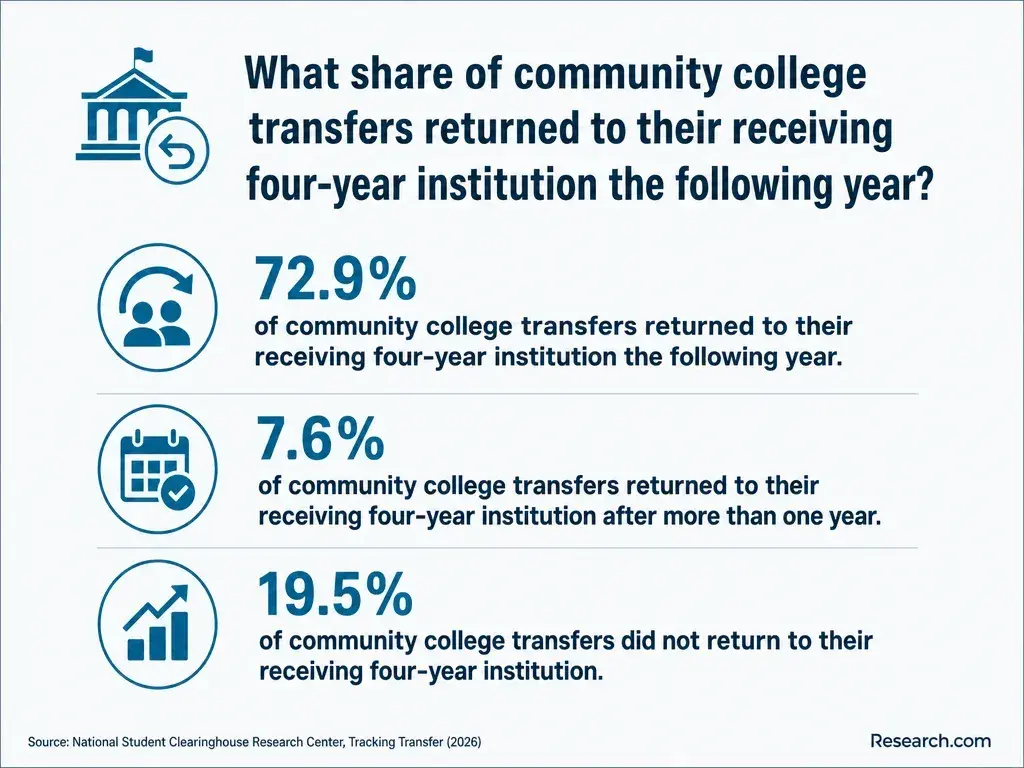
If direct admission is unavailable, ask whether you can establish a stronger recent record through approved coursework and apply again. A community college may offer transferable general education or prerequisites, but confirm equivalencies with the intended bachelor's institution before enrolling. An associate degree can provide a route into a bachelor's program, though an applied associate degree may not satisfy the same requirements as a transfer-oriented one.
Other possibilities include conditional admission, readmission under an academic-renewal policy, or a school-approved assessment of prior learning. Each depends on institutional rules. Prior-learning credit may address a requirement only if the receiving school formally awards and applies it; years of work alone are not credits.
Keep the destination degree in view. If your actual goal is project coordination, online project management bachelor's programs accepting transfer credits may be worth comparing with a general business BS. Ask both programs to evaluate the same transcripts so you can compare applicable credits rather than advertised transfer limits.
The most realistic next role usually builds on what you already do. An employee who schedules staff and tracks purchasing might pursue operations or administrative coordination; someone with customer-facing and campaign experience might pursue marketing coordination. HR, procurement, project support, and business analysis are other possibilities, but each requires its own mix of technical knowledge and relevant experience.
Map target job postings to evidence you can provide: a process you documented, a budget you supported, a spreadsheet you built, or a team assignment you completed. Use approved coursework or projects to address gaps. Do not present confidential workplace material in an application without permission, and do not assume that finishing a degree qualifies you immediately to manage people or major budgets.
If your goal is advancement into organizational leadership, compare the business curriculum against the responsibilities of the role and compare completion times for organizational leadership degrees. A narrower degree may suit an established leadership path, while general business may better address gaps across finance, operations, and marketing.
There is no single salary for BS in business administration graduates. Pay depends on occupation, location, industry, and the responsibility you have already demonstrated. The U.S. Bureau of Labor Statistics reports a May 2025 median annual wage of $75,940 for human resources specialists and projects 6% employment growth for that occupation from 2025 to 2035. Those are occupation-wide measures, not an offer a new graduate should expect.
For a useful personal comparison, identify jobs you could plausibly qualify for now and jobs the degree could help you pursue. Compare their stated duties and requirements with your experience, then weigh the cost of unfinished coursework against the value of meeting an actual bachelor's requirement. If your target is supply chain work, supply chain program tuition time and earnings context can help frame a specialized alternative; do not apply one occupation's median wage to a different job.
Which certifications and licenses complement a business administration degree?
Choose an additional credential for a defined role, not as a substitute for investigating admissions or completing a degree an employer requires. HR, project management, accounting, and financial-services credentials have different eligibility rules, experience expectations, examinations, and issuing bodies. A business administration BS does not itself grant CPA licensure, a financial-services license, or a professional certification.
If you already perform relevant work, a role-specific certificate or employer training may address an immediate skill gap more directly than a full degree. If advancement is blocked by a bachelor's requirement, compare the complete degree's cost with the narrower credential's cost and limits. You can find inexpensive online business administration colleges to start that comparison, but verify the degree audit and the credential issuer's eligibility rules before paying for either path.
Other Things You Should Know About Business Administration
Usually not unless an application or employer requests it. Emphasize relevant work, recent training, and documented accomplishments instead. If asked for your GPA, report it accurately under the requester's instructions.
Not by itself. Aid eligibility has separate rules, including a school's satisfactory academic progress policy for enrolled students. Ask the financial aid office how prior enrollment or a previous aid suspension affects your situation.
Contact the former school about readmission and transcript policies, then ask prospective schools how they review applicants with a dismissal. A later record of successful coursework may help, but it does not erase the earlier record unless a specific policy says so.
Ask about second-bachelor's admission and degree rules before applying. A certificate, targeted coursework, or graduate option might better meet your goal, and aid eligibility can differ from that of a first bachelor's student.
- Holistic Review in Applicant Selection: A Scoping Review - PMC https://pmc.ncbi.nlm.nih.gov/articles/PMC11776880/
- School-Determined Requirements | 2024-2025 Federal Student Aid Handbook https://fsapartners.ed.gov/knowledge-center/fsa-handbook/2024-2025/vol1/ch1-school-determined-requirements
- Choosing a School | Federal Student Aid https://studentaid.gov/resources/prepare-for-college/students/choosing-schools
- College Credit for Professional Certifications and Training | Purdue Global https://www.purdueglobal.edu/transfer-students/professional-training/
- Do Transfer Credits Affect GPA? | The University of Olivet https://www.uolivet.edu/how-do-transfer-credits-affect-gpa/
- Grades and Grade Point Average (GPA) Calculation | University of Arizona Office of the Registrar https://registrar.arizona.edu/records-enrollment/enrollment/grades/grades-and-grade-point-average-gpa-calculation
- Online Bachelor of Applied Science Business Administration Degree - USC Upstate https://online.uscupstate.edu/degrees/undergraduate/bachelors-business-administration/
- Transfer requirements - UC Admissions - University of California https://admission.universityofcalifornia.edu/counselors/preparing-transfer-students/transfer-requirements.html
- Resumes and Cover Letters - Career Services | The University of Memphis https://www.memphis.edu/careerservices/students-alumni/apply.php
- Prerequisites, Placement, & College Readiness | Martin Community College https://www.martincc.edu/handbook/admissions/prerequisites-placement-college-readiness/