2027 Best Online Stackable Credentials With 5-Week Courses

Co-Founder and Chief Data Scientist
A five-week online course can be a fast way to build job skills, but speed only helps if each credential leads somewhere useful. Stackable credentials let learners complete short certificates or microcredentials that may build toward a larger certificate, associate degree, or professional pathway.
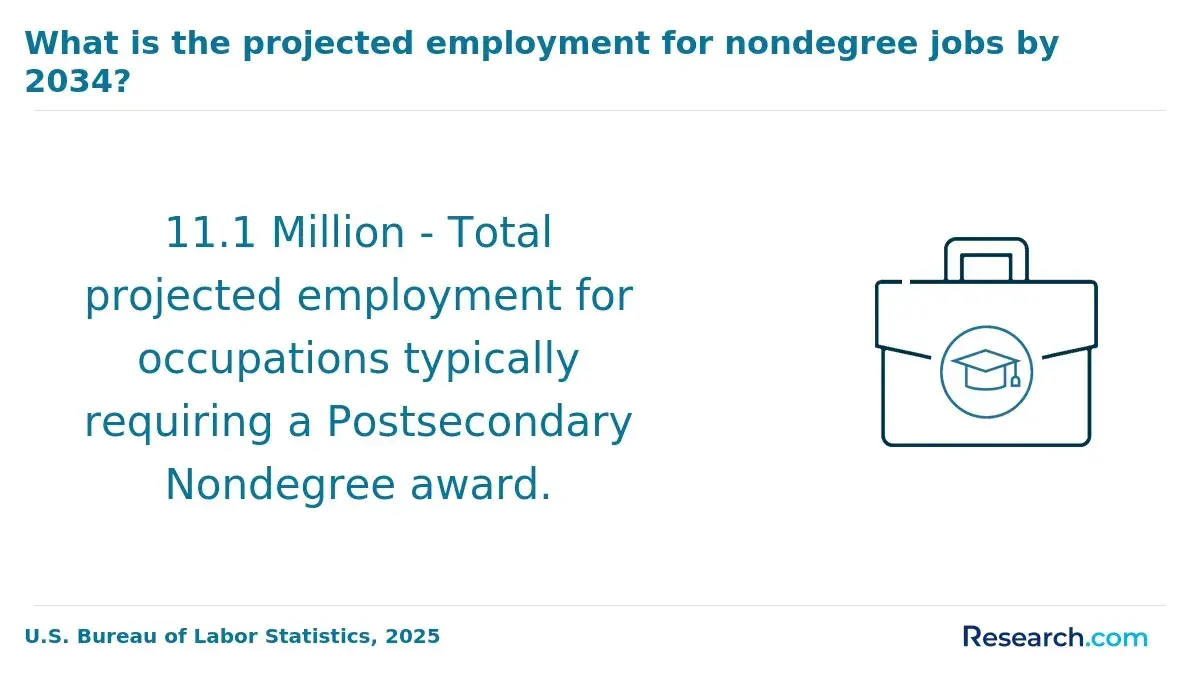
This guide is for working adults, career changers, and students testing a field. U.S. Bureau of Labor Statistics data show that occupations requiring postsecondary nondegree awards had a $48,980 median annual wage in 2024, but outcomes vary widely by occupation and program quality.
Key Things You Should Know
- Five-week courses are accelerated terms, not necessarily five-week programs: completing a stack may take several terms, and students should confirm the total credit hours, weekly workload, and sequence before enrolling.
- Choose credit-bearing credentials when you want a documented route into a certificate or degree; choose industry training when an employer values a specific certification exam, portfolio, or practical skill more than college credit.
- BLS reported a $48,980 median annual wage for occupations typically requiring a postsecondary nondegree award in 2024, but a short credential alone does not guarantee entry into every role, license, or pay level.
Top 10 Best Online Stackable Credentials With 5-Week Courses
Popular Trade School Programs
Online stackable trade options commonly include construction management, HVAC fundamentals, electrical theory, welding safety, industrial maintenance, logistics, and project coordination. They work best for learners who need related technical knowledge while employed.
However, hands-on trades usually require campus labs, apprenticeships, supervised fieldwork, or employer training before a learner can perform regulated work independently. A short online certificate can strengthen an application or provide theory preparation, but it generally does not replace state licensing requirements, union apprenticeship standards, or documented on-the-job hours.
Healthcare Programs
Stackable healthcare study may cover medical terminology, billing and coding, health information, pharmacy operations, patient navigation, or healthcare administration. Online coursework is particularly practical for administrative and records-focused paths. Clinical occupations, including nursing, medical assisting, and many technician roles, normally require in-person labs and supervised clinical experiences.
Check whether a program is credit-bearing and whether it prepares students for a separate certification examination, such as a coding credential. Completion of a school certificate is not the same as earning professional certification or state licensure.
Criminal Justice / Law Programs
Short online credentials in criminal justice may introduce corrections, homeland security, crime analysis, emergency management, or legal studies. Legal-support sequences can include legal research, writing, contracts, and litigation support. These options suit learners seeking foundational knowledge or advancement in an adjacent role, but they do not qualify someone to practice law.
Paralegal employment may involve employer preferences for accredited education, a degree, prior legal experience, or voluntary certification. Public-safety jobs can also require background checks, physical standards, academy training, and agency-specific hiring processes beyond online coursework.
Arts & Design Programs
Design stacks often combine graphic design foundations, typography, user experience, digital marketing, web content, video editing, or portfolio development. They are useful when the courses produce work samples employers can review.
A credit-bearing sequence may later apply to a design degree if the school confirms that policy in writing; noncredit courses usually focus on skills rather than transfer. For freelance and creative roles, the portfolio, software fluency, client communication, and project experience may matter as much as the credential title.
What are online stackable credentials with 5-week courses and how do they work?
Online stackable credentials are intentionally connected short learning experiences. A learner may complete one course or badge, apply it toward a certificate, and then use that certificate toward a larger academic award when the provider has a formal pathway. A five-week course is an accelerated delivery format: the same subject matter may be compressed into intensive weekly modules, discussions, quizzes, projects, and deadlines.
Programs generally fall into two models. Understanding the difference prevents a common mistake: assuming every digital badge transfers to college credit.
| Model | What the learner earns | Best use | Key question |
| Credit-bearing academic stack | College credits and usually a certificate | Building toward a certificate, associate degree, or bachelor's degree | Which courses apply, and is there a time limit? |
| Noncredit or professional stack | Provider certificate, badge, or completion record | Learning a focused tool, workflow, or employer-requested skill | Which employers or certifying bodies recognize it? |
| Certification-preparation stack | Training certificate; possibly exam preparation | Preparing for an independent industry exam | Are exam fees, eligibility rules, and experience requirements separate? |
Before choosing an accelerated format, compare the provider's pacing with your schedule. Learners seeking similarly short formats can also review 4-6-week certification programs online, while confirming whether each option is credit-bearing and stackable.
How do online stackable credentials compare to traditional certificates and degrees?
A traditional certificate usually has a fixed curriculum and a single completion point. A stackable credential has planned milestones: each completed component should have value on its own and, where stated, count toward the next award. An associate or bachelor's degree is broader, takes longer, and commonly includes general education requirements. A professional certification is different again: it is awarded by a certifying organization after meeting its standards, often including an examination.
This comparison helps match the credential to the goal rather than selecting the fastest-looking option.
| Option | Typical purpose | Transfer potential | When it makes sense |
| Stackable academic credential | Progressive college learning | Depends on the institution's written pathway | You may continue to a degree |
| Standalone certificate | Focused education in one subject | May be limited or unavailable | You need targeted training without a longer commitment |
| Industry certification | Validation against occupational standards | Not college credit by default | Employers request a named credential |
| Associate or bachelor's degree | Broader academic and career preparation | Often designed for transfer or progression | Your target occupation requires or prefers a degree |
If your end goal is a four-year credential, compare the stack's written articulation terms with an accelerated bachelor's degree online accredited option. A direct degree route can be more efficient when few short-course credits will apply.
Are these accelerated online stackable programs accredited and widely recognized by employers?
They can be recognized, but recognition depends on the provider, field, and credential type. For credit-bearing programs, evaluate the institution's institutional accreditation and verify that the specific certificate is listed in the catalog. For career training, evaluate whether the curriculum aligns with a known employer need or an independent certification exam. In regulated fields, confirm approval with the relevant state licensing board rather than relying on marketing language.
Employers commonly care most about whether the credential signals usable skills, credible assessment, and a relevant provider. They may also value portfolios, supervised experience, software proficiency, and prior work. A college's accreditation does not automatically mean every online program fulfills licensing or certification eligibility rules.
Use these checks before paying a deposit.
- Find the credential in the official catalog and confirm whether it carries academic credit.
- Ask for the exact courses, total credits, and written stack-to-degree or stack-to-certificate policy.
- For regulated work, verify clinical, laboratory, practicum, exam, and state-specific requirements directly with the appropriate board.
- Ask local employers whether they recognize the credential and what entry-level applicants typically need in addition.
What admission requirements do students need for short, stackable online certificate programs?
Admission requirements range from open enrollment for noncredit training to standard college admission for credit-bearing certificates. Many entry-level academic certificate programs require a high school diploma, GED, or equivalent, an application, and placement information. Some may request transcripts or prerequisite coursework, especially in healthcare, IT, accounting, or advanced technical sequences. Graduate certificates require a completed bachelor's degree and may have field-specific prerequisites.
A five-week term intensifies the importance of readiness. Students should ask whether they need reliable broadband, proctored testing equipment, specific software, textbook access, background checks, immunizations, or in-person attendance. Do not assume a program without a GPA requirement has no eligibility rules; it may still enforce prerequisites or require placement before students take higher-level courses.
Career changers and returning learners should also ask about prior-learning assessment and transfer evaluation. Credit may be awarded only after an official review, and a course accepted by one school may not transfer to another.
How long do stackable online credentials take to complete and can they lead to a degree?
One five-week course is only a building block. A short stack may involve two to six courses delivered in consecutive accelerated sessions, while a larger certificate can take multiple terms. The realistic timeline depends on credit load, course availability, prerequisites, transfer credit, and whether learners study continuously. Programs with clinical practice, labs, or internships can take longer than fully online academic sequences.
For a stack to lead to a degree, the school must explicitly state that completed courses apply to a named future award. Obtain that confirmation before enrollment, including the minimum grade required, residency requirement, expiration policy, and whether credits transfer only internally. Learners who want a broader education path can compare these stacks with quick degree programs; a degree may be the better investment when job postings consistently require one.
Fast pacing is best for students who can reserve regular study blocks each week. It is less suitable when unpredictable shifts, caregiving demands, or weak foundational skills make compressed deadlines difficult.
What do typical 5-week stackable credential course sequences and curricula include?
Five-week courses generally use weekly modules instead of a traditional 15-week rhythm. A well-designed sequence introduces a foundation, adds role-specific skills, requires applied assessment, and ends with a credential milestone. Exact course names vary, so use the catalog rather than assuming programs with similar titles teach the same material.
The following example shows how a career-oriented, credit-bearing stack may be organized. It is an illustration, not a universal curriculum.
| Sequence stage | Common curriculum focus | Evidence of learning |
| Foundation | Industry terminology, digital tools, ethics, and communication | Quizzes, short assignments, and scenario work |
| Core skill | Role-specific procedures, software, regulations, or workflows | Applied projects, simulations, or case analysis |
| Specialization | One focused area such as coding, logistics, UX, or project coordination | Portfolio artifact or capstone task |
| Next credential | Additional courses that meet a certificate or degree requirement | Transcripted credit or documented completion |
Review assessment methods carefully. A program built mainly around attendance or unproctored quizzes may offer less persuasive evidence of skill than one requiring projects, demonstrations, feedback, and verified assessments.
How much do online stackable credential programs cost and what financial aid is available?
Cost varies more by provider and credit status than by the five-week format itself. For college programs, multiply the published per-credit tuition by required credits, then add fees, books, technology, proctoring, supplies, exam vouchers, travel, and any lab or clinical costs. Noncredit providers may charge a single bundled price but may not qualify for the same aid or transfer options as a college program.
Federal student aid generally applies only to eligible students enrolled in eligible programs at eligible institutions; a short standalone course may not meet enrollment or program-length rules. Complete the FAFSA when considering an eligible academic program, then ask the financial aid office how accelerated terms affect disbursement, satisfactory academic progress, and withdrawal consequences. Employer tuition assistance, workforce grants, military education benefits, scholarships, and installment plans may be alternatives.
Adults returning to study should compare support services as well as tuition. Resources for degrees for older adults can be useful for evaluating flexibility, advising, and technology support across education options.
To avoid surprise costs, request an itemized estimate that includes the full stack rather than only the first five-week course. Do not borrow based on an assumed salary outcome; first compare the total cost with local job requirements and realistic advancement opportunities.
What careers, job roles, and industries do stackable credentials with 5-week courses support?
Stackable credentials support careers when the sequence matches a recognizable hiring pathway. Common industries include healthcare administration, information technology support, business operations, logistics, skilled-trade support, digital design, education support, public safety administration, and legal services. The strongest fit is usually an entry-level or upskilling role where employers can verify a specific skill set.
Possible roles differ by credential content and local employer requirements.
- Healthcare administration stacks may support medical records, scheduling, billing, patient-access, or coding-preparation roles.
- Technology stacks may support help desk, junior data support, cybersecurity support, cloud operations, or software-tool roles when paired with demonstrable skills.
- Business and logistics stacks may support project coordination, customer operations, procurement support, inventory, or dispatch roles.
- Creative stacks may support junior design, content production, marketing coordination, or freelance portfolio work.
Choose a longer degree, apprenticeship, or approved clinical program instead when the desired role has a legal license requirement, significant hands-on training requirement, or consistent degree requirement in local job postings.
What salary potential and job outlook can graduates with stackable online credentials expect?
Salary and outlook belong to occupations, not to a particular short credential. The U.S. Bureau of Labor Statistics reported that medical records specialists had a 2024 median annual wage of $50,250 and projected 7% employment growth from 2024 to 2034. That makes health-information coursework worth investigating for learners interested in the field, but employers may still expect specialized software knowledge, certification, or experience.
This occupational comparison illustrates why readers should assess the target job before paying for a stack.
| Occupation | 2024 median annual wage | 2024-2034 outlook | Credential caution |
| Medical records specialists | $50,250 | 7% growth | A certificate may help, but job requirements vary by employer. |
| Computer user support specialists | $60,340 | Decline projected | Skills, certifications, and experience can affect hiring; automation and AI tools are changing support work. |
| Paralegals and legal assistants | $61,010 | 0% growth | Employers may prefer a degree, approved program, or legal experience. |
| Graphic designers | $61,300 | 2% growth | A portfolio is central; a short credential alone may not be enough. |
BLS figures are national medians and projections, not local starting pay or graduate outcomes. Use them to compare field direction, then review local openings, required credentials, and advancement routes. AI adoption makes demonstrable problem-solving, quality control, communication, and tool fluency increasingly important in many administrative, technical, and creative roles.
Other Things You Should Know About
Sometimes. This is possible only when a college has a formal policy applying completed courses toward a named certificate or degree. Confirm the pathway, grade minimums, residency rules, and time limits in writing before enrolling.
They can feel harder because deadlines arrive faster. The content may be comparable to a longer course, but students have less time to recover from a missed week. Plan regular study time and avoid taking too many accelerated courses at once.
Not automatically. A school certificate shows completion of education; professional certification is awarded by a separate certifying organization. Check the organization's exam, education, work-experience, and renewal requirements directly.
A provider that cannot clearly explain what each credential leads to, whether credits transfer, total costs, assessment methods, and any licensure limitations. Transparent programs provide these details before enrollment.
References
- Stackable Credentials: Living Links Between Learning and Work https://www.cael.org/resouces/pathways-blog/stackable-credentials-living-links-between-learning-and-work
- Financial Aid For Online College Students | LearnHowToBecome.org https://www.learnhowtobecome.org/career-resource-center/financial-aid-for-online-colleges/
- Stackable Certificates & Credentials - Complete College America https://completecollege.org/our-approach/structure/stackable-certificates-credentials/
- States see short-term credentials as key to long-term success https://www.luminafoundation.org/news-and-views/states-see-short-term-credentials-as-key-to-long-term-success/
- Stackable Credentials | Learn & Work Ecosystem Library https://learnworkecosystemlibrary.com/topics/stackable-credentials/
- Rethinking Credentialing in Higher Education for the 21st Century https://moderncampus.com/blog/rethinking-credentialing-for-the-21st-century.html
- Best Online Colleges for Working Adults [2026] https://www.straighterline.com/blog/degree-completion-best-online-colleges-for-working-adults
- What Are Stackable Credentials and Why Do They Matter? https://www.pltw.org/blog/what-are-stackable-credentials
- Financial Aid For Online Colleges https://www.affordablecollegesonline.org/financial-aid/financial-aid-for-online-colleges/
- What are Stackable Credentials? https://assess.com/stackable-credentials/