2027 Best Non-Degree Programs With Financial Aid Options

Co-Founder and Chief Data Scientist
Choosing a fast career program is harder when tuition, aid eligibility, and job requirements vary widely. Non-degree options can range from credit-bearing college certificates to noncredit workforce training, and only some qualify for federal aid.
The U.S. Bureau of Labor Statistics projects strong 2024-2034 growth in several certificate-friendly fields, including medical assisting at 12%. This guide helps prospective students compare program types, funding routes, time commitments, credential value, and realistic career outcomes before enrolling.
Key Things You Should Know
- Federal aid generally requires enrollment in an eligible program at a school approved to participate in federal student aid; a short noncredit course may not qualify even if the school is accredited.
- Career value depends on the target role: electricians had a 2024 median annual wage of $62,350, while medical assistants had a $44,200 median; these are occupation-wide figures, not guaranteed graduate earnings.
- Compare total cost, licensing eligibility, clinical or lab requirements, and employer recognition before paying a deposit; the fastest program is not always the most employable option.
Top 10 Best Non-Degree Programs With Financial Aid Options
Popular Trade School Programs
Popular trade pathways include certificates in welding, HVAC/R, electrical technology, plumbing, automotive service, machining, and construction management. Many are hands-on, campus-based programs because employers and licensing boards may expect documented lab hours.
A certificate can support entry-level work, but electrician and plumbing careers commonly require an apprenticeship and state or local licensing process. HVAC programs may prepare students for EPA Section 608 certification testing. Choose a credit-bearing program when you may later pursue an associate degree; choose employer-aligned short training when immediate entry-level skills matter most.
Healthcare Programs
Common healthcare non-degree options include medical assisting, practical nursing certificates, dental assisting, pharmacy technician training, phlebotomy, medical billing and coding, and sterile processing. Requirements differ sharply by occupation and state.
Clinical placements, background checks, immunizations, drug screening, CPR training, uniforms, and exam fees can add to tuition. Medical assisting certificates may prepare students for national certification exams, while practical nursing programs generally prepare eligible graduates for the NCLEX-PN and state licensure. Confirm that online coursework includes approved clinical arrangements before enrolling.
Criminal Justice / Law Programs
Legal studies, paralegal studies, court reporting, legal transcription, corrections, and public safety certificates are common non-degree options. A paralegal certificate can be useful for people who already hold a bachelor's degree or have office experience, but it does not authorize someone to practice law.
Court reporting generally requires specialized equipment, intensive skill development, and state-specific credential review. Police and corrections roles typically have agency hiring standards beyond classroom training, such as fitness, background, and academy requirements. Ask whether a program is academic, job-skills training, or exam preparation.
Arts & Design Programs
Graphic design, digital media, web design, photography, animation, UX design, fashion, and interior design certificates can build focused technical skills and a portfolio. These programs are best for learners who need structured practice, software access, and feedback rather than a broad liberal-arts degree.
Portfolio quality often matters more than the certificate title in creative hiring, although some interior design roles may have credential or jurisdiction-specific requirements. Verify software costs, ownership of student work, instructor experience, and whether portfolio reviews connect students with local employers or freelance opportunities.
What are non-degree programs and which types typically offer financial aid?
A non-degree program is organized education that does not culminate in an associate, bachelor's, or graduate degree. It may award a college certificate, diploma, workforce credential, continuing-education certificate, microcredential, or completion record. These credentials are not interchangeable: a college certificate documents completion of a course of study, while a professional certification is usually awarded by an industry body after a qualifying examination or other standards are met.
Financial aid is most likely when a student enrolls in a credit-bearing or clock-hour certificate program at an institution that participates in federal student aid. Noncredit bootcamps, vendor courses, and many short online professional certificates may instead rely on employer tuition assistance, workforce grants, scholarships, payment plans, or private financing.
The comparison below helps identify which route fits a particular goal.
| Program type | Typical provider | Financial-aid likelihood | Best use |
| Credit-bearing certificate | Community college or career college | Often eligible if the program and school qualify | Career entry, stackable college credit |
| Clock-hour diploma | Trade or technical school | May be eligible when the school participates | Hands-on occupational training |
| Noncredit workforce course | College continuing education unit | Usually limited federal aid | Short skill upgrade or employer training |
| Industry certification preparation | Training provider or employer | Varies; often employer-funded | Preparing for a separate credential exam |
Do not assume a program qualifies because its marketing mentions "financial aid available." Ask whether your exact program length, format, and enrollment status are eligible.
How can you tell if a non-degree program and school are properly accredited?
Accreditation is a quality-review process for institutions and, in some fields, individual programs. Institutional accreditation matters most for federal aid and transfer credit. Programmatic accreditation can matter even more in regulated fields such as nursing, dental hygiene, medical imaging, and certain allied-health occupations because it may affect eligibility for licensure, certification, or employer hiring.
Use these checks before applying. They help separate a legitimate career pathway from a program that may not meet a board's or employer's standards.
- Ask the school for the legal name of its accreditor and whether the institution participates in federal student aid.
- Verify that the accreditor is recognized by the U.S. Department of Education or the Council for Higher Education Accreditation when institutional recognition is relevant.
- For regulated careers, check the licensing board or certifying organization's education requirements and confirm the program is specifically accepted.
- Request written confirmation of transfer-credit, clinical-placement, exam-eligibility, and refund policies.
A common mistake is treating state authorization, business licensing, and accreditation as the same thing. They are different: a school can legally operate in a state yet not hold the program approval required for a particular license.
What financial aid options are available for certificate and non-degree students?
Certificate students may have more funding routes than they expect, but eligibility follows the program rather than the student's career goal alone. For the 2024-25 award year, the maximum Federal Pell Grant was $7,395; an eligible student's actual award depended on financial need, enrollment intensity, and other federal calculations. Check the current award-year amount because it can change.
Possible funding sources include the following, with availability determined by school, program, residency, and personal eligibility.
- Federal Pell Grants, Direct Loans, and Federal Work-Study for students in eligible programs at participating schools.
- State workforce grants, including support administered through workforce-development agencies or American Job Centers.
- Institutional scholarships and emergency grants offered by colleges, technical schools, unions, or community organizations.
- Employer tuition assistance, union apprenticeship support, veterans education benefits, and military education funding when applicable.
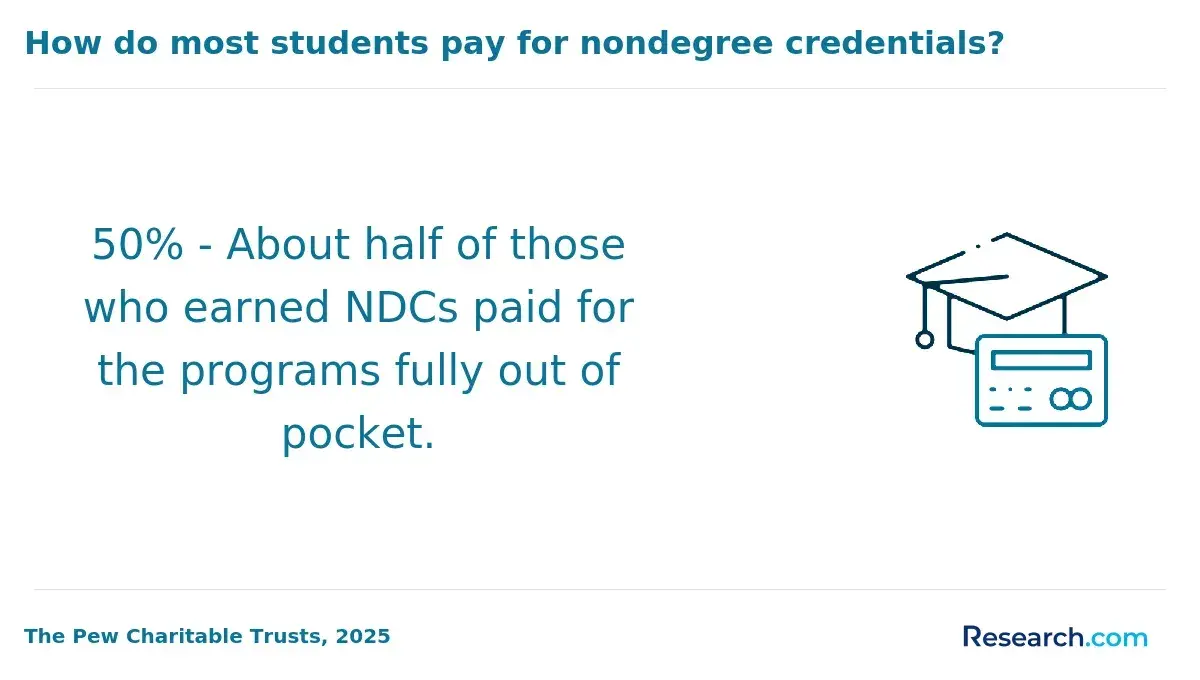
- Payment plans for students who do not qualify for aid or choose a noncredit program.
File the FAFSA early if the school participates, then compare the aid offer against the program's full cost. Students considering flexible study because of family obligations can also explore online degrees for military spouses when a degree pathway would provide stronger portability or broader aid eligibility.
How do online and campus non-degree programs compare in cost, flexibility, and outcomes?
Online non-degree programs can reduce commuting and scheduling barriers, but they are not automatically cheaper or equivalent to campus programs. Theory-heavy subjects such as billing, coding, legal studies, and digital design can work well online when instruction includes active feedback and career support. Trades, clinical healthcare, and laboratory-based programs usually need in-person labs, supervised clinicals, or hybrid delivery.
This comparison highlights the trade-off between convenience and required practical experience.
| Factor | Online or mostly online | Campus or hybrid |
| Schedule | Often asynchronous and flexible | Usually fixed labs, shops, or clinical blocks |
| Direct costs | May reduce commuting, but may include technology fees | May include parking, tools, lab supplies, and commuting |
| Hands-on learning | Limited unless local placements are arranged | Better suited to equipment-intensive training |
| Licensure preparation | Must be confirmed by state and program | Often easier to coordinate required hours |
| Career network | Depends on virtual advising and local partnerships | May offer local employer and instructor connections |
Before choosing online delivery, confirm where clinicals or labs occur, who secures placements, whether your state accepts the education, and whether proctored exams or live attendance are required. Avoid programs that cannot answer these questions in writing.
What admission requirements and prerequisites do leading non-degree programs usually have?
Leading non-degree programs often use simpler admissions than degree programs, but requirements reflect the occupation. Many entry-level certificates require a high school diploma, GED, or equivalent and an application. Competitive healthcare and technical programs may add placement testing, prerequisite coursework, minimum grades, interviews, or limited-seat selection.
Applicants should expect requirements to fall into three categories.
- Academic readiness: high school completion, reading and math placement, or prerequisites such as anatomy, algebra, or computer literacy.
- Safety and compliance: background checks, drug screening, immunizations, CPR certification, physical examinations, or proof of insurance for clinical and public-safety pathways.
- Equipment and performance: tools, laptops, software, portfolio submissions, typing-speed tests, or physical capability expectations for trade programs.
A low GPA does not always prevent entry into an open-admission certificate, but selective cohorts may consider prerequisite grades. Students needing a broader admissions reset may compare low GPA colleges before choosing a noncredit program with limited transfer value.
How long do non-degree programs take, and what tuition and fees should you expect?
Non-degree programs can take from a few weeks to roughly two years, depending on whether they are short-term training, a clock-hour diploma, or a college certificate. A part-time schedule extends completion time but can make working while studying more practical. Clinical rotations, externships, apprenticeship hours, and limited course sequencing can prevent acceleration even when online classes are available.
Tuition varies too much by state, provider, and field for one price to be reliable. The total cost is more useful than advertised tuition because required supplies can substantially change the budget.
| Cost category | Why it matters | Question to ask |
| Tuition and mandatory fees | Primary billed educational expense | Is the quoted amount for the full program or one term? |
| Tools, kits, and uniforms | Common in trades and healthcare | Are these required purchases included in the estimate? |
| Exams and licensing | May be needed after completion | Does tuition include first-attempt exam fees? |
| Transportation and childcare | Can affect completion of labs or clinicals | What in-person attendance is mandatory? |
| Lost work time | Represents an opportunity cost | Can the schedule support continued employment? |
Request a written, itemized estimate and compare it with likely aid and out-of-pocket costs. A short program with high private financing costs may be less affordable than a longer public-college certificate with grant aid.
What careers can non-degree programs lead to, and what entry-level roles are common?
Non-degree programs can support entry-level work when the curriculum matches a local employer's hiring requirements. They are especially practical for occupations that use supervised training, skill demonstrations, industry exams, or apprenticeships. They are less suitable when a target job legally requires a degree, graduate education, or a license that the program does not support.
The roles below illustrate common entry points, not guaranteed job placements.
| Program area | Common entry-level role | Important limitation |
| HVAC or electrical technology | Helper, installer trainee, apprentice | Independent work may require apprenticeship and licensure |
| Medical assisting | Medical assistant | Employer and state rules vary by task |
| Pharmacy technician | Pharmacy technician trainee or technician | Registration or certification rules vary by state |
| Paralegal studies | Legal assistant or paralegal support staff | Does not permit legal practice |
| Digital design | Production artist, junior designer, content assistant | Portfolio and software skills drive hiring |
Match the program to actual job postings in your area. If the role increasingly requires a bachelor's degree, explore related top-paying degrees rather than assuming a short certificate will provide the same advancement ceiling.
What salary ranges and job outlook can graduates of non-degree programs expect?
Salary information should be used as labor-market context, not as a promise tied to a certificate. Pay varies by location, experience, shift, union coverage, employer, and licensing status. The most useful comparison is whether the role's typical pay and openings justify your total training cost and time away from work.
According to U.S. Bureau of Labor Statistics 2024 wage data and 2024-2034 projections, several certificate-aligned occupations show the following national picture.
| Occupation | 2024 median annual wage | Projected 2024-2034 growth | Interpretation |
| Electricians | $62,350 | 9% | Typically requires apprenticeship and licensing beyond school |
| Heating, air conditioning, and refrigeration mechanics and installers | $59,810 | 8% | Certificate training can support entry, with employer experience important |
| Medical assistants | $44,200 | 12% | Fast growth does not remove variation in local pay and duties |
| Paralegals and legal assistants | $61,010 | -1% | Competition and employer preferences may affect entry prospects |
| Graphic designers | $61,300 | 2% | Portfolio quality and software capability remain central |
Automation and AI tools are changing task mix in design, administrative, and legal-support work, increasing the value of software fluency, quality control, and client-facing judgment. Ask programs how their curriculum is updated and whether students build evidence of those skills.
How do licensing, certification exams, and industry credentials work for non-degree pathways?
Licensure, certification, and a school certificate are separate milestones. A school certificate shows that you completed a program. A professional certification is awarded by an independent organization after meeting its requirements, often through an examination. A license is government permission to practice a regulated occupation and may require education, examinations, supervised experience, background review, and continuing education.
Use this sequence to avoid enrolling in training that does not meet your end goal.
- Identify the exact job title and state where you plan to work.
- Check the relevant licensing board, employer, or certifying organization for current eligibility rules.
- Confirm in writing that the program's curriculum and required hours meet those rules.
- Budget separately for application, examination, fingerprinting, insurance, tools, and renewal costs.
- Keep transcripts, clinical records, and proof of supervised hours for future applications.
For example, an HVAC certificate may prepare a student for EPA Section 608 testing, but it does not automatically create a contractor license. Likewise, a practical nursing program may prepare graduates for NCLEX-PN eligibility only when its approval status meets the state board's requirements. Students who later need broader advancement options may consider stackable credits or easy master's degrees after completing the appropriate undergraduate education.
Other Things You Should Know About
Possibly. You generally must enroll in an eligible program at a school that participates in federal student aid. Ask the financial aid office whether your exact certificate, attendance level, and start date qualify before enrolling.
Online delivery alone does not determine eligibility. A program may qualify if the institution and program meet federal requirements, but noncredit online courses and many third-party certificates often do not receive federal aid.
A certificate can be better for a focused, lower-time-commitment entry path. An associate degree may be stronger when employers prefer broader education, when licensure requires it, or when you want transferable credits and long-term advancement options.
A school that will not provide written information about total costs, accreditation or approval, exam eligibility, clinical placement, completion requirements, and refund policies deserves extra scrutiny. Never rely solely on marketing claims about jobs or pay.
References
- Student Loan Repayment Options | Sallie Mae https://www.salliemae.com/student-loans/manage-your-private-student-loan/understand-student-loan-payments/explore-loan-repayment-options/
- Tuition Reimbursement Programs [A Guide for HR and Employers] https://compt.io/blog/employee-tuition-reimbursement/
- How does a college degree improve graduates' employment and earnings potential? - APLU https://www.aplu.org/our-work/publicuvalues/employment-earnings/
- Navigating the Impact of Gainful Employment on Higher Education https://bibliu.com/blog/navigating-the-impact-of-gainful-employment-on-higher-education
- Find a Center https://www.brighthorizons.com/employers/benefits/employer-tuition-assistance
- Getting a job without a 4-year degree. Prospects increase with a certificate. https://www.luminafoundation.org/resource/non-degree-credentials-provide-value-for-adults-in-the-labor-market/
- Employer Tuition Assistance Plans May Help Pay for College https://campus.edu/blog/financial-aid/employer-tuition-assistance-programs-can-help-pay-for-college
- Employer-offered educational assistance programs can help pay for college | Internal Revenue Service https://www.irs.gov/newsroom/employer-offered-educational-assistance-programs-can-help-pay-for-college
- Frequently Asked Questions on Public Service Loan Forgiveness | NEA https://www.nea.org/your-rights-workplace/student-debt-support/faqs
- Cancellation & Forgiveness Options - Student Loan Borrowers Assistance https://studentloanborrowerassistance.org/for-borrowers/dealing-with-student-loan-debt/loan-cancellation-forgiveness-bankruptcy/cancellation-forgiveness-options/