2027 Best Certifications With Low GPA Options

Co-Founder and Chief Data Scientist
A low GPA can limit admission to selective degree programs, but it does not end access to career training. Many workforce certificates evaluate readiness through placement tests, prerequisites, interviews, portfolios, or work experience instead of a minimum college GPA.
The U.S. Bureau of Labor Statistics projects healthcare support occupations to grow 15% from 2024 to 2034, illustrating why short, skills-focused training remains a practical option. This guide compares certificate and certification routes, requirements, costs, licensing issues, and next steps so you can choose a credential that fits your goals.
Key Things You Should Know
- Low-GPA applicants often have the widest choice in open-admission community-college certificates, adult career training, and vendor certifications; regulated healthcare programs may still require prerequisite grades, entrance testing, background checks, or competitive selection.
- A certificate is education completed through a school or provider, while a certification is a professional credential usually earned through an exam or documented experience; verify which one employers and licensing boards actually require.
- Healthcare support occupations are projected by the U.S. Bureau of Labor Statistics to grow 15% from 2024 to 2034, but program cost, state licensing rules, clinical placement, and total time to employment should drive your choice - not GPA alone.
Top 10 Best Certifications With Low GPA Options
Popular Trade School Programs
Trade certificates and associate degrees commonly emphasize practical aptitude, attendance, safety, and placement testing more than prior GPA. Options include welding, HVAC/R, electrical, plumbing, automotive technology, commercial driver training, industrial maintenance, and construction management. Certificates can prepare learners for entry-level work or an industry exam; apprenticeships are often the stronger route for licensed trades such as electrical work.
An associate degree adds general education and may help with advancement, but it takes longer. Ask whether equipment fees, tools, safety gear, exam fees, and apprenticeship connections are included before enrolling.
Healthcare Programs
Healthcare certificates may include medical assisting, phlebotomy, pharmacy technician, dental assisting, medical billing and coding, practical nursing, nursing assistant, and sterile processing. Low overall GPA may be workable, but anatomy, math, English, immunization, drug-screening, and background-check requirements can be decisive.
Programs leading to licensure or certification exams should meet the relevant state-board or programmatic approval standards. Clinical training is usually in person, even in online or hybrid programs. Choose healthcare training only after confirming that it meets the rules in the state where you intend to work.
Criminal Justice / Law Programs
Certificates and associate degrees in criminal justice, legal studies, paralegal studies, corrections, emergency management, and homeland security can offer accessible entry points. Admission may be open or require a placement assessment rather than a GPA threshold. A paralegal certificate can build legal research, writing, and document-management skills, but it does not authorize someone to practice law.
Police, corrections, and public-safety roles can impose age, fitness, background, citizenship, academy, and agency-specific standards beyond education. Compare programs by internship access, local employer relationships, and whether credits can transfer into an associate or bachelor's degree.
Arts & Design Programs
Arts and design certificates commonly focus on portfolio quality and technical ability, making them useful options when GPA is not a strong part of an application. Programs may cover graphic design, UX design, digital media, photography, animation, fashion, web design, or audio production. A certificate can teach software and project workflows, while a portfolio demonstrates employability.
Noncredit bootcamps may be faster but usually do not transfer for college credit. Before paying, review graduate portfolios, required software costs, instructor experience, and whether the curriculum includes feedback, client-style projects, and career support.
What are the most flexible certifications for applicants with a low college GPA?
The most flexible options are usually credentials that assess current capability rather than past academic performance. Open-admission college certificates, continuing-education programs, workforce training funded through local agencies, and vendor-issued technology certifications generally do not use a college GPA in the same way a selective graduate program does.
Flexibility does not mean every path is equally useful. The comparison below separates credentials by how admissions typically work and what they can realistically do for a career.
| Credential type | Typical GPA role | Best for | Important limitation |
| Community-college certificate | Often open admission; course prerequisites may apply | Credit-bearing career training | Selective cohorts may rank prerequisite grades |
| Industry certification | Usually no GPA review | Demonstrating a defined technical skill | May require exam preparation or work experience |
| Noncredit workforce certificate | Often no GPA requirement | Short, job-focused training | Usually does not transfer as college credit |
| Graduate certificate | Frequently reviewed | Professionals with a completed bachelor's degree | May require a minimum undergraduate GPA |
For applicants who already hold a bachelor's degree but need a more forgiving academic route, compare admissions policies for easiest master's programs to get into. A certificate is a better fit when you need targeted skills quickly; a master's degree is more appropriate when a role requires graduate education.
Which certification fields offer the best salary potential with modest academic records?
Fields with stronger salary potential generally require a combination of technical competence, licensing, experience, or an employer-recognized certification. A modest academic record does not prevent entry, but a short credential alone may not qualify a person for higher-paying roles.
The U.S. Bureau of Labor Statistics reported a 2024 median annual wage of $104,420 for information security analysts; this is occupational pay data, not the expected salary of a beginner who completes one entry-level certificate.
Consider these fields when comparing earnings potential against time, cost, and entry barriers.
| Field | Useful starting credential | Why GPA may matter less | Career reality |
| IT support and networking | Vendor or industry certification | Skills tests and technical portfolios can carry weight | Entry roles may lead to networking, cloud, or security work |
| Cybersecurity | Foundational IT certification or college certificate | Employers often value hands-on evidence | Many analyst roles require prior IT experience |
| Skilled trades | Pre-apprenticeship or trade certificate | Practical assessments are central | Licensure and apprenticeship rules vary by state |
| Allied healthcare | Approved certificate or associate degree | Program-specific prerequisites matter more than cumulative GPA | Certification, clinical hours, or licensure may be required |
Choose a field based on local job postings and required credentials, not national wage figures alone. Cybersecurity, for example, can have attractive long-term pay but is not always an entry-level field.
How do admission requirements differ for certificate programs that accept lower GPAs?
Admission requirements vary more by credential type than by the label "certificate." Open-admission academic certificates may admit students without a minimum GPA and then use placement results to determine course sequencing. Limited-enrollment healthcare, nursing, and technical programs may calculate a separate admission score using prerequisite grades, test scores, work history, interviews, or residency.
Before applying, ask admissions staff these specific questions so that "low GPA accepted" is not mistaken for guaranteed entry into a competitive cohort.
- Is admission open to the college, to the certificate program, or to a limited clinical or technical cohort?
- Is there a minimum cumulative GPA, prerequisite GPA, or grade requirement for anatomy, math, English, or technical courses?
- Can placement testing, recent coursework, work experience, or a portfolio offset older academic performance?
- Are there background checks, drug screening, immunizations, physical exams, tools, or transportation costs?
- Does completion qualify graduates to take a required certification or licensing examination in the intended state?
A common mistake is relying on a school's general open-admission statement. Always obtain the requirements for the exact program, start term, and campus or online format.
What types of accredited online certificate programs are available for low-GPA students?
Accredited online options for low-GPA students are most commonly credit-bearing certificates from institutionally accredited community colleges and universities. They can include business, bookkeeping, information technology, web development, project management, medical billing, and general education certificates. Online delivery can reduce commuting and scheduling barriers, but it does not eliminate proctored exams, lab work, internships, clinical rotations, or state authorization limits.
The format should match the occupation, not simply the need for convenience.
| Format | Works well for | Watch for |
| Fully online | Business, IT theory, coding, bookkeeping, and legal studies | Proctoring, self-paced workload, and employer recognition |
| Hybrid | Technical programs needing occasional labs or assessments | Required campus travel and fixed lab schedules |
| Online coursework with local placement | Some healthcare and education-support pathways | Whether the school secures placements near you |
| Campus-based | Hands-on trades and clinical programs | Commute, tool costs, and lab availability |
If you need a credit-bearing pathway that can later support broader education goals, review associate's degrees online. Confirm in writing whether certificate credits apply to that associate degree.
How can students verify accreditation and licensing for certification programs in the U.S.?
Verify both the school and the career-specific approval before paying a deposit. Institutional accreditation is important for credit transfer and federal aid eligibility, while programmatic accreditation or state approval may be essential for licensure-oriented fields. Neither one automatically proves that a credential meets every employer's expectations.
Use the following process to reduce the risk of enrolling in a program that cannot support your intended job.
- Search the institution in the U.S. Department of Education's Database of Accredited Postsecondary Institutions and Programs and identify its recognized accreditor.
- For healthcare, teaching, cosmetology, skilled trades, or other regulated fields, check the relevant state licensing board's approved-program list.
- Confirm whether the program prepares you for a named certification or licensing exam and whether eligibility has additional clinical, experience, or background requirements.
- Ask whether online students in your state are eligible for enrollment, placement, examination, and licensure.
- Request written information on completion requirements, total charges, refund policies, and the credential awarded.
Red flags include vague claims of "accreditation" without naming the accreditor, pressure to enroll immediately, and promises of guaranteed jobs or licenses.
What are typical program length, tuition costs, and financial aid options for certificates?
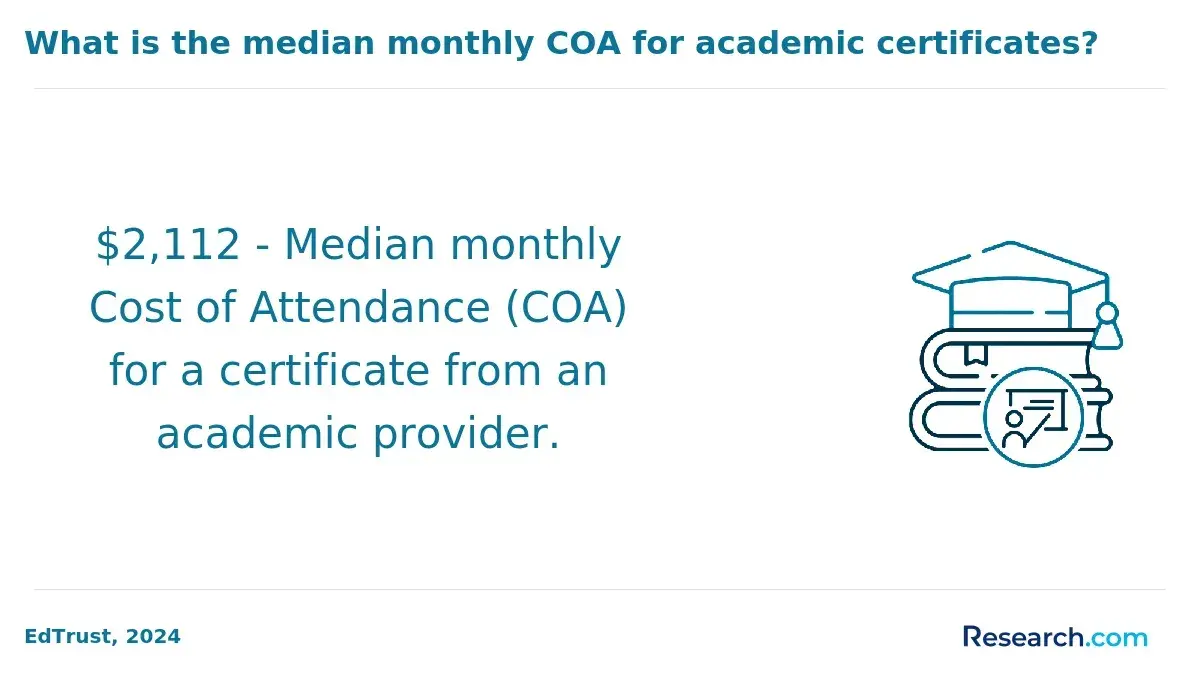
Certificate length ranges from a few weeks for exam-preparation or vendor training to about one year for many college certificates; associate degrees commonly take about two years of full-time study. Tuition varies sharply by provider, residency, program length, and equipment needs. The College Board's 2024-25 published average tuition and fees at public two-year colleges was $4,050 for in-district students, a useful benchmark but not a complete program-price estimate.
Total cost is more informative than tuition because career programs often add substantial required expenses.
| Cost category | Often applies to | How to evaluate it |
| Tuition and institutional fees | Credit-bearing college certificates | Compare in-district, in-state, and online rates |
| Tools, uniforms, software, and supplies | Trades, design, and healthcare | Request an itemized estimate |
| Exam, fingerprinting, and licensing fees | Regulated and certification-based fields | Confirm which fees are mandatory |
| Lost work time and transportation | Campus, lab, and clinical programs | Assess schedule and location before enrolling |
Credit-bearing certificates at eligible schools may qualify for federal aid when students meet program and enrollment rules; noncredit and third-party certifications often do not. Investigate employer tuition assistance, workforce grants, scholarships, payment plans, and apprenticeships before borrowing. Working adults may also compare schedule-friendly options such as best accelerated bachelor's degree online when a bachelor's degree is the actual requirement for their target role.
Which certifications lead to strong entry-level job prospects and clear career pathways?
Strong entry-level prospects tend to come from credentials tied to a defined employer need, recognized examination, apprenticeship, or supervised training requirement. Good examples include nursing assistant training, commercial driver training, pharmacy technician education where required, IT support certifications, bookkeeping software credentials, welding, HVAC/R, and medical assisting. Availability varies by state and local labor market.
A clear pathway has a realistic first job and a next credential or advancement step.
| Starting path | Potential first role | Typical next step |
| IT support certificate or certification | Help desk or desktop support | Networking, cloud, systems, or security specialization |
| HVAC/R certificate | Installer helper or service trainee | Apprenticeship, licensing, and advanced service work |
| Medical assistant program | Clinical or administrative assistant | Specialty certification or allied-health advancement |
| Paralegal studies certificate | Legal assistant or records role | Experience, advanced legal specialization, or degree completion |
Do not assume a certificate substitutes for education required by an occupation. Review local job ads to see whether employers request a certificate, certification, associate degree, bachelor's degree, license, or prior experience.
What are the common coursework and skills taught in career-focused certificate programs?
Career-focused certificates teach a narrower set of skills than a degree program, usually emphasizing applied tasks, workplace tools, and job-specific communication. Credit-bearing programs may also include foundational math, writing, or general education courses, while noncredit programs usually focus solely on occupational content.
Across fields, coursework commonly develops the following capabilities.
- Technical procedures, equipment use, software workflows, safety standards, and quality control relevant to the occupation.
- Documentation, customer communication, teamwork, scheduling, and professional ethics.
- Problem-solving through labs, simulations, case studies, projects, clinical practice, or supervised fieldwork.
- Preparation for a separate industry certification exam, portfolio review, apprenticeship, or employer assessment when the field uses one.
Ask to see the course sequence and assessment methods. A program is more credible when its training tasks resemble the work performed in local entry-level jobs.
How can applicants strengthen their profile beyond GPA when applying to certification programs?
Applicants with a low GPA should make their recent readiness easy to verify. A concise explanation can provide context for an older academic record, but evidence of current performance is usually more persuasive than an extended personal statement. This is especially important for selective certificate cohorts with limited seats.
Build an application around relevant, documented strengths.
- Complete prerequisite courses and aim for strong recent grades, particularly in required math, science, writing, or technical subjects.
- Prepare for placement or entrance testing with official study materials and take advantage of retesting policies where available.
- Include a current resume, relevant work history, volunteer experience, military training, portfolio, or completed industry coursework.
- Request recommendations from supervisors or instructors who can describe reliability, technical aptitude, and readiness to complete the program.
- Apply early and maintain a backup plan, such as a related open-admission certificate, apprenticeship, or entry-level role.
Adult learners returning to education may find that flexible pacing and support services matter as much as admission standards. Explore online degrees for seniors if you are comparing certificate training with a broader online degree path later in life.
Other Things You Should Know About
Often, yes. Many open-admission certificates and industry certifications do not set a cumulative GPA minimum. However, competitive healthcare and technical cohorts may require higher grades in prerequisite courses or use an entrance exam and ranking system.
Many employers focus more on the credential, demonstrated skills, certification status, portfolio, license eligibility, and work experience. GPA can matter for some internships, competitive employers, or later degree admissions, so do not misrepresent it if asked.
It can be, especially when issued by a recognized college or respected industry provider and paired with demonstrable skills. For regulated work, confirm that the online format includes required labs or clinical training and meets state rules.
The fastest sensible route depends on local openings and the credential employers request. Compare short programs in IT support, commercial driving, healthcare support, and trades, then verify total cost, licensure requirements, placement support, and realistic entry-level job listings before enrolling.
References
- Calculating Return on Investment https://www.ccfcu.org/calculating-return-on-investment/
- What Is a Good GPA? Complete Guide by Goal (2026) https://whatisagoodgpa.com/for-jobs
- Getting Into College With A Low GPA - Excel High School https://www.excelhighschool.com/blog/getting-into-college-with-a-low-gpa/
- Top Job Certifications That Will Boost Your Resume in 2025 https://www.hedyholmesstaffing.com/post/top-job-certifications-that-will-boost-your-resume-in-2025
- How Certifications Can Help Grow Your Career https://www.hrci.org/community/blogs-and-announcements/hr-leads-business-blog/hr-leads-business/2022/02/14/how-certifications-can-help-grow-your-career
- Five certifications that actually impress recruiters - Engage TU https://www.engagetu.com/2019/04/09/certificates-to-impress-recruiters/
- How We Calculated the Return on Investment of Associate Degrees and Certificates - Freopp https://freopp.org/whitepapers/how-we-calculated-the-return-on-investment-of-associate-degrees-and-certificates/
- A Guide to Small Business Certifications https://www.uschamber.com/co/start/strategy/small-business-certifications-guide
- Top Skills and Certifications Needed to Land High-Impact Healthcare Roles | GHR Healthcare https://www.ghrhealthcare.com/blog/certifications-high-impact-healthcare-roles
- Is College Worth it? | Return on Investment Analysis of College Degree https://educationdata.org/college-degree-roi