2027 Choosing an Online Data Science Master's for a Career in Hospitality

Co-Founder and Chief Data Scientist
An online data science master's can help a hotel, travel, or tourism professional move into analytics - but a strong general program is not automatically a strong hospitality fit. The useful distinction is whether its courses and projects prepare you to work with bookings, pricing, guest behavior, and operational decisions. This guide helps you compare programs against a target role, assess the cost and preparation required, and decide whether a full master's is the right next step.
Key Things You Should Know
- Choose by target role: revenue analytics calls for forecasting and experimentation, while data science roles also demand substantial programming, statistics, and model evaluation.
- A hospitality-focused capstone can be more useful than a hospitality-themed course title; confirm that you can use suitable data and work on a relevant business problem.
- The U.S. median annual wage for data scientists was $120,230 in May 2025, but that figure covers industries broadly - not hospitality jobs or new graduates specifically.
What is an online data science master's degree for hospitality careers?
It is a graduate data science degree whose skills can be applied to hospitality decisions, rather than necessarily a degree in hotel management. Students typically need a combination of statistical reasoning, programming, data management, and applied projects. For a hospitality career, the important question is whether the program lets you practice those skills on problems such as demand forecasting, room pricing, staffing, or guest retention.
Choose a data science master's if you want to build and evaluate analytical models or move toward a technical analytics role. If your goal is primarily to manage hotel operations and use reports produced by others, a hospitality or business program with strong analytics coursework may be a better fit. Industry knowledge remains valuable in either path: a technically sound forecast is useful only if it reflects how bookings, cancellations, and operational constraints work.
How can data science support hospitality, tourism, and hotel management careers?
Hospitality teams can use reservation histories, booking lead times, rates, cancellations, guest feedback, staffing records, and event calendars to inform decisions. Forecasting can support inventory and labor planning; experimentation can test whether an offer changes bookings; text analysis can help organize feedback. The business measure matters as much as model accuracy: a pricing model that predicts demand well but recommends impractical changes may not help a revenue manager.
These uses also create constraints worth studying. Guest records may contain sensitive personal information, and data from different properties or booking channels may be incomplete or governed by different access agreements. Look for coursework that teaches data quality, privacy, and how to explain uncertainty to nontechnical decision-makers - not just how to produce a prediction.
Which online data science master's programs best prepare students for hospitality?
No program is best for every hospitality career, and a school's marketing examples do not establish that students can complete hospitality projects. Compare official course descriptions and project rules against your intended role. The table distinguishes three useful program emphases; these are selection categories, not rankings of particular schools.
| Program emphasis | Strongest hospitality fit | Trade-off to check |
| Statistics and business analytics | Revenue management, demand forecasting, and testing offers | May provide less software engineering or advanced machine learning depth |
| Technical data science | Building predictive models and pursuing data scientist roles | May leave industry applications and stakeholder communication largely to electives or projects |
| Data engineering and applied AI | Combining property data sources and supporting models in production | May be more technical than a reporting-focused role requires |
Shortlist programs only after confirming that their current catalog includes the methods you need, their project policy permits an appropriate hospitality topic, and their online schedule fits your work. Ask who approves capstone data and whether students can use public or employer-authorized datasets. For employees balancing shifts with study, compare working-professional pathways to a data science master's before treating the word "online" as a guarantee of scheduling flexibility.
What accreditation should an online data science master's program have?
Start with the institution's recognized accreditation, rather than assuming that a data science master's must have a separate subject-specific accreditor. Verify the institution's current status through the accreditor or the U.S. Department of Education's accreditation records. Accreditation is a baseline check, not evidence that a particular curriculum fits hospitality.
Also confirm that the institution can enroll online students where you live; state authorization and enrollment eligibility are separate from accreditation. Before applying, ask whether the degree appears on the institution's official catalog and transcript, and whether any required campus visits apply. Do not use a ranking or an "accredited" claim on an advertising page as a substitute for these checks.
What courses are included in an online data science master's degree?
Course requirements vary, but a hospitality-oriented shortlist should be checked for statistics, Python or another programming language, databases and SQL, machine learning, and data visualization. Forecasting, causal inference or experimentation, optimization, and text analysis are especially relevant to pricing, promotions, staffing, and guest feedback. A course title alone does not show how deeply a method is taught: inspect assignments, prerequisites, and the work expected in a project.
Data pipelines also matter when information is spread across reservations, property systems, and marketing tools. If building those systems is your goal, compare data science curricula with artificial intelligence master's degrees with data systems training. A program focused mainly on modeling may still suit a revenue analyst, but it may offer less preparation for an engineering-heavy role.
What are the admission requirements for an online data science master's?
Requirements differ by institution. Review each program's official admissions page for its degree, mathematics, programming, testing, and application requirements rather than assuming hospitality experience satisfies a technical prerequisite. Experience interpreting occupancy or revenue reports can strengthen an application, but it is not the same as evidence that you can write code or work with statistics.
If your background is operational rather than quantitative, compare your preparation with the program's stated prerequisites. A recent programming project or relevant coursework can demonstrate readiness, but self-study fulfills a formal prerequisite only if the program accepts it. Applicants considering AI-heavy degrees can also investigate programs offering foundations for an AI master's; confirm which bridge courses count toward admission and which add time or expense.
How long does an online data science master's take and cost?
There is no reliable universal price or completion time: credit requirements, tuition rules, course availability, and study pace vary by school. Compare a full-degree estimate, not a single course price. Include required fees, any prerequisite courses, software or equipment, and travel if a program has in-person components. Ask whether tuition changes with residency or enrollment pace and whether your employer offers tuition assistance.
A faster schedule may reduce time out of the job market but be difficult alongside irregular hospitality shifts. A slower schedule may be easier to sustain yet increase the time before you can use the credential. Request an official course sequence and current cost schedule for each finalist; use an online data science master's affordability guide to identify options, then verify each school's current total. Avoid treating a higher post-degree salary as a guaranteed return on tuition.
What hospitality careers can you pursue with a data science master's degree?
Possible targets include hotel or travel revenue analyst, marketing analyst, operations analyst, business intelligence analyst, data scientist, and data engineer. Titles vary by employer, so compare actual job duties with the skills a program teaches. A revenue analyst may spend more time forecasting and presenting pricing recommendations; a data scientist may be expected to develop and test models; a data engineer may focus on dependable data systems.
For someone already in hospitality, an adjacent analytics role can be a practical first move because operational knowledge helps frame useful questions. A master's may help close technical gaps, but it is not automatically required for every analyst opening. U.S. Bureau of Labor Statistics projections show 35% growth in data scientist employment from 2025 to 2035 across industries. That signals broad demand for the occupation, not a hospitality-specific hiring forecast or an assurance of a job after graduation.
What salary can data science professionals earn in hospitality?
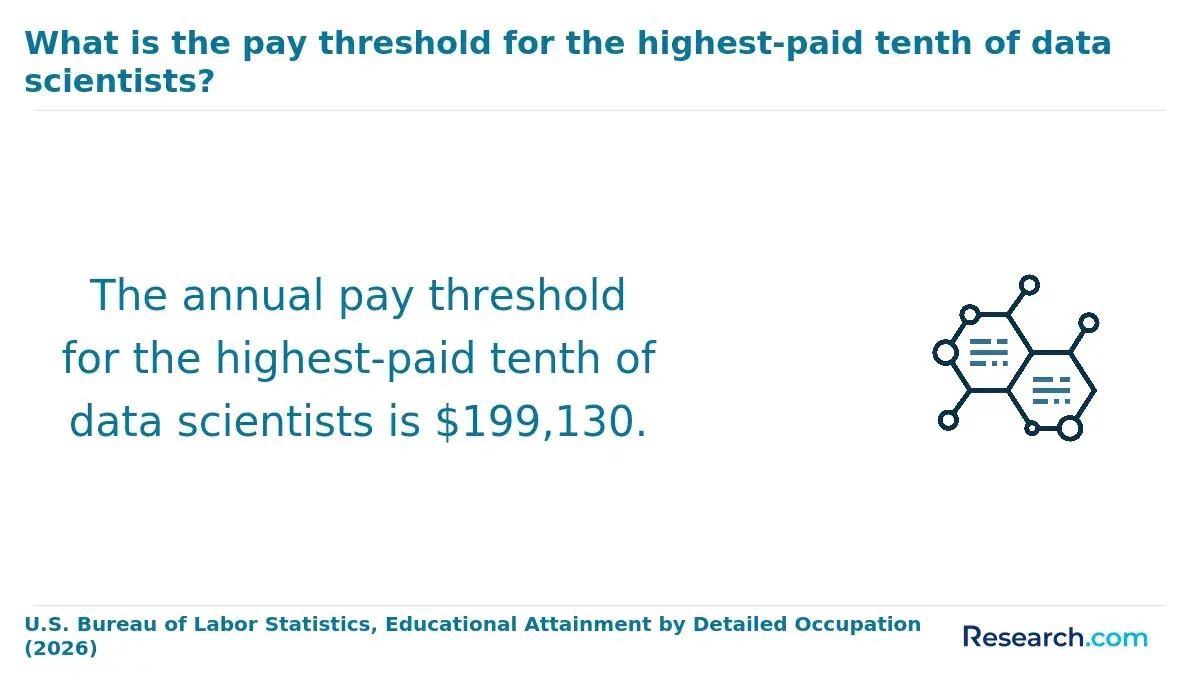
The U.S. Bureau of Labor Statistics reports a $120,230 median annual wage for data scientists in May 2025. This is a benchmark for the occupation across industries, not a hospitality-only salary, an entry-level offer, or the pay for every role described above. Compensation depends on duties, experience, employer, and location; a revenue analyst and a data scientist should not be compared as though they were the same occupation.
Use job postings for your target role and location alongside data science compensation across industries. When weighing tuition against potential pay, compare a plausible next role with your current compensation - not with the national data scientist median - and account for the possibility that a degree does not cause a promotion or salary increase.
What certifications and skills improve hospitality data science job prospects?
Prioritize demonstrable skills over collecting credentials. SQL, programming, statistical testing, forecasting, and clear communication are useful when paired with a project that explains a hospitality decision. For example, a booking-demand project should state which data were available at the time of prediction, how performance was evaluated, and how a manager could use the result. A model built with information that would only become available after a guest's stay is a warning sign, however impressive its accuracy appears.
Vendor certifications may help demonstrate familiarity with a tool named in a target job posting, but they do not replace evidence that you can solve an analytical problem. Before enrolling, examine the program's project expectations and ask whether you can produce a portfolio example without disclosing guest or employer data. Choose the program that lets you develop the skills your target jobs request and show how those skills improve a real hospitality decision.
Other Things You Should Know About Data Science
Only with explicit permission and a plan that meets your employer's privacy and data-use rules. Ask the program how restricted datasets are handled before proposing a project.
Yes. Publicly available tourism or travel data can support a useful project if you explain its limitations and avoid claiming it represents a particular hotel's customers.
Not necessarily. Check whether your chosen program requires one. Relevant work experience, an authorized employer project, or a well-designed independent project may also demonstrate industry application.
Delivery format does not determine job eligibility. Check each employer's location, travel, and on-site requirements; some analytical roles still involve close collaboration with property or corporate teams.
References
- Cost of Attendance (Budget) | 2025-2026 Federal Student Aid Handbook https://fsapartners.ed.gov/knowledge-center/fsa-handbook/2025-2026/vol3/ch2-cost-attendance-budget
- Partnering with Students to Develop a Capstone for a... - PMC https://pmc.ncbi.nlm.nih.gov/articles/PMC11732519/
- Hospitality & Tourism Jobs: The Top Careers For Grads | USC Online https://online.usc.edu/news/careers-hospitality-tourism-masters-graduates/
- In-Person Program - UChicago Data Science Institute https://datascience.uchicago.edu/education/masters-programs/in-person-program/
- Online Master's Degree in Applied Data Analytics | Purdue Global https://www.purdueglobal.edu/degree-programs/information-technology/online-master-data-analytics/
- Online Master's Degree in Hospitality and Tourism Management | purdue.edu https://hhs.purdue.edu/graduate-programs/online-master-of-science-in-hospitality-and-tourism-management/
- Admissions Requirements | upenn.edu https://amcs.upenn.edu/admission/
- Master's in Data Science - University of Notre Dame https://datascience.nd.edu/masters/
- What Can I Do With a Degree in Data Science? Career Paths & Skills | Harvard SEAS https://seas.harvard.edu/news/what-can-i-do-degree-data-science-career-paths-skills
- Embracing open innovation in hospitality management | sciencedirect.com https://www.sciencedirect.com/science/article/pii/S2199853125000228