2027 Best Associate Degrees With Credit for Work Experience

Co-Founder and Chief Data Scientist
If you have years of work experience, the question is whether a college will recognize what you learned - and whether that credit will actually shorten your path to a degree. The College Board reports average published tuition and fees of $4,050 for in-district students at public two-year colleges in 2024-25. Avoiding an unnecessary course can matter, but credit is never automatic.
This guide compares associate degree fields, explains how prior learning is evaluated, and shows working adults what to check before choosing a program.
Key Things You Should Know
- Business, IT, and criminal justice often offer the clearest opportunities to document job-related learning; healthcare and nursing have tighter clinical and licensing constraints.
- Many associate degrees require about 60 credits, but accepted prior-learning credit counts only when it applies to remaining degree requirements and satisfies residency rules.
- Ask for a written estimate of transferable courses, eligible certifications, assessment fees, and credits still required before comparing completion time or total cost.
Top 10 Best Associate Degrees With Credit for Work Experience
Business Programs
An associate degree in business administration can suit supervisors, bookkeepers, and operations staff whose training matches courses in accounting, management, or business software. An Associate of Science (AS) may emphasize transfer; an Associate of Applied Science (AAS) may emphasize workplace skills. Ask whether a portfolio, approved training, or an exam can satisfy specific business requirements - not merely elective credits. Choose a transfer-oriented curriculum if a bachelor's degree is the goal; prior-learning credit may not transfer the same way as classroom credit.
Healthcare Programs
Health information, medical coding, and healthcare administration associate degrees may recognize documented training or approved industry credentials. They are stronger work-credit candidates than programs whose laboratory or clinical competencies must be completed under supervision. Check whether a credential replaces a required course, counts only as an elective, or earns no credit. Coding credentials have their own eligibility and maintenance rules; an associate degree does not automatically confer certification or qualify someone for a clinical license.
Information Technology Programs
IT support, networking, and cybersecurity associate programs may evaluate current certifications, employer training, military education, or challenge exams. An AAS often targets technical employment, while an AS may offer a clearer transfer path. Compare the school's approved credential-to-course equivalencies with your actual certificates: a credential that earns elective credit may leave every required networking course untouched. Check hands-on lab requirements and whether older certifications still qualify under the current catalog.
Nursing / Pre-Nursing Programs
An Associate Degree in Nursing (ADN) has supervised clinical and laboratory requirements that employment alone generally cannot replace. Licensed practical nurses or other eligible applicants may find formally approved advanced-placement pathways, but these depend on program rules and demonstrated competencies. Pre-nursing AA or AS programs may accept more general education or exam credit without granting entry to a selective nursing major. Verify state board approval, required in-person placements, admission criteria, and eligibility for the NCLEX-RN before enrolling.
Criminal Justice Programs
Criminal justice AA, AS, and AAS programs may evaluate documented academy training, military education, or agency instruction against course outcomes. This can be useful for experienced public safety employees, but accepted credit may be limited to electives or depend on a formal agreement. An AA or AS can fit a bachelor's transfer plan; an AAS may better match an immediate workplace goal. Hiring standards, academy attendance, and certifications remain separate from the degree and vary by agency and state.
Psychology / Counseling Programs
A psychology AA or AS is usually a transfer foundation, not a counseling qualification. Work in peer support or behavioral health may support a portfolio for an introductory course or elective, but colleges may restrict credit in the major. Compare psychology and statistics requirements with your intended bachelor's program before accepting elective-only credit. Professional counseling and psychologist roles generally require substantially more education and state licensure; an associate degree alone does not qualify graduates to practice independently.
What Are Associate Degrees That Grant Credit for Work Experience?
Associate degrees that grant credit for work experience are ordinary college degrees with a policy for evaluating learning acquired outside a college classroom. The college awards credit for demonstrated knowledge - not for years employed or a job title. Assessments may consider training, certifications, examinations, military education, or a portfolio matched to course outcomes.
The best field depends on how much of your existing learning can meet required courses. This comparison shows where to look first and where additional restrictions are likely.
| Degree field | Potential work-credit evidence | Main decision point |
| Business | Documented management training, accounting knowledge, or exams | Will credit satisfy the major and transfer goals? |
| Information technology | Approved technical certifications or assessed training | Are credentials current and equivalent to required courses? |
| Criminal justice | Evaluated academy, military, or agency training | Does the college have an applicable credit agreement? |
| Healthcare administration or coding | Approved credentials or documented nonclinical training | Does credit apply to required courses rather than electives? |
| Nursing | Approved advanced placement for eligible prior credentials | Which clinical, lab, and licensing requirements remain? |
An Associate of Arts (AA) or AS often supports transfer, while an AAS often emphasizes workforce preparation; individual curricula and transfer agreements matter more than the abbreviation. If a shorter credential meets your immediate goal, compare the degree's remaining requirements with relevant online certificate programs before committing.
Which Accredited Colleges Offer Associate Degrees for Prior Learning?
Thomas Edison State University, Charter Oak State College, Excelsior University, and Empire State University are examples of institutionally accredited colleges or universities with associate-level options and established ways to evaluate learning outside conventional courses. Their degree offerings, eligible assessment methods, fees, and credit limits differ. An institution's prior-learning policy is not proof that every associate major accepts work-derived credit.
Use these schools as starting points rather than a universal ranking. Thomas Edison State University and Charter Oak State College are worth examining if portfolio assessment is important; Excelsior University and Empire State University also provide routes for evaluating forms of prior learning. For any school, identify a current associate degree you actually want, then request a degree audit showing where each proposed credit would apply. Local community colleges can be a better fit when they have lower total costs or formal credit agreements with your employer or training provider.
Schools with accessible admission processes are not necessarily generous with prior-learning credit. If application logistics are a barrier, compare online colleges with open enrollment and no application fee, then verify each college's current associate offerings and assessment rules separately.
How Does Prior Learning Assessment Convert Work Experience Into College Credit?
Prior learning assessment (PLA) is a college's process for deciding whether learning acquired outside a traditional course meets college-level outcomes. PLA does not award credit merely because an applicant held a job. A qualified evaluator may review a portfolio, score an exam, or use an approved guide or institutional agreement to translate training into course credit.
Follow this sequence before paying an assessment fee; it distinguishes credit you could earn from credit that will move you closer to graduation.
- Collect transcripts, licenses, certificates, training records, military education records, and descriptions of substantial job responsibilities.
- Ask the college which evidence it evaluates and request the current course equivalencies, credit limits, and assessment fees.
- Compare possible awards with the degree audit, including general education, major, elective, and residency requirements.
- Confirm when evaluation occurs, whether credit appears on a transcript, and how the college handles a denied assessment.
A portfolio typically explains what you learned and supplies evidence - such as work products or training records - against a course's learning outcomes. Sensitive employer or patient information should never be submitted without appropriate permission and safeguards. If the assessment yields elective credit but all elective slots are filled, it may save no time or tuition.
Which Associate Degree Programs Accept the Most Professional Certifications?
There is no dependable field-wide answer to which associate program accepts the most professional certifications. Colleges decide which credentials they recognize, how much credit to award, and whether that credit fits a particular degree. IT and some healthcare administration or coding programs are practical places to look because industry credentials can map to defined technical subjects; quantity alone is a poor measure of value.
The comparison below shows how the same type of evidence can have different value depending on the curriculum. Request the school's current equivalency list rather than assuming a certification will count.
| Program area | Credential to ask about | What to verify |
| IT support or networking | Current vendor or industry technical certifications | Exact course equivalency and credential-version rules |
| Cybersecurity | Approved security certifications | Whether credit satisfies the security major or only electives |
| Medical coding or health information | Approved coding or health information credentials | Whether separate practicum or certification rules remain |
| Business | Approved professional training or examinations | Whether assessed learning matches required business courses |
If a specific certification is the immediate hiring requirement, compare the time and cost of earning it directly with degree study. A guide to the best certifications for jobs can help frame that alternative, but employer expectations and college-credit eligibility are separate questions.
Are Online Associate Degrees With Work-Experience Credit Legitimate and Accredited?
Yes - an online associate degree that awards properly evaluated work-experience credit can be legitimate. Check the institution's accreditation through a recognized accreditor, confirm the degree appears in its current catalog, and read its published PLA and graduation policies. Accreditation applies to the institution or, where relevant, a particular professional program; a claim that an employer "accredits" work experience is not a substitute.
Online also does not always mean fully remote or self-paced. IT programs may require labs or scheduled assessments, while nursing requires supervised clinical work and may require campus activities. Ask where every required component takes place, whether online classes meet at fixed times, and whether the program meets the rules of the state where you intend to seek a license. Be wary of schools that promise a degree solely for submitting a résumé or guarantee an award of credit before evaluating evidence.
What Are the Admission Requirements for Associate Degrees With Work Credit?
General admission to an associate program commonly requires a high school diploma or equivalent and an application. Transfer transcripts and proof of prior training are usually needed if you seek those forms of credit. A portfolio assessment may require enrollment in a particular course or advance approval; ask about that timing before applying.
Admission to the college is different from admission to a selective major. Nursing and some allied-health pathways can require prerequisites, minimum grades, background checks, or other screening, even at colleges with broadly accessible admission. Standardized admission testing and GPA policies vary, so rely on the requirements for the specific major and entry term. Applicants returning with previous coursework should also ask whether old credits remain eligible and whether an official evaluation is available before enrollment.
How Long and How Much Do These Associate Degree Programs Take?
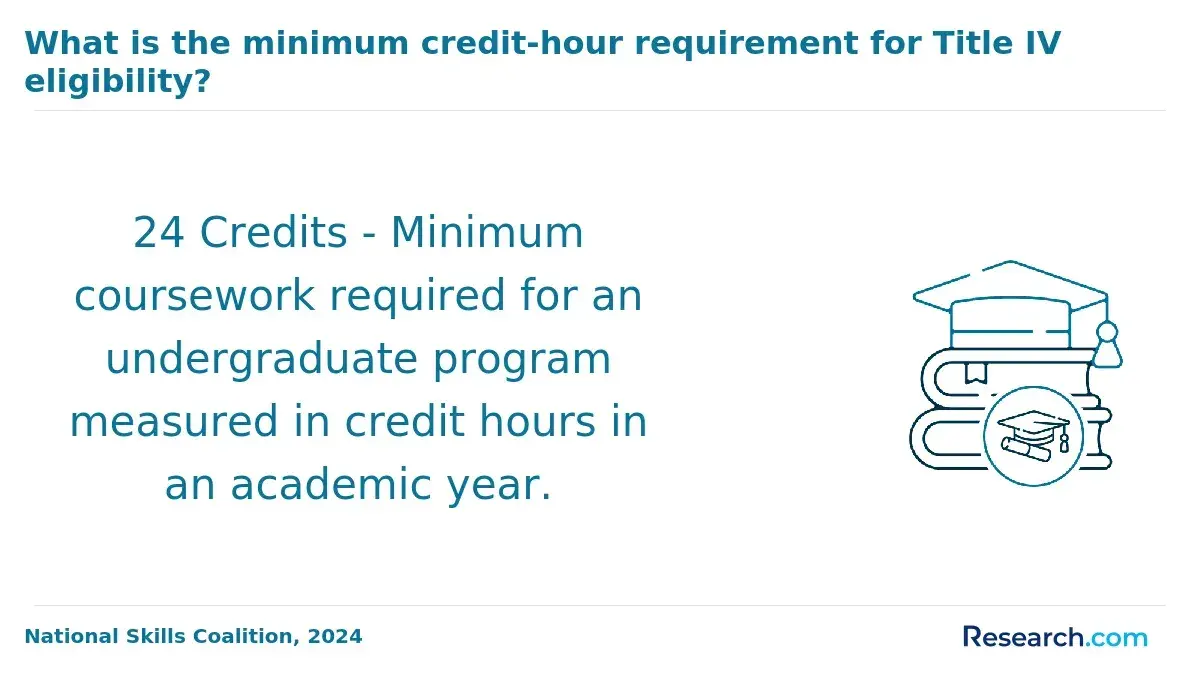
Many associate degrees require about 60 credits, but a student's remaining work depends on the degree audit, enrollment pace, course availability, and any prerequisites, labs, or clinical sequences. A full-time student starting without credit often plans for roughly two academic years; a working adult attending part time may need longer. Prior-learning credit can shorten the path only when it replaces outstanding requirements without violating minimum credits that must be earned at the institution.
For a U.S. public two-year benchmark, the College Board's 2024-25 published in-district tuition and fee figure is:
- $4,050 for one academic year; this is an average sticker price, not a quote for a particular program or the total cost of a degree.
Compare personalized estimates that include mandatory fees, PLA charges, books, equipment, travel for required in-person work, and the credits left after evaluation. Residency status and financial aid can substantially change what a student pays. Ask whether the program is eligible for federal aid and whether employer assistance covers assessment fees; do not assume that earning PLA credit itself produces an aid payment or a refund.
What Careers and Salaries Can These Associate Degrees Lead To?
Career outcomes depend on the field, the employer, and credentials beyond the associate degree. Business and criminal justice programs may support entry-level administrative or public safety paths; IT programs can support technical support work; health information programs may prepare students for records or coding roles subject to employer requirements. Psychology is principally a foundation for further study, not a license to provide counseling.
Nursing illustrates why occupational data need careful interpretation. The U.S. Bureau of Labor Statistics reports a May 2024 median annual wage of $93,600 for registered nurses and projects 5% employment growth from 2024 to 2034. These figures describe the occupation, not the earnings or placement rate of ADN graduates. Becoming a registered nurse also requires meeting state licensing rules and passing the NCLEX-RN. Use occupational figures to evaluate a possible destination, then ask colleges for program-specific completion, licensure-exam, and employment information where available.
How Can Students Choose a Reputable Program With Transfer and Licensing Options?
Choose the program that turns your verified learning into useful degree credit at an acceptable total cost - not the one advertising the largest theoretical credit award. Before enrolling, request a written evaluation and compare it with your career or transfer objective.
These checks expose the most consequential differences between otherwise similar programs.
- Confirm institutional accreditation and, for a regulated career, applicable program approval and state licensing eligibility.
- Ask which proposed credits meet general education or major requirements, which count only as electives, and which must be earned through the college.
- Request the remaining-course plan, assessment charges, tuition and mandatory fees, delivery requirements, and a realistic schedule at your intended enrollment pace.
- If transferring, ask the destination bachelor's institution whether each prior-learning award will apply to the intended major, not just whether it will accept the associate degree.
Skipping the destination-school check is a common and costly mistake: credit accepted toward one associate degree may not satisfy a bachelor's major. If your longer-term goal requires a bachelor's degree, compare the full pathway rather than assuming the fastest associate option is best. An accelerated bachelor's route, such as those discussed in the best 1 year bachelor degree online, also requires close scrutiny of entry-credit assumptions and remaining requirements.
Other Things You Should Know About
Generally, no. Colleges award assessed credit for demonstrated college-level learning and still enforce degree, general education, and residency requirements. A résumé alone is not a degree.
Not necessarily. The receiving college decides whether to accept it and whether it applies to your intended major. Get that decision from the destination institution before relying on the credit.
It may. Submit the appropriate military education transcript and ask the college to evaluate training against its current degree requirements. An award of elective credit may not reduce required coursework.
Use an approved certification or exam when it already matches a required course; a portfolio may help when substantial learning lacks a recognized credential. Compare evaluation fees, required evidence, and the specific credit each route could earn.
References
- Rule 3358:5-7-12 | Prior learning assessment policy. https://codes.ohio.gov/ohio-administrative-code/rule-3358:5-7-12
- Credit for Prior Learning - Ohio Department of Higher Education https://highered.ohio.gov/students/adult-learners/credit-for-prior-learning
- TNReconnect | Prior Learning Assessment Information https://tnreconnect.gov/Choose-a-Degree-College-Path/Prior-Learning-Assessment-Information
- Prior Learning Assessment - Westminster University https://westminsteru.edu/professional-and-continuing-education/prior-learning-assessment.html
- Transferring Credits - Cuyahoga Community College Catalog - Tri-C https://catalog.tri-c.edu/transfer-information/transferring-credits/
- Academic Catalog | USC Upstate Academic Catalog https://academic-catalog.uscupstate.edu/academic-regulations/credit-prior-learning/
- AA109-H General Education Requirements Policy | UT System Policies https://policy.tennessee.edu/procedure/aa109-h-general-education-requirements-policy-academic-affairs/
- How Transfer Credits Work | Lackawanna College https://www.lackawanna.edu/college-transfer-credits-guide/
- Credit for Prior Learning (CPL) Glossary | NCCCS https://www.nccommunitycolleges.edu/credit-for-prior-learning-glossary/
- Transfer credit policies - Office of Admissions https://admit.washington.edu/apply/transfer/policies/