
2027 An MHA After a Bachelor's in Statistics

Co-Founder and Chief Data Scientist
A statistics degree gives you tools for analyzing healthcare data, but it does not automatically prepare you to manage a hospital department, budget, or care-delivery team. A Master of Health Administration (MHA) can bridge that gap - if healthcare leadership is the career you want. This guide is for statistics graduates weighing an MHA against more technical or broader business degrees. It explains what you can bring to an MHA program, where you may need preparation, and how to judge programs, costs, and career possibilities before committing.
Key Things You Should Know
- Yes. A bachelor's degree in statistics can qualify you to apply to MHA programs; individual schools set their own prerequisites and experience requirements.
- An MHA is most useful if you want to turn quantitative evidence into healthcare operating decisions. For advanced statistical research, a biostatistics degree may be more direct.
- Do not treat management pay as an MHA starting-salary estimate: the U.S. median for all management occupations was $126,520 in May 2025 and includes experienced managers across industries.
What is an MHA after a bachelor's degree in statistics?
An MHA is a graduate degree focused on running healthcare organizations and services. It typically connects finance, operations, policy, quality improvement, and leadership. Your statistics training helps you interpret evidence; the MHA teaches you to make decisions with that evidence while accounting for patients, staff, regulations, and limited resources.
You generally do not need a second bachelor's degree in healthcare administration before applying. If you have not yet completed your first bachelor's degree, understanding healthcare administration articulation and transfer options may help with undergraduate planning; those pathways are not a prerequisite for statistics graduates who already hold a bachelor's degree.
Can you get into an MHA program with a statistics degree?
Yes, potentially. A statistics major is not inherently disqualifying, and quantitative preparation can strengthen an application. Requirements vary: one program may welcome recent graduates, while another may expect professional experience or ask applicants without healthcare experience to complete introductory coursework or an internship.
Review each school's published requirements for GPA, prerequisites, recommendations, essays, testing policies, and work experience rather than assuming a common MHA admissions standard. If you have not worked in healthcare, comparing MHA experience requirements for non-healthcare applicants can help you identify programs worth investigating.
In your application, connect your statistical work to a healthcare decision: for example, explaining uncertainty in a hospital-capacity forecast or identifying bias in a quality measure. Healthcare volunteering, informational interviews, or relevant employment can also help you test your interest and explain why you want to move from analysis toward administration. These are ways to prepare, not universal admission requirements.
Why choose an MHA with a statistics background?
Statistics graduates can spot weak comparisons, assess whether an apparent improvement is meaningful, and communicate uncertainty. Those skills matter when administrators evaluate staffing, patient access, costs, and quality. The added value of an MHA is learning who makes those decisions, what constraints they face, and how to lead implementation - not simply learning more data methods.
The best degree depends on the work you want to own. This comparison separates organizational leadership from technical analysis and other healthcare-focused paths.
| Degree path | Best fit for a statistics graduate seeking to... | Important limitation |
| MHA | Manage healthcare services, operations, or improvement initiatives | Does not replace clinical credentials or extensive management experience |
| Biostatistics or applied statistics master's | Deepen statistical modeling, study design, or research methods | Usually offers less preparation for organizational leadership |
| Healthcare-focused MBA | Build broad business-management skills with healthcare applications | Healthcare-specific depth depends on the actual curriculum |
| MPH | Focus on population health, prevention, or public-health systems | May be less focused on managing a healthcare organization |
Healthcare administration is also different from managing health records and information systems. If data governance or medical-records operations interest you more than service-line leadership, examine how healthcare administration differs from an HIM degree before choosing a program.
MHA curricula commonly cover healthcare finance, organizational leadership, policy and regulation, operations, quality improvement, and strategy. Programs may add health informatics, analytics, a capstone, an internship, or an administrative residency. The exact mix matters: a statistics graduate may need more practice with budgeting, reimbursement, and leading people than with introductory data interpretation.
Look for assignments that require you to explain an analysis to a nontechnical decision-maker, evaluate competing operational priorities, or design an improvement that a team could implement. If you prefer general business education, compare the MHA curriculum with low-cost healthcare management MBA options online. An MBA's broader management core is not the same as an MHA's healthcare-centered training, and an individual healthcare elective does not necessarily constitute a formal concentration.
Neither format is automatically better. An online MHA may suit someone who already has healthcare employment and wants to apply coursework at work. A campus program may be more useful to a recent statistics graduate seeking local employer contacts, structured experiential learning, or a substantial career change. The deciding factor is access to relevant experience, not where lectures appear on a screen.
For any online option, ask whether classes meet live, whether group work requires scheduled attendance, whether internships must be arranged locally, and whether visits to campus are required. Compare those details - not just the "online" label - when reviewing MHA degree choices through online universities. Also ask who helps students without healthcare contacts find practical placements and whether online students receive the same career-service access as campus students.
Completion time depends on credit requirements, enrollment intensity, course sequencing, and any required internship or residency. A full-time route may span roughly two academic years; part-time study generally takes longer. An accelerated calendar can shorten the elapsed time without reducing the work required, so check whether its course load is manageable alongside employment.
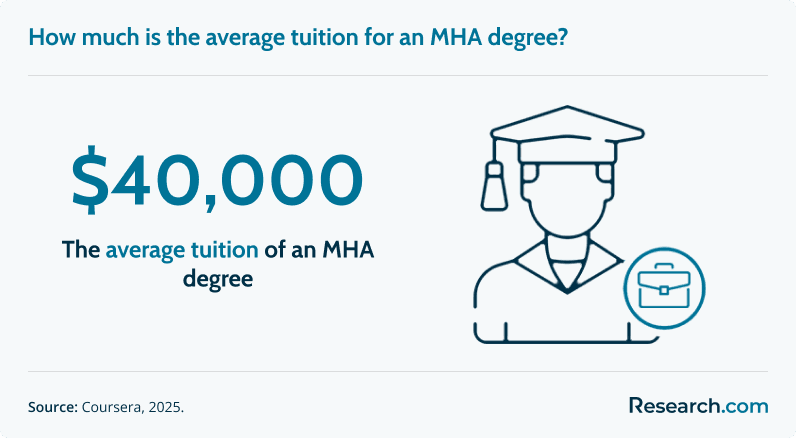
Schools may quote tuition per credit, per term, or for an entire program. To compare offers, calculate tuition using each program's required credits and published rate, then add mandatory fees, books or software, travel, and any costs associated with a placement. Ask whether an internship requires time away from paid work. Lower-tuition master's pathways in health administration are worth comparing, but the lowest advertised tuition is not necessarily the lowest total cost.
If your employer offers education assistance, confirm that the MHA, school, and course schedule qualify before counting that support. Borrowing also adds financing costs; compare the amount you would need to fund with a realistic career path rather than assuming a degree will produce an immediate raise.
Start by checking the institution's recognized accreditation, then check the specific MHA program's status with the Commission on Accreditation of Healthcare Management Education (CAHME). Institutional accreditation and CAHME programmatic accreditation answer different questions; do not infer that every graduate program at an accredited university is CAHME-accredited. Verify current status directly with the accreditor and school.
A guide to evaluating accredited universities for a health administration degree can help you think about institutional recognition, but a bachelor's-program listing does not establish an MHA program's accreditation or fit.
After that initial check, compare the curriculum against your gaps, the availability of internships or applied projects, total cost, scheduling constraints, and career support for students entering healthcare from another field. Ask each program where recent students completed practical experiences and whether it can document outcomes relevant to your goal. A strong analytics course matters less if your primary need is supervised healthcare management experience.
Your first role depends heavily on prior experience. A statistics graduate without healthcare employment may be more competitive initially for an analyst or project role than for a department-director position. An experienced healthcare analyst may be able to use an MHA to pursue broader responsibility for budgets, teams, or service performance.
These paths illustrate how your existing skills and the experience you build can shape the transition.
| Potential path | Typical contribution | What to build beyond statistics |
| Healthcare operations or quality analyst | Interprets performance measures and supports improvement work | Knowledge of care delivery and communication with operational teams |
| Service-line or practice manager | Coordinates staffing, budgets, workflows, and performance | Supervisory experience and financial accountability |
| Healthcare improvement project manager | Coordinates a defined change across departments | Stakeholder management and implementation experience |
Administrative fellowships can offer structured experience, but eligibility and placement are competitive and vary by employer. Senior leadership normally requires a record of managing people and results after graduation. A doctorate is not the default next step; if you eventually pursue advanced leadership or academic work, examine healthcare leadership doctoral completion paths and requirements against the experience those roles actually demand.
There is no reliable single salary for the combination of an MHA and a statistics bachelor's degree. Pay depends on the occupation, employer, location, management responsibility, and prior experience. The U.S. Bureau of Labor Statistics reports a $126,520 median annual wage in May 2025 for management occupations as a group. That figure covers managers across industries and career stages; it is not an MHA graduate salary or a reasonable starting-pay promise.
For a useful personal estimate, compare posted pay for the specific roles you could qualify for now with roles you could plausibly reach after gaining healthcare and supervisory experience. Then weigh the difference against the degree's full cost and any income you might give up while studying. If you are comparing an MHA with an MBA, review quicker healthcare management MBA degree routes as one scheduling option, but compare their healthcare coursework and total costs before assuming a faster program offers better value.
What certifications or licenses do MHA graduates need?
An MHA does not, by itself, grant a clinical license, and most healthcare administration jobs do not have one universal MHA-specific license. Requirements attach to the particular job: for example, a role that involves licensed clinical practice still requires the relevant clinical credential. Some administrator positions, particularly nursing home administrator roles, have state-specific licensure requirements. Check the applicable state board before choosing coursework for a regulated role.
Optional credentials in areas such as project management, quality, or health information may be useful when they match a target job, but they do not substitute for required experience or licensure. Nor is a doctorate generally necessary for an administrative career. If you later consider one, online healthcare administration doctoral formats compared can help distinguish those programs' purposes; a doctoral degree does not create a clinical license.
Other Things You Should Know About Healthcare Administration
Possibly, but do not count on it. Graduate transfer policies typically address prior graduate coursework, and schools decide whether any course satisfies an MHA requirement. Request a written credit evaluation before enrolling.
Not necessarily. A quantitative background does not determine a graduate program's designation. Ask the school about the designation of its specific program if it matters to your plans.
No. Programs may use a capstone, applied project, internship, or other culminating requirement instead. Check the curriculum and ask whether you can complete a project relevant to your career goal.
No. An internship is usually part of a student's program; an administrative fellowship is generally a separate, competitive professional development opportunity, often pursued around graduation. Confirm eligibility and timing with the employer.
- Healthcare Analytics - StatPearls - NCBI Bookshelf - NIH https://www.ncbi.nlm.nih.gov/books/NBK614158/
- Accreditation in the U.S. | ed.gov http://www.ed.gov/laws-and-policy/higher-education-laws-and-policy/college-accreditation/accreditation-in-the-us
- The imperative of professionalising healthcare management | nih.gov https://pmc.ncbi.nlm.nih.gov/articles/PMC11401068/
- Evaluating Online MHA Programs - Graduate Programs | The University of Scranton https://gradadmissions.scranton.edu/blog/articles/healthcare/evaluating-online-mha-programs.shtml
- MHA or MPH? Salary, career path, and ROI | USC Price https://priceschool.usc.edu/price-blog/mha-or-mph-salary-career-path-and-roi/
- What Can You Do with an MHA? | UCLA https://mha.ucla.edu/articles/what-can-you-do-masters-degree-healthcare-administration-mha/
- What Can You Do With a Master's in Health Administration? | Mass General Brigham University of Health Professions https://www.mgbu.edu/news-and-more/opinions/health-sciences/what-can-you-do-masters-health-administration
- Master of Health Administration - Online | UNT Health Fort Worth https://www.unthealth.edu/tcom/public-health/online-master-of-health-administration.html
- MHA Program Frequently Asked Questions at Moorhead | mnstate.edu https://www.mnstate.edu/academics/graduate/mha/questions
- Master of Health Administration (MHA) Capstone Projects | kgi.edu https://www.kgi.edu/degrees-and-programs/healthcare/master-of-health-administration/capstone-projects.html


