2027 A Room Utilization Observation Sheet: A Healthcare Administration Student Portfolio Project

Co-Founder and Chief Data Scientist
A room utilization observation sheet turns a common healthcare operations problem into a measurable student project: When are rooms in use, unavailable, or sitting idle? For healthcare administration students, the value lies in defining those states consistently, not simply producing a busy-looking spreadsheet.
This guide shows how to collect appropriate observations, calculate defensible measures, explain operational limits, and present findings without exposing patient information. It also helps you decide whether a prospective degree program offers the access and support needed to complete a credible portfolio project.
Key Things You Should Know
- Measure occupied room-hours against staffed, available room-hours. For example, 12 occupied hours out of 20 available hours is 60% utilization in an illustrative project.
- Record turnaround, scheduled closures, and idle time separately. An empty room is not necessarily available for another patient.
- A strong portfolio shows observation rules, privacy safeguards, calculations, limitations, and a feasible operational recommendation, not just a utilization percentage.
What Is a Room Utilization Observation Sheet in Healthcare Administration?
A room utilization observation sheet is a structured log of how a defined set of healthcare spaces is used during a defined period. A student might observe outpatient exam rooms, imaging rooms, or treatment bays, provided the facility approves the project. Each entry assigns a room and time interval to a state such as occupied, being prepared for the next use, available but idle, or closed.
The sheet supports a management question: whether space, staffing, and scheduling are aligned. It does not assess clinical quality or establish why an individual patient waited. The distinction matters when comparing this project with work centered on health records. Healthcare administration versus HIM curriculum and career options can help students identify which type of project fits their interests.
How Do Students Complete a Healthcare Room Utilization Observation Sheet?
Start with permission, a narrow question, and a recording method that staff can understand. A small, consistently observed sample is more defensible than a larger log with uncertain timestamps.
- Obtain instructor and facility approval; establish permitted locations, hours, data fields, and storage rules before observing.
- Define each room state and its start and end points, like when a patient leaves versus when cleaning is complete.
- Choose a sampling window that includes the hours relevant to the question, and note whether it misses peak days or shifts.
- Record room states at the agreed intervals or transitions, along with operational context such as staffing or scheduled closures.
- Check entries for missing intervals and conflicting states, then calculate measures and discuss findings with an authorized site contact.
Never record patient names, record numbers, or other identifiers merely to make the sheet more detailed. Students moving through associate-to-bachelor's credit planning in healthcare administration should also ask whether an approved field project is required at their current institution or only after transfer.
What Skills Does This Healthcare Administration Portfolio Project Demonstrate?
The project demonstrates more than spreadsheet proficiency. Clear state definitions show operational judgment; consistent observation shows data discipline; and an explanation of what the sample cannot prove shows analytical restraint.
A useful recommendation also connects a finding to a decision someone could make, such as reviewing turnover processes before proposing another room.
These skills are relevant to operations coordination, practice management, and quality-improvement support. They do not, by themselves, qualify a student to manage a facility or make clinical decisions.
Students comparing job pathways for healthcare administration graduates should match their portfolio examples to the responsibilities and experience requirements of specific roles.
The sheet needs enough detail to reconstruct each room's observed time without identifying patients. The following fields separate demand for space from the reasons space cannot be used.
| Field | What it captures |
| Room code and service area | A consistent, non-patient identifier and the room's operational context |
| Date and observation window | When the sample was collected |
| State and start/end times | Occupied, turnaround, available-idle, or closed intervals |
| Reason for closure, if known | Staffing, maintenance, scheduled closure, or another approved category |
| Observation method and notes | How states were determined and any missing or uncertain entries |
Use categories appropriate to the site: an exam room and an operating room have different preparation requirements. When choosing an accelerated health administration bachelor's, ask whether the program allows enough time to secure a site, agree on these fields, and complete the observations.
First specify the denominator. For a basic occupancy measure, divide occupied room-hours by staffed, available room-hours during the observation window. Exclude scheduled closures from that denominator if the question is how effectively available capacity was used; retain and report them separately if the question is whether the facility has enough total capacity.
Consider an illustrative observation of two staffed rooms over a 10-hour window each. If the rooms account for 12 occupied hours, three turnaround hours, and five available-idle hours, occupied utilization is 12 ÷ 20, or 60%. The remaining time is not all usable spare capacity: turnaround must occur before the next appointment.
Check that every room-minute belongs to one state and that totals reconcile with the observation window. Then compare patterns by hour or day only if the sample supports it. A short convenience sample cannot establish typical demand, and high utilization alone cannot show whether patients received timely care.
Students who want deeper operations or analytics study can review shorter online graduate healthcare management pathways, checking actual course content rather than assuming an accelerated degree includes advanced statistical training.
Rooms connect scheduling to staffing, equipment, cleaning, and patient flow. Persistent idle time during staffed hours may suggest mismatched appointment patterns; crowded periods may indicate a bottleneck.
Neither observation proves that adding or removing a room is the right response. Staff availability, visit length, preparation requirements, and demand at other times can change the conclusion.
A practical recommendation therefore names a testable change and a balancing measure. For example, a team might trial a revised room-assignment process and track both idle time and delays, rather than maximizing occupancy at the expense of flexibility.
Students interested in leading such decisions can examine healthcare-focused MBAs with accelerated schedules, while recognizing that an MBA's broad management training is not a substitute for site-specific operations experience.
Healthcare operations courses help students define capacity and process states; statistics and business analytics courses support valid calculations and sampling; quality-improvement courses help frame a limited test of change. Health law or ethics coursework can inform privacy and organizational approvals. A capstone or practicum may bring these elements together, but its format varies by program.
An MHA may offer more directly focused healthcare operations study than a general MBA, while an MBA may be useful for broader budgeting and organizational management goals. Compare actual assignments and practicum access in health administration master's degrees offered online; a relevant course title alone does not establish that students can conduct a site-based project.
Present the work as a decision brief rather than a raw log. State the operational question, site type, approved observation window, room-state definitions, denominator, principal finding, and one recommendation. A simple chart of states by time of day can make the pattern visible, provided it does not reveal sensitive schedules or patient details.
Include a short limitations statement: observation may cover only selected rooms or shifts, and the project cannot isolate causes without additional evidence. Obtain permission before displaying any facility-derived material publicly; if permission is unavailable, use a clearly labeled synthetic example.
Students comparing online MHA degree options and CAHME program accreditation can ask how programs support competency-based capstones and whether students may retain a shareable, appropriately cleared work sample.
Students can practice translating observations into capacity measures, discussing constraints with staff, and communicating uncertainty to a manager. Those are transferable skills for entry-level operations, scheduling, and improvement roles. Advancement still depends on relevant work experience, the employer's expectations, and the scope of responsibility a candidate has held.
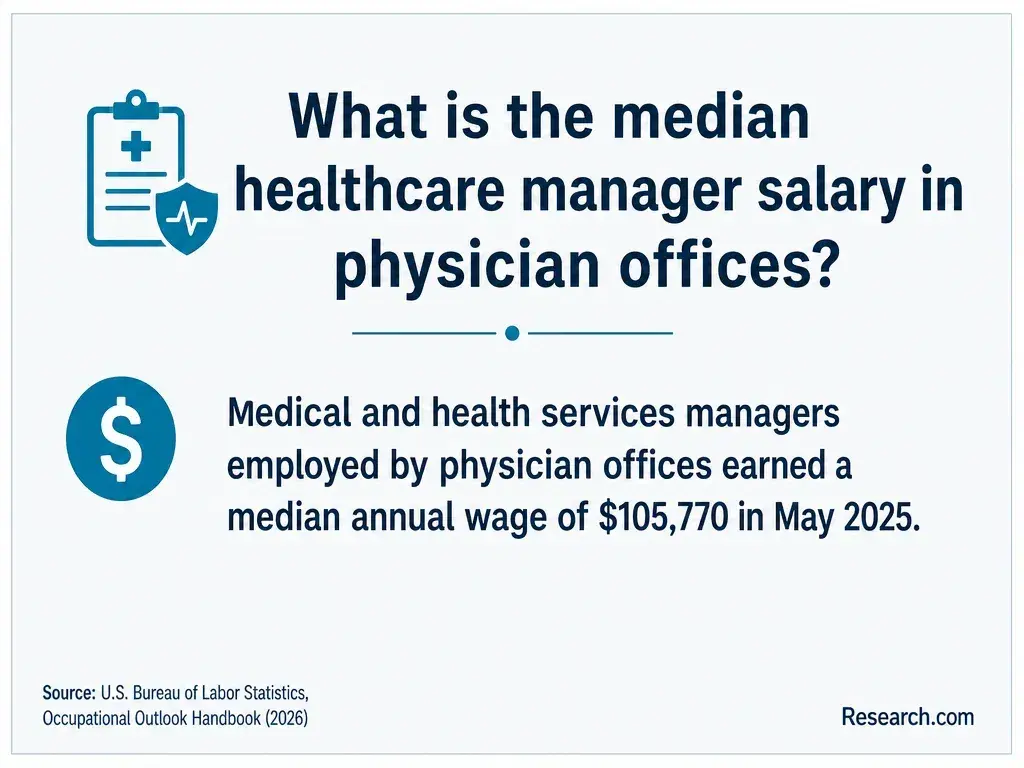
For context, the U.S. Bureau of Labor Statistics reports a median annual wage of $126,520 for management occupations as a group in May 2025. That figure is not a starting salary for healthcare administration graduates or a return attributable to this project.
A student considering an MBA should weigh its broader management coursework against the more direct experience an operations role might provide. Meanwhile, doctoral study serves a different purpose, and understanding time-to-completion in healthcare administration doctorates is useful only if your goal extends to sustained advanced research or leadership study.
How Should Students Choose a Healthcare Administration Program for Portfolio Experience?
Ask programs for an example of an approved capstone or practicum deliverable and verify who arranges the site, what happens if access falls through, and whether remote students can use an employer site. Also ask whether students receive feedback on data definitions, privacy, analysis, and executive-style presentation. These answers are more useful for this goal than a general promise of "hands-on learning."
Compare the total cost and time required with the experience you expect to gain. An undergraduate program may fit someone building foundational skills; an MHA may fit a healthcare-specific management goal; an MBA may fit someone seeking broader business leadership preparation.
If the immediate goal is one credible project, employer-supported improvement work or a targeted course may be more efficient than another degree. Use compare tuition for online healthcare administration degrees guides as a starting point, then verify current tuition, fees, project requirements, and site-access policies with each school.
Other Things You Should Know About Healthcare Administration Programs
Not generally for an administrative observation project. A facility may still restrict where students can go and what they may observe; the project does not authorize clinical work.
It depends on the activity and applicable institutional policies. A facility or school should determine whether a proposed project is operational improvement, classroom work, or human-subjects research before data collection begins.
Only with authorization and appropriate safeguards. System timestamps may not correspond to actual room occupancy, so students must validate what each field means before using it.
Ownership and permission to share depend on the school's and facility's agreements. Students should obtain written guidance before publishing a deliverable, even if they remove patient identifiers.
- Using Technologies for Data Collection and Management | cdc.gov https://www.cdc.gov/field-epi-manual/php/chapters/data-collection-management.html
- Understanding sources of bias in research - PMC - NIH https://pmc.ncbi.nlm.nih.gov/articles/PMC12229048/
- Patient Confidentiality - StatPearls - NCBI Bookshelf - NIH https://www.ncbi.nlm.nih.gov/books/NBK519540/
- Summary of the HIPAA Privacy Rule | hhs.gov https://www.hhs.gov/hipaa/for-professionals/privacy/laws-regulations/index.html
- Using Portfolios in Program Assessment | Assessment and Curriculum Support Center https://manoa.hawaii.edu/assessment/resources/using-portfolios-in-program-assessment/
- Innovation and Best Practices in Health Care Scheduling | NAM https://nam.edu/perspectives/innovation-and-best-practices-in-health-care-scheduling/
- The Ultimate Guide to Exam Room Management | QGenda https://www.qgenda.com/blog/the-ultimate-guide-to-exam-room-management/
- Observation Care Payments to Hospitals FAQ | ACEP https://www.acep.org/administration/reimbursement/reimbursement-faqs/observation-care-payments-to-hospitals-faq