2027 How to Build a Strong SLP Graduate School Application From Scratch

Co-Founder and Chief Data Scientist

Reviewed by Rhea Paul, PhD
SLP Education & Research Expert
Many applicants with undergraduate degrees outside speech pathology face uncertainty when preparing graduate school applications. They often struggle to demonstrate relevant skills and meet prerequisites, creating barriers to entry in this competitive field. Without clear guidance, candidates risk submitting weak applications or missing crucial steps that could improve their chances. This challenge can delay or derail career pivots into speech pathology, especially for those needing flexible, accredited programs.
This article outlines practical strategies to build a strong speech pathology graduate school application from scratch, helping prospective students present compelling profiles and navigate admissions requirements effectively.
Key Things You Should Know
- Applicants must present a competitive GPA, with 3.5+ being the average for admission to accredited speech pathology graduate programs in 2025.
- Clinical experience, including at least 100 observation hours, is essential and strongly correlates with acceptance rates across top U.S. programs.
- Strong letters of recommendation from speech pathology professionals significantly enhance applications, reflecting key candidate competencies and readiness for graduate-level work.
What is a strong SLP graduate school application?
A strong SLP graduate school application components focus on academic excellence and relevant clinical experience. Admissions committees typically look for a competitive GPA above 3.5, backed by rigorous coursework in communication sciences, linguistics, biology, and psychology. Standardized test scores may also influence decisions depending on the program.
Hands-on experience in diverse clinical settings, such as volunteering at speech clinics or internships with different client populations, further demonstrates understanding of speech pathology roles. The personal statement plays a key role by explaining your motivation and how past experiences shaped your career goals. Strong letters of recommendation from professors or clinicians should emphasize your analytical thinking, empathy, and teamwork.
The key elements of a competitive speech pathology graduate application include meeting educational prerequisites, showing real-world involvement, and aligning with specific program goals. Timely submission is vital given the projected 17% employment growth in this field from 2025 to 2035, creating about 13,700 annual job openings according to the U.S. Bureau of Labor Statistics.
Applicants should tailor their materials by researching each program's mission and requirements. For those seeking flexibility and affordability, exploring the best online SLP programs can offer additional pathways to success.
What are SLP graduate program admission requirements?
Admission requirements for speech pathology graduate programs typically include a bachelor's degree in communication sciences and disorders or a related field, with a minimum cumulative GPA around 3.0, though many competitive programs expect 3.5 or higher. Prerequisite courses often cover anatomy, physiology, linguistics, speech science, and hearing science. Clinical experience, either volunteer or paid, is essential to demonstrate commitment and understanding of the field.
Many programs require the GRE, but some have recently waived this testing; applicants should check specific program policies. Strong letters of recommendation from academic advisors and clinical supervisors are vital, attesting to both academic abilities and interpersonal skills. Personal statements allow candidates to express career goals and motivation, while some programs include interviews to evaluate professionalism and communication skills.
Statistics from ASHA's CSD Education Survey indicate an average acceptance rate of 42% for master's SLP programs, with the most competitive accepting just 18-25%. This underscores the importance of meeting all SLP graduate program application criteria and submitting well-prepared materials. Additional requirements may include background checks and immunization records, showing the need for early preparation and thorough research.
Prospective students should also explore career opportunities after graduation; resources like speech language pathologist jobs provide valuable insights into potential paths and earning potential within the profession.
How do I choose the best SLP graduate programs?
Choosing the best speech pathology graduate programs in the United States involves assessing several key factors aligned with your goals. Prioritize programs accredited by the Council on Academic Accreditation in Audiology and Speech-Language Pathology (CAA) to ensure the curriculum meets national standards and prepares you for certification.
Competitive applicants typically have a cumulative GPA around 3.7, with most exceeding 3.5 in essential prerequisite courses such as anatomy and statistics (ASHA CSD Education Survey). Evaluating your academic profile against these benchmarks can guide application strategy.
Consider top accredited speech pathology master's programs for graduate applicants that offer specialized tracks or faculty expertise, especially if you are interested in working with pediatric populations or other focused areas. Clinical practicum experiences in diverse environments like hospitals, schools, and rehab centers are crucial for hands-on learning.
Location and program length impact practical choices. Some students may prefer accelerated speech pathology programs online that offer flexibility along with clinical opportunities near supportive networks. Financial aid and tuition costs also influence program affordability and reduce stress during graduate studies.
Review outcome metrics such as graduation rates, certification exam pass rates, and employment statistics. Programs excelling in these areas are often more effective at preparing students for ASHA's Certificate of Clinical Competence. Speaking with current students or alumni can provide valuable insights into the program's academic rigor and mentorship quality.
The Council on Academic Accreditation in Audiology and Speech-Language Pathology (CAA), operating under the American Speech-Language-Hearing Association (ASHA), is the primary accrediting body for SLP programs accredited by the American Speech-Language-Hearing Association. This accreditation ensures that graduate programs meet strict standards in curriculum, clinical training, faculty qualifications, and student outcomes. Graduates from CAA-accredited programs become eligible to take the Praxis exam and obtain licensure and certification.
Non-accredited programs often fall short of the educational requirements crucial for certification and licensure, significantly limiting career opportunities. Accreditation guarantees training aligned with current professional standards and prepares students to provide evidence-based care. Applicants should also confirm prerequisite coursework; for example, in 2025, 92% of accredited graduate programs in speech pathology in the United States required statistics, with admitted students averaging a 3.8 GPA in that subject-highlighting its importance for research comprehension and evidence-based practice.
Regional accreditation from agencies like the Higher Learning Commission may affect institutional recognition but does not replace CAA accreditation specific to speech pathology training. Prospective students should seek programs maintaining CAA accreditation to ensure licensure portability across states. Verify accreditation through ASHA's directory or program disclosures before applying.
For those exploring options, online speech pathology programs can offer accessible pathways while maintaining accreditation standards.
The slp graduate program curriculum integrates academic coursework with clinical training. Core classes generally cover anatomy and physiology of speech and hearing, language development, phonetics, audiology, neuroanatomy, and speech disorders across the lifespan. Students also study evidence-based practice and research methods specific to speech pathology assessments and treatments.
Clinical practicum experience is essential. Accredited programs require supervised hands-on hours from ASHA-certified educators. According to the 2024 ASHA survey, admitted students average 125 clinical observation hours, with at least 25 guided hours emphasized to build practical readiness and direct client interaction skills early on.
Curricula balance foundational knowledge and applied practice, often starting with observation and diagnostics before advancing to treatment planning and intervention techniques. Specialized tracks may be available for pediatric, adult neurological, or augmentative communication disorders.
Many programs include research projects or theses to develop critical thinking and evidence synthesis. Clinical placements vary across schools, hospitals, rehab centers, and private practices, broadening experience and adaptability.
Prospective students should ensure programs exceed ASHA minimum standards for clinical hours and coursework. Ask about faculty expertise, clinical site diversity, and student support to plan academic and clinical commitments strategically.
Several online speech pathology graduate programs offer a flexible blend of asynchronous courses and required in-person clinical practica, meeting certification criteria while accommodating students who cannot attend traditional campus-based classes. Fully online degrees remain uncommon due to the profession's essential hands-on clinical training.
Many accredited universities provide hybrid formats where theoretical coursework is completed remotely, but clinical experiences must occur at approved local sites. This setup benefits working professionals, parents, and students in remote locations. It's crucial to verify that practicum locations are recognized by the student's state license board and that programs hold accreditation from the Council on Academic Accreditation in Audiology and Speech-Language Pathology (CAA).
Applicants should prepare for a demanding curriculum that requires strong time-management and self-discipline. The personal statement is critical; a 2024 Council of Academic Programs in Communication Sciences and Disorders survey found 75% of admissions committees equal its importance to GPA. Crafting a unique narrative linking personal experiences with speech pathology goals enhances application strength.
Key considerations before enrolling include:
- Clarifying how clinical hours align with state licensure requirements
- Assessing technology needs for online coursework
- Confirming program accreditation status
- Understanding program length and financial aid availability
- Direct communication with admissions counselors can help resolve questions about balancing online study and clinical requirements.
Most graduate programs in speech pathology in the U.S. take between two and three years to complete, depending on whether students enroll full-time or part-time. Full-time enrollment typically involves 24 to 36 months of coursework, clinical practicum, and a final research or capstone project. Part-time students benefit from flexibility but should be prepared for a longer timeframe and solid time management skills.
Tuition costs vary widely by type of institution and residency status. Public universities commonly charge between $20,000 and $40,000 annually for in-state students, while out-of-state and private schools may exceed $50,000 per year. Additional expenses like books, clinical fees, and licensing exam preparation push total costs to a range of $60,000 to over $150,000 for the entire program.
Strong letters of recommendation are critical for admission success. Data shows applicants with at least three endorsements from communication sciences and disorders (CSD) faculty or licensed SLPs are 2.5 times more likely to be accepted, underscoring the value of early professional relationships through undergraduate studies or related employment.
Prospective students should explore financial aid options such as assistantships, scholarships, and employer tuition reimbursement. Additionally, part-time or accelerated options can help balance education with work or family commitments.
An SLP graduate degree opens diverse career pathways in healthcare, education, research, and corporate sectors. Graduates often work as licensed speech-language pathologists diagnosing and treating speech, language, cognitive-communication, and swallowing disorders. These roles span pediatric to geriatric populations in hospitals, outpatient clinics, rehabilitation centers, and nursing homes.
In schools, SLPs support students with communication challenges, collaborating with educators to implement individualized education programs (IEPs). Specializations may include assisting English language learners or children with learning disabilities. Early intervention programs also offer opportunities to provide therapy for infants and toddlers at risk of developmental delays.
Research and academia attract some graduates focused on communication sciences, assessment tool development, or teaching. Corporate settings provide roles in voice therapy and communication coaching for professionals including actors and executives.
With only 22% of SLP master's programs requiring the GRE-down from 65% five years ago according to the ASHA EdFind GRE filter report-clinical experience has become a key factor in employability. Obtaining specialized certifications such as swallowing disorders or augmentative and alternative communication (AAC) further broadens career options.
Salary and job outlook vary by setting and region but generally reflect strong demand. Matching your graduate training to specific practice areas and certifications can lead to successful career placement and growth.
The average salary for speech-language pathologists (SLPs) in the United States ranges from $65,000 to $90,000 annually, influenced by experience, location, and work setting. Entry-level SLPs typically start near $65,000, while those with specialized skills or years of experience can earn $90,000 or more.
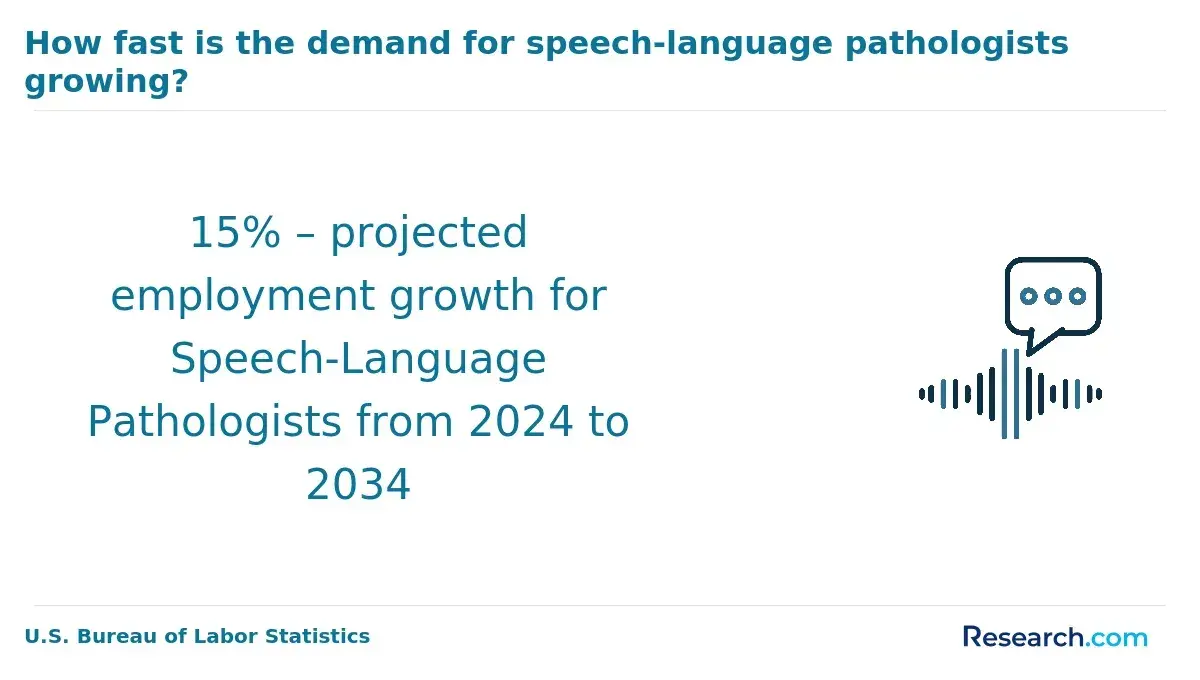
Employment growth for SLPs is projected at 17% from 2025 to 2035, driven by an aging population, greater awareness of speech disorders, and expanding healthcare and educational services.
Applicants to graduate programs in speech pathology face competitive admissions. Data shows successful applicants submitted an average of seven applications through CSDCAS, and applying to six or more programs increases acceptance chances to 68%. Strategic application efforts are essential for entering this growing field.
Location greatly affects salary and job availability: urban and healthcare-rich areas offer higher wages but more competition, while rural regions may have fewer openings but provide loan forgiveness and incentives.
Specializing in pediatric, geriatric, or voice disorders can improve job prospects and salary potential. SLPs in schools generally earn less than those in hospitals or private practice but benefit from more predictable schedules.
These factors help shape education and career strategies for those pursuing speech pathology.
What licensing is needed for SLP practice?
To become a speech-language pathologist (SLP) in the United States, earning the Certificate of Clinical Competence in Speech-Language Pathology (CCC-SLP) from the American Speech-Language-Hearing Association (ASHA) is crucial. This certification verifies that candidates have completed a master's degree in speech pathology from an accredited program, accumulated at least 400 supervised clinical hours, passed the Praxis Examination in Speech-Language Pathology, and finished a 36-week clinical fellowship under a certified mentor.
State licensure is also mandatory and varies by state. Requirements typically include holding an active CCC-SLP or equivalent credentials, passing a state jurisprudence exam, and undergoing a background check. Some states mandate continuing education for license renewal. For example, California requires a specific Speech-Language Pathology License aligned with ASHA standards but includes additional state-specific criteria. Certain states permit provisional licenses for new graduates during their clinical fellowship, allowing limited supervised practice.
The median starting salary for new SLP graduates is about $82,000, reflecting a 5-year return on investment of 250% after average tuition costs of $45,000 in public programs, according to the ASHA 2025 Graduate Debt and Salary Report. Early awareness of both certification and licensure pathways helps graduates navigate the process effectively and supports long-term career success.
Other Things You Should Know About Speech Pathology
Many SLP graduate programs expect at least a 3.0 undergraduate GPA, and competitive applicants often present a 3.5 or higher. Some programs also require a 3.0 in prerequisite science and communication courses, plus official transcripts from every college attended.
Yes, participating in undergraduate research related to communication sciences or disorders can strengthen your application. It shows your analytical skills and genuine interest in advancing knowledge within speech pathology. Research experience with faculty mentors in topics such as speech development, neurogenic disorders, or treatment outcomes is particularly valuable.
Letters of recommendation play a crucial role in the admission process. Strong references from professors, clinicians, or supervisors who know your academic abilities and work ethic can provide insight into your potential as a graduate student and future clinician. Ideally, recommenders should directly relate your skills to speech pathology and clinical readiness.
Most speech pathology graduate programs require applicants to complete foundational courses such as anatomy and physiology of the speech and hearing mechanisms, linguistics, psychology, and statistics. These prerequisites ensure you have a solid understanding of the scientific principles underlying speech disorders. Checking program-specific requirements is essential to align your undergraduate coursework accordingly.
- U.S. Bureau of Labor Statistics - Speech-Language Pathologists https://www.bls.gov/ooh/healthcare/speech-language-pathologists.htm
- ASHA EdFind - Accredited Speech-Language Pathology Programs https://find.asha.org/ed/
- O*NET OnLine - Speech-Language Pathologists https://www.onetonline.org/link/summary/29-1127.00
- California State University-Northridge - Master of Science in Communicative Disorders (Online) https://tsengcollege.csun.edu/programs/CDS
- Idaho State University - Master of Science in Speech-Language Pathology (Online/Distance Education) https://www.isu.edu/slp/programs-offered/slp-graduate-program/
- Maryville University - Master of Science in Speech-Language Pathology https://www.maryville.edu/masters/speech-language-pathology/
- University of North Carolina at Greensboro - Speech-Language Pathology, M.A. (Online) https://csd.uncg.edu/graduate/masters-of-arts-online/
- Nova Southeastern University - SLP Program - Master of Science in Speech-Language Pathology https://osteopathic.nova.edu/degrees/masters/speech-language-pathology/index.html