Interview With Academic Writing Software Experts: Answering Student’s Most Common Questions

Co-Founder and Chief Data Scientist
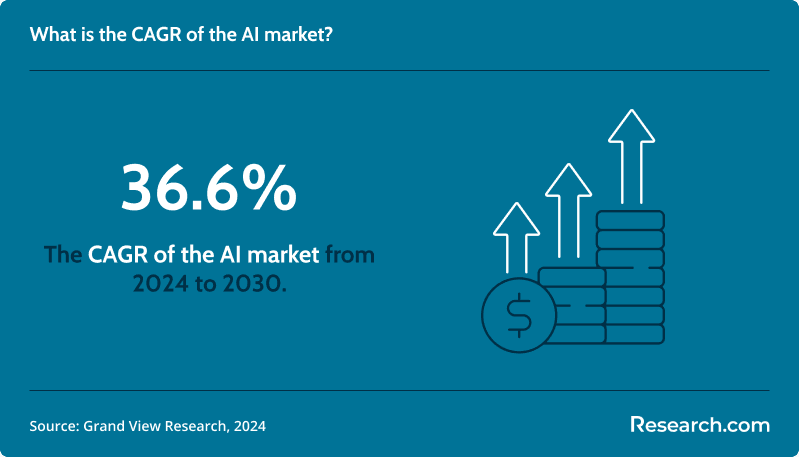
Students frequently express uncertainty regarding the use of academic writing software, not the least its affordability. This concern arises amidst a rapidly expanding market, driven by the increasing demand for content creation. The global AI writing assistant software market was valued at USD 1.7 billion in 2023 and is projected to experience a CAGR exceeding 25% through 2032.
To address these student queries, Research.com sat down with industry experts to discuss how academic writing software can aid students and what to expect from this technology in the years to come. We've consolidated relevant information to provide clarity on the utility and accessibility to help you make informed decisions about integrating these solutions into your academic workflow.
Experts We Interviewed
- Roop Reddy - Co-founder of AI research assistant Paperguide.
- Silvana di Gregorio, PhD - Product Research Director and Head of Qualitative Research at Lumivero.
- Oren Beit-Arie - Senior Vice President, Strategy & Innovation, Academia & Government, Clarivate
Table of Contents
- How does Paperguide solve academic writing/research problems, and what makes it unique?
- How does Citavi improve research structure and analysis beyond basic citation?
- How has EndNote adapted to the rise of AI and cloud-based tools in research?
- How will AI impact researchers/students in 5-10 years?
- What are the key trends in future reference management?
- Will AI research tools benefit specific fields more than others?
- How can reference tools support open access/science?
- Will AI make academic writing less essential in education, much like how calculators changed the way we view mental math?
- How can reference tools aid interdisciplinary/international research teams?
- Will AI change traditional academic publishing?
- Can AI/reference tools improve how scholarly impact is measured?
- How can students use AI paraphrasing tools to avoid plagiarism and improve sentence structure?
- How does the use of AI writing software affect the development of critical thinking and original thought in students?
How does Paperguide solve academic writing/research problems, and what makes it unique?
Paperguide solves academic writing and research problems by offering a unique, integrated AI platform. This platform accelerates research discovery, analysis, writing, and citation management, streamlining the process for researchers, students, and professionals.
- Roop Reddy: “Academic research takes a lot of time, especially when it comes to finding and analyzing papers for literature reviews or systematic/meta-analyses. Researchers often have to go through dozens, sometimes hundreds, of papers manually, which can take days or even weeks. Paperguide makes this process much faster by helping researchers quickly find relevant papers, extract key insights, and organize their findings. Most of the other AI research assistants are single-pointed solutions. With Paperguide, everything is connected. You don’t have to switch between different tools; research discovery, analysis, and writing all in one system.”
Paperguide directly addresses the time-consuming nature of academic research, as highlighted by Reddy, by offering an AI-powered system that streamlines key tasks. Specifically, it aims to accelerate the typically lengthy six to 18-month systematic review process. The platform achieves this by providing tools that enable users to discover, analyze, and synthesize papers more efficiently, thereby fostering stronger arguments and more comprehensive research—a direct response to the manual, time-intensive processes Reddy describes.
Furthermore, Paperguide's AI writing assistant tackles common writing challenges, such as document structure, clarity of ideas, and language quality—skills highly valued not only in academic research but also in fields like those pursued by students earning an online creative writing degree. It also simplifies citation formatting, a task often dreaded by many. Paperguide, as emphasized by Reddy, features an integrated workspace, a feature students will find convenient. Unlike single-purpose tools that necessitate switching between multiple applications, Paperguide offers a unified environment for research discovery, analysis, and writing, a feature we can expect in more platforms soon. This integration is designed to reduce the time and stress researchers face when juggling numerous academic responsibilities, effectively consolidating the research workflow into a single, efficient system.
How does Citavi improve research structure and analysis beyond basic citation?
Citavi improves research structure and analysis beyond basic citation by offering comprehensive knowledge organization and analysis tools.
- Silvana di Gregorio, PhD: “Citavi transcends conventional reference management by not only storing information but also structuring it into a coherent knowledge organization system. Researchers can systematically categorize and tag every source, note, quote, and insight, facilitating the retrieval and connection of related data. The tool allows users to tag selected text, diagrams, charts, and images from articles to specific themes or topics within a hierarchical outline. This outline can serve as the backbone for an article or report. Moreover, with the Citavi add-in for Word, this structured outline, along with the stored data, can be seamlessly imported to generate a preliminary draft of the document with all quotes, diagrams, and references accurately cited. As data continues to grow exponentially—doubling every 18 months—effective information management becomes crucial. Citavi acts as a central hub for organized knowledge, addressing the challenge of scattered data and improving productivity and research effectiveness.”
As di Gregorio highlights, Citavi aims to elevate research management beyond basic citation by offering tools for knowledge organization, task planning, and collaborative work. These features enable researchers to structure their work more effectively and conduct deeper analysis.
The software's ability to categorize, tag, and create hierarchical outlines, as described by di Gregorio, allows researchers to build a comprehensive understanding of their subject matter. This structured approach is particularly valuable, especially given findings that suggest 54% of citations have limited influence on citing authors. Tools like Citavi, by emphasizing impactful sources and ideas, directly address this challenge.
By integrating reference management with knowledge organization and writing assistance, Citavi, as di Gregorio points out, tackles the complexities of modern research. With academic literature expanding rapidly, tools that streamline processing, analysis, and synthesis are essential. These skills are highly applicable in various professional paths, addressing the common question, "What can you do with a masters in writing?" by demonstrating the practical, transferable skills acquired through advanced research and writing processes.
Citavi's features, by fostering structured academic writing, directly support more effective scholarly work and, by extension, enhance the capabilities of individuals pursuing advanced writing-focused careers. This echoes di Gregorio's emphasis on organized knowledge as a central hub for research productivity and professional development.
How has EndNote adapted to the rise of AI and cloud-based tools in research?
EndNote has significantly evolved in response to the rise of AI and the increasing demand for cloud-based research workflows, particularly with the release of EndNote 2025.
- Oren Beit-Arie: “EndNote has supported researchers for over three decades, and throughout that time, it has continually evolved to meet the changing ways research is done. Today, it’s more than just a reference manager — it’s a connected, intelligent research assistant.”
Over ten years ago, EndNote introduced cloud-based syncing, which allowed users to access their libraries from anywhere, automatically back up their work, and collaborate in real time. They also began integrating machine learning with tools like Manuscript Matcher to help researchers find the right journals for their work.
With the launch of EndNote 2025 in April, EndNote expanded its use of AI to save researchers time and improve accuracy with new features and tools, further streamlining research discovery and writing workflows. Later this year, EndNote will introduce the EndNote Research Assistant, part of a broader initiative powered by the Clarivate Academic AI Platform. This unified foundation allows them to rapidly bring advanced AI capabilities to researchers across their ecosystem.
EndNote’s evolution reflects a simple goal: to help researchers focus on what matters most—discovery and insight—while EndNote takes care of the rest.
How will AI impact researchers/students in 5-10 years?
In the next five to ten years, AI is poised to become an integral part of the research process, augmenting human capabilities rather than replacing them. Its rapid integration into professional workflows, including research, is underscored by a recent Reuters study, which found that 77% of respondents anticipate AI having a transformational or high impact within the next five years, with an average of 56% of all professional work expected to incorporate new AI-powered technologies. This shift suggests that researchers and students who can effectively collaborate with AI tools, while maintaining critical thinking and ethical considerations, will likely be at an advantage.
- Roop Reddy: “AI is already changing research in big ways. There’s even a study showing that, when applied well, AI can perform better literature reviews than the average researcher in fields like pharma. With things moving so fast, it’s hard to predict exactly where we’ll be in five or ten years. But one thing seems certain—AI will become a core part of research workflows. I believe AI will play a bigger role in helping researchers find insights and make discoveries that would take much longer with manual reviews.”
Reddy's insights align with projections of increased productivity. Professionals predict potential time savings of approximately four hours per week, translating to roughly 200 hours annually, due to new AI-powered technologies. This efficiency allows researchers and students to focus on higher-level analysis, problem-solving, and innovation.
As AI evolves, its influence on research methodologies and academic practices will likely expand. Its capacity to process vast datasets, aid hypothesis generation, and streamline literature reviews could accelerate scientific discovery. Consequently, AI literacy and robust critical thinking skills become paramount.
- Oren Beit-Arie: “When the first iPod launched in 2001, it was a breakthrough in music — but more importantly, it signaled the beginning of a much larger transformation that reshaped how we live and work. AI in academia feels similar today. What we’re seeing now is likely the start of a deeper shift in how research and learning are conducted. AI is already embedded in academic life, and over time, the current divide between “AI” and “non-AI” tools will likely blur, with AI capabilities integrated into many steps of the research and learning process.”
The future of research envisions a collaborative synergy between human expertise and AI capabilities. While AI handles time-intensive tasks and offers valuable insights, human judgment remains essential for interpreting results, ensuring ethical compliance, and advancing knowledge. Therefore, those who master AI utilization while retaining their unique human perspectives and critical thinking will excel.
Indeed, as Beit-Arie emphasizes, AI won't replace the inherent nature of academic work for researchers and students; instead, it will undeniably shift how that work is accomplished. AI can readily take over repetitive or inefficient tasks, thereby giving humans more room to exercise critical thinking, creativity, and judgment. This means the researcher's role will evolve to guiding, questioning, and interpreting AI-supported outputs. For students, learning may become more inquiry-driven and personalized, shifting the focus away from mere information retrieval and toward deeper understanding, analysis, and problem-solving. Naturally, evaluation and assessments of research and learning are bound to change as well.
Amidst these transformative changes, it's essential to stay grounded in core academic principles: AI should amplify, not replace, human expertise. It must rely on trusted sources, protect user privacy, and be evaluated critically. If implemented correctly and thoughtfully, AI could genuinely open the door to a new era of research and learning.
This AI-driven research paradigm necessitates ongoing education and adaptation within academic and professional spheres. To ensure widespread access to this crucial education, particularly as institutions integrate AI literacy into curricula, many are exploring options like the most affordable online universities in the USA. Universities and research institutions must integrate AI literacy into curricula to prepare future researchers and students. The integration of AI in research promises to save time and unlock novel avenues of scientific inquiry, potentially leading to transformative developments in academia and beyond.
What are the key trends in future reference management?
The future of reference management in academic research is being shaped by several significant trends, driven largely by advancements in AI technology.
- Silvana di Gregorio, PhD: “The biggest trends in reference management are increasingly shaped by AI-powered and cloud-based solutions. Today’s AI innovations are revolutionizing literature discovery by moving beyond traditional keyword searches. For instance, tools like Citavi’s Find Papers feature allow researchers to simply describe what they’re looking for and then generate a list of relevant articles—complete with abstracts, summaries, and even full PDFs. This streamlined process not only accelerates the discovery phase but also supports a more intuitive evaluation of each article’s relevance. In addition, AI-driven summarization features can extract key points from articles, providing researchers with a quick overview that kickstarts a more detailed analysis. Looking ahead, AI is poised to take an even more proactive role by suggesting literature that aligns with a researcher’s specific needs—identifying connections between references and understanding whether a study supports or refutes a given hypothesis. There is also a growing emphasis on quality control, as AI tools are being developed to automatically flag retracted articles, ensuring the integrity of research materials. In parallel, the shift toward cloud-based solutions is transforming how reference management systems facilitate collaboration. Platforms like Citavi Web, along with cloud-enabled features in Citavi’s desktop version, allow research projects to be stored online, supporting seamless collaboration among research teams. Real-time chat functionalities and shared libraries further enhance this collaborative process, making it easier for teams to work together efficiently and effectively. Together, these trends highlight a future where reference management not only becomes more intelligent and responsive but also more collaborative, ensuring that researchers can access, assess, and share knowledge in increasingly dynamic ways.”
The global reference manager market, projected to grow from USD 523.9 million in 2023 to USD 864.6 million by 2033, with a CAGR of 7.9%, underscores the rising demand for the very features di Gregorio describes. This market growth reflects the increasing need for efficient literature management solutions across academia, research institutions, and businesses.
Di Gregorio's insights highlight AI and cloud-based collaboration. These trends drive change. Reference tools will become smarter and more intuitive. Integration into research workflows will also be seamless, delivering dynamic knowledge access. This fulfills di Gregorio's vision.
Will AI research tools benefit specific fields more than others?
AI research tools will benefit some fields more immediately and dramatically than others. Reddy highlights that disciplines with vast data and extensive research timelines, like pharmaceuticals and life sciences, will experience the most significant and immediate transformations. However, AI's real power comes from its adaptability. Beit-Arie suggests that we'll see increasingly specialized AI tools, custom-designed for each discipline's unique needs, alongside exciting, unexpected cross-disciplinary applications that enhance learning and discovery across the board.
- Roop Reddy: “Definitely, AI research tools will be more beneficial in some fields than others. One clear example is pharma/life sciences, where bringing a new drug to market can take 8-10 years and cost hundreds of millions of dollars. AI has the potential to speed up every stage of the process, from early research to clinical trials, making drug discovery faster and more efficient. While AI will impact all fields in some way, areas with complex data and long research timelines, like healthcare and biotech, will likely see the biggest transformations.”
The AI in the pharma market is projected to surge from $1.8 billion in 2023 to $13.1 billion by 2034. It demonstrates the rapid integration and perceived value of AI in this sector, directly mirroring Reddy's observation about the transformative potential in pharma. Nevertheless, AI's influence extends beyond pharmaceuticals and life sciences. In engineering, mathematics, and natural sciences, over 70% of students report using AI-based tools in their studies. This indicates a broad adoption across STEM fields, even if the impact's magnitude differs as Reddy suggests.
Building on Reddy's perspective, as AI advances, its applications will likely become more specialized and tailored to specific disciplines. Beit-Arie emphasizes that while AI has the potential to support all fields of study, it won't do so in the same way or always where we expect.
- Oren Beit-Arie: “AI has the potential to support all fields of study, but not in the same way and not always where we expect. What makes AI powerful is not just its broad capabilities but also how it can be adapted to the specific needs, workflows, and traditions of different disciplines. In the coming years, we’ll likely see more domain-specific AI tools that are fine-tuned to work with particular types of content, methodologies, and academic practices.”
Beit-Arie also highlights that some of the most exciting developments in AI may stem from unexpected cross-disciplinary use. He cites Alethea, the Clarivate academic learning assistant, as an example. Initially designed for the humanities and social sciences, Alethea has seen enthusiastic adoption from STEM faculty who are using it to build more engaging assignments or support inquiry-based learning in technical courses.
As Beit-Arie points out, the real opportunity with AI isn't in a uniform transformation across every discipline. Instead, it lies in identifying the most valuable use cases for each field and building solutions that enhance its unique nature.
While certain industries, like pharmaceuticals, may experience more immediate and dramatic changes due to AI's ability to revolutionize complex data processes, this specialization also opens doors for advanced, accessible education, such as through online pharmacy school. Ultimately, the long-term impact of AI research tools promises to be extensive, refining methodologies and accelerating discoveries across all academic fields, even if the degree of impact varies.
How can reference tools support open access/science?
As the push for open access and open science reshapes academic publishing, reference management tools are evolving to become integral components of transparent and collaborative research workflows.
- Silvana di Gregorio, PhD: “To support open science, reference management tools are transforming from being a personal citation tool to a connected platform embedded in open science workflows. Already, reference management tools such as Citavi have features to support simultaneous collaboration in a shared project. In addition, in Citavi, it is possible to export and share bibliographies or projects to an open repository or the Open Science Framework – allowing others to see not only which sources were used, but also the context in which they were used (categories, comments, and quotes). In terms of open access, Citavi connects to open-access platforms at several levels – journal aggregators (DOAJ), preprint servers (arXiv), open-access PDF providers (Unpaywall), and library catalogs/repositories. This integration reduces barriers to accessing literature and encourages the use of open resources, reinforcing open science practices. Looking ahead to the future, as all references carry DOIs or other PIDs, the act of citation might automatically link readers to not just the cited paper, but also to its data or source code, via those identifiers – turning each reference into a gateway to all components of the original research. This kind of deeply interlinked scholarly ecosystem fundamentally improves knowledge dissemination because anyone reading a paper can immediately access supporting materials and related works through the robust reference metadata.”
Following di Gregorio's vision, reference management tools are indeed playing a significant role in supporting open access and open science initiatives. By integrating with open-access platforms, preprint servers, and library catalogs, these tools help reduce barriers to accessing literature and promote the use of open resources. Features such as exporting and sharing bibliographies or projects to open repositories, as highlighted by di Gregorio, enhance transparency and collaboration in research. As the scholarly ecosystem becomes more interconnected, reference tools are evolving to support easier access to related materials. This integration, as di Gregorio points out, contributes to a more transparent and accessible research environment, directly supporting the goals of open science by facilitating collaboration and knowledge dissemination through robust reference metadata.
Will AI make academic writing less essential in education, much like how calculators changed the way we view mental math?
The rapid advancement of artificial intelligence has permeated numerous academic domains, fundamentally altering the way research and writing are conducted. Just as the advent of calculators reshaped how we approach mental math, the increasing sophistication of AI in academic writing forces us to consider whether foundational writing abilities will soon take a backseat.
- Oren Beit-Arie: “The calculator analogy is useful, but only to a point. Calculators changed how we approach math, but they didn’t make math literacy irrelevant. In the same way, AI-powered writing tools may transform how students and researchers produce text, but they don’t diminish the value of academic writing.”
Beit-Arie states that academic writing fundamentally involves organizing ideas, developing arguments, engaging with evidence, and demonstrating critical thinking. He emphasizes that these core academic skills remain vital, even as writing tools change. Because of this, the responsible design of AI academic tools is crucial. He believes AI writing assistants should serve as learning partners, not shortcuts. Well-designed tools can support structure, clarity, and iteration in writing, yet still require users to develop and express their own thoughts. These tools, Beit-Arie concludes, should actively guide students toward strong academic practices. Therefore, he asserts that writing will not become secondary but will instead evolve. The challenge ahead, he notes, involves helping students write, think, and communicate effectively in a world where AI is part of the process.
- Roop Reddy: “Writing is still an important skill, even with AI. Writing helps clarify their own thoughts, structure ideas, something AI can assist with but not completely replace. That said, some aspects of academic writing, like editing and reviewing, will likely become replaced with AI. But core writing skills, especially critical thinking and the ability to form strong arguments will always be valuable.”
AI is changing academic writing, but it's unlikely to make it less essential in education. Instead, as both experts suggest, AI functions as a complementary tool. Recent data reinforces this perspective: a 2024 survey revealed 86% of students use AI in their studies, with 54% doing so weekly. However, this widespread adoption doesn't negate the importance of core writing skills—the very skills that Beit-Arie and Reddy emphasize.
The fundamental aspects of academic writing, such as critical thinking, argument formation, and idea structuring, remain paramount. AI tools, as Reddy implies, support rather than replace these abilities. The most common student uses of AI—gathering information (53%) and brainstorming (51%)—illustrate this point. Students leverage AI to enhance their writing process, not to abdicate intellectual input.
Furthermore, educators and institutions are adapting to this new reality. With 58% of students reporting insufficient AI knowledge and skills, a growing emphasis exists on developing AI literacy alongside traditional writing abilities. This aligns with Reddy's point that understanding AI's capabilities is crucial for effective integration.
It's crucial to acknowledge that while AI is widely used, its impact on academic writing continues to unfold. Future research will provide clearer insights into how AI shapes academic writing in education. This further illuminates the balance between human skill and AI assistance, as Beit-Arie and Reddy predict. To ensure equitable access to the evolving landscape of academic writing and AI literacy, particularly for students who may benefit from flexible entry points, institutions like open admission colleges will play a vital role.
Meanwhile, the chart below shows a breakdown of potential barriers to future AI use in classrooms:
How can reference tools aid interdisciplinary/international research teams?
As research increasingly transcends disciplinary and geographical boundaries, modern reference management systems are evolving to meet the complex needs of diverse, global research teams. These systems play a crucial role in facilitating collaboration, streamlining workflows, and bridging language gaps in today's interconnected academic landscape.
- Silvana di Gregorio, PhD: “Modern reference management systems can better support interdisciplinary and international research teams by offering secure, integrated collaboration tools that streamline workflows and enhance team efficiency. Citavi facilitates this by enabling researchers to export and share references and source documents quickly, ensuring compliance with institutional and funding requirements in minutes rather than days. To keep teams aligned, Citavi provides real-time chat and task management features, allowing colleagues to communicate seamlessly and track progress within the platform. Researchers can work together in the cloud or on a local server, ensuring that security requirements are met while maintaining accessibility. By offering these collaborative and flexible features, Citavi ensures that interdisciplinary and international teams stay organized, efficient, and compliant, regardless of location. In addition, the Lumivero AI Assistant in CItavi supports summarizing whole documents or selected sections of text in any language – overcoming language barriers in working with literature not in your native language.”
As research continues to evolve towards a more interconnected and interdisciplinary landscape, modern reference management systems like Citavi are adapting to meet the complex needs of global research teams. These systems are not just tools for organizing citations; they have become integral platforms for fostering collaboration across disciplines and borders.
The features highlighted by Dr. Silvana di Gregorio underscore the transformative potential of these systems. By enabling quick sharing of references and documents, providing real-time communication tools, and offering flexible deployment options, Citavi, and similar platforms are breaking down traditional barriers to collaboration. The ability to ensure compliance with institutional requirements efficiently is particularly crucial in today's fast-paced research environment.
Moreover, the integration of AI-powered features, such as Citavi's Lumivero AI Assistant for multilingual document summarization, addresses one of the most significant challenges in international collaboration: language barriers. This technology enables researchers to engage with literature outside their native language, potentially broadening the scope of their research and fostering more diverse collaborations.
The importance of such tools is evident in the growing trend towards interdisciplinary research. Studies suggest that universities worldwide are increasingly focusing on cross-disciplinary scientific research. This shift towards interdisciplinarity necessitates tools that can handle diverse data types and facilitate seamless collaboration across traditional academic boundaries.
Will AI change traditional academic publishing?
With AI increasingly capable of automating key aspects of academic publishing, the viability of traditional models comes into question. The current system faces criticism for its restrictive paywalls and lack of author compensation, prompting a potential shift towards a more open, AI-driven dissemination of knowledge.
- Roop Reddy: “I believe the traditional academic publishing model has some fundamental flaws. Authors don’t get paid for their work, and access to their research is often restricted by paywalls, making it harder for other researchers to build on existing knowledge. This needs to change. I am already seeing signs of a shift. Many groundbreaking AI research papers are now first published on preprint platforms like ArXiv rather than in prestigious journals. A recent example is the DeepSeek training research paper, which was shared openly instead of going through traditional publishing channels. I believe the system will move toward a more open and AI-driven way of sharing knowledge.”
Academic publishing is undergoing a revolution, driven by AI. The push is for democratized knowledge, challenging the old profit-driven models. Consider ArXiv, a preprint platform. As Roop Reddy observed, it's become a central hub for cutting-edge AI research, illustrated by the DeepSeek training paper. Researchers are increasingly choosing these platforms, prioritizing swift collaboration and open access. This shift reflects a growing discontent. The traditional system, with its paywalls and unpaid authors, stifles progress. Especially in AI, where rapid development hinges on open, iterative dialogue.
Reddy’s vision of an “AI-driven way of sharing knowledge” resonates with emerging practices. For example, AI-powered platforms now enable real-time updates to research, dynamic citation networks, and automated translation, breaking language barriers that once fragmented global collaboration. However, systemic challenges remain, including equitable access to AI tools and the need for standardized ethical frameworks to prevent misuse.
Can AI/reference tools improve how scholarly impact is measured?
AI and advanced reference tools hold significant potential to revolutionize scholarly impact measurement. By incorporating qualitative analysis, such as sentiment detection and network mapping, alongside traditional quantitative metrics, these tools can provide a more nuanced and comprehensive understanding of a research's true influence.
- Silvana di Gregorio, PhD: “AI and modern reference management tools will help balance the current quantitative ways of measuring scholarly impact with more qualitative ways. For example, AI will be able to detect the sentiment of an article – if citing authors are praising or critiquing an article or treating it neutrally. A paper heavily cited with positive sentiment has a very different impact profile than one heavily cited due to controversy. AI combined with network analysis can be used to map the web of citations and collaborations to map influences – who is citing whom. AI tools can create influence maps to see whose work is central and how far a reach it has – and whether it is influencing disciplines beyond their own. Obviously, there will need to be transparency in how AI-derived metrics are calculated, but by introducing more qualitative measures, the research community will have a more nuanced understanding of the true impact of scholarly work.”
AI-powered tools are not merely enhancing traditional methods but are reshaping the landscape of impact measurement by incorporating qualitative insights and network analyses. As these technologies evolve, they promise a more holistic approach to assessing scholarly contributions—one that values both quantitative reach and qualitative resonance across disciplines.
Meanwhile, the chart below shows the main types of AI used in academic activities:
How can students use AI paraphrasing tools to avoid plagiarism and improve sentence structure?
Students can effectively use AI paraphrasing tools to avoid plagiarism and improve sentence structure in several ways:
- Rewriting content while maintaining original meaning: AI paraphrasing tools can help students rephrase essays, theses, and research papers while retaining the original context. These tools ensure students meet academic requirements and standards while maintaining originality. By using such tools, students can express ideas in their own words, reducing the risk of unintentional plagiarism.
- Enhancing readability and clarity: These tools can improve the overall readability of academic writing by restructuring complex sentences and introducing diverse vocabulary. This helps students present information in a more understandable way, which is particularly beneficial when dealing with complex topics.
- Learning alternative phrasing: By observing how AI tools rephrase content, students can enhance their writing skills and learn new ways to express ideas. This exposure to different sentence formations and vocabulary can help expand their linguistic repertoire.
- Simplifying complex content: AI paraphrasing tools often have modes specifically designed for academic writing, which can help simplify difficult concepts into more easily understandable language. This is particularly useful when students are grappling with complex subject matter.
- Ensuring plagiarism-free content: Many AI paraphrasing tools are designed to generate unique content that won't be flagged as plagiarized. This helps students avoid accidental plagiarism while still incorporating ideas from various sources.
- Improving sentence structure: These tools can help students create well-structured sentences and paragraphs, ensuring their writing is concise and impactful. This is particularly helpful for students who struggle with organizing their thoughts coherently.
- Saving time on editing: AI paraphrasing tools can quickly restructure content, allowing students to focus more on research and critical thinking rather than spending excessive time on rephrasing.
How does the use of AI writing software affect the development of critical thinking and original thought in students?
The use of AI writing software in education has a complex impact on the development of critical thinking and original thought in students. While it offers opportunities for enhancing creativity and learning, it also presents challenges that educators must address thoughtfully, particularly for students in disciplines like a creative writing major, where originality is paramount.
Positive Effects of AI Writing Software
- Enhanced Creativity and Brainstorming: AI tools can assist students in generating ideas quickly, serving as a "nonjudgmental collaborator" that encourages exploration of diverse concepts. This can help students refine their own creative processes by providing a starting point for further exploration.
- Skill Development: AI writing tools improve technical aspects of writing, such as grammar and style, and can help students better understand complex texts.
- Support for Diverse Learners: Generative AI (GenAI) provides personalized assistance, helping students who may struggle with traditional writing tasks to engage more effectively with academic material.
Negative Effects of AI Writing Software
- Overreliance and Reduced Originality: Students may become overly dependent on AI tools, leading to a "fixation of the mind" where they struggle to generate their own ideas once exposed to AI-generated content. This can undermine their confidence in their creative abilities.
- Erosion of Critical Thinking Skills: The ease of using AI paraphrasing tools might discourage deep engagement with source material, reducing opportunities for students to practice critical analysis and synthesis.
- Ethical Concerns: Reliance on AI raises issues related to plagiarism and intellectual property, as students may inadvertently misuse these tools without proper guidance on ethical practices.
Strategies for Mitigating Negative Impacts
- Emphasis on Core Writing Skills and Critical Thinking: Beit-Arie’s and Reddy's perspectives emphasize that AI should complement, not replace, fundamental writing skills. Educators must design assignments that prioritize critical thinking, argument formation, and original analysis, ensuring students understand that AI is a tool, not a substitute.
- Promoting AI Literacy and Ethical Use: Given the widespread student usage of AI, educators must prioritize AI literacy. This includes teaching students how to ethically use AI tools, understand their limitations, and avoid plagiarism.
- Balancing Quantitative and Qualitative Analysis: Di Gregorio's insights on AI's ability to enhance scholarly impact measurement through sentiment analysis and network mapping highlight the importance of balancing quantitative and qualitative data. This principle should be applied in educational settings, where students are taught to critically evaluate AI-generated information and understand its context.
Meanwhile, here are the top five GenAI uses by students who use AI daily.
Balancing AI Efficiency with Academic Integrity and Human Insight
Experts like Reddy, di Gregorio and Beit-Arie emphasize that AI writing tools are reshaping academia by streamlining research and fostering collaboration. However, these tools must serve as enhancers, not substitutes, for critical thinking and creativity. The responsibility lies with educators to prioritize AI literacy, ensuring students understand both the potential and limitations of these technologies while adhering to ethical standards. The future of academia will hinge on striking a balance between the efficiency of AI and the irreplaceable depth of human insight. By valuing qualitative rigor alongside quantitative advancements, we can position AI as a powerful augmentation to scholarly work. Ultimately, these tools should amplify, not diminish, the core principles of academic integrity, originality, and intellectual growth.
More Information About The Experts We Interviewed
Roop Reddy

Roop Reddy is the co-founder of Paperguide, an AI research assistant designed to aid researchers in analyzing scientific research and streamlining writing. Prior to establishing Paperguide, he held various technology leadership roles at YuppTV and Turito.
Silvana di Gregorio, PhD

Silvana di Gregorio, PhD is the Product Research Director and Head of Qualitative Research at Lumivero. She is a sociologist and former academic with a PhD in Social Policy from the London School of Economics. She has been training, consulting, and publishing about technology and research since 1995. For 16 years she had her own training and consulting business, SdG Associates. She is author of “Voice to Text: Automating Transcription” and “Using Web 2.0 tools for Qualitative Analysis,” and co-author with Judith Davidson, “Qualitative Research Design for Software Users and Qualitative Research and Technology: In the Midst of a Revolution,” and co-author with Linda Gilbert and Kristi Jackson, “Tools for Qualitative Analysis.” She is part of the Product Team at Lumivero.
Oren Beit-Arie

Oren Beit-Arie, Senior Vice President of Strategy & Innovation for Academia & Government at Clarivate, shapes the sector's long-term vision. He also leads teams focused on rapid innovation, including projects in Academic Generative AI, an innovation incubator, and various community collaborations.
Before this, Beit-Arie served as Chief Strategy Officer at both Ex Libris and ProQuest. He also managed ProQuest's Books division. With significant experience in strategy, business leadership, and product management, he spearheaded the development of cutting-edge solutions like Primo, Alma, and Rialto. Beit-Arie works out of Boston, Massachusetts.
References:
- Center on Reinventing Public Education. (n.d.). AI is coming to U.S. classrooms, but who will benefit? https://crpe.org/ai-is-coming-to-u-s-classrooms-but-who-will-benefit
- Data Insights Market. (2024). Analyzing the future of reference manager: Key trends to 2033. https://www.datainsightsmarket.com/reports/reference-manager-1421113
- Digital Education Council. (2024). Digital Education Council Global AI Student Survey 2024. https://www.digitaleducationcouncil.com
- Diliberti, M. K., Schwartz, H. L., Doan, S., Shapiro, A., Rainey, L. R., & Lake, R. J. (2023). Using artificial intelligence tools in K–12 classrooms. RAND Corporation. https://www.rand.org/pubs/research_reports/RRA956-21.html
- GMI Insights. (2024, September). AI writing assistant software market size - By deployment model, by application, by technology, by end-user & forecast, 2024 – 2032. https://www.gminsights.com/industry-analysis/ai-writing-assistant-software-market
- Hasker, S. (n.d.). Future of professionals. Thomson Reuters. Retrieved from https://www.thomsonreuters.com/en/c/future-of-professionals
- Nagelhout, R. (2024, September 10). Students are using AI already. Here’s what they think adults should know. Harvard Graduate School of Education. https://www.gse.harvard.edu/ideas/usable-knowledge/24/09/students-are-using-ai-already-heres-what-they-think-adults-should-know
- Teplitskiy, M., Duede, E., Menietti, M., & Lakhani, K. R. (2022, May). How status of research papers affects the way they are read and cited. Research Policy, 51(4), 104473. https://doi.org/10.1016/j.respol.2022.104473
- Transparency Market Research. (2024, April). AI in pharma and biotech market. https://www.transparencymarketresearch.com/ai-in-pharma-and-biotech-market.html
- Tulane University Libraries. (2025, January 13). How long does a systematic review take? - Systematic Reviews. https://libguides.tulane.edu/systematicreviews
- Tyton Partners. (2023). GenAI in higher education: Fall 2023 update—Time for class study. https://tytonpartners.com/app/uploads/2023/10/GenAI-IN-HIGHER-EDUCATION-FALL-2023-UPDATE-TIME-FOR-CLASS-STUDY.pdf
- Vieriu, A. M., & Petrea, G. (2025). The Impact of Artificial Intelligence (AI) on Students’ Academic Development. https://doi.org/10.3390/educsci15030343