2027 Social Work Time Management: Balancing Contacts, Documentation, Supervision, and Travel
Audited and Verified:
Our Editorial and Data Verification Process
Research.com uses government datasets, official education statistics and primary institutional information to support its career and degree guides. Our review process checks factual accuracy, occupational definitions, source dates and the requirements associated with the credentials discussed.
How This Article Was Fact-Checked
Our editorial team verifies salary estimates, employment projections, education requirements and program information against original data providers and official organizations. Salary figures are checked against the relevant occupational definitions and reporting periods. Information about licensure, accreditation and required in-person training is reviewed separately.
Fact-checked and verified on:

Co-Founder and Chief Data Scientist
A full social work calendar can still leave essential work unfinished: a visit runs late, a safety concern needs consultation, and case notes are due before the next appointment. For students, new graduates, and agency staff, time management is less about fitting in more contacts than protecting time for safe, accountable practice.
This guide shows how to plan contacts, documentation, supervision, and travel together - and how to tell when the problem is an unworkable caseload rather than a personal scheduling flaw.
Key Things You Should Know
- Plan from the work that must happen, not just appointment slots: reserve time for notes, travel, consultation, breaks, and unexpected needs before accepting more contacts.
- In an illustrative 7.5-hour paid day, 3.5 hours of client contact may leave only 4 hours for every other duty; the right allocation depends on the setting and agency requirements.
- Use supervision to reset priorities when urgent needs displace planned work. If required tasks repeatedly exceed available hours, document the gap and seek an agency-level solution.
Why is time management important in social work?
Social work time management is the allocation of limited working hours across direct service, records, coordination, consultation, and travel. Each activity supports the others: a contact may create a documentation deadline, a home visit requires transit and safety planning, and a complex decision may require supervision before the next step.
The goal is not to maximize the number of appointments. It is to meet client needs and agency obligations without treating notes, consent, or safety checks as optional. A calendar that looks efficient because it excludes those duties creates predictable delays.
When evaluating a job or further study, account for the time and financial trade-offs together; an overview of MSW study costs and potential career directions can help frame an education decision, but another degree will not fix an agency's staffing problem.
How do social workers balance client contacts with competing responsibilities?
Start with fixed obligations: scheduled contacts, agency deadlines, supervision, required meetings, and travel. Then block realistic time for notes and coordination. Prioritize a new request by its urgency, deadline, client impact, and whether someone else is authorized to handle it - not simply by who asked most recently. Crisis and reporting duties must follow current law and agency protocols, rather than a generic calendar rule.
A practical daily sequence makes the trade-offs visible:
- At the start of the day, review time-sensitive needs and confirm which contacts require preparation, travel, or consultation.
- Group compatible contacts while leaving room for unpredictable calls and transitions; do not schedule back-to-back visits across locations.
- Place a short documentation block after contacts when feasible, plus a larger block before records are due.
- When urgent work displaces a planned task, record what moved, notify affected people through approved channels, and agree on a revised priority with a supervisor when needed.
For example, a 7.5-hour paid day might include 3.5 hours of contacts, 1.5 hours of documentation, 1.5 hours of travel, and one hour for triage, coordination, and consultation. That is a planning illustration, not a contact target; a school, hospital, or outreach role may need a different mix. If you are considering a change in duties rather than trying to optimize the same calendar, compare career paths with an MSW by their actual contact, coordination, and documentation demands.
How can social workers complete documentation accurately and on time?
Write notes as close to the service as practical, using the agency's approved system and deadlines. Capture the purpose of contact, relevant observations and client-reported information, actions taken, follow-up responsibilities, and any required consultation. Distinguish facts from impressions; use respectful, specific language; and avoid copying forward material that has not been checked. Requirements differ by setting, payer, law, and employer.
Templates and permitted dictation tools can reduce repetitive work, but they do not replace review for accuracy, privacy, or appropriate access. Never put identifying client information into an unapproved personal app or AI tool. If documentation routinely spills into unpaid time, track the volume and time required, then discuss workflow or staffing changes rather than silently lowering note quality.
Students combining coursework and placement should also budget for records and field assignments when comparing MSW completion time and program format comparisons. A shorter academic schedule does not make placement documentation disappear.
Group visits by area when client availability, urgency, accessibility, and safety permit. Confirm appointments before leaving, check expected transit and parking time, and keep enough space for a late visit or disrupted route. An efficient route is not appropriate if it delays a time-sensitive response or pressures a client into an unsuitable appointment.
Ask whether a contact may appropriately occur by phone, video, or at an accessible community site. Confirm client preference, consent, privacy, agency policy, and applicable jurisdictional rules first; remote service is not interchangeable with every in-person visit. Where travel is unavoidable, separate travel time from contact time in workload reports so managers can see the true capacity of a geographic assignment.
Placement applicants should ask who pays for mileage, parking, and required travel. Those costs can change the apparent value of an online social work master's affordability guide: online classes do not necessarily mean a nearby field site or fewer in-person visits.

What are social workers' salary expectations and job outlook?
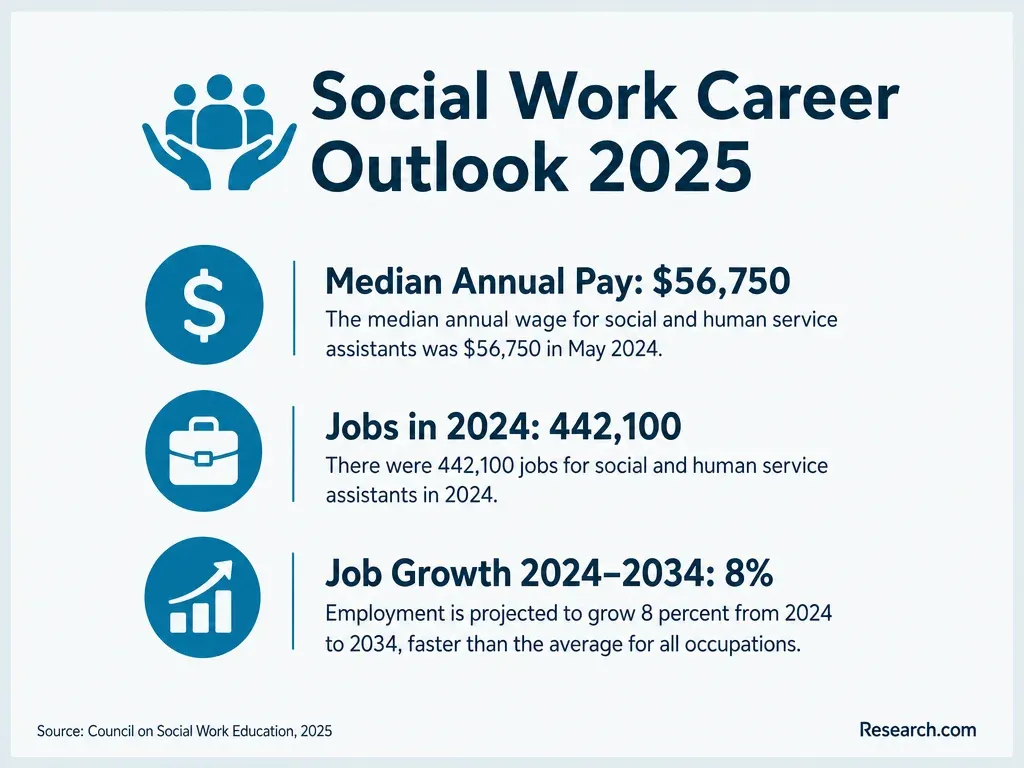
Pay varies by occupation, location, employer, experience, and role - not by time-management technique alone. The U.S. Bureau of Labor Statistics figures below provide national occupational context. They are not starting salaries or guaranteed earnings for BSW or MSW graduates.
| BLS occupation | May 2025 median annual pay | Projected employment growth, 2025-2035 |
| Social workers, all specialties | $61,780 | 6% |
| Child, family, and school social workers | $59,550 | 4% |
| Healthcare social workers | $67,880 | 8% |
| Mental health and substance abuse social workers | $60,280 | 10% |
The differences make occupation and setting useful starting points for a job comparison, but projected growth does not measure workload quality. Compare an offer's salary with expected hours, travel reimbursement, supervision, and documentation support. A state-by-state MSW salary overview can add geographic context; verify the occupation and local employer terms before relying on any figure.
Other Things You Should Know About Social Work
Use only scheduling tools your agency approves for client information. A personal calendar may expose names, locations, or sensitive details through notifications, syncing, or shared access.
Only if your employer expressly permits a particular tool and its use complies with privacy and recordkeeping requirements. You remain responsible for checking accuracy and should never enter client information into an unapproved tool.
Follow agency procedures for checking immediate safety needs, contacting the client, rescheduling, and documenting what occurred. Seek supervision promptly if the missed contact has a deadline or safety implications.
Occasional disruptions occur, but routine after-hours documentation signals a workflow or capacity problem worth raising. Track the time involved and ask how required work should fit within your assigned hours and employer pay policies.
- Impact of clinical supervision on healthcare organisational outcomes: A mixed methods systematic review - PMC https://pmc.ncbi.nlm.nih.gov/articles/PMC8604366/
- Supervision frequency and duration | www.vic.gov.au https://www.vic.gov.au/best-practice-supervision-guidelines/supervision-standards/supervision-frequency-and-duration
- NASW Standards for Social Work Case Management | nycourts.gov https://www.nycourts.gov/reporter/webdocs/nasw_standards_socialwork_casemgt.htm
- CSR Handbook 2017 | LSC https://www.lsc.gov/i-am-grantee/grantee-guidance/lsc-reporting-requirements/case-service-reporting/csr-handbook-2017
- Risk Factors for Stress and Burnout | Healthcare Workers https://www.cdc.gov/niosh/healthcare/risk-factors/stress-burnout.html
- Time management in health care social work | PubMed https://pubmed.ncbi.nlm.nih.gov/3232095/
- Effective Workload Management in Child Welfare | iu.edu https://scholarworks.indianapolis.iu.edu/bitstreams/b91b2244-16b4-4dfd-8176-0e61a6200ccb/download
- Record keeping guidelines | apa.org https://www.apa.org/practice/guidelines/record-keeping
- Understanding Personal Safety for Social Workers | brescia.edu https://www.brescia.edu/2019/03/personal-safety-for-social-workers/
- Caseload & Workload | CWLA https://www.cwla.org/our-work/practice-excellence-center/workforce-2/caseload-workload/