# 1 position
Pima Community College - Plumbing Technology/Plumber.
certificate or diploma

Audited and Verified:
Our Editorial and Data Verification Process
Research.com uses government datasets, official education statistics and primary institutional information to support its career and degree guides. Our review process checks factual accuracy, occupational definitions, source dates and the requirements associated with the credentials discussed.
How This Article Was Fact-Checked
Our editorial team verifies salary estimates, employment projections, education requirements and program information against original data providers and official organizations. Salary figures are checked against the relevant occupational definitions and reporting periods. Information about licensure, accreditation and required in-person training is reviewed separately.
Fact-checked and verified on:

Co-Founder and Chief Data Scientist

Reviewed by Karolina Broda
Fact-Checker and Data Verification
Choosing plumbing training in Arizona means deciding whether to pay for a school program, pursue a paid apprenticeship, or learn on the job - and whether that route will lead to the work you want. The U.S. Bureau of Labor Statistics projects 6.8% national growth for plumbers, pipefitters, and steamfitters from 2025 to 2035. This guide compares credentials, costs, practical training, and Arizona licensing rules. It also accompanies a Best Plumber Trade Schools in Arizona for 2027 ranking created by the Research.com team of data scientists to help students identify programs worth considering.
Expect instruction in pipe systems, safety, code use, measurement, and installation or repair, with practical work that lets you handle materials and tools. A short school program can help you qualify for entry-level work; it generally cannot provide the extended supervised experience gained on jobsites. Ask how much time is spent in a plumbing shop rather than a general construction classroom.
These pathways differ most in how they provide field experience and whether you earn wages while training. Compare the credential with the work you want to do, not just the program title:
| Pathway | Typical credential or outcome | Best fit and main trade-off |
| School certificate or diploma | School-issued plumbing or construction-trades credential | Useful for foundational skills and employer introductions; confirm plumbing-specific labs and whether an employer will credit the training. |
| Associate degree with relevant plumbing coursework | Academic degree | May suit someone seeking broader technical study; usually requires a larger time and cost commitment than entry-level training alone. |
| Registered apprenticeship | Sponsor-issued completion credential after required work and instruction | Suited to someone ready for paid, supervised fieldwork; openings and entry requirements depend on the sponsor. |
| Direct employer entry | Work experience, with any later credential depending on the employer or sponsor | Can minimize upfront school costs; ask whether training is structured and documented. |
Arizona public colleges, technical education providers, apprenticeship sponsors, and employers may offer different combinations of these routes. A school program is most worthwhile if its shop access, schedule, and employer relationships solve a problem you cannot solve through paid entry-level work. Lists of online programs that pay well are not substitutes for checking whether plumbing training includes supervised practical work.
Plumbing training can lead to work with residential service contractors, commercial construction firms, building-maintenance teams, or employers that install and maintain water, drainage, and gas piping. Construction projects and existing-building service work involve different schedules and skills: service jobs emphasize diagnosis and customer communication, while new construction emphasizes plan reading, layout, and coordination with other trades (U.S. Bureau of Labor Statistics, Occupational Outlook Handbook).
Location affects access to the next training step. A program near Phoenix or Tucson may offer a different set of contractor contacts and worksites from one serving a smaller community. In a rural area, compare the commute to both the classroom and the employer site; practical placement is valuable only if you can reliably attend it.
The U.S. median annual wage for plumbers, pipefitters, and steamfitters was $63,800 in May 2025 (U.S. Bureau of Labor Statistics, Occupational Outlook Handbook). This is a national figure for an occupational group that includes experienced workers and related trades. It is neither an Arizona wage estimate nor a likely first-year wage for a school graduate.
For a useful local comparison, request actual wage ranges for trainee openings and apprenticeship steps in the Arizona area where you plan to work. Also ask whether pay is based on regular hours, overtime, or project availability. Compare expected earnings during training - not just eventual pay - when deciding between a tuition-funded program and a paid apprenticeship.
There is no single statewide length for an Arizona plumbing school program. A short pre-apprenticeship or certificate covers less material and field practice than a longer college pathway; each provider sets its course sequence and contact hours. Ask for the current catalog's total hours, the hours devoted specifically to plumbing labs, and the time needed at your intended full- or part-time pace.
A registered apprenticeship usually extends over multiple years because supervised work and related classroom instruction occur together. The U.S. Department of Labor describes a common apprenticeship model of roughly 2,000 hours of on-the-job learning and 144 hours of related instruction per year, but a sponsor's registered standards - not that benchmark - determine its actual requirements. If speed matters, compare the date you could start paid work, not merely the date you would finish classes. Even fastest associate degree programs online do not remove the need for in-person plumbing practice.
Online instruction can work for terminology, estimating, safety concepts, and some code study. It cannot by itself demonstrate that you can measure and join pipe, troubleshoot a leak, or work safely at an occupied site. Campus shops, supervised field placements, and employer worksites provide the practical assessment that an online course may lack.
A hybrid option makes sense if its in-person sessions and worksites are reachable on your schedule. Before enrolling, ask where practical skills are assessed, who supervises them, and whether local employers recognize the credential. Institutional accreditation - even for top accredited non profit online universities - does not turn remote coursework into plumbing field experience.
There is no dependable single price for every Arizona plumbing route: a public college, private career school, and paid apprenticeship have different charges and wage arrangements. Request a written, program-specific cost of attendance rather than relying on an advertised tuition figure. Public-college resident rates may differ from nonresident rates, so confirm how your residency is classified.
Include mandatory fees, books, consumables, tools, protective equipment, transportation to labs and jobsites, and any applicable exam or application charges. Then subtract grants or employer-paid costs and account for wages you could earn while training. Check federal-aid eligibility with the school and apprenticeship or workforce-training assistance with the relevant sponsor or Arizona workforce office; neither is automatic (Federal Student Aid; Arizona Department of Economic Security).
For return on investment, compare total out-of-pocket cost and debt with your current earnings, likely pay during training, completion prospects, and a realistic period of work afterward. A low sticker price can be a poor value if it provides too little practical training. Searches for an online bachelor degree cheap address a different cost question; plumbing comparisons must include the cost of becoming job-ready.
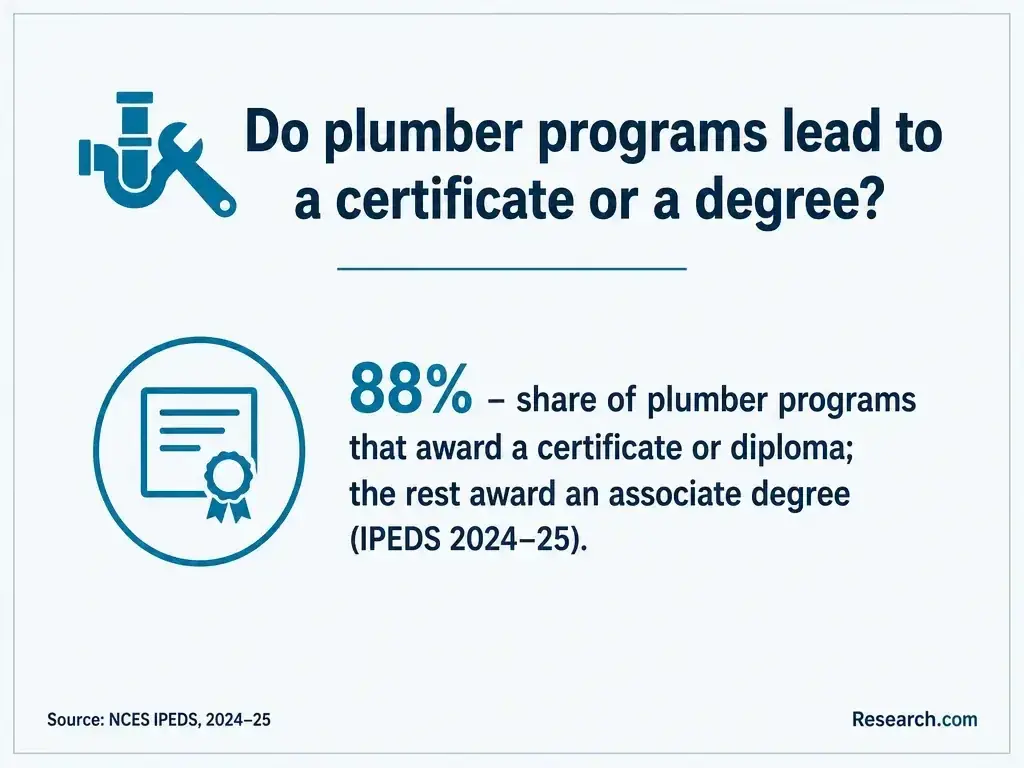
The answer depends on the route: a school may award a certificate, diploma, or relevant associate degree; a registered apprenticeship awards its own completion credential under the sponsor's standards (U.S. Department of Labor, Apprenticeship.gov). A school's completion certificate is not the same as apprenticeship registration, an industry certification, or an Arizona contractor license.
Ask to see the exact credential name and whether employers or apprenticeship sponsors recognize the coursework for placement or advanced standing. Get any promised credit in writing. Institutional accreditation concerns the school; state authorization concerns its permission to operate; industry recognition concerns particular training or assessments. None, by itself, establishes that you can work independently as a licensed contractor (Arizona Registrar of Contractors).
School and sponsor requirements vary. A provider may request proof of prior education, placement assessment, or a minimum age; an apprenticeship sponsor may also assess math readiness, physical ability to perform essential tasks, and access to transportation. These are provider entry criteria, not one statewide admission rule. Ask about accommodation procedures and any required equipment or screening before applying.
If you already have construction experience, ask whether the school grants prior-learning credit or whether an apprenticeship sponsor offers advanced standing. Neither is guaranteed, and the sponsor may still require you to demonstrate specific plumbing competencies.
Useful training connects calculations and code reading to tasks you will perform: measuring and cutting pipe, selecting fittings, joining materials, installing fixtures, testing systems, and diagnosing drainage or supply problems. Safety instruction should address tools, confined or awkward workspaces, and hazards encountered on construction and service calls (U.S. Bureau of Labor Statistics, Occupational Outlook Handbook).
Look closely at the lab syllabus. A course that lets students repeatedly assemble and test working systems offers different preparation from one centered on demonstrations. Also ask whether instruction addresses the plumbing codes used by the jurisdictions where local employers operate; learning a code in class does not eliminate the need to follow current requirements on a particular job.
Arizona's Registrar of Contractors licenses businesses and qualifying parties undertaking regulated contracting work, including plumbing contracting. It does not issue a single statewide journeyman plumber license that every plumbing employee must hold. That distinction matters: you may enter supervised employment without first obtaining a contractor license, but finishing a school course does not authorize you to bid or perform contracting work independently (Arizona Registrar of Contractors).
If your goal is to run a plumbing business, check the Registrar's current license classification, qualifying-party experience and examination requirements, and application rules well before selecting training. Local jurisdictions and employers may impose additional job-specific requirements. Optional industry credentials can document skills, but they do not replace an applicable contractor license (Arizona Registrar of Contractors).
Start with the job you want: residential service trainee, commercial construction apprentice, or eventually a contractor qualifying party. The best program is the one that provides a workable route to that goal at a cost and schedule you can sustain - not necessarily the shortest course or highest-ranked school.
Use these checks when speaking with a school or apprenticeship coordinator. Ask for written evidence where the answer will affect your time or money:
Red flags include a promise that graduation automatically makes you a licensed Arizona contractor, an "online-only" course advertised as complete hands-on preparation, or a quote that excludes required tools and travel. Rankings can identify options to investigate, but they cannot confirm a current seat, worksite, or licensing outcome for you.
A typical starting point is supervised installation or service work. With documented experience, workers may move toward more complex troubleshooting, commercial systems, crew leadership, estimating, or business ownership. Some employers also offer related pipefitting work, but its tasks and training should not be assumed identical to plumbing (U.S. Bureau of Labor Statistics, Occupational Outlook Handbook).
If ownership is your goal, plan for Arizona's contractor-licensing requirements in addition to technical training (Arizona Registrar of Contractors). If you prefer to earn while learning, a registered apprenticeship or structured employer training may be a better first investment than a separate school credential. Comparisons with four year degrees that pay well do not answer the immediate question of which plumbing route provides supervised experience at an affordable cost.
The U.S. Bureau of Labor Statistics projects 6.8% employment growth from 2025 to 2035 for plumbers, pipefitters, and steamfitters nationwide. That projection signals continuing demand for the occupational group, but it is not an Arizona-specific forecast or a guarantee of openings near your home.
Use current Arizona trainee postings and apprenticeship openings to test local demand before enrolling. Check whether opportunities are concentrated in service, new construction, or maintenance, because each favors somewhat different practical preparation. A program's value rises when its worksite training matches the openings you can realistically reach.
Education is a consequential investment, so the Research.com team evaluates programs against others in the same occupation and location rather than treating every trade program as interchangeable. The ranking includes only programs with completions reported to IPEDS. That makes it a useful comparison of eligible school programs, not a complete directory of Arizona apprenticeships or employer training.
Best-program rankings assess student outcomes; earnings and return on investment; costs and debt; and quality and recognition. Programmatic accreditation or relevant industry recognition accounts for 20% of the score, institutional accreditation for 10%, and student support for 10%. The remaining 60% covers completion, full- and part-time retention, earnings one year after completion, earnings relative to annual attendance cost, tuition, attendance cost, debt - including for students who withdrew - and federal loan default rates. Those indicators receive entropy-based weights, giving more weight to measures that vary more across programs. Most-affordable-program rankings instead score only tuition, attendance cost, debt, and default rates using entropy-based weights; accreditation and other quality measures are not included in that score.
To check coverage, outcomes, costs, and relevant recognition, the team uses the following data sources. Some sources cover other trades and may not identify a plumbing-specific credential:
Use the ranking to narrow your school choices, then confirm current plumbing coursework, shop hours, costs, and employer connections directly with each provider. More detail about the evaluation appears on the Research.com methodology page.
# 1 position
# 2 position

# 3 position
# 4 position
# 5 position
# 6 position

# 7 position
# 8 position
# 9 position
No single school credential is required for every plumbing employee. Paid apprenticeship or structured employer training can also provide an entry route. Arizona contractor licensing is a separate issue if you intend to contract independently (Arizona Registrar of Contractors).
Choose based on access and goals. An apprenticeship combines wages with supervised work and instruction; a certificate may help you build foundational skills or qualify for a trainee opening. Ask whether the apprenticeship sponsor credits school training before paying for both.
You can study some theory online, but pipe installation, testing, and troubleshooting require in-person practice. Confirm where and how a hybrid provider assesses those skills.
No. A certificate alone does not establish the experience, examinations, or other requirements for an Arizona Registrar of Contractors license. Check the current rules for the license classification you intend to pursue.
Request the total for tuition, fees, materials, tools, safety gear, and travel. Ask separately about grants, aid eligibility, placement support, and whether you can earn wages during training.